
Heavy Duty Pillar Jib Cranes: Motorized Slewing Drives for Heavy Fabrications
In the fields of steel structures, pressure vessels, machinery, and shipbuilding heavy industries, the transfer and alignment of heavy workpieces is related to workshop efficiency, safety, and machining accuracy.The carrying capacity and positioning of light-duty spreaders are insufficient, making it difficult to operate with high frequency and heavy loads; bridge cranes are expensive and have poor flexibility, and are not suitable for fine hoisting of stations.
The heavy-duty column jib crane comes with an independent landing base, large load and flexible working radius, and is equipped with an electric rotary drive, which can smoothly and accurately automatically complete the rotation and alignment of heavy-duty workpieces, and overcome the laborious manual rotation, inaccurate positioning, and low efficiency.This article explains its structure, rotation principle, application, selection, safety and procurement points in detail, and provides a professional basis for the selection of heavy factory equipment.
What Is a Heavy-Duty Pillar Jib Crane?
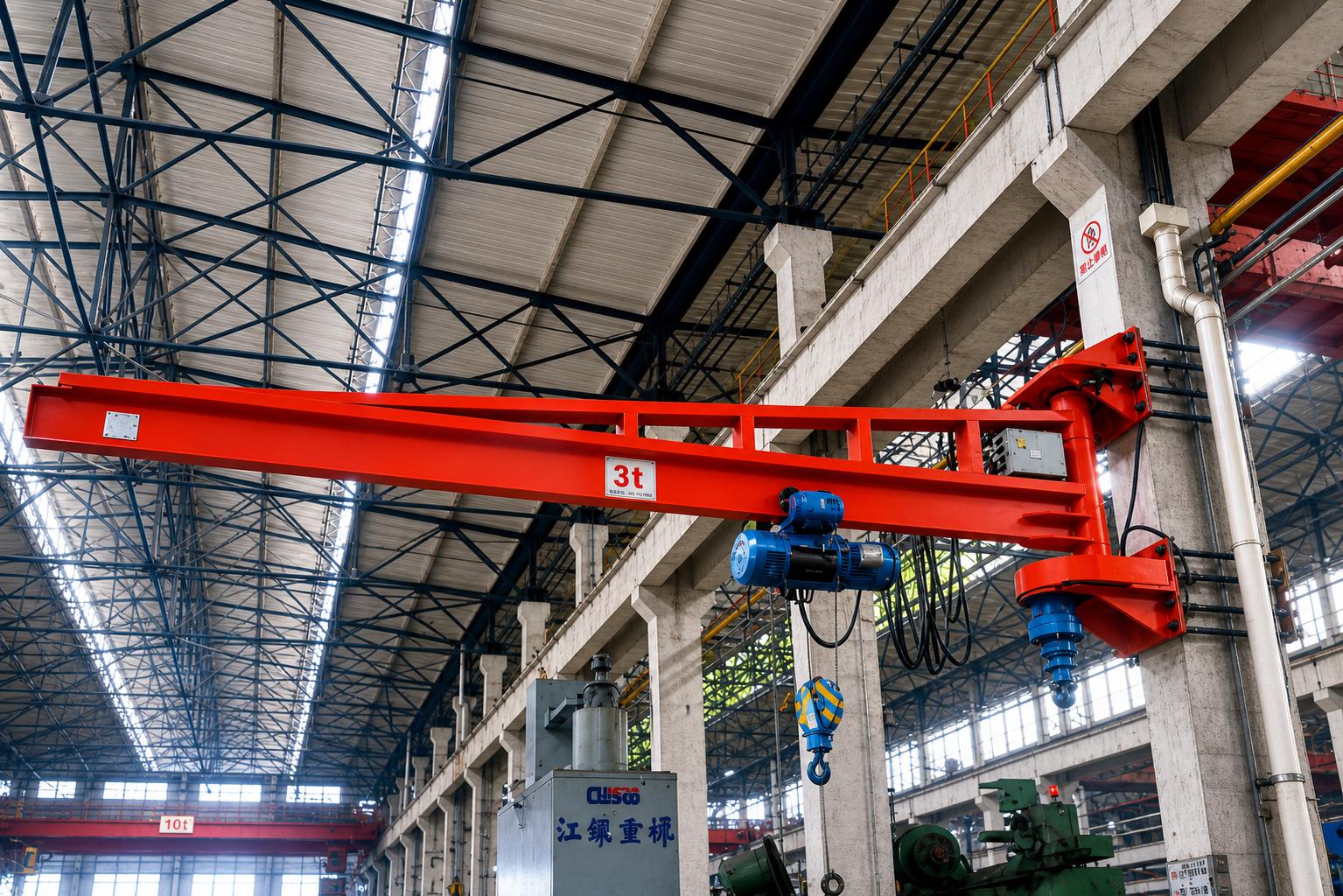
Heavy-duty column-type jib crane (floor-standing independent jib crane), facing heavy-duty high-frequency fixed stations, relying on independent ground columns and rotating boom frames, to achieve workpiece lifting, translation and alignment in circular/semicircular areas, suitable for heavy industry processing, assembly and maintenance stations.
Compared with light-duty jib cranes, it has a higher rated load (conventional 5-10 tons, customized up to 15 tons), strengthened structure and rotary system, and can carry large special-shaped welded parts and mechanical parts without relying on plant walls or driving tracks, and has strong adaptability.
Infrastructure
The overall structure of the heavy-duty column jib crane is simple, compact and extremely rigid. The five core components work together to ensure the stability and safety of heavy-duty operations.:
- Self-supporting vertical column: it adopts thickened steel pipe or box-shaped welded steel structure, which is the core load-bearing body of the equipment, carrying all vertical loads and torsional moments.The bottom of the column is equipped with a thickened bottom plate, which is fixed to the reinforced concrete foundation by high-strength anchors, with strong overall rigidity and excellent deformation resistance.
- Horizontal spiral arm (boom): I-beam, wide flange steel or customized box beam structure are mostly used to determine the working radius of the crane.The lifting trolley can walk horizontally along the boom to achieve radial displacement of heavy-duty workpieces, and the thickened and strengthened structure can effectively control the deflection deformation under heavy loads.
- Hoist and walking trolley: equipped with electric wire rope or chain hoist, it is responsible for the vertical lifting of the workpiece; supporting manual or electric walking trolley, it moves smoothly along the spiral arm track, adapting to the needs of lifting operations of different tonnages and frequencies.
- Slewing mechanism: The core moving parts are made of tapered roller bearings or large slewing bearing structures, and the supporting spiral arms rotate flexibly around the column. The self-supporting structure can achieve a maximum of 360° rotation without dead ends, smooth operation and strong bearing capacity.
- Foundation and anchoring system: customized reinforced concrete load-bearing foundation, with high-strength anchoring bolts, can effectively resist overturning torque, vertical load and dynamic impact force in lifting operations, and eliminate safety hazards such as equipment shaking and offset.
How Motorized Slewing Drives Work on a Heavy-Duty Jib Crane
The rotary mechanism is the core moving part of the jib crane, which directly determines the positioning accuracy and operating efficiency of the workpiece.Compared with traditional manual slewing, the electric slewing drive system completely solves the problems of laborious operation, inaccurate positioning, and low efficiency in heavy-duty operations. It is the core configuration of heavy-duty jib cranes adapted to heavy-duty working conditions.
Comparison of manual rotation and electric rotation
Manual rotation relies on human push-pull or handwheel drive, and is only suitable for light-duty workpieces and low-frequency operations; under heavy-duty working conditions, the resistance is large, the labor intensity is high, and the workpiece is prone to shaking, inaccurate positioning, and high safety risks.
The electric rotary automatically drives the boom through the motor reducer, without manpower. It has advantages in control accuracy, speed, positioning stability and efficiency. It can accurately adjust the angle of heavy-duty workpieces and adapt to heavy-duty welding and precision assembly. The difference between the two is reflected in the four items of control, speed, positioning, and labor cost.
Core components of electric rotary system
A complete set of heavy-duty electric rotary drive system consists of five modules: power, transmission, bearing, control, and safety. All components work together to ensure the smooth and safe operation of heavy-duty rotary operations.:
- Rotary motor: fully enclosed air-cooled industrial motor with sufficient power, high protection level, high temperature resistance and dustproof, suitable for harsh working conditions in the workshop, and sustainable and stable power output.
- Deceleration gearboxes: helical gears, worm gears or planetary deceleration structures are used to greatly reduce motor speed and amplify output torque to meet the needs of heavy-duty and low-speed rotation conditions. They are equipped with oil bath lubrication, wear-resistant and durable.
- Slewing bearing bearings: core bearing components, which can withstand vertical load, radial load and overturning torque at the same time, with ring gear structure and drive pinion gear, to achieve smooth drive rotation, strong bearing capacity and smooth rotation.
- Transmission drive mechanism: Heavy-duty equipment comes standard with a gear meshing transmission structure and a torque limiter, which can effectively buffer the impact of heavy loads, avoid equipment overload damage, and ensure transmission stability.
- Control system: including electric control box, handle operator or wireless remote control, it supports one-button start and stop, speed regulation, and reversing, and the operation is simple and convenient.
- Limit and safety devices: equipped with rotary limiter, overload protection, power-off braking, and emergency stop devices, the rotation range can be accurately defined to prevent safety accidents caused by over-range, overload, and misoperation.
Electric rotation improves heavy-duty positioning accuracy
The electric rotary system drives the boom to rotate at a constant and controllable low speed, and the conventional rotation speed is stable at about 0.5RPM, which completely solves the problem of uneven manual rotation speed and shaking of the workpiece.
The stable power output can achieve impact-free and uniform displacement of heavy-duty workpieces, greatly reducing the swing amplitude of hoisting.At the same time, with a frequency conversion speed control system, soft start and soft stop can be achieved to avoid mechanical impact and workpiece offset at the moment of start and stop.
The system not only completely liberates manpower and reduces the labor intensity of operators, but also realizes highly repetitive and accurate positioning, with uniform rotation angle and displacement accuracy for each rotation, perfectly matching high-precision processes such as welding alignment, precision assembly, and workpiece calibration, greatly improving the pass rate of finished product processing.
Why Heavy Fabrication Applications Benefit From Motorized Slewing
In heavy-duty processing scenarios such as steel structures, pressure vessels, ship accessories, and large mechanical components, the workpieces are large in size, high in weight, and irregular in shape, making it extremely difficult to carry and align.The installation of electric rotary drive system has solved many pain points in heavy industry production in a targeted manner, reducing costs and increasing efficiency for enterprises and improving operational safety.
Handling of large special-shaped components
The core workpieces of heavy-duty processing are mostly heavy-duty steel structures, pressure vessels, large-scale mechanical assemblies, welding assemblies, industrial racks, etc. These components have large weight, offset center of gravity, and irregular shape. Manual alignment cannot be assisted, and ordinary lifting equipment is difficult to control smoothly.
With the advantages of high torque drive, smooth rotation and strong bearing capacity, electric rotary jib cranes can easily lift all kinds of heavy-duty special-shaped components, keep the workpieces stable and non-shaking throughout the process, and adapt to the handling needs of various complex workpieces.
Welding assembly alignment optimization
In the welding and assembly production of workpieces, the angle and position of the workpieces need to be adjusted frequently to complete precise docking, spot welding, full welding, assembly and other processes.The electric rotary system can drive the workpiece to rotate flexibly and accurately in the working area, and quickly complete the splicing and calibration of parts.
There is no need to manually pry and move the workpiece.At the same time, it can realize the rapid transfer of workpieces between different stations, connect cutting, welding, grinding, assembly and other processes, and coherently produce processes to reduce process faults.
Shorten material handling time
Traditional heavy industry production relies on forklifts and manual lifting equipment to assist in handling. Secondary transshipment and repeated alignment occur frequently, which is time-consuming and laborious.A jib crane equipped with an electric rotary system.
It can quickly complete the lifting, rotation, and translation of heavy-duty workpieces within a fixed working radius, and complete the positioning operation at once without secondary adjustment.Effectively reduce the investment in auxiliary handling equipment, improve the utilization rate of stations, significantly shorten the processing cycle of single workpieces, and improve the overall production line efficiency.
Heavy-duty operation of high-frequency assembly line
Scenarios such as mass-produced heavy-duty component production, equipment assembly, and equipment maintenance require high-frequency start-stop, rotation, and hoisting of lifting equipment.The electric rotary system is adapted to the continuous cycle operation mode, which can operate stably for a long time without manual operation fatigue and efficiency degradation. It is perfectly adapted to assembly-line and high-frequency heavy-duty operating conditions to ensure production continuity and stability.
Key Specifications to Consider When Selecting a Heavy-Duty Pillar Jib Crane
The selection of equipment directly determines the adaptability of the operation, production efficiency and safety of use. When purchasing, enterprises need to combine workshop working conditions, workpiece parameters, and production frequency, and focus on the following core indicators to avoid problems such as equipment idleness and overload failure caused by inconsistent parameters.
Rated lifting capacity
It is necessary to select the type according to the maximum weight of the workpiece processed in the workshop, distinguish the rated load from the actual working load, and reserve a safety margin at the same time.When selecting the type, it is necessary to consider the weight of the workpiece, the weight of the spreader, and the dynamic impact load of the hoisting. Long-term full load and overload operation are strictly prohibited.In view of the occasional peak loads in production, redundant bearing capacity needs to be reserved in advance to ensure the long-term stable operation of the equipment and extend the service life of the equipment.
Spiral arm length and working radius
The length of the spiral arm determines the effective operating coverage of the equipment, which must be determined in combination with the layout of the station, the transfer distance of the workpiece, and the placement of the equipment.When selecting the type, it is not only necessary to meet the requirements of the maximum workpiece transfer radius, but also to reserve a safety gap to avoid the rotation of the spiral arm and the collision of workshop equipment, walls, and pipelines during the movement of the workpiece.The conventional operating radius of heavy equipment can reach 10-12 meters, which can be adapted to the operating needs of most heavy industry stations.
Lifting height
The lifting height is determined by the net height of the workshop, the size of the workpiece, and the working process.It is necessary to ensure that the lowest and highest stroke of the hook can meet the requirements of lifting, alignment, and landing of the workpiece, and at the same time reserve the top safety gap to avoid the hook rushing to the top and the workpiece colliding with the boom.For ultra-high and heavy-duty components, the lifting height needs to be customized to ensure sufficient working space.
Rotation angle and rotation range
The mainstream configuration is divided into three rotation modes: 180°, 270°, and 360°.180° and 270° restricted rotation are suitable for stations against walls and obstacles; 360° full-angle rotation is suitable for open independent stations, which can achieve full coverage without dead ends.The selection needs to strictly match the layout of the workshop, avoid obstacles such as columns, equipment, and walls, and ensure that the rotating operation is unobstructed.
Rotation speed and motor power
For heavy-duty workpiece operations, a low-speed and controllable rotation speed is preferred to avoid the workpiece shaking and alignment deviation caused by excessive rotation speed.For precision welding and fine assembly scenarios, it is necessary to use a frequency conversion speed control system to achieve fast and slow switching.The motor power needs to be accurately matched according to the equipment load, operating radius, and rotation torque to ensure heavy-duty start-up, non-stuck rotation, and sufficient power.
Work level and frequency of operation
The working level directly corresponds to the fatigue resistance and continuous operation ability of the equipment, and it needs to be selected in combination with the daily operating time, the number of lifting cycles per hour, and the frequency of load use.Heavy-duty processing assembly line operations require the use of high-level equipment, which is adapted to high-frequency and continuous heavy-duty cycle conditions to avoid structural fatigue and component wear and failure caused by long-term high-frequency operations.
Motorized Slewing Drive Options for Heavy Fabrication
According to different machining accuracy, operating frequency, and process requirements, the electric rotary system is divided into a variety of configuration options, and enterprises can choose the type on demand, taking into account practicality and cost performance.
Fixed speed rotation
The structure is simple, the failure rate is low, and the cost is high. The equipment completes the rotation operation at a fixed speed, which is convenient to operate.It is suitable for conventional heavy-duty handling, loading and unloading procedures with fixed operating processes, unified workpiece specifications, and no need for fine alignment. It is the basic and preferred configuration of standardized heavy-duty stations.
Frequency conversion rotation
Equipped with a frequency conversion control system, the rotation speed can be freely adjusted to achieve low-speed precise alignment, high-speed and efficient transfer.The soft start and soft stop functions can completely eliminate mechanical shocks, protect the equipment structure and the surface of the workpiece, and adapt to processes that require extremely high positioning accuracy such as precision welding, assembly of special-shaped components, and high-precision calibration. It is the core configuration of heavy-duty finishing scenarios.
Control method
Standard suspension handle operator, the operator can observe the status of the workpiece at close range and accurately control the equipment; optional wireless remote control, get rid of the shackles of cables, expand the operating range, and keep the operator away from welding sparks, high temperature, dust and other dangerous areas, not only to improve the flexibility of operation, but also to ensure the safety of operations.
Frequency conversion control system
Integrated frequency conversion speed regulation, overload protection, fault early warning, speed adjustment and other functions in one, stable operation and high degree of intelligence.It can accurately control the acceleration, deceleration, and uniform speed operating conditions, minimize equipment and mechanical wear, reduce failures and downtime, and adapt to long-term continuous heavy-duty processing and production conditions.
Heavy-Duty Pillar Jib Crane Applications in Fabrication
Relying on the advantages of heavy-duty capacity, precise positioning, flexible operation, and independent installation, heavy-duty column jib cranes equipped with electric rotary systems are widely used in various heavy-duty manufacturing and maintenance fields.:
- Steel structure processing workshop: Steel structure processing workshop: complete the transfer, turnover and alignment of steel beams, steel plates, steel frames and large welded components, covering the whole process of cutting, welding and splicing.
- Machinery manufacturing industry: it is suitable for the assembly, installation and precise positioning of heavy-duty parts such as large racks, motors, gearboxes, etc., which can effectively reduce the difficulty of workpiece alignment and improve the machining accuracy and overall operating efficiency of mechanical assembly.
- Pressure vessel and tank processing: suitable for large cylindrical tanks, high-pressure containers and other special-shaped heavy-duty workpieces, which can complete the lifting, turning and welding of workpieces and accurately align the welding stations to meet the needs of pressure vessel welding production operations.
- Shipbuilding and marine heavy industry: it is suitable for the transfer and assembly of heavy-duty ship components, deck accessories and marine equipment modules, and can meet the requirements of large-scale and heavy-duty shipbuilding heavy industry manufacturing conditions.
- Equipment maintenance workshop: it can efficiently complete the disassembly, replacement and maintenance hoisting operations of large engines, industrial complete sets of equipment, and heavy-duty assembly components, adapt to the maintenance and maintenance conditions of heavy-duty equipment in various workshops, and greatly improve the safety and convenience of heavy-duty equipment maintenance operations.
Structural and Safety Considerations for Heavy-Duty Jib Cranes
Heavy-duty lifting equipment can withstand heavy loads, dynamic shocks and cyclic loads for a long time. Structural reliability and safety protection system are the key to ensuring long-term stable operation. The whole process of design, installation, operation and maintenance needs to be strictly controlled.
Basic anchoring specification
The equipment foundation needs to be poured with high-strength reinforced concrete, and the foundation size and burial depth are calculated based on the equipment load, height, and operating torque to adapt to the soil bearing capacity of the site.With high-strength anchoring bolts and floor grouting technology, it effectively resists overturning moments, vertical loads and dynamic impact forces in the operation of the equipment, and eliminates problems such as foundation settlement and equipment shaking.
Main structure strength
The structure of the whole machine needs to strictly control the deflection deformation of heavy loads, and improve the overall rigidity by strengthening the ribs, optimizing the load distribution, and strengthening the joint structure.At the same time, special design is carried out for the structural fatigue problems caused by long-term cyclic operations to avoid structural deformation and cracking caused by long-term high-frequency operations and ensure the service life of the equipment.
Overload protection system
The equipment comes standard with multiple overload protection devices, including load limiter, hoist overload protection, motor thermal overload protection, and emergency stop system.When the hoisting load exceeds the standard, the equipment is stuck, or there is a sudden failure, the system automatically shuts down and locks the operation to prevent safety accidents such as overload collapse and workpiece fall.
Rotary walking limit
It is equipped with a dual mechanical and electrical limiting device to accurately define the rotation angle of the spiral arm and the walking stroke of the trolley to prevent collisions and equipment damage caused by over-range operation.The limit system can accurately divide the safe operating area, adapt to the layout of the complex workshop, and effectively avoid the risk of equipment collision.
Inspection and maintenance
It is necessary to establish a regular maintenance system in accordance with industry norms, focusing on checking the lubricating oil of the slewing gearbox, the wear of the slewing bearing, the loss of the wire rope/chain, the reliability of the hook and brake system, the stability of the electrical circuit and the control system, and the fastening status of the basic bolts.Regular maintenance can check for hidden faults in advance, reduce the failure rate of equipment, and extend the service life of equipment.
Conclusion
The heavy-duty column jib crane is equipped with electric rotary drive, which is suitable for hoisting stations such as heavy industry processing and mechanical assembly.The self-supporting structure is flexible in installation, and the heavy-duty fuselage supports high-frequency lifting of large-tonnage workpieces; electric rotation improves operating flexibility and positioning accuracy, and reduces manual load.
The selection of equipment cannot only look at the procurement cost, but also the workpiece parameters, operating range, operating frequency, installation conditions and other elements need to be integrated.Rationally configure the load and rotary system, cooperate with standardized installation and maintenance, and ensure the stable and efficient operation of the equipment.Henan Mine Crane can provide customized solutions for heavy-duty column jib cranes and electric rotary systems based on station layout and hoisting conditions.