
How Gantry Crane Span Affects Lifting Coverage and Operating Costs
The span of the gantry crane directly affects the hoisting coverage and daily operating costs of the equipment.The span is too small, which may cause some operating areas to be unable to be effectively covered, increase the difficulty of material transfer, and affect the overall operating efficiency.If the span is too large, it may increase equipment manufacturing costs, structural load and long-term maintenance expenses.Therefore, the choice of the appropriate span cannot only depend on the width of the site, but also needs to be combined with the actual operating requirements and equipment layout to find a reasonable balance between hoisting efficiency and investment cost, so that Henan Mine Crane manufactured gantry cranes can better meet the daily production and material handling needs.
What Is Gantry Crane Span and Why Does It Matter?
Define crane span
The span of a gantry crane refers to the horizontal distance between the centerlines of the two operating tracks, and it is also the horizontal spacing between the centerlines of the two legs of the main beam. It is the key geometric parameter that distinguishes it from the lifting height, lifting weight, and working level. It should not be confused with the outer width of the outrigger and the effective stroke of the trolley.It should be noted that the hook cannot be tightly attached to the outrigger all the time, and there is a safety margin for the trolley limit, so the effective operating width will be slightly smaller than the nominal span.Both single-main beam and double-main beam gantry cranes use span as the basic design benchmark. The bending resistance, outrigger stability, and track foundation plans of all main beams are calculated around this value, which is also the primary reference index for manufacturers to customize quotations.
Explain lifting coverage
The hoisting coverage area is the entire area where the hook can safely pick and place materials under the linkage operation of the cart and trolley, and the span is the upper limit that determines the width of the horizontal coverage.Under the premise that the cart walks vertically along the track, the larger the span, the wider the horizontal material stacking area that can be covered by a single longitudinal travel.If the span is too small, the material stacking and truck parking position exceed the reachable range of the hook, the forklift needs to transfer the material twice, adjust the material position, and increase the process and waiting time.Reasonable hoisting coverage can reduce the investment in on-site transportation equipment, so that the processes of stacking raw materials, loading finished products, and turning components can be concentrated within the scope of crane operations, and the efficiency of site circulation can be improved.
Link span to cost
The span and cost are not linearly proportional. As the span increases, the bending moment of the main beam rises rapidly. The amount of steel, structural reinforcement requirements, and track foundation load will all increase simultaneously, and the cost of equipment procurement, civil construction, and operation and maintenance will increase significantly.Under the same tonnage, large-span models need to thicken the steel plate of the main beam, replace the cart walking mechanism with a stronger bearing capacity, and strengthen the foundation.In order to reserve the margin, many customers blindly choose a large span, increase the procurement budget in the early stage, and continue to bear higher electricity bills, testing and maintenance costs in the future.Insufficient span will indirectly generate transportation labor and forklift fuel costs, which are also uneconomical in the long run, and the selection needs to balance the risks at both ends.
How Gantry Crane Span Affects Lifting Coverage
Cover wider work areas
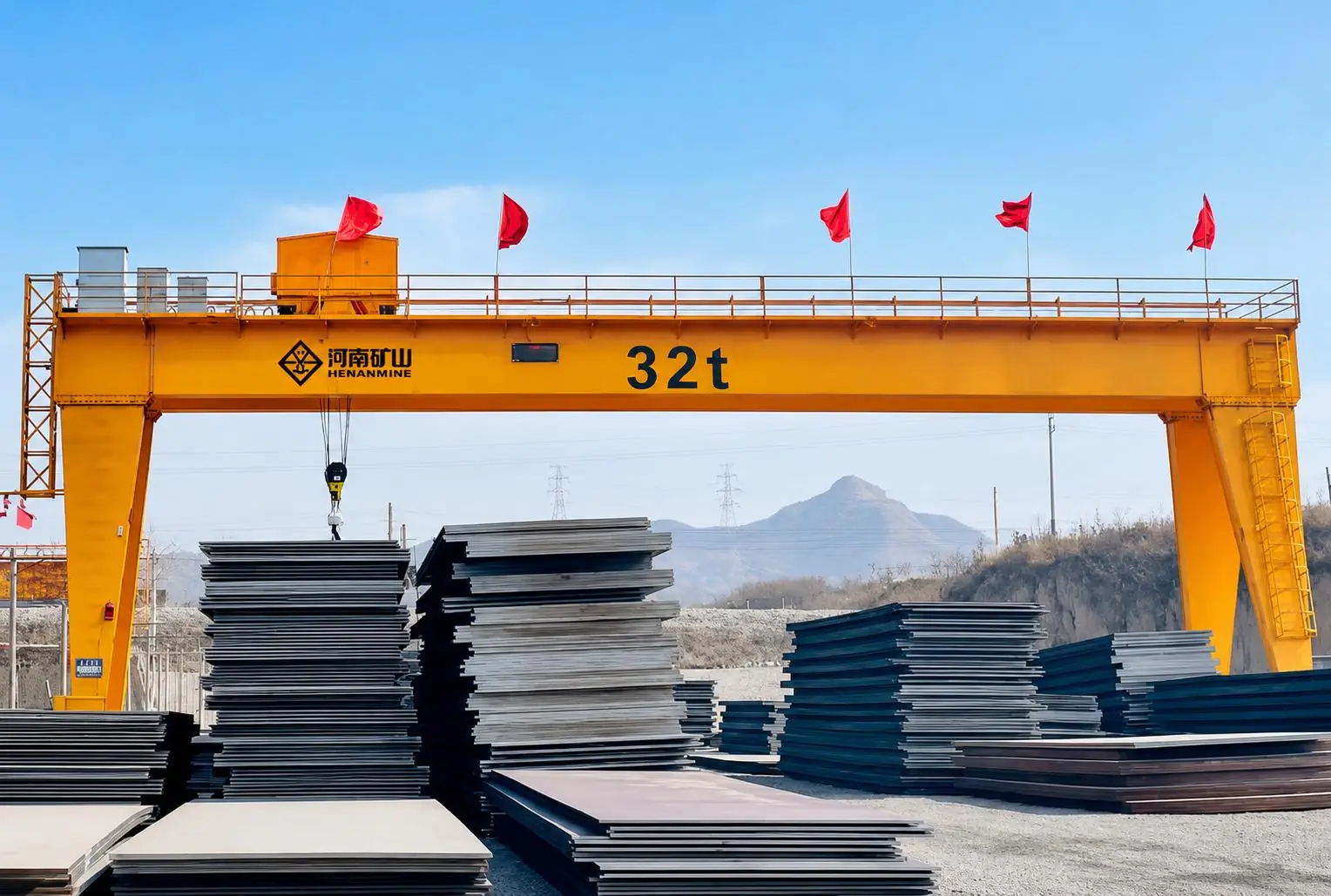
The larger gantry crane span can cover a wider yard and prefabricated pedestal area at once, which is suitable for operations across multiple rows of material stacking areas and multiple truck loading and unloading channels.In the scene of prefabricated beam yards and steel yards, wide-span models can cover multiple production lines and stacking areas on both sides on the basis of a single track, without having to arrange multiple small-span gantry cranes side by side, saving track laying space.However, the wide span is not equal to infinite width. It is limited by the deflection and lateral stability of the main beam. After the span exceeds a reasonable range, it needs to be upgraded to a double main beam structure. At the same time, safety gaps on both sides are reserved to avoid collisions between the outriggers and the surrounding containers, components, and enclosures to ensure the safety of a wide range of operations.
Reach more loading points
After the span matches the layout of the site, the hook can directly reach more loading and unloading points, which is suitable for simultaneous loading of multiple lanes and hoisting of multi-station prefabricated components.In many factories, the parking position of trucks is not fixed and the materials are stacked in multiple columns. If the span is too narrow, only the middle area can be hoisted, and the loading and unloading points on both sides need to be frequently moved to large parking positions, and the rhythm of the operation is interrupted.The appropriate span allows multiple assembly parking spaces to fall within the travel range of the trolley, and the operator can complete the lifting of goods at different points by only moving the trolley, reducing the frequency of starting and stopping of the trolley, reducing the wear of the trolley's walking mechanism, and shortening the lifting cycle time of a single piece of material, and increasing the average daily lifting throughput.
Avoid coverage gaps
The blind spot of hoisting is the most common problem of span selection errors, that is, there are dead corners that cannot be reached by hooks on both sides of the yard and near the outriggers.After the blind spot appears, the materials can only be stacked in a narrow area in the middle, the space utilization rate of the site has decreased significantly, and the stacking planning is limited.If you want to lift the workpiece in the blind area, you must shift it with the help of a forklift to increase the risk of bumps.During the early survey, it is necessary to mark all the points that must be hoisted, calculate the left and right limit travel of the trolley, deduct the safe buffer distance, and push back the minimum span to ensure that all commonly used stacking and loading and unloading areas fall within the effective coverage area, eliminate fixed blind spots, and reduce the investment in additional auxiliary equipment on site.
Match span to site layout
The span selection must fit the existing layout of the site, including track direction, truck passage, stacking arrangement, surrounding buildings and pipeline location.The narrow and long single-row storage area is suitable for small and medium-span gantry cranes.Multi-channel, multi-pedestal prefabricated yard, large-piece yard, suitable for customized wide-span models.At the same time, it is necessary to reserve space for passage, and the passage channels for trucks and trailers need to be reserved between the legs. You cannot only consider the width of the hoisting and ignore the traffic requirements.We will combine the drawings of the customer's factory area to plan the track direction and span size, so that the crane and the yard moving line can be adapted, so that material stacking, vehicle traffic, and hoisting operations do not interfere with each other, and maximize the utilization of existing site resources.
How Gantry Crane Span Impacts Operating Costs
Compare initial costs
Under the same lifting weight and working level conditions, the larger the span, the higher the initial procurement cost of the gantry crane.The cross-section of the main beam, the thickness of the steel plate, the reinforcement scheme of the ribs, and the configuration of the walking wheel set will all be upgraded with the increase of the span, and the cost of the double main beam model is significantly higher than that of the single main beam.In addition to the main engine, the increase in civil construction costs is also prominent, the wheel pressure of long-span cranes is greater, and the cost of track foundations, concrete cushions, embedded parts, and foundation reinforcement has increased.If the geology of the site is weak, piling treatment is also required to further increase the investment in the project.When comparing plans, you can't just look at the quotation of the host. The track, foundation, installation and commissioning should be included in the total initial investment to avoid underestimation of the budget.
Assess structural loads
As the span increases, the bending stress and deflection of the main beam when lifting heavy objects will become significantly larger, and the structural load of the whole machine will increase non-linearly.In order to meet the deflection and stability requirements of the national standard, the weight of the main beam will be increased in the design, the outriggers and the lower beam should also be strengthened, and the wheel pressure will be transmitted to the track and the ground synchronously.If a small-span structure is forcibly used to enlarge the span, there will be hidden dangers of excessive lower deflection of the main beam, large shaking, and lateral instability.If the load assessment is too conservative, it will cause redundancy and waste of steel.We will do structural calculations according to the actual maximum lifting weight and frequency of working conditions of the customer, optimize the cross-section of the main beam under the premise of meeting the safe load limit, control its own weight, avoid the risk of structural overload, and reduce unnecessary steel investment.
Evaluate energy use
Henan Mine Crane manufactured Gantry cranes with larger spans have higher self-weight, and the power configuration of the driving motor of the cart is greater, and the energy consumption of the cart when starting and stopping and moving at a uniform speed is higher than that of the small-span model.In long-term high-frequency operation scenarios, the difference in electricity bills caused by the span will continue to accumulate and become a fixed operating expense.The trolley runs back and forth on the long main beam to overcome the resistance caused by the elastic deformation of the main beam, and the power consumption will be slightly increased.For prefabricated factories and port depots that operate continuously for a long time every day, the power-saving effect of span optimization is very impressive.For low-frequency and intermittent use conditions, the energy consumption weight is relatively low. When selecting the type, the coverage requirements can be prioritized and the priority can be flexibly adjusted.
Estimate maintenance costs
The structure of large-span gantry cranes is more complex, with higher force loads on main beam welds, connecting nodes, cart wheels, and tracks, and faster loss rates.During regular inspections, professional climbing equipment is required for main beam deflection testing, weld flaw detection, and outrigger verticality correction, and maintenance working hours and inspection service fees are higher.The probability of wear and failure of the main beam and track is increased, the replacement cycle of spare parts is shorter, and the long-term maintenance budget is higher.The small-span single-main beam model has a simple structure, few inspection points, low difficulty in daily maintenance, and controllable maintenance costs.We will simultaneously output annual maintenance estimates based on the span plan to help customers calculate the full-cycle cost of equipment ownership, not just compare the one-time purchase price.
Key Factors to Consider When Choosing Gantry Crane Span
Measure site width
The measured width of the site is the first basis for span selection. It cannot be estimated based on drawings alone. It is necessary to measure the net width of the track layout area on site and mark boundary obstacles.When measuring, divide the total site width and the effective operating width, deduct the safe avoidance distance on both sides, the space occupied by pipelines, fences, and columns.At the same time, confirm whether there is reserved space for forklifts and trucks on both sides of the track. Many customers only count the width of the pile when measuring, ignoring vehicle traffic, resulting in trucks unable to drive under the outriggers after the equipment lands.After the measured data is submitted to the engineer, we will reserve a reasonable safety margin and output the adaptation span interval to avoid the inability to retrofit and rework in the later stage.
Check load capacity
The rated lifting weight and span need to be matched by linkage. With the same gantry crane, the maximum allowable safe span will narrow as the tonnage rises.When hoisting heavy objects of large tonnage, the bending resistance of the main beam is strict, and the span cannot be blindly enlarged.For small and medium-sized tonnage and light-load conditions, a larger span can be selected to expand the coverage.If customers need large tonnage + large span, the double main beam structure scheme is usually recommended to ensure stable stiffness.When selecting the type, the tonnage and span cannot be determined separately. A combination of verification is required. First confirm the normalized maximum lifting weight and the minimum component size, and then determine the span within the safety structure limit to prevent design defects of "sufficient tonnage and excessive span" and avoid long-term safety risks.
Consider lifting height
The lifting height and span affect the stability of the whole machine. The high lifting height is matched with a large span, the center of gravity of the whole machine is raised, and the design standards for lateral wind resistance and overturning resistance are higher. It is necessary to increase the stiffness of the outriggers and add windproof devices.For gantry cranes in open-air yards, the combination of high span + high lifting is particularly critical for wind load verification, which will increase the cost of windproof anchoring and rail clamp configuration.If the lifting height requirement is low, there is more room for span adjustment.Under high lifting conditions, the span should not be over-enlarged to balance the safety margin of overturning.We simultaneously check the working conditions of the lifting height, span, and wind load combination to give customers a safe solution that takes into account the lifting height and horizontal coverage.
Evaluate working frequency
The frequency of operations directly determines the economic trade-off of the span plan. For prefabricated plants and steel markets with high work levels of A5 and A6 and continuous hoisting throughout the day, the energy consumption, maintenance, and production capacity losses caused by unreasonable spans will be magnified, which is suitable for accurately matching needs and rejecting excessive redundancy.Temporary hoisting on construction sites with low-frequency and intermittent use can moderately relax the span and reserve the margin to facilitate multi-scene switching.High-frequency working conditions give priority to controlling the span to reduce continuous operating expenses.Priority is given to low-frequency operating conditions to ensure coverage flexibility.We will divide the work level according to the customer's daily work time, annual working days, and lifting times, and give span recommendations that fit the intensity of use.
Review ground conditions
The geological conditions of the ground determine the upper limit of the carrying capacity of the orbital foundation, which directly limits the optional span.The bearing capacity of soft soil and backfilled land foundations is poor, and the high wheel pressure caused by large-span cranes will cause sedimentation and track deformation. Subsequent carts will chew the rails and the main beam will be subjected to uneven force, and the repair cost is high.Hardened floors and rock foundations with excellent geology can withstand greater wheel pressure and have higher freedom of span selection.Geological survey reports need to be collected simultaneously during the site survey phase. When the bearing capacity of the foundation is insufficient, the span should be reduced to reduce the wheel pressure, or the foundation reinforcement plan should be increased.We can cooperate with civil construction units to provide the basic construction parameters of the track according to the selected span to ensure the long-term smooth operation of the equipment.
How to Balance Lifting Coverage and Operating Costs
Avoid excessive span
Excessive span redundancy is a common misunderstanding in many purchases. Blindly increasing the span simply for the purpose of "a wide range may be used in the future" will bring continuous waste of funds.The span that exceeds the actual hoisting requirements raises the input of the main engine and foundation, continuously generates higher electricity bills and maintenance expenses, and the main beam shakes more, and the alignment accuracy decreases.If the future expansion needs are uncertain, the priority is not to select the oversized span in place at the same time. The track extension space can be reserved and the crane will be added later, rather than a single equipment over-enlarging the span.We will distinguish between just-needed coverage and long-term vision, control the span to the minimum reasonable value that meets the current operation, and compress unnecessary TCO.
Prevent insufficient coverage
The hidden cost of insufficient span can easily be underestimated. The blind spot of hoisting forces long-term dependence on forklifts to transfer materials. Labor, fuel, and forklift losses are superimposed, and the accumulated overhead is considerable. It will also slow down the pace of loading and component release, resulting in production capacity bottlenecks.During the peak period of orders, the loading and unloading points are congested, and the delivery efficiency is affected.Don't compress the span in order to drive down the quotation. It is recommended to include all conventional hoisting points and new stacking areas in the next 1-2 years in the coverage calculation, and reserve a small expansion margin to ensure that the hoisting range is still sufficient after the production capacity is increased, so as to avoid insufficient coverage soon after the equipment is put into operation, which requires secondary transformation or new equipment.
Optimize crane positioning
Under the premise of fixed span, optimizing the Henan Mine Crane manufactured crane track direction, parking location, and operating range of the cart can maximize the use of existing hoisting coverage.The track is arranged as far as possible along the direction of the main flow of the material, and the high-frequency loading and unloading points are arranged in the area with the optimal stiffness in the middle of the main beam to reduce the operation of the limit position of the trolley.When multiple gantry cranes work together, the span coverage area is staggered to avoid duplication and waste of operations, and anti-collision limits are set at the same time.Reasonable planning of stacking zoning, placing heavy-duty and high-frequency materials in the core area of coverage, and low-frequency and lightweight materials at the edge, without changing the crane span, can improve the efficiency of site use, balance the coverage capacity and transformation costs.
Plan for future expansion
Long-term production expansion planning needs to take into account flexibility and cost. It is not recommended to configure a large span at once, and modular planning ideas are recommended.First determine the optimal span according to the current production capacity, and reserve the expansion interface for the track foundation and power supply line.In the subsequent expansion of the yard and the addition of loading and unloading stations, a gantry crane of the same series can be added, or the span can be adjusted slightly when the foundation conditions permit.We collect customers' 3-5-year production capacity plans in the plan stage, distinguish between rigid requirements and long-term planning, and design an expandable track layout to make the early investment controllable, while retaining room for upgrading to avoid span selection locking in the future development of the plant.
Henan Mine Crane Factory Custom
The choice of the span of the gantry crane is not only related to how large the working area the equipment can cover, but also affects the design of the main beam structure, the cost of equipment manufacturing and the long-term operating efficiency.For steel depots, prefabricated component factories and heavy-duty processing workshops, a reasonable span should be based on the actual site size, cargo distribution and hoisting requirements, not only to ensure that the main operating area is effectively covered, but also to avoid unnecessary equipment investment due to excessive span.Only by considering the span, lifting weight, lifting height and working level comprehensively can the equipment configuration truly match the on-site working conditions.
Henan Mine Crane Factory provides a variety of gantry cranes such as single main beam, double main beam and truss type. The span, lifting weight and lifting height can be customized according to project needs, which are suitable for industrial material handling scenarios of different sizes.Whether it is a new loading and unloading site or an upgrade of existing equipment, we can combine the site layout with the actual hoisting tasks to assist in determining the appropriate equipment structure and configuration plan.