
How to Choose a Portal Slewing Crane for Shipyard?
Shipyards require a crane that can handle heavy loads of hull blocks, ship sections, large outfitting modules at the quayside. For this, a shipyard portal slewing crane. A portal slewing crane, with a rail-mounted gantry frame and a 360 degrees rotating jib, provides the lifting capacity and flexibility expected of a fixed-boom gantry crane but with the advantages of a rail-mounted frame. This brochure covers specifications, uses and choosing your right shipyard portal slewing crane.
What Is a Portal Slewing Crane?
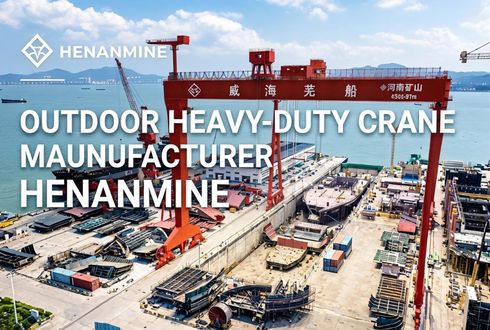
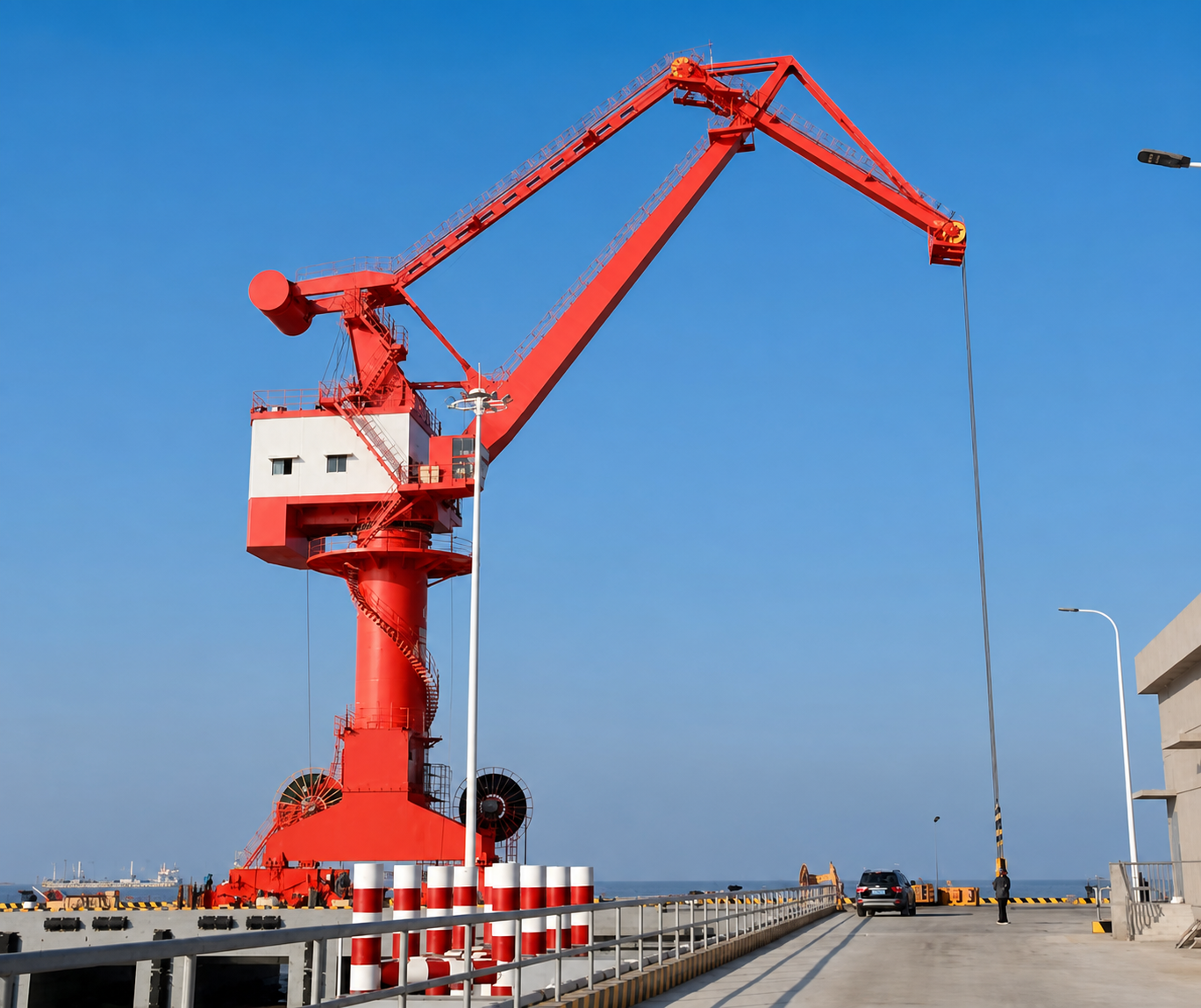
Henan Mine Crane manufactured portal slewing crane is a rail mounted gantry crane with a traveling jib or boom that slews and lifts loads through 360 °. They are used in ship yards, ports and heavy industry yards. This type of crane consists of a portal frame on a pair of parallel rails that carry loads over a work area, usually a dry dock, slipway or fabrication yard, and this frame is fixed to a pair of rails for travel across the work area. A jib is mounted onto the top of the gantry can rotate independently of the travel motions of the gantry itself. This allows the load to be hovered at any point within the working radius of the crane without traveling the whole gantry between pick points. This type of crane is found in shipyards to assemble hull blocks, rotate ship sections and install equipment, often where the gantry travel between pick points is not sufficient to reach the locations.
How It Works
- The portal frame runs along fixed rails through the work bay, powered by electric travel motors (one per leg).
- The slewing jib has a turntable bearing on top of the portal which rotates independently of the gantry travel.
- The load radius from the pivot is either increased or decreased as the hoist trolley moves on the jib.
- The main hoist lifts and lowers large loads. the auxiliary hoist lifts lighter loads more rapidly.
- Operator monitoring of travel, slewing and hoisting at the same time from cab or remote pendant for accuracy placement.
Travel, slew and hoist together form three independent motions, which when combined in different directions allow a single crane to serve the entire dry dock.
Key Specifications and Technical Parameters
| Parameter | Value / Range |
| Lifting Capacity | 5–100 t standard; up to 300+ t heavy-duty (verify with manufacturer) |
| Rail Gauge (Span) | 8–30 m |
| Slewing Angle | 270°–360° |
| Jib / Boom Length | 10–40 m |
| Lifting Height | 15–45 m |
| Travel Speed | 20–40 m/min |
| Slewing Speed | 0.3–1.0 rpm |
| Main Hoist Speed | 3–10 m/min |
| Auxiliary Hoist Speed | 8–20 m/min |
| Power Supply | 380V/400V, 50/60Hz, three-phase (configurable) |
| Duty Class | ISO 4301 A5–A7 / FEM 1Bm–3m (verify with manufacturer) |
| In-Service Wind Resistance | Up to 20 m/s |
Core Benefits
- 360° slewing jib: reaches every point around a dry dock from one rail position, cutting crane repositioning time
- Heavy lift capacity (up to 300+ t): handles complete hull blocks and pre-outfitted sections in a single lift, reducing crane cycles per vessel
- Dual hoist configuration: separates heavy main lifts from fast auxiliary moves, increasing daily lift throughput
- Rail-mounted portal frame: distributes load across a wide rail gauge, allowing taller lifts with better stability than mobile cranes
- Variable-frequency drive control: enables smooth, low-shock load placement critical for precision hull alignment
- Modular customization:boom length, capacity, and rail gauge configured to existing dry dock dimensions, avoiding costly civil works changes
Applications and Use Cases
Portal slewing cranes serve shipyards wherever heavy loads need precise, rotational placement around a fixed work area. Their combination of rail travel and 360° slewing suits tasks that straight-line gantry cranes handle poorly, particularly hull block turning and section transfer near dry docks. Typical shipyard applications include:
- Hull block lifting and turning during dry dock assembly
- Pre-outfitted module installation onto ship sections
- Engine and generator set installation during outfitting
- Steel plate and prefabricated panel handling in fabrication bays
- Ship section transfer between fabrication hall and slipway
- Offshore platform jacket section assembly
- Rudder, propeller, and shaft installation at the stern
- Dry dock blocking and keel block positioning support
How to Choose the Right Portal Slewing Crane — Buying Guide
Choosing a Henan Mine Crane Supply portal slewing crane involves a multi-step engineering decision process, not a single capacity number. The following considerations are used to determine an appropriate crane for a 20+ year service life.
- Capacity and the full load chart, not just headline tonnage Determine match capacity to your biggest planned lift plus a safety margin of 10-15 percent. However, look at the full load chart over the working radius--as the jib extends away from the pivot point, the capacity diminishes; so what your crane labeled “100 ton” can lift “what, a third, a fourth ” of that weight at full extension? Make sure to use the rated capacity at the radius of your largest lift.
- Span and rail gauge Span must be consistent with width of your dry dock or fabrication bay area. Determine the exact distance between the proposed rail centerlines prior to specifying changing rail foundations after the fact is very costly and will create disturbances to yard operations for weeks.
- Working radius/jib length Longer jib will increase working radius, yet decrease working capacity at maximum reach and increase wind loading at upper sections of the structure. Try mapping your dry dock’s pick points over candidate jib lengths before settling on a size excessive jib length merely adds to the structure and investment.
- Duty class, and structural design life Need to specify duty class (ISO 4301 or FEM 1001) according to actual working load, not choose by default. A shipyard with several shifts of heavy lifts will choose duty class A6-A7, while a shipyard with light lifting may choose A5, thus saving money. Duty class is a primary factor in size of steel sections, selection of bearings and final fatigue life of the structure.
- Site and civil works survey Verify soil bearing capacity, foundation design, and existing rail condition (retrofit) before determine crane weight and wheel load. Ensure foundation design is verified by a structural engineer based on the supplier wheel-load data, as this is one of the most common causes for delay in installation.
- Electrical infrastructure Confirm that the site voltage, frequency, and available power capacity are capable of supporting the total installed power of the crane. If power supply is erratic on the site, check with supplier that appropriate mitigating measures are in place to prevent nuisance trips during heavy lifts.
- Corrosion protection for maritime conditions Use hot-dip galvanized structural components or clear multi-coat marine grade epoxy/polyurethane paint system for salt-air recommended. It is definite for crane within several hundred meters of open water – under coated systems will require excessive Structural repairs 5–8 years.
- Control System and Operator Ergonomics Decide on an operator cab, ground level pendant or radio remote control, as determined by sight lines and size of work area. Larger dry docks tend to need cabs with anti-glare glazing and controls for long radius lifts, whereas the smaller bays are more suited to radio remote control.
- Safety and anti-collision systems When more than one crane operates on the same track, normal overload protection must include anti-collision sensors and zone-limiting software. Wind speed recording with automatic alarm or lock-out is necessary for any crane operating over water.
- Total cost of ownership in addition to purchase price Lower purchase costs by comparing energy consumption and spares availability with the quotations from the supplier. Selecting a supplier who does not have a regional service team available, may be very costly during its 20 year life span, if down time occurs during a breakdown.
- Track record of the supplier and after sales support For reference installations, request references at similar shipyards. Ensure warranty conditions, spare parts delivery time, and whether the supplier offers operator training or commissioning support on site.
- Certifications to confirm Confirm CE marking, class society approval (ABS, DNV, LR) or ASME B30.2 in accordance with your shipyard’s regulations and any vessel class requirements related to the lift.
Safety Systems and Maintenance Considerations
Henan Mine Crane manufactured portal slewing crane in a shipyard has to be fitted with engineered safety devices and maintained in order to be able to operate at its rated duty class throughout the lifetime of the machine.
Conventional safety devices consist of overload limit devices which interrupt the hoist movement prior to weights exceeding rated capacity, anti-collision detectors on cranes operating on shared rail tracks, wind speed sensors (anemometers) with automated alarm or travel lock-outs, and the presence of emergency stop controls at the cab, ground level, and remotely on a pendant.
Recommended maintenance intervals:
- Daily visual survey of wire ropes, hooks and brakes prior to working shift
- Monthly lubrication of the slewing bearing, wheel bogies and hoist gearboxes.
- Each yearcomprehensive structural examination, load testing, electrical system assessment to be carried out as per ISO 9927 or its equal.
- Every 5 yearsnon-destructive testing (NDT) of critical welds and the slewing bearing, especially for cranes above duty class A6.
Shipyards should allocate scheduled down time for these planned breaks rather than being reactive to maintenance unplanned crane down time during a docking schedule is significantly more costly than planned maintenance window.
Portal Slewing Crane vs. Gantry Crane
| Feature | Portal Slewing Crane | Standard Gantry Crane |
| Rotation | 270°–360° slewing jib | None — straight travel only |
| Reach pattern | Circular/radial coverage | Linear coverage along rails |
| Best for | Dry dock hull block handling, ship turning | Straight-line material transfer, container handling |
| Footprint flexibility | High — one position covers a wide arc | Low — must travel to align with load |
| Typical capacity | 5–300+ t | 5–500+ t (heavier-duty models common) |
| Relative cost | Higher (slewing mechanism, turntable bearing) | Lower for equivalent capacity |
Neither type is universally "better" , gantry cranes suit high-throughput linear transfer, while portal slewing cranes suit shipyards needing radial coverage around a fixed dry dock or assembly bay.
Compliance and Certifications
- ISO 4301 / FEM 1001: classifies crane duty/usage group, ensuring structural design matches actual lift cycles.
- CE Marking (EU): confirms compliance with EU Machinery Directive safety requirements for sale and use in Europe.
- ABS / DNV / LR Classification: required when the crane forms part of a classed shipyard facility or vessel-related lifting operation.
- ASME B30.2: US standard covering overhead and gantry crane design, inspection, and operating safety.
- RoHS / REACH: relevant for electrical and control components exported to EU markets.
Frequently Asked Questions
Q: How much can a portal slewing crane lift?
Typical shipyard portal slewing cranes lift from about 5 to 100 tons, heavy duty cranes over 300 tons (check with manufacturer). Lifting capacity varies according to duration of jib, radius of slewing and width of rail. Shipyards constructing large ships tend to specify larger capacity cranes to lift entire hull segments in one lift.
Q:-How a portal slewing crane is different from a tower crane?
A portal slewing crane rides on rails between two fixed points across the working area; a tower crane is fixed on one foundation point. A portal crane is used in shipyards for long dry-docks, whereas tower cranes are used for vertical construction, but have a limited horizontal axis.
Q: What duty class should be specified to the shipyard?
ISO 4301 duty class A6–A7 (check with manufacturer) is often used as appropriate for shipyards frequently lifting heavy weights, being high-duty duty class and a wide load spectrum less so for quartermasts. Lower duty classes should be specified for less frequent light lifting. Duty class influences structure sizes and fatigue life.
Q: Are the cranes suitable for adaptation to an existing dry dock?
In general, rail gauge, jib length and lifting height are proven to dimensions of an existing dry dock, site conditions will usually be surveyed by the manufacturers before the final design is completed, thus preventing expensive modification to existing rails or quay structures.
Q: Is any special foundations needed for the portal slewing crane?
Rail mounted portal cranes must be provided with reinforced concrete rail foundations sized to carry the wheel loads and travel distance of the crane. Final foundation design depends on the nature of the ground, the entire weight of the crane and the maximum lift load. The requirements must be checked by a structural engineer prior to installation.
Q: Are operators’ training needed in the case of portal slewing cranes?
Operator shall have certified training on simultaneous movement, travel, slewing, and hoisting controls this combination is more hazardous than basic gantry movement. Many of the stands and classification societies may require agentat least documentary evidence of operatores certification prior to operation.
Henan Mine Crane Factory Custom
Selecting the right portal slewing crane is a long-term investment in safety, productivity, and operational efficiency. The ideal solution depends on your lifting capacity, working radius, rail layout, duty cycle, and the specific requirements of your shipyard or industrial facility. Careful engineering at the planning stage helps reduce downtime, improve lifting accuracy, and lower maintenance costs throughout the crane's service life.
As an experienced crane manufacturer, Henan Mine Crane Factory provide customized portal slewing crane solutions for shipyards, ports, and heavy-duty industrial applications. Every project is engineered to match your operating conditions, with support covering design, manufacturing, quality inspection, installation guidance, and after-sales service. Whether you need a standard configuration or a fully customized solution, our engineering team is ready to help you find the most efficient and cost-effective crane for your project.