
Flexible Bridge Crane Systems for Harsh Environments
In heavy industrial scenes such as steel, mining, chemical industry, and coastal terminals, harsh working conditions such as extreme temperature, dust, high humidity, chemical salt spray, and continuous vibration are common.Ordinary standardized cranes have no special protection, and long-term operations are prone to aging of components, frequent failures, and greatly shortened life, which cannot guarantee stable production.
Flexible bridge cranes for harsh environments support customized structure, hierarchical protection and flexible control, and can be adapted to various complex and harsh working conditions, taking into account operational stability, safety and economy.This article explains the hazards of harsh working conditions, equipment advantages, core design, industry selection, operation and maintenance skills and procurement points in detail, and provides a professional reference for the scientific selection of enterprises.
What Makes an Environment Harsh for a Bridge Crane?
The harsh environment in the industrial scene will erode crane equipment in all directions from structure, machinery, electrical, control system, etc.If you want to choose the right suitable model, you first need to clarify the hazard mechanism and scope of influence of various harsh working conditions.
Extreme temperature environment
Temperature upheaval is the core factor affecting the operating stability of the crane. High temperature and low temperature conditions will cause irreversible damage to various core components of the crane.
There is strong thermal radiation in high-temperature scenarios (steel mills, foundries, forging workshops), which can easily cause the motor to overheat and burn, lubrication failure, circuit aging, and thermal deformation of the steel structure, greatly shortening the life of the equipment.
Low-temperature scenarios (cold chain, high-cold factories) will make the steel brittle and easy to crack, the lubricating grease will solidify and caton the transmission components, and at the same time cause the electrical components to harden and fail, and the electronic control system needs to be equipped with thermal insulation protection.
Dust and particulate matter pollution
Dust particles in mining, building materials, metal processing and other scenes are the cause of high crane failures.Dust will clog the motor's heat dissipation, penetrate the insulation, wear the braking structure, and cause electrical short circuit corrosion and accelerated wear of transmission components.In this scene, a high-protection fully enclosed motor and a sealed electrical cabinet need to be selected to isolate dust intrusion.
High humidity rainwater environment
The high humidity environment is a common cause of early crane failure. It is widely present in outdoor operations, water-facing factories, closed and humid workshops and other scenes. It mainly erodes equipment through rainwater erosion, environmental condensation, and high air humidity to accelerate the occurrence of failures.
Chemical salt spray corrosion
There are strong corrosive media such as acid-base mist, hydrogen sulfide, and salt spray in chemical, sewage, and coastal scenes, which can seriously corrode steel structures and corrode electrical circuits and contacts.Anticorrosive materials, special anticorrosive coatings and fully sealed electrical systems are required to protect the core components.
Strong vibration continuous operation
There is continuous strong vibration and high-frequency continuous operation in forging, stamping, assembly lines and other working conditions, which can easily cause equipment welds to crack, loose screws, poor circuit contact, and premature aging of transmission components.High-frequency 24-hour operation scenarios need to match the corresponding work-level models to avoid fatigue loss and frequent failures.
Why Choose Flexible Bridge Crane Systems for Harsh Environments
Standardized bridge cranes are only adapted to conventional indoor and mild working conditions, which are prone to failure, short life, and high operation and maintenance costs in harsh environments.The flexible bridge crane system supports customized design of the whole scene, and can flexibly adjust the configuration according to working conditions, site, and protection needs. It is the optimal solution for harsh scenarios in heavy industry.
Flexible structure design
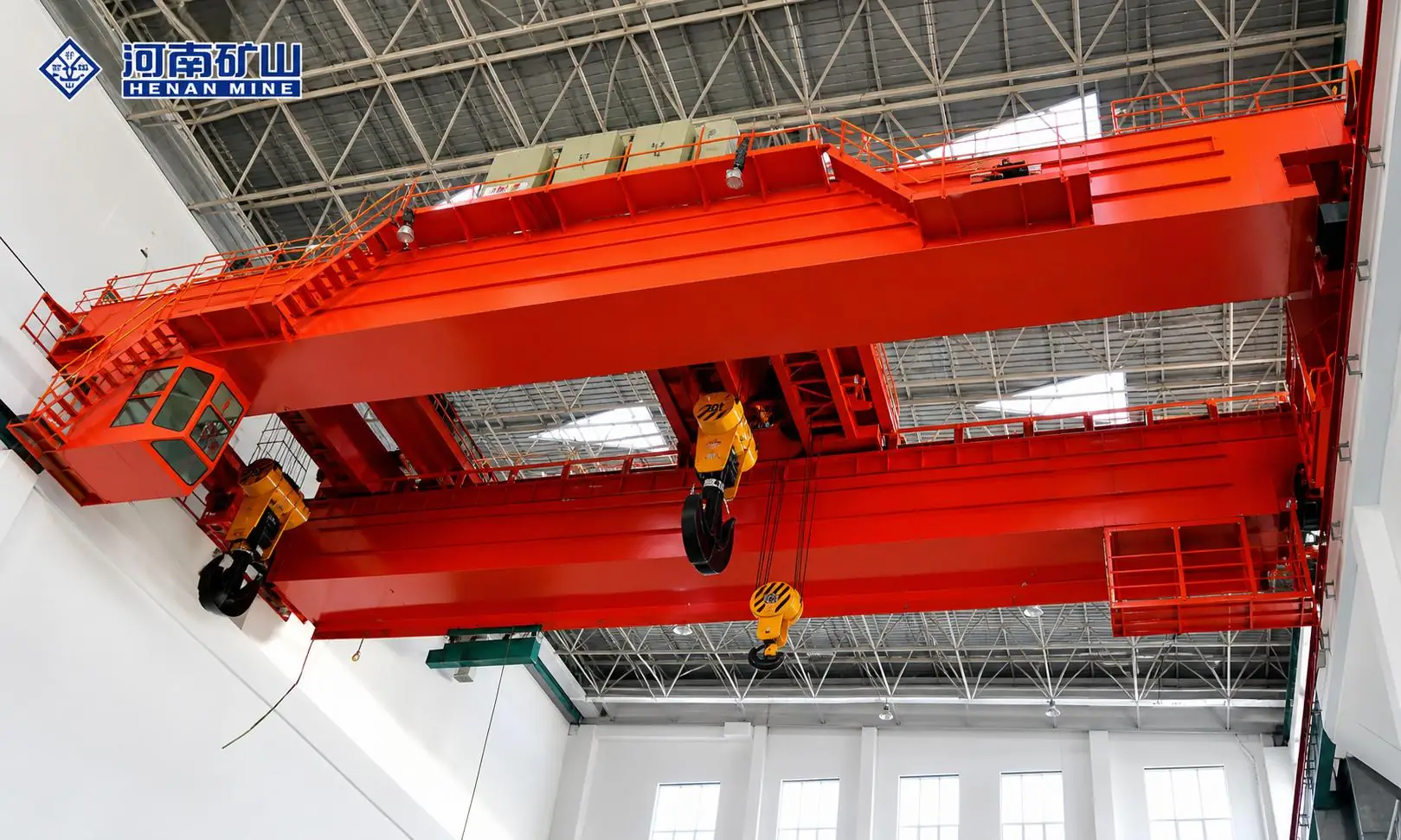
Flexible bridge cranes can flexibly switch single-beam and double-beam structural forms according to site conditions and operating needs: single-beam models are suitable for light-load, low-lifting height working conditions, and are more cost-effective; double-beam models have stronger structural rigidity, greater lifting height, and better operating stability, and are suitable for heavy-duty, harsh and high-intensity operating scenarios.
At the same time, the equipment span, lifting height, and operating track layout can be customized, which can be perfectly adapted to special sites such as irregular factories, low-lying spaces, and dense obstacles.For restricted working space, special structures such as low-clearance hoists and narrow-range end beams can be customized to solve the problems that standardized equipment cannot be installed and operations are limited.
Heavy-duty operation performance
Flexible bridge cranes can accurately match the needs of various heavy-duty operations, and stably lift heavy-duty cargo such as heavy machinery, steel, molds, large components, and bulk materials.
Different from the fixed parameter design of standardized equipment, this model can accurately match the rated load and working level according to the actual working conditions, so as to eliminate the waste of resources of “overkill” or the hidden dangers of overload of “small materials and large uses”.The structure of the whole machine has been strengthened, the force is uniform, the deflection is controllable, and there is no shaking in heavy-duty operations, which is suitable for long-term high-intensity heavy-duty operation scenarios.
Customized protection system
For different harsh working conditions, flexible bridge cranes can build exclusive protection schemes to achieve precise protection: multi-layer protective coatings are constructed through special anticorrosive primers and industrial topcoats to resist corrosion, salt spray, and chemical corrosion.;
Fully sealed electrical components are used, with corresponding IP protection level cabinets, which are dustproof, waterproof and moisture-proof; key hardware and connectors are made of stainless steel and hot-dip galvanized anticorrosive materials; shading, heat preservation, heat insulation, and airtight protective devices can be installed in outdoor, high-temperature, and low-temperature scenes to adapt to complex environments in all directions.
Intelligent control system
The equipment is equipped with a variety of control schemes, which can be adapted to different working conditions and safety standards as needed. It is mainly divided into two categories: basic manual control and intelligent speed control.:
- Basic control mode: Wired handle control is used for conventional scenes, with accurate positioning and intuitive operation, which is suitable for daily standardized operations; high temperature, dust, and high-risk operation scenes give priority to wireless remote control, allowing operators to stay away from dangerous areas and ensure personal safety from the source.
- Frequency conversion speed control system (VFD): Supports smooth start-stop and stepless speed regulation of equipment, effectively reduces mechanical impact and cargo shaking, greatly reduces the wear of structure, braking and transmission components, and improves the operating stability and service life of equipment.
- PLC intelligent automation control: Equipped with a programmable control system, it can seamlessly connect automated production lines and intelligent storage equipment to realize intelligent processes such as automatic positioning, partitioning operations, and linkage transportation, and adapt to the unmanned, high-precision and high-efficiency operation needs of modern smart factories.
Key Design Features of Bridge Cranes for Harsh Environments
Anticorrosive structural coating
Anticorrosion is the core design point of cranes in harsh working conditions.The substrate of the equipment is treated with high-standard sandblasting and rust removal to ensure the adhesion of the coating.
A multi-layer anticorrosive system is formed through a zinc-rich primer, an epoxy middle layer, and a corrosion-resistant topcoat to effectively resist corrosion and media erosion.
For marine and enhanced chemical corrosion scenarios, the key load-bearing structures are directly made of hot-dip galvanized steel and stainless steel to improve the corrosion resistance of the equipment from the root cause and greatly extend the service life of the structure.
Protective electrical system
The electrical system is the most easily damaged component in harsh environments. Special cranes are designed with graded IP protection: IP54/IP55 electrical cabinets are standard in dust environments, which can prevent dust and particulate matter from invading; IP65/IP66 sealed cabinets are used in outdoor and humid scenes, which are waterproof and spray-proof.
All electrical components are made of special models for high and low temperature resistance, moisture-proof and dust-proof, the motor is equipped with heat insulation and sealing structure, and the control cabinet has a built-in dehumidification heating device to prevent electrical failures caused by condensation, stagnant water, and dust accumulation, and ensure the long-term stable operation of the control system.
Hoist motor system
Both the hoist and the motor have been specially upgraded for harsh working conditions, and the fully enclosed sealed motor is used to adapt to high temperature and dust environments; it is equipped with a sealed disc brake system, which is dustproof and waterproof, and the braking is stable and reliable.
At the same time, it is equipped with motor overheating protection and thermal monitoring devices to prevent high temperature overload and burning; according to the frequency of operation, the corresponding work level is matched, and the thermal management system is optimized to avoid fatigue damage to components caused by long-term continuous operation.
Walking transmission parts
The transmission components such as walking wheels, gears, bearings, etc. are made of high-strength wear-resistant materials and are hardened to withstand heavy loads, high-frequency start-stop and continuous vibration conditions.For dust and humid environments, sealed bearing housings and labyrinth sealing structures are adopted, and gear protective covers are installed to prevent pollutants from invading worn parts.
At the same time, special lubricating greases are matched according to the ambient temperature and pollution type, and a centralized lubrication system is equipped to avoid component loss caused by lubrication failure and reduce the difficulty of operation and maintenance.
Intelligent security protection
The risk of operation in harsh working conditions is high, and the equipment is equipped with a full set of safety protections as standard: overload protection against overload, rapid shutdown of emergency stop devices, limit switches to prevent over-range, anti-collision systems to avoid collisions on the same track, and all-round avoidance of hidden dangers in operations.
In addition, the equipment is equipped with load monitoring, sound and light alarm devices to warn of operating risks in real time, ensure the safety of equipment and personnel in all directions, and adapt to high-risk and harsh operating scenarios.
Bridge Crane Configurations for Different Harsh Environments
The core hazards of harsh working conditions in different industries vary greatly, and the crane configuration needs to be matched in a targeted manner. The following are the professional selection plans for mainstream harsh scenarios.
Steel mill scene
The core is suitable for high-temperature and heavy-duty working conditions, equipped with high-temperature protective motors and electrical systems, and the steel structure has an additional thermal insulation shielding layer. It is equipped with a high-level heavy-duty hoist, which supports remote or cab control, can effectively resist high-temperature thermal radiation, and is suitable for long-term continuous heavy-duty operations.
For foundries
Suitable for casting high temperature and slag erosion operating environment, the core force and operating components are all configured with high temperature resistance, and the whole machine is sprayed with a special heat-resistant and anticorrosive coating.The hoist has been optimized by special technology and has strong resistance to slag scouring and high temperature erosion.
The equipment is equipped with a standard remote control system. Through the dual guarantee of high temperature resistant hardware protection and unmanned remote operation, the safety risks of high-temperature casting operations are avoided in all directions, and it is suitable for high-frequency lifting operations around the furnace.
Mine dedicated
Customized and upgraded for the harsh working conditions of dust, strong impact and high load in mines, the electrical system adopts high-end dust-proof sealing protection level of IP55 and above.The steel structure of the whole machine is strengthened and reinforced to match the heavy-duty work level standards, and the materials and manufacturing processes of key components such as core transmission and walking are optimized.
It has the characteristics of high wear resistance, impact resistance, and anti-dust clogging. It can resist the impact of mine gravel, dust erosion, and continuous heavy-duty wear, and is suitable for all kinds of complex operating scenarios in underground and open-pit mines.
For chemical plants
The whole machine adopts an exclusive anti-corrosion structure design and is sprayed with a special corrosion-resistant coating for chemical industry, which can resist the corrosion of various media such as acid-base liquids, organic solvents, and chemical fumes for a long time.
The electrical control cabinet is fully sealed and explosion-proof to eliminate the safety hazards of chemical flammable and explosive environments. All exposed hardware accessories are made of stainless steel anticorrosive materials, which comprehensively enhances the corrosion resistance, rust resistance and anti-aging capabilities of the equipment, and is suitable for all kinds of corrosive operating environments in chemical workshops.
Dedicated for marina/wharf
It is suitable for coastal high salt spray, high humidity, and strong corrosion marine working conditions. The whole machine adopts marine-grade heavy anticorrosive coating, and the main steel structure is reinforced with hot-dip galvanized as a whole, and the double anticorrosive protection prevents corrosion problems.
The electrical system is fully waterproof and salt spray-proof sealed, and all exposed accessories are optimized for salt spray environment adaptation to effectively resist seawater and salt spray erosion, avoid equipment corrosion, aging, and failure, and ensure long-term stable operation of docks and coastal ports.
Dedicated for outdoor yard
Suitable for outdoor and open-air changeable climatic environments, the whole machine has waterproof, sunscreen, anti-aging, and weather-resistant characteristics, and is equipped with an exclusive wind-resistant reinforced structure, which can resist strong outdoor winds.
The surface coating of the equipment has been optimized to be resistant to ultraviolet rays, exposure, wind and rain, and not easy to fade and crack.For low-temperature areas, it can be equipped with low-temperature special core components and antifreeze lubricants to take into account complex outdoor working conditions such as high temperature exposure, rain, snow, frost, wind, sand and dust.
Dedicated for sewage treatment plants
It is specially designed for high humidity, hydrogen sulfide corrosion, and humid and airtight working conditions in sewage plants. The steel structure of the whole machine is strengthened with anti-corrosion and moisture-proof treatment to prevent corrosion, paint loss, and structural aging in humid environments.
The electrical system adopts a fully sealed and protective design, which is waterproof, moisture-proof and gas-proof.The equipment adopts a large number of stainless steel and polymer anticorrosive and wear-resistant accessories, which can be adapted to the high humidity and corrosive working conditions of the sewage environment for a long time, and the operation is stable and the failure rate is low.
Dedicated for cold chain storage
It is deeply adapted to the operating environment of the low-temperature cold chain, and the main structure adopts special low-temperature resistant steel that has passed the low-temperature impact test to eliminate the problems of steel brittleness and structural failure at low temperatures.
Supporting low-temperature special lubricants, cold-resistant cables and antifreeze motors to solve low-temperature caton, lubrication failure, and line hardening failures.The electrical control cabinet is equipped with a heating and heat preservation device to accurately adapt to extremely cold working conditions such as low-temperature storage and cold storage to ensure stable start and stop of the equipment in a low-temperature environment and normal operation throughout the process.
How to Select the Right Flexible Bridge Crane System
Precise lifting of heavy loads
When selecting the type, it is necessary to distinguish between the rated load and the actual commonly used load. The rated lifting weight of the equipment must be greater than the maximum operating load on the site.At the same time, you can't just look at the peak load. You need to judge the fatigue load of the equipment based on the daily average lifting load to avoid long-term light-load high-frequency operations or heavy-load extreme operations to accelerate the aging of the equipment.In addition, a certain load margin needs to be reserved to meet future production capacity upgrades and heavy lifting needs.
Span lifting parameters
The crane span is determined based on the track spacing of the plant, and the lifting height and clearance size are determined according to the net height of the plant, the height of the cargo stacking, and the operation requirements.For low-rise factories and restricted spaces, priority is given to customized models with low headroom to maximize the use of working space, while matching the length of the track and the walking distance to ensure full coverage of the operation.
Clear working condition parameters
Comprehensively sort out the core parameters of the on-site environment, including: high and low temperature limit temperature, dust concentration and particulate matter type, environmental humidity and condensation, corrosive media type and concentration, indoor/outdoor installation scenarios of equipment, all parameters will directly determine the coating level, electrical protection, material selection and core configuration of the equipment.
Adapt to work level
According to the hourly lifting frequency, the average daily operating time, the average load ratio, and the total number of operating cycles, the corresponding work level is matched with reference to ISO, FEM, and CMAA standards.For 24-hour continuous operation and high-frequency heavy-duty scenarios, high-level models need to be selected to eliminate overload and fatigue operations of ordinary models.
Optional control mode
Wired handle control is used for conventional indoor and outdoor industries; wireless remote control is used for high-temperature, dust, and high-risk sites to ensure personnel safety; cab control is used for large-scale heavy-duty and long-span equipment to have a better field of vision; automated production lines and intelligent warehousing scenarios are adapted to PLC automated centralized control to achieve unmanned and precise operations.
Convenient post-operation and maintenance
The selection gives priority to the modular structure design that is easy to disassemble and easy to overhaul. The core components such as motors, brakes, electrical cabinets, hoists, etc. are easy to disassemble and assemble, effectively reducing the difficulty of late operation and maintenance.
At the same time, the operating condition monitoring and intelligent early warning expansion interface can be reserved according to on-site working conditions, supporting predictive maintenance and upgrading, greatly shortening the length of equipment downtime and maintenance, and ensuring production continuity.
Flexible Bridge Crane Systems vs. Standard Bridge Cranes
Environmental adaptability
Ordinary bridge cranes are standardized and universal designs, which are only suitable for normal temperature, clean, low humidity, and light load conventional working conditions. There are no targeted protective measures, and they are easy to corrode, age, and fail in harsh environments.
The flexible bridge crane adopts scenario-based customized R&D and design, and completes a full range of special protection and structural optimization for various complex and harsh working conditions. The environmental adaptability and operating stability are significantly better than ordinary standard models.
Operation and maintenance cost
Ordinary cranes lack special protection for harsh working conditions. In complex environments, components wear out quickly and have a high failure rate. Frequent maintenance and replacement are required. Equipment downtime is frequent, production losses are large, and overall operation and maintenance costs are high for a long time.
The flexible crane adopts the protection design adapted to working conditions from the source, which effectively delays the aging of components, reduces the failure rate of equipment, greatly lengthens the maintenance cycle, reduces the loss of downtime and missed work, and compresses the operation and maintenance costs of the whole life cycle of the equipment in all directions.
Service life and reliability
Ordinary standard cranes have a service life of only 10-15 years under harsh working conditions. After the equipment enters the middle and late stages of use, it is prone to frequent failures and performance attenuation, and the operating stability and reliability are greatly reduced.
The structure, electrical and mechanical components of the flexible customized models have been strengthened and upgraded, the protection system is perfect, the service life can reach 25-30 years, the long-term operating stability is extremely strong, and the overall price ratio is higher.
Flexibility and extensibility
Ordinary cranes are standardized and stereotyped structures with solid parameters and single adaptation. It is difficult to adapt to the needs of special-shaped sites and special process operations. The space for the late transformation and upgrading of equipment is very small, and it is impossible to follow the production iteration and optimization.
The flexible crane supports flexible customization of all dimensions such as span, load, control method, and protection plan. It can be continuously expanded and optimized according to the needs of site transformation, capacity expansion, and process upgrade, and is adapted to the long-term production iteration and working condition upgrade of enterprises, and the equipment is more reusable and scalable.
Maintenance Strategies for Bridge Cranes in Harsh Environments
High-quality customized cranes, combined with a scientific operation and maintenance system, can maximize the life of equipment and ensure the stability of operations.The operation and maintenance of equipment in harsh environments must follow the core principles of preventive and predictive combination.
Regular structural inspections
Regularly inspect the main beam, end beam, welds, and connecting bolts to investigate fatigue cracks, coating shedding, structural corrosion, deformation, etc.; Verify the flatness and installation accuracy of the track to avoid walking wear and equipment shaking caused by track offset, and find hidden dangers. Repair and paint in time, strengthen and fasten.
Special inspection of electrical system
Regularly inspect cables, terminals, control cabinets, and protective devices, clean up dust and water in the cabinets, and investigate problems such as line aging, terminal corrosion, and seal failure; test functions such as dehumidification heating, overload protection, and limit alarm to ensure the stable operation of the electrical system.
Hoist brake maintenance
Check the wire rope/chain, reel, hook, and brake in accordance with the manufacturer's standard cycle, detect the wear, broken wire, and deformation of the wire rope, and investigate the hidden dangers of plastic deformation and brake failure of the hook; replace the gear oil and brake pads on time to prevent sick operations.
Lubrication replacement maintenance
Special lubricating greases are selected strictly according to the ambient temperature and working conditions, high-temperature-resistant greases are selected for high-temperature working conditions, and low-temperature flowing greases are selected for low-temperature working conditions. The dust environment avoids easy-to-stick dust lubrication products.Establish a component loss ledger, replace worn and aging parts in advance, and prevent sudden failures and shutdowns.
Predictive intelligent operation and maintenance
Relying on intelligent monitoring methods such as vibration monitoring, temperature monitoring, and load cycle statistics, it can grasp the operating status of the equipment in real time and accurately predict the trend of component loss.From the traditional regular maintenance and fault repair, it has been upgraded to state-driven predictive maintenance, which greatly reduces the probability of failure and operation and maintenance costs.
Conclusion
In harsh industrial environments, the core of bridge crane selection is not low price, but adaptation to working conditions, stable operation and full life cycle cost.Through structural customization, environmental protection and intelligent control, flexible bridge cranes can better cope with complex working conditions such as high temperature, dust, corrosion and high-frequency operations.
Choosing a crane that accurately matches the needs of the site can improve operation safety and continuity, while reducing long-term operation and maintenance costs.Henan Mine Crane can provide customized bridge crane solutions according to the actual environment and operating needs to help enterprises create a more reliable hoisting system in harsh environments.