
10t Semi-Gantry Cranes (BMH): Space-Saving Outdoor Bay Layouts Along Factory Walls
The space of the outer yard of the factory building is limited. It is necessary to add outdoor loading, unloading and hoisting capabilities, but also does not want to occupy valuable production area inside the workshop. At the same time, it is also limited by the original plant structure. Conventional bridge and full-gantry cranes are often difficult to adapt.In view of such pain points, the 10-ton BMH semi-gantry crane provides a highly adaptable solution.
It adopts a unique asymmetric structure of one-sided relying on the building and one-sided landing legs. It can be arranged along the outer wall track of the plant, taking into account the lifting performance and site utilization rate, and it has become the preferred lifting equipment for material transfer and truck loading and unloading in outdoor narrow yards.The following will be introduced in detail from the aspects of structure, application, layout planning, selection points, etc.
What Is a 10t Semi-Gantry Crane (BMH)
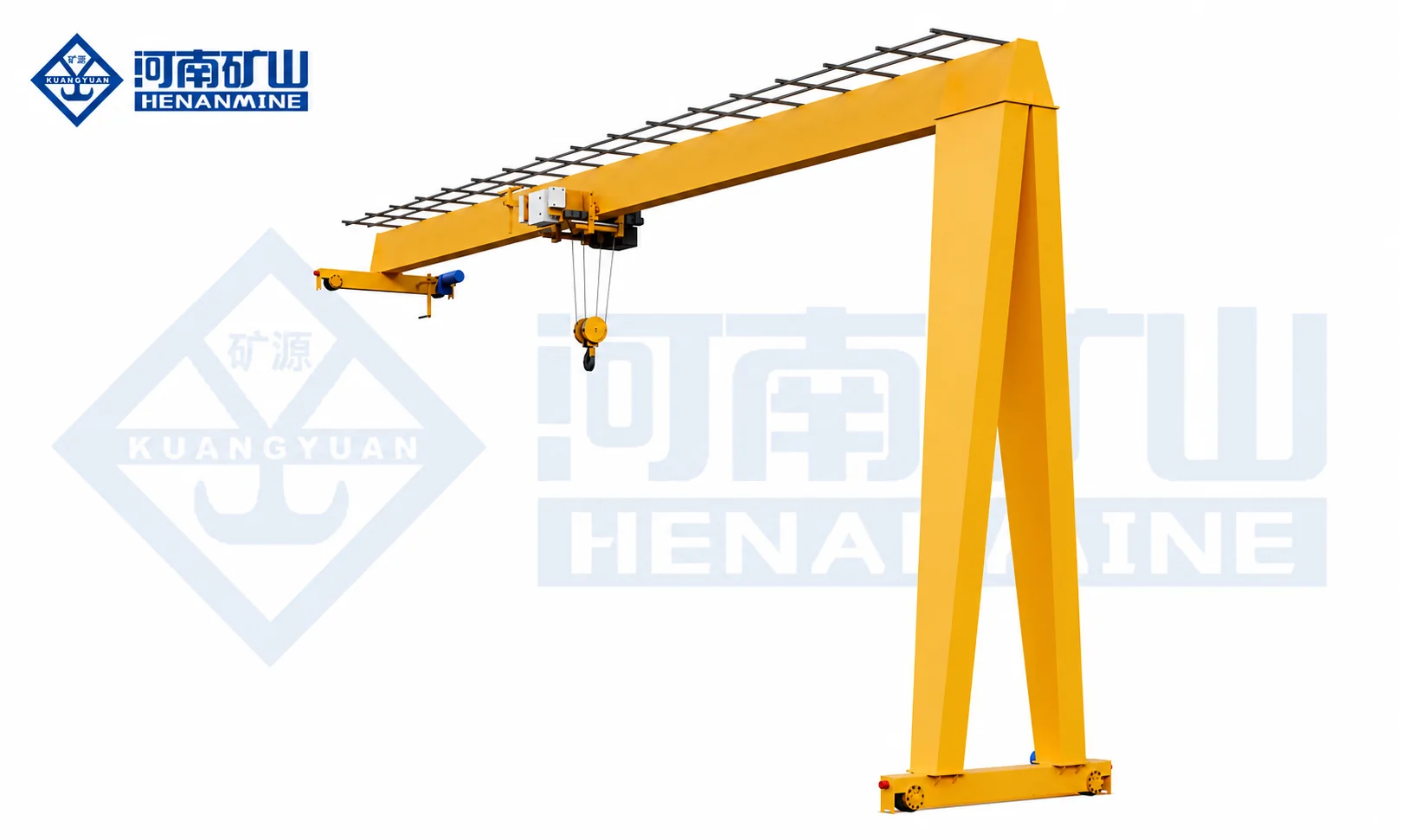
The 10-ton BMH half-gantry crane is a composite lifting equipment between a bridge crane and a full-gantry crane, and adopts a unique asymmetric support structure.One side of the main beam relies on the original building structures such as plant columns and cattle legs to erect the track beam, and the other side relies on a single leg to walk along the ground track. It combines the advantages of both bridge and gantry cranes and can move flexibly along the track of the outdoor yard. , Efficiently complete all kinds of material lifting operations.
The main components and functions of 10-ton BMH semi-gantry crane:
| Component | Function Description |
| Main Girder | A horizontal load-bearing beam spanning between the building-side runway and the ground travelling leg, allowing the electric hoist trolley to move transversely along it. |
| Hoist Trolley | Moves along the main girder for lateral load positioning. It is equipped with a wire rope electric hoist to carry out lifting operations. |
| Supporting Leg | Vertical load-bearing component on the ground side, transferring loads from the main girder to the ground end carriage. |
| End Carriages | Driven or idle bogies that carry the crane along the runway. One set runs on the elevated building-side rail, and the other set runs on the ground rail. |
| Runway System | Includes the elevated rail fixed to factory columns and the ground rail embedded or fastened to the concrete foundation. |
It should be noted that there is no unified standard for support schemes such as the height of the high-altitude track, the connection form of the building, and the shape of the outriggers. It needs to be customized separately in combination with the crane design plan and the original structure of the plant.The connection position between the crane and the building must be verified separately by engineering.
Typical application scenarios of 10-ton BMH semi-gantry crane
The 10-ton rated load and the unique half-door structure make BMH cranes very suitable for outdoor and semi-outdoor industrial lifting operations.:
- Outdoor material transfer between the production workshop and the adjacent yard and the transit area, and areas that cannot be covered by indoor lifting equipment for polishing: It is used for outdoor material transfer between the production workshop and the adjacent yard and the transit area, and is suitable for work areas that cannot be covered by indoor lifting equipment.
- Polishing the loading and unloading operations of steel, structural parts, mechanical parts, and prefabricated processed parts on flatbed trucks: Complete the loading and unloading operations of steel, steel structure parts, mechanical spare parts, and prefabricated processed components on flatbed trucks.
- Transfer of raw materials along the exterior wall of the plant, the incoming materials are unloaded on the periphery of the plant, and then transferred to the internal processing station of the workshop for polishing: The raw materials along the exterior wall of the plant are transferred, and the incoming materials are unloaded on the periphery of the plant, and then transferred to the processing stations in the workshop.
- The internal headroom of the plant is limited, or the maintenance stations and production lines that have been equipped with bridge-type vehicles have been arranged indoors, and the outdoor lifting points have been added. Polishing: Add outdoor lifting points for the workshop with insufficient headroom, or the maintenance stations and production lines that have been equipped with bridge-type vehicles.
Why Choose a 10t Semi-Gantry Crane for Outdoor Factory Bays?
Save workshop production area
Transferring lifting operations such as unloading, receiving incoming materials, and temporary storage of raw materials to the outdoor yard is a major core advantage of semi-gantry cranes to avoid loading and unloading operations from squeezing the internal space of the workshop.
The internal area of the workshop can be reserved for production equipment, assembly lines, and internal logistics turnover, and there is no need to reserve places for trucks to stop and goods to be temporarily stacked.For factories with tight workshop sites, separating outdoor unloading from indoor production can significantly straighten out the on-site order and improve the efficiency of production capacity flow.
Use the original structure of the plant
If the wall of the plant has columns, cattle legs, and reserved track beams with qualified bearing capacity, the semi-gantry crane can directly fix one side of the track on the original building, eliminating the need to build a second set of gantry outriggers and supporting civil foundations to revitalize the existing resources of the plant.
However, it cannot be assumed that the wall of the plant can be directly carried by default.Before the track is installed, a professional structural engineer must verify the bearing capacity of the plant column, track beam, connecting node, and foundation. The vertical load of the wheel, the horizontal force caused by braking, and the dynamic load generated by the crane operation must be considered.The track is directly installed without verification, and there are major structural safety risks.
Reduce interference with indoor driving operations
Many factories have been equipped with bridge cranes to complete assembly and production hoisting.If the unloading of incoming materials and the delivery of finished products also rely on indoor driving, it is easy to rush, wait, and collide risks, slowing down the pace of production.
The semi-gantry crane arranged independently outside can completely isolate the outdoor loading and unloading from the production and hoisting in the workshop.External incoming materials are received in the outdoor yard, sorted and temporarily stored before being sent to the workshop; the outbound transportation of finished products and waste materials is also completed outdoors, which does not take up indoor driving working hours, and opens up the material movement line of receipt—production—delivery, eliminating the conflict of driving competition.
Suitable for narrow outdoor work areas
The outer space of the outer walls of many factories is small, and the outer side is adjacent to the carriageway, fence or other structures.If a full-gantry crane is selected, floor-to-ceiling legs are set on both sides, which covers a large area and can easily block lanes, pedestrian passages and adjacent work areas.
The semi-gantry crane has only one-sided landing legs, and the side of the building adopts a high-altitude track without ground legs, so the ground near the wall remains unobstructed.In the scene of a narrow yard on the outside of the factory building, it will not squeeze the passage space, which is the preferred solution when the whole door type cannot be put down.
How to Plan a Space-Saving Outdoor Bay Layout Along Factory Walls
Determine the span and scope of operation
The span of a semi-gantry crane refers to the horizontal distance from the centerline of the side track of the building to the centerline of the ground track, which needs to be accurately calculated in accordance with the needs of on-site lifting.
Need to focus on measurement:
- The distance from the wall of the plant (the center line of the track on the side of the wall) to the farthest hanging point;
- A gap is reserved on one side of the ground track to meet the buffer distance of the outriggers and end beam trolleys, avoiding equipment, lanes, and shelves.
- The span can match the lifting needs, and it should not be increased blindly.The larger the span, the greater the force on the main beam, the larger the steel structure is required, and the higher the requirements for the track support of the plant.When planning the span, all surrounding fixed obstacles and traffic routes should be taken into account.
Optimize the total length of the track
The length of the trolley track determines the range of the yard that the crane can cover. There is no need to lengthen it blindly, and priority is given to arranging the track in the high-frequency loading and unloading area.
Key references when planning the length of the track: the location of the material stacking area, the conventional stopping point of the truck, and the location of the entrance and exit doorways of the factory to ensure that after the vehicle stops, the goods just fall within the scope of the crane's operation.A reasonable track length can reduce the empty running distance of the crane, shorten the single lifting cycle, and improve the efficiency of material handling.
Select the appropriate lifting height
The lifting height cannot be selected only according to the height of the conventional cargo, the maximum working conditions must be considered:
- The height of the carriages of flatbed trucks, high-rail trucks, and low-flatbed trucks is polished: the height of the carriages of flatbed trucks, high-rail trucks, and low-flatbed trucks
- The height of stacking materials, storage shelves, and loading and unloading platforms in the yard is highly polished: the height of stacking materials, storage shelves, and loading and unloading platforms in the yard
- Additional height occupied by slings, shackles, hanging beams, etc. Touch-up: The additional height occupied by slings, shackles, hanging beams, etc.
- The lifting height is defined as the distance from the datum of the cargo to the lowest position of the hoist hook; in the maximum lifting state, sufficient safety clearance must be reserved between the hook and the highest cargo and spreader.
Collaborative design of ground track, foundation and drainage
The ground side outriggers will bring concentrated wheel pressure to the track foundation, and the foundation conditions must be investigated before installation.:
- Foundation bearing capacity: Verify the carrying capacity of the original concrete floor or the newly built reinforced concrete foundation in advance to ensure that the foundation can withstand the concentrated wheel pressure generated by the crane operation, and avoid problems such as foundation settlement, surface cracking, and local pressure loss. Damage.
- Track flatness: The level, elevation deviation and track gauge deviation of the cart track need to strictly meet the technical specifications and installation standards given by the equipment manufacturer.
- Uneven settlement: If the settlement rate of the building side track foundation and the ground side track foundation is inconsistent, it will cause the height of the track to be misaligned, which can easily cause crane operation deviation, gnawing rail, stuck rail and other failures, affecting the safe operation of the equipment.
- Drainage design: Long-term water accumulation in the outdoor track area will continue to corrode the track pressure plate and floor plate, erode the foundation surface layer, and damage the walking road surface; the site should be reasonably equipped with drainage slopes, drainage ditches, and permeable layers to drain rainwater in time to ensure that the crane can operate smoothly and safely for a long time.
Ensure the gap between traffic safety and operation safety
The half-door outdoor yard needs to clarify the operating boundaries and keep a safe distance throughout the process.:
- When planning the layout of the outriggers and tracks, it is necessary to combine the comprehensive arrangement of on-site traffic and avoid the main traffic lanes to ensure that trucks can pass smoothly, stop for loading and unloading, and there will be no traffic blocking the road.
- The site needs to ensure that the pedestrian walkways and emergency evacuation exits are unimpeded throughout the process, and protective fences are set up in high-risk areas where cranes are operating, and eye-catching safety warning signs are placed to avoid personnel straying into dangerous areas.
- In the layout stage, sufficient operating space must be reserved for the hoist trolley, end beam trolley, and along the track to meet the needs of maintenance operations such as daily inspection, parts replacement, and fault repair in the later stage.
- Limit stops and buffers must be installed at both ends of the track to limit the running stroke of the cart and prevent the crane from rushing out of the track; for adjacent walls, fixed equipment, and locations where personnel are frequently active, anti-collision protection measures should be taken simultaneously.
Key Technical Specifications for a 10t BMH Semi-Gantry Crane
In the inquiry and selection stage, the following parameters must be confirmed separately in combination with the project, not just the rated tonnage of 10 tons.:
| Parameter Item | Selection Key Points |
| Rated Lifting Capacity | 10 tons. Restricted by lifting point configuration, hook position and working class. Tonnage alone cannot determine applicability. |
| Span | Determined by yard width, positions of building-side rail and ground rail, to match the required lifting coverage. |
| Lifting Height | Defined based on the maximum height of cargo, lifting gear allowance and safety clearance. |
| Lifting Speed | Selected according to positioning accuracy and lifting frequency; multi-speed or variable frequency drive is optional. |
| Trolley Travel Speed | Shorten cycle time for frequent lifting operations while ensuring controllable positioning. |
| Crane Long-travel Speed | Enables smooth start and stop to avoid excessive impact on the building supporting structure. |
| Working Class | Selected in accordance with daily operation cycles, load spectrum and service intensity, complying with FEM, ISO and other relevant standards. |
| Power Supply Scheme | Voltage and frequency shall match on-site power distribution. Collector rails or cable trolley systems can be chosen depending on travel length. |
| Control Mode | Pendant push-button station for local operation; radio remote controller for flexible operation; interfaces can be reserved for automation requirements. |
Outdoor Installation Challenges and Engineering Considerations
Wind load and climate impact
Indoor cranes do not need to focus on wind load, but outdoor semi-gantry cranes must account for wind load.The wind acts on the main beam, outriggers, trolleys, and hooks, which will produce lateral thrust, which can easily cause the crane to swing and make alignment difficult.
These measures should be implemented in windy areas: design wind-resistant structures in accordance with local wind pressure standards; set wind speed operating limits; equip rail clamps and anchoring devices in the shutdown state; delineate the wind-proof shutdown location, and park the crane at this point to fix it when there is a strong wind.
Adaptability of plant building structure
The side track of the wall will transmit vertical wheel pressure, longitudinal horizontal force of acceleration and deceleration of the cart, and lateral force of the trolley operation to the column of the plant.The original design of the plant generally only considers the roof, enclosure, and floor loads. Most of them do not reserve the load margin of the lifting track, which may need to be reinforced.
The columns, track beams, connecting nodes and foundations must be reviewed by professional structural engineers, and it is strictly forbidden to directly assume that the wall can carry the crane track.
Anticorrosion and electrical protection
Open-air use will continue to rain, accumulate ash, and be damp, and there is also a risk of corrosion in coastal or chemical plant areas.:
- The steel structure adopts sandblasting and rust removal + multi-layer anticorrosive paint, and high-performance coatings are used in areas with strong corrosion.;
- The motor, control cabinet, and junction box are protected by IP55 and above;
- The cable is selected from UV-resistant and aging-resistant models, and the connector is waterproof;
- Bolts and fasteners are made of hot-dip galvanized or stainless steel to avoid corrosion of dissimilar metal galvanic;
- The hoist and transmission components are selected with sealed bearings and sealed gearboxes, which are suitable for outdoor working conditions.
Foundation conditions and track calibration maintenance
The ground track foundation requires geotechnical survey, and the reinforced concrete foundation is designed according to the wheel pressure.The pressure of the half-door outrigger wheel is concentrated, and the load cannot be underestimated.At the same time, it is necessary to monitor uneven settlement for a long time. Once the track is deformed and the elevation is misaligned, the crane will easily chew the track.Since it was put into use, a regular inspection and maintenance system has been established to check the damage of track pressure plates, joints, and foundations.
How to Improve Handling Efficiency with a 10t BMH Crane
After the crane is put into use, the on-site management method directly determines the output efficiency. You can refer to the following plan to optimize:
- Plan the material stacking area within the effective operating coverage of the crane, so that when accessing the goods, there is no need to move carts and trolleys frequently, and unnecessary equipment movements are reduced.
- Reasonable planning and optimization of the sequence of lifting operations, reduce the empty running of cranes to and from, prevent a large number of invalid lifting trips due to the disorderly and chaotic layout of the warehouse, and reduce operating efficiency.
- Set up fixed stopping points for trucks, do a good job of moving line planning, to ensure that the passage of forklifts and the walking routes of crane legs are separated from each other, no cross-interference occurs, and the risk of collision is avoided.
- For goods that need to be hoisted repeatedly, special hanging beams, electromagnetic suction cups, container spreaders and other tooling spreaders can be used to greatly shorten the operating time for each hanging and disassembly of the sling.
- Implement a preventive maintenance plan.Outdoor cranes operate in complex and harsh environments for a long time, and they need to carry out regular inspections and maintenance of electric hoists, walking trolleys, rails, electrical systems, and various safety protection devices to reduce sudden failures and shutdowns, and effectively extend the service life of the whole machine.
How to Select a 10t Semi-Gantry Crane Supplier
The selection of suppliers cannot only compare prices, but focus on checking the following items:
- Project experience: Confirm that the manufacturer has mature cases of semi-gantry and outdoor wall-mounted rail cranes, and you can ask for a reference for the same type of project.;
- Plan drawings: Regular suppliers will issue layout drawings based on your site size, marking the span, track length, lifting height, safety clearance, and building connection nodes.;
- Calculation book and qualification: provide the calculation book of the structure of the main beam, outriggers, and track nodes to confirm that the equipment complies with national standards and industry specifications, and the information is complete;
- Outdoor protection plan: clarify the electrical IP level, anti-corrosion plan, sliding contact line/cable plan;
- Safety device: standard with overload protection, limit buffer, emergency stop, anti-collision and other safety components;
- Customization ability: Can be customized according to the special structure of the plant, environmental corrosion level, and control needs, rather than only selling standard models;
- Delivery and after-sales: confirm whether to provide installation guidance, installation of the whole machine, commissioning, personnel training, spare parts supply, and post-technical services.
Conclusion
The 10-ton BMH semi-gantry crane is suitable for a small yard on the outside of the outer wall of the plant. It relies on the track of the plant on one side and a single leg on the other. The civil construction cost is lower, and the loading and unloading operations and the site passage do not interfere with each other.
The stable and safe operation of the project is inseparable from detailed site survey, verification of the bearing capacity of the plant structure, anti-corrosion electrical scheme adapted to the outdoor environment, and reasonable material yard movement line planning to maximize the scope of crane operation.
If you are planning to support outdoor lifting equipment on the exterior wall of the plant, and want to evaluate the suitable span, lifting height, work level, track layout, and outdoor protection plan, please contact us for exclusive layout plans and project suggestions.