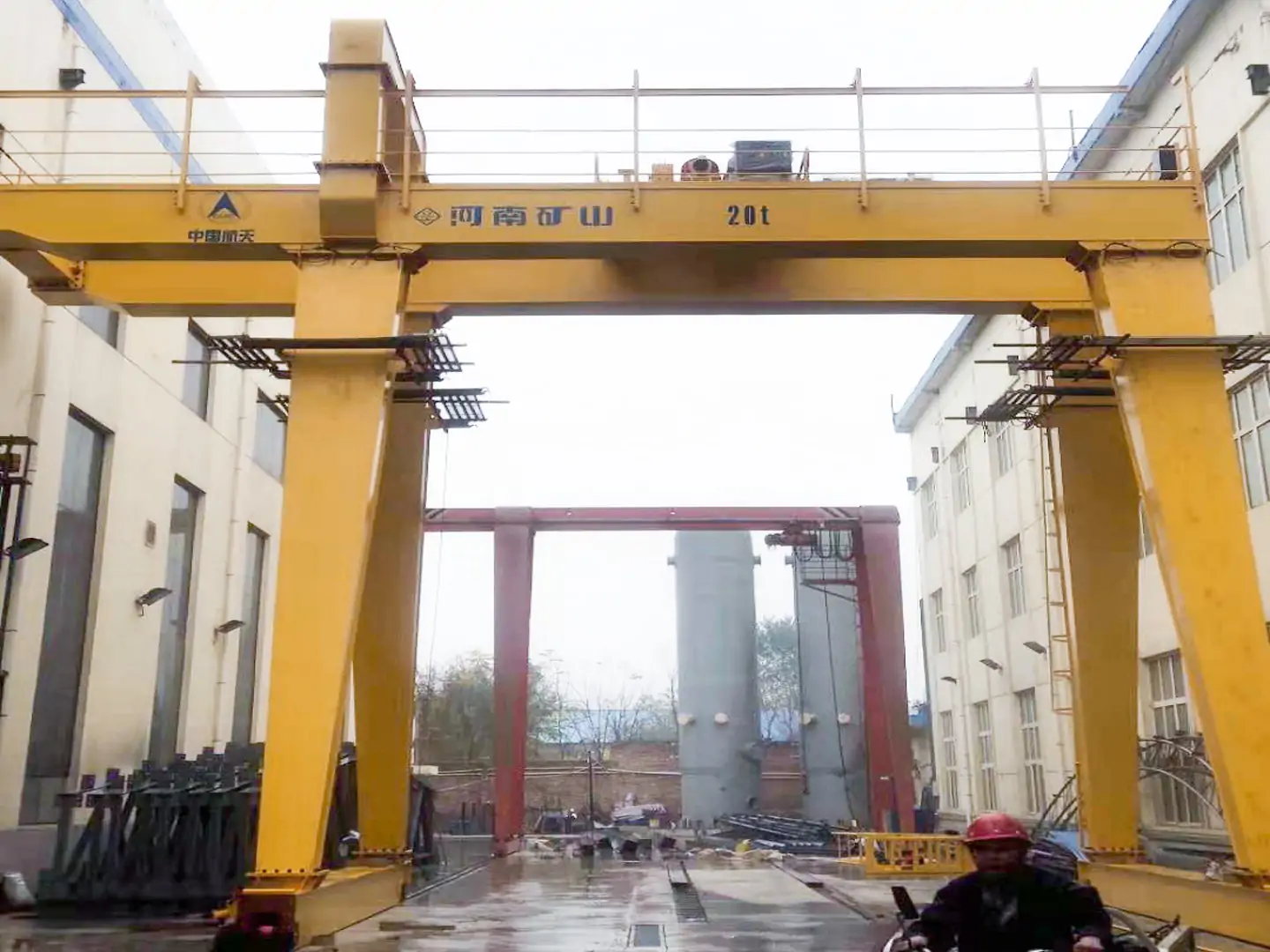

Rubber-Tyred Mobile Gantry Cranes (RMG): Flexible Indoor/Outdoor Heavy Load Transport
In heavy industry manufacturing, construction, port warehousing and other scenarios, traditional orbital and fixed lifting are subject to site and infrastructure restrictions, making it difficult to adapt to dynamic operation needs.
Relying on the advantages of trackless walking, indoor and outdoor versatility, flexible transition, and stable heavy-duty, tire-type mobile gantry crane (RMG) has become the core equipment of modern flexible heavy-duty handling.This article analyzes the principle, structure, advantages, selection, safety and maintenance points of RMG in a concise manner, and provides a reference for engineering procurement and on-site application.
What Is a Rubber-Tyred Mobile Gantry Crane?
Tire-type mobile gantry crane is a trackless gantry lifting equipment equipped with a rubber tire walking system. It integrates mechanical, hydraulic, electrical and safety protection systems, and can independently complete the whole process of positioning, lifting, translation, transshipment, and unloading of heavy objects.The core features are no need for track, global adaptation, flexible displacement, and free switching of indoor and outdoor working conditions.
Tire Type RMG vs Rail Type Gantry Crane
Orbital gantry cranes need to be laid with fixed steel rails and concrete foundations. They have high positioning accuracy and are suitable for fixed-point and high-frequency operations, but the infrastructure cost is high, they cannot be shifted, and the site adaptability is poor.
Tire-type RMG relies on rubber tires to walk without a fixed track. It can turn at multiple angles and transition across regions. It has stronger mobility and versatility. It is more suitable for changeable working conditions, temporary construction, and dynamic production line scenarios. The ultimate positioning accuracy is slightly lower than that of track models.
Principle of trackless autonomous walking
RMG supports straight, diagonal, 90° steering, and in-situ fine-tuning through high-strength load-bearing tires, independent drive motors, and intelligent steering modules.As long as the ground meets the leveling and load-bearing standards, it can move freely in the whole area, completely solving the pain points of traditional gantry crane track constraints and inability to shift flexibly.
Main Components
The rmg gantry crane relies on the coordinated operation of multiple systems to achieve stable, safe and efficient heavy-duty operations. The major core components perform their respective functions and are accurately adapted to working conditions. The core structure functions are as follows:
- Gantry frame: welded and formed with high-strength steel, the overall structure is stable, the deformation resistance is strong, and the weight and heavy-duty pressure of the whole machine can be stably carried. It is the core load-bearing body of the equipment operation.
- Tire walking system: equipped with wear-resistant and explosion-proof industrial rubber tires and a dedicated drive mechanism, it has strong bearing capacity and stable walking. It can be adapted to a variety of flat ground to achieve flexible movement and free transition in the whole area.
- Electric hoist/lifting trolley: it can slide horizontally accurately along the beam of the gantry, and it is equipped with professional spreaders to complete the vertical lifting and fine-tuning of heavy objects to ensure the accuracy of hoisting.
- Lifting mechanism: it is composed of a hoist, a wire rope, and a dual brake assembly. The braking is sensitive and the lifting is stable, which effectively eliminates the risk of falling off the hoisting, and is suitable for all kinds of heavy-duty lifting operations.
- Intelligent steering system: supports multi-mode steering adjustment, can be adapted to complex operating environments such as narrow spaces and irregular sites, and greatly improves the flexibility of equipment maneuvering.
- Drive system: it is divided into two drive modes, electric and hydraulic. The electric model is silent and low-consumption, and is suitable for indoor normalization operations; the hydraulic model has plenty of power and strong bearing capacity, and is suitable for outdoor high-intensity and heavy-duty working conditions.
- Electrical control cabinet: the intelligent control core of the equipment, through frequency conversion and speed regulation technology, the walking, lifting, and steering speed of the equipment are accurately regulated to ensure stable and controllable operation.
- Wireless remote control system: equipped with a long-distance wireless control device, it is responsive and easy to operate, allowing operators to operate in a safe area, effectively avoiding the risk of close-range hoisting.
- Safety protection system: integrates multiple safety devices such as overload protection, travel limit, intelligent anti-collision, emergency braking, sound and light alarm, and strengthens the safety line of defense for equipment and personnel operations in all directions.
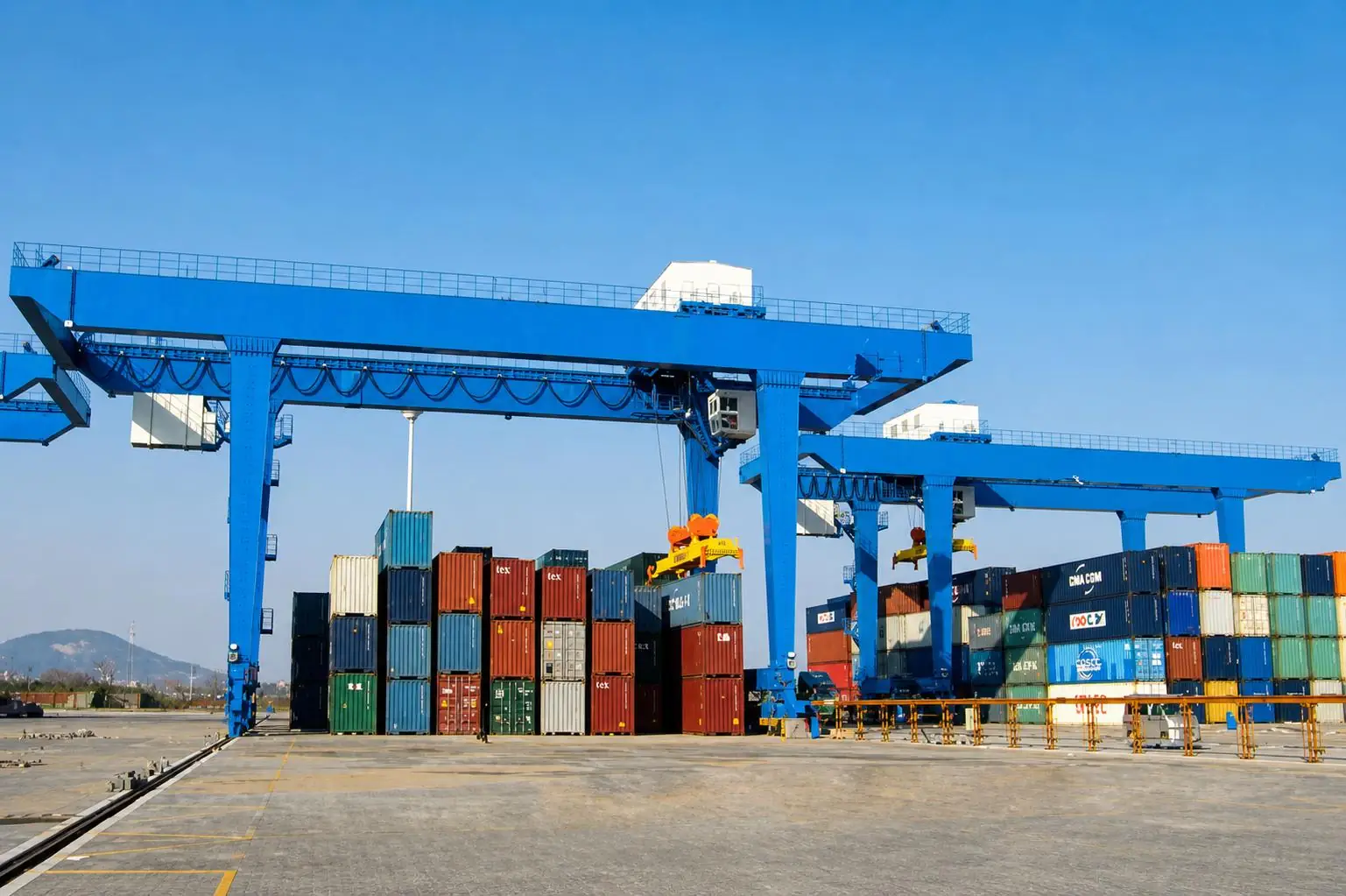
Key Advantages of Rubber-Tyred Mobile Gantry Cranes
Indoor and outdoor dual-scene universal
The equipment supports indoor and outdoor all-weather cross-border operations, which can not only meet the needs of precision equipment hoisting and bulk material transfer in workshops and warehouses, but also adapt to complex outdoor working conditions such as construction sites, road and bridge infrastructure, port depots, and prefabricated component factories, and truly realize one-machine multi-scene reuse, with outstanding environmental adaptation capabilities.
No rail infrastructure required
The equipment does not need to lay steel rails and special civil foundations, and can be quickly put into use by relying only on flat ground with up-to-standard bearing capacity, eliminating the need for high supporting investments such as traditional track laying, transformation and expansion, and regular maintenance.The overall deployment is convenient, the production speed is fast, the initial infrastructure investment is greatly streamlined, and the project landing cost is effectively controlled.
Strong heavy-duty capacity
The equipment supports heavy-duty customization from 2 tons to 100 tons, with a wide load coverage, and can easily undertake the hoisting of various large and overweight materials such as steel structures, prefabricated components, industrial molds, generator sets, containers, etc.
The whole machine has strong structural rigidity and uniform load distribution. Even if it is under heavy-duty conditions for a long time, it can maintain a stable operating state, with excellent bearing capacity and operating reliability.
High site utilization rate
The equipment can flexibly adjust the operation coverage according to the material stacking location and construction layout, eliminate the operation blind spots of fixed equipment, effectively reduce the redundant processes of secondary material handling and back-and-forth transportation, fully activate the available space of the plant and yard, and greatly improve the site utilization rate and overall operation flow efficiency.
Adapt to dynamic working conditions
The whole equipment does not need to be disassembled, and can be flexibly and quickly transitioned and shifted with the upgrading and iteration of the production line and the advancement of the construction process, and can be efficiently adapted to dynamic and changeable working conditions such as temporary engineering projects and phased construction.The equipment has wide versatility and high reuse rate, which can effectively reduce the idle loss of equipment and further improve the overall construction and production efficiency.
Easy to deploy
The equipment does not require supporting plant runways and permanent track infrastructure, and has strong compatibility with work sites, and can be directly adapted to conventional working conditions such as concrete, asphalt, and compacted hardened ground.With minimalist landing conditions, short equipment deployment cycle and low entry threshold, no large-scale civil construction investment is required, the overall investment is controllable, and the long-term economic benefits are outstanding.
Indoor Applications of Rubber-Tyred Mobile Gantry Cranes
RMG gantry cranes are suitable for various indoor industrial refinement and heavy-duty operation scenarios, and can be flexibly scheduled and used for different workshop working conditions. The core indoor applications are classified as follows:
- Intelligent manufacturing plant: mainly used for the displacement and disassembly of large-scale production molds, die-casting tooling, motors, transformers and complete sets of production equipment.It can follow the transformation of the production line and the flexible transition of process adjustment, without the need to fix the hoisting point, and adapt to the needs of flexible production.
- Mechanical assembly workshop: For the assembly process of large-scale heavy-duty equipment and machine modules, the alignment, lifting, and fine-tuning positioning of heavy-duty parts are accurately completed, so as to effectively improve the assembly accuracy and assembly efficiency, and avoid the problem of manual hoisting and alignment deviation.
- Warehousing and logistics center: It specializes in the stacking, loading, unloading, and transshipment of oversized equipment, heavy pallet goods, and industrial raw materials, to solve the pain points that ordinary forklifts cannot carry and the coverage of fixed cranes is limited, and to improve the efficiency of warehousing and circulation.
- Shipbuilding and heavy industry manufacturing workshop: suitable for cross-station transfer of large-scale welded components, hull accessories, and heavy steel structure modules, it can flexibly shuttle in the multi-process flow of the workshop to meet the needs of multi-station and multi-process continuous hoisting operations.
- Factory operation and maintenance scenarios: provide flexible heavy-duty hoisting support for the replacement, maintenance, and emergency repair of large-scale machinery and equipment, electrical mainframes, and supporting equipment in the workshop, and adapt to irregular and multi-point maintenance operations, greatly reducing the length of equipment downtime.
Outdoor Applications of RMG Cranes
RMG gantry crane is equipped with excellent outdoor environment adaptation capabilities, can adapt to open-air, multi-process, dynamic displacement construction scenarios, stable bearing capacity, flexible transition, is the core equipment for outdoor heavy-duty handling, the core outdoor applications are classified as follows:
- Construction site of construction projects: it is mainly used for the hoisting and placement of steel structure frames, precast concrete components, large-scale building materials and construction equipment.It can flexibly shift according to the advancement of construction buildings and work surfaces, adapt to the needs of multi-point and multi-regional rotation construction, and effectively improve the efficiency of on-site hoisting.
- Road, bridge and railway infrastructure engineering: focus on the lifting and shifting of bridge prefabricated beams, steel structure rods, railway subgrade modules, and large-scale engineering components.In view of the characteristics of the phased construction of road and bridge projects and the continuous advancement of the work area, the equipment can quickly transition to the new work surface and adapt to the dynamic construction rhythm.
- Ports and open-air depots: it is suitable for the loading and unloading, stacking and cross-regional transshipment of heavy cargo, bulk cargo, and container components in inland depots and small and medium-sized ports.The equipment has no track restrictions, and the operation movement line can be freely planned, greatly improving the space utilization rate of the yard and the efficiency of cargo turnover.
- Prefabricated component factory area: Responsible for the whole process of transportation of concrete prefabricated parts, building materials components, and assembled modules between the pouring area, maintenance area, stacking area, and loading area.It is suitable for high-frequency circulation operations in the factory area, and the handling path can be flexibly adjusted to ensure the continuous and efficient operation of the production line.
- Power and energy engineering projects: mainly undertake the hoisting, alignment and installation of heavy equipment such as transformers, generator sets, wind power equipment, and large industrial modules.The equipment has strong environmental adaptability, can operate stably in complex open-air working conditions, and meets the high-precision and high-safety construction requirements of energy engineering.
How to Select the Right Rubber-Tyred Mobile Gantry Crane
RMG gantry cranes are customized heavy-duty equipment, and the matching of parameters directly determines the operation safety and cost performance.The selection needs to be combined with the actual working conditions on the site to accurately match in all directions, so as to prevent insufficient parameters from affecting the operation, or excessive parameters from causing waste of resources. The seven core selection points are as follows:
- Lifting load: accurately calculate the daily routine operating load and the maximum limit load, strictly reserve the safe load margin, while taking into account the load requirements of later production line upgrades and operating conditions expansion, and ensure the long-term adaptation of equipment.
- Lifting height: Combined with the effective clearance height of the site, the dimensions of heavy-duty materials, and the distribution of obstacles on the site, the effective lifting height of the equipment is accurately determined to avoid problems such as lifting bumps and restricted lifting.
- Span and operating range: According to the overall width of the on-site operating area and the material transfer radius, match the adapted equipment span to ensure the global coverage of hoisting operations, with no operating blind spots and no travel shortcomings.
- Ground conditions: Check the flatness, hardening degree and carrying capacity of the operating ground in advance, and adapt the models to different sites such as concrete, asphalt, and compacted earthwork to eliminate safety hazards such as slippage, tilt, and settlement of equipment operations.
- Walking steering mode: Straight walking mode can be selected for regular and open work sites. According to the needs of narrow sites, irregular depots, and multi-directional transitions, priority is given to the multi-directional intelligent steering system to improve operation flexibility.
- Power supply method: Cable power supply is preferred for indoor fixed and normalized operations, which is energy-saving and stable, and convenient operation and maintenance; for outdoor conditions where there is no fixed power grid and frequent transitions are required, lithium battery, diesel hybrid and other power supply solutions can be selected to adapt to non-grid operation scenarios.
- Working condition level: Distinguish between the frequency of operations and the intensity of working conditions. Conventional models are used for intermittent and temporary heavy-duty operations. High-frequency, continuous, and high-intensity handling operations need to be equipped with heavy-duty and durable models to meet the needs of long-term stable operation.
Important Safety Features for Mobile Gantry Cranes
The RMG gantry crane has strong dynamic operation, flexible working conditions, and higher safety control requirements.The equipment relies on a full set of intelligent safety protection configuration and standardized operation system to ensure the safety of man-machine operations in two dimensions.
Full set of core security configuration
The equipment is equipped with multiple intelligent protection devices at the factory, and a full-dimensional passive protection system is built to avoid the hidden dangers of hoisting from the hardware level.:
- Load protection device: equipped with overload protection and real-time load monitoring system, it can identify dangerous working conditions such as overload and partial load in real time, and automatically limit the lifting action to eliminate the risk of overload hoisting.
- Travel limit device: integrated dual protection of lifting low limit and walking limit, accurately limit the operating boundary of the equipment, and effectively prevent equipment failures and safety accidents such as rushing to the top, offside, and collision.
- Emergency braking device: equipped with an emergency stop switch and an emergency braking system of the whole machine, it can instantly cut off the power and lock the operation of the equipment when the working conditions are abnormal, and quickly stop loss and avoid danger.
- Intelligent early warning and anti-collision device: equipped with intelligent anti-collision sensor module and sound and light alarm device, it can warn surrounding obstacles and personnel in real time throughout the operation, and remind the scene to avoid.
- Control safety device: equipped with a remote control fault self-locking function, the equipment control system automatically locks and runs when it fails, eliminating safety issues such as misoperation and uncontrolled operation.
Standardized operating specifications
Perfect hardware protection needs to be matched with standardized operating procedures, and normalized and standardized operations are the core guarantee of safe operations.:
- Pre-operation inspection: Before the equipment is turned on, it is necessary to complete all-round inspections of tire status, site flatness, braking system, limit device, control system, etc. to eliminate site hidden dangers and equipment failures.
- Standardize hoisting operations: operate in strict accordance with the rated load, eliminate illegal operations such as overload, cable-stayed crooked hoisting, and extreme speed start and stop, and smoothly complete the whole process of hoisting, transshipment, and unloading.
- Normalized safety inspection: monitor the operating status of the equipment in real time during the operation process, find abnormal noises, offsets, alarms and other abnormal conditions, immediately stop for investigation, and prohibit operations with faults.
- Licensed compliance operations: operators need to be licensed, familiar with equipment performance and emergency response processes, and strictly follow the safety regulations for lifting operations to carry out construction.
How Much Does a Rubber-Tyred Mobile Gantry Crane Cost?
RMG gantry cranes are non-standard customized heavy-duty equipment. There is no unified fixed quotation, and the total price of the equipment fluctuates according to the customized needs of working conditions.In order to facilitate procurement, accurately control the budget and rationally select the type, the core cost composition factors and professional procurement recommendations are now classified and explained.:
Core cost components
The price of equipment is determined by multiple dimensions such as fuselage configuration, function customization, and landing services. The core influencing elements are as follows:
- Basic parameter configuration: it includes three core parameters: rated lifting tonnage, gantry span, and maximum lifting height. The larger the parameter specifications, the higher the material used in the fuselage and the structural process standards, and the basic cost will increase accordingly.
- Walking steering system: it covers multi-mode walking configurations such as industrial explosion-proof tire specifications, straight/diagonal/in-place steering, and intelligent steering modules adapted to complex sites will increase equipment configuration costs accordingly.
- Power control system: it is divided into different power solutions such as cable power supply, lithium battery power supply, and hybrid power supply. It is equipped with frequency conversion speed control, intelligent control, and remote control systems. The configuration level directly affects the equipment pricing.
- Safety protection configuration: basic protection, a full set of intelligent protection, explosion-proof and dust-proof customized protection and other different safety configuration packages, the higher the protection level, the higher the equipment safety redundancy and manufacturing cost.
- Customization of special working conditions: exclusive customization for special operating environments such as high temperature, low temperature, dust, humidity, explosion-proof, etc., as well as personalized transformation of non-standard sizes and special loads, will produce a customized premium.
- Landing and after-sales supporting: including one-stop services such as equipment transportation, on-site installation, commissioning training, quality assurance services, and spare parts supporting, it is an important part of the overall procurement cost.
Chemical procurement advice
Do not single-compare bare metal quotations for procurement and selection. It is necessary to consider the overall cost performance based on the use value of the equipment throughout the life cycle.:
- Focus on the whole life cycle cost: abandon the misunderstanding of only looking at the initial purchase price, and focus on equipment energy consumption efficiency, failure rate, maintenance cost, parts versatility and service life of the whole machine to reduce long-term operating investment.
- On-demand customization and rejection of redundancy: combined with the actual working conditions of the site to match the parameters and configuration, there is no need to overly pursue ultra-high-specification configuration, avoid cost waste caused by excess functions, and take into account practicality and economy.
- Pay attention to after-sales supporting capabilities: give priority to manufacturers with perfect installation training, quality assurance and maintenance, and rapid spare parts supply system to reduce equipment downtime and ensure long-term stable operations.
RMG Crane Maintenance Checklist
Daily inspection
Focusing on daily visual inspection and functional verification, it focuses on checking the tire wear status of the equipment, the sensitivity of the braking system, the integrity of the hook and wire rope, the effectiveness of the limit switch, and the response status of the control system. Comprehensively investigate the appearance of the equipment, damage, abnormal operation and other basic hidden dangers, to ensure the safe operation of the equipment on the same day.
Regular maintenance
Carry out periodic in-depth maintenance operations to clean, lubricate, fasten and debug core components such as gearboxes, drive motors, electrical circuits, fuselage welding welds, hydraulic systems, and transmission bearings, and simultaneously verify the operating performance of various safety protection devices to prevent failures caused by component aging and performance attenuation.
Long-term overhaul
Carry out annual systematic maintenance of the whole machine, including flaw detection and testing of the overall structure of the fuselage, replacement of worn tires, calibration and debugging of a full set of electrical systems, simultaneous completion of third-party professional load testing and annual inspection of equipment safety, all-round repair of equipment loss problems, to ensure long-term stable and compliance operation of equipment.
Conclusion
With the advantages of trackless walking, flexible transition, indoor and outdoor adaptation, and heavy-duty stability, the tire-type mobile gantry crane (RMG) is suitable for a variety of material handling scenarios such as manufacturing, infrastructure, ports, and energy.Compared with fixed lifting equipment, it is more suitable for projects where working conditions change frequently and flexible scheduling is required.
When selecting the type, it should be combined with a comprehensive assessment of load, span, operating frequency, site conditions and mobile needs, and daily maintenance should be done.Henan Mine Crane can provide customized design and manufacturing services for RMG tire-type mobile gantry cranes according to actual working conditions to help customers obtain more matching lifting solutions.
This article analyzes the principle, structure, advantages, selection, safety and maintenance points of RMG in a concise manner, and provides a reference for engineering procurement and on-site application