
Overhead Crane Design for High-Temperature Industrial Environments
In heavy industrial scenarios such as steel smelting, metal casting, hot-rolled processing, and molten metal transportation, equipment has long been in extreme working conditions of high temperature radiation, hot air flow impact, and high temperature load contact.General-purpose bridge cranes are prone to structural deformation, electrical appliances, mechanical stagnation, safety failures and other failures due to structural, electrical, and protective design shortcomings, which not only greatly increase the equipment failure rate and operation and maintenance costs, but also cause major safety and production risks such as falling objects, equipment collapse, and shutdown. Production risks.Special bridge cranes for high-temperature industrial environments are customized lifting equipment adapted to extreme high-temperature working conditions. Through structural optimization, thermal insulation protection, forced cooling, intelligent monitoring, and safety redundancy design, they are perfectly adapted to the continuous operation needs of high-temperature workshops.This article will disassemble the core logic of high-temperature bridge crane design in an all-round way, and provide a professional reference for industrial enterprise equipment procurement.
Why High-Temperature Environments Require Specialized Crane Design
Conventional bridge cranes are designed for hoisting workshops and general materials at room temperature. The structural strength, lubrication system, electrical accessories, and protection level are all adapted to the conventional environment of 20℃-40℃.In the high-temperature industrial scene, there are multiple and complex working conditions such as continuous high-temperature radiation, local ultra-high-temperature shocks, large temperature differences between hot and cold, high-temperature dust and slag sputtering, and conventional equipment is completely unable to meet the needs of long-term stable operation. This is also the core reason why special cranes must be used in high-temperature working conditions.
First of all, the high temperature environment will continue to erode the core components of the crane. Ordinary steel, insulation materials, and lubricating greases will age and fail rapidly at high temperatures, resulting in a precipitous decline in the service life of the equipment. Under high temperature conditions, the service life of conventional cranes is only 1/3 or even shorter than that of special equipment.Secondly, structural deformation, electrical failure, and mechanical stagnation caused by high temperature are sudden hidden dangers that cannot be avoided through conventional operation and maintenance, and can easily cause safety production accidents.Finally, the high-temperature scenarios of heavy industry are mostly continuous assembly line operations, and the equipment downtime loss is great. The high stability and high fault tolerance of the dedicated Henan Mine Crane manufactured high-temperature crane can maximize the continuous operation of the production line and reduce the comprehensive operating costs of the enterprise.
Key Challenges in High-Temperature Overhead Crane Operation
Thermal stress and structural deformation
Under high temperature conditions, the main steel structure of the crane, such as the main beam, end beam, and trolley frame, will produce thermal expansion and contraction effects, and continuous thermal stress will break the structural force balance.General-purpose cranes do not reserve thermal expansion margin, and problems such as attenuation of the upper arch of the main beam, side bending deformation, track stagnation, and wheel gnawing will occur after long-term high-temperature operation.At the same time, local high-temperature radiation can cause uneven heating of steel structures, produce residual thermal stress, and cause hidden dangers such as weld cracking, sheet deformation, and structural fatigue damage.After long-term operation, the accuracy of the equipment decreases significantly, and the carrying capacity gradually attenuates. In severe cases, the lifting structure will fail and the hoisting accident will be caused.
Mechanical and electrical overheating
The mechanical transmission system and electrical control system are the core modules of the crane that are most susceptible to high temperature damage.At the mechanical level, conventional lubricating greases will experience viscosity failure and grease loss in environments above 60℃, which will cause dry grinding and heating of transmission components such as reducers, reels, pulleys, bearings, etc., exacerbating component wear, stagnation and even locking, greatly increasing the probability of mechanical failure.At the electrical level, precision accessories such as motors, frequency converters, contactors, cables, and sensors have limited high temperature resistance. High temperature will accelerate the aging and carbonization of the circuit insulation layer, causing leakage, short circuit, tripping and other failures.Data show that when the ambient temperature exceeds 40℃, the crane inverter needs to be used with a 15% reduction in capacity, otherwise it is prone to overcurrent shutdown and production operations will be directly interrupted.
Radiant heat and hot loads
The core hazard of high-temperature industrial scenarios is not only environmental temperature, but the direct impact of high-intensity thermal radiation and high-temperature loads.Molten metal, high-temperature steel billets, and hot-rolled workpieces in steelmaking and foundry workshops will release high-intensity infrared thermal radiation. During close-range operations, the bottom structure, lifting system, and wire rope of the Henan Mine Crane manufactured crane will continue to receive thermal radiation and heat up, and the surface temperature can exceed 80℃-120℃.At the same time, when hoisting high-temperature materials, the hot air flow rises and the slag sputtering will directly burn the wire rope, hooks, protective covers and other components, resulting in broken wire ropes, reduced annealing toughness of hooks, corrosion and damage of accessories, greatly reducing the safety of hoisting, which is the core invisible risk of high-temperature crane operations.
Essential Design Features for Heat-Resistant Overhead Cranes
Reinforced crane structures
The structural strengthening design of high-temperature resistant cranes is the basis for resisting thermal stress and deformation.The main body of the equipment abandons ordinary carbon steel materials and adopts Q345B and Q355D low-alloy high-strength and high-temperature resistant steels. These materials have low coefficient of thermal expansion, excellent thermal fatigue resistance and high temperature deformation resistance, and can be adapted to working conditions from -10℃ to 100℃ for a long time. Environment.The structural form gives priority to the use of double-beam box-type rigid structure to improve the overall stiffness and bearing stability, and suppress high temperature deformation.
At the same time, special optimization is made for the thermal expansion and contraction characteristics, special thermal expansion gaps are reserved for track installation and end beam connection positions, and elastic support structures are configured to allow the steel structure to freely expand and shrink, completely solving the problems of stagnation and deformation caused by thermal stress.The key welds adopt a multi-layer continuous welding process and do non-destructive flaw detection to improve the fatigue resistance of the structure under high temperature conditions and avoid cracking of the welds.The overall structure has been optimized by mechanical simulation, which can evenly disperse the thermal stress and lifting load to ensure the structural stability of long-term high-temperature operations.
Protected hoisting systems
The lifting system is the core protection unit of the high-temperature crane, which provides comprehensive protection against the risks of high-temperature wear, thermal radiation burning, and slag sputtering.The steel wire rope adopts special high-temperature-resistant galvanized steel wire rope, which is equipped with a high-temperature-resistant and wear-resistant sheath to eliminate the problem of high-temperature oxidation and broken wire by thermal radiation.The hook assembly is made of integral forged high-temperature-resistant alloy steel, which is annealed to avoid toughness loss and brittleness fracture at high temperatures, and is equipped with a fully enclosed protective cover to block slag sputtering damage.
Reducer, reel, pulley and other transmission components are equipped with special high-temperature greases with temperature resistance ≥200℃ to eliminate the failure of high-temperature greases and ensure the smooth operation of the transmission system.The lifting motor adopts a special high-temperature-resistant motor for metallurgy, with built-in high-temperature-resistant insulated windings, which are suitable for continuous high-temperature operation to prevent the motor from overheating and burning down.The complete lifting system adopts a closed protective structure, which can effectively isolate the erosion of high-temperature dust, hot air, and molten waste residue, and greatly improve the service life of the core components.
Thermal shielding and insulation
Thermal insulation shielding and thermal insulation design are the key means to block high temperature conduction and protect the core components of equipment.The bottom of the main beam of the Henan Mine Crane manufactured crane and the bottom of the trolley frame are fully covered with a high-temperature thermal insulation layer. The double-layer structure of rock wool thermal insulation substrate and high-temperature protective steel plate can effectively block the thermal radiation conduction of the high-temperature materials below, and avoid the continuous heat accumulation and heating of the main beam structure.
Electrical units such as electrical control cabinets, frequency converters, junction boxes, etc. are individually equipped with independent thermal insulation boxes. Thermal insulation cotton is installed inside the box, and the outside is equipped with high temperature protection to isolate environmental thermal radiation and hot air impact.The operator's cab adopts a double-layer heat insulation and sealing structure to isolate the external high temperature, and is equipped with ventilation and cooling equipment to ensure a comfortable operating environment for the operator.At the same time, all exposed lines and joints are wrapped in high-temperature-resistant insulating sleeves to block high-temperature erosion in all directions and protect the stable operation of the electrical system.
Cooling and Safety Systems for High-Temperature Cranes
Cooling solutions
In view of the problem of heat accumulation in high-temperature working conditions, the high-temperature crane is equipped with a hierarchical forced cooling scheme, which matches different cooling modes according to the harshness of the working conditions.Conventional high-temperature workshops adopt a forced air-cooling system, and install axial fans and cooling ducts in the core parts of the heating such as motors, reducers, and electrical control cabinets to actively accelerate air circulation and quickly take away the heat from the operation of the equipment to avoid excessive heat accumulation of components. Temperature.
Circulating water cooling systems are used in extreme high temperature scenarios such as steelmaking and casting. The core electrical and transmission components are equipped with closed water-cooled circulating pipelines, and the circulating cooling water continues to cool down, which can stabilize the temperature of the core components in a safe range.At the same time, the cab and electrical room are equipped with industrial air conditioning and fresh air systems, which can not only cool down the equipment, but also improve the working environment of the personnel.All cooling systems are equipped with independent protective structures, which are high temperature resistant, dust-proof, and anti-clogging. They are adapted to the harsh working conditions of heavy industry to ensure the continuous and stable operation of the cooling system for 24 hours.
Temperature monitoring
The intelligent temperature monitoring system is the core of early warning for the safe operation of high-temperature cranes, and realizes full-point and real-time temperature control.The equipment is equipped with high-precision temperature sensors in key locations such as motor windings, reducer bodies, electrical control cabinets, main beam steel structures, and lifting reels. The temperature data of the equipment is collected in real time 24 hours a day, and the data is transmitted synchronously to the cab console and the background intelligent system.
The system presets a multi-level temperature threshold, and when the temperature of the component is close to the warning value, an acoustic and optical warning is automatically triggered to remind the operator to check and cool down in time.When the temperature exceeds the standard, the system automatically starts overload protection, power-down operation, and emergency shutdown under extreme circumstances to prevent high temperature burning and failure out of control.At the same time, it supports temperature data storage, traceability and curve analysis, which can help enterprises grasp the high-temperature operating status of equipment, predict the aging of components and hidden dangers of failure in advance, and realize preventive operation and maintenance.
Operator and lifting safety
Safety protection under high temperature working conditions takes into account equipment safety, hoisting safety and personnel safety, and builds an all-round safety protection system.At the lifting safety level, the equipment is equipped with multiple overload protection, lifting height limit, operating limit, and anti-fall locking device as standard to prevent overloading, topping, and falling hook accidents caused by the failure of high-temperature components.For the molten metal hoisting scene, a dual braking system and an emergency locking device have been added to improve fault tolerance in extreme working conditions.
At the level of personnel safety, Henan Mine Crane manufactured bridge cranes are equipped with heat-insulating and sealed cabs to isolate high temperature and dust, and with cooling and ventilation equipment to avoid high-temperature fatigue and lag in response of operators.Some extreme scenarios support remote control, realize man-machine separation operations, and completely avoid the damage caused by high-temperature radiation and slag sputtering to personnel.At the same time, the equipment is equipped with high-temperature emergency heat dissipation, automatic fault alarm, and emergency power-off system. Once an abnormality occurs, it can be quickly dealt with to minimize the risk of safety accidents and ensure continuous safe production under high-temperature working conditions.
Designing Cranes for Steel Mills, Foundries, and Molten Metal Handling
Ladle and casting cranes
Ladle and casting cranes are special high-temperature equipment for the core of steel mills and foundries. They are mainly responsible for the transportation and pouring of molten molten steel and molten iron. The working conditions are extremely high and the safety level is demanding.This type of crane adopts a double-beam or four-beam structure with super-stiffness, with strong overall carrying capacity and high stability, and a working level of up to A7-A8, which is suitable for 24-hour continuous heavy-duty operations.The thermal protection design of the equipment is strengthened in all directions, the main beam and the trolley frame are fully covered with a thickened thermal insulation layer, and the lifting system adopts a redundant design of dual independent braking, double reel and double wire rope to prevent the failure of a single component from causing the ladle to fall.The electrical system is equipped with a water-cooled cooling device and an explosion-proof thermal insulation structure, which can resist high-intensity thermal radiation from molten metal at close range.At the same time, it is equipped with high-precision weighing monitoring, attitude monitoring, and temperature early warning systems to accurately control the pouring and transportation accuracy to ensure the absolute safety of molten metal hoisting.
Charging and furnace cranes
Feeding and furnace cranes mainly serve the material supply, furnace physical examination and repair, and slag cleaning operations of blast furnaces and smelting furnaces. They face high temperature heat waves, open flame radiation and dust erosion at the furnace mouth for a long time.The equipment adopts high-temperature and high-strength steel structure, focusing on strengthening the side thermal protection of the furnace mouth, and installing a detachable high-strength thermal insulation protective plate, which can resist the instantaneous ultra-high temperature impact of the furnace mouth.The lifting and operating mechanism adopts impact-resistant and high-temperature-resistant customized accessories, which are adapted to the operating mode of frequent start-stop and heavy-duty impact. The lubrication system adopts long-lasting high-temperature-resistant grease to reduce the frequency of high-frequency operation and maintenance.The electrical system should be protected from dust, heat insulation and waterproofing to avoid short circuits caused by high-temperature dust and hot air at the furnace mouth.The equipment is equipped with a large-stroke operating range and a precise positioning control system, which can quickly complete the furnace body feeding, material alignment, and waste cleaning operations, and adapt to the high-intensity production rhythm of the smelting workshop.
Billet, slab, and hot material cranes
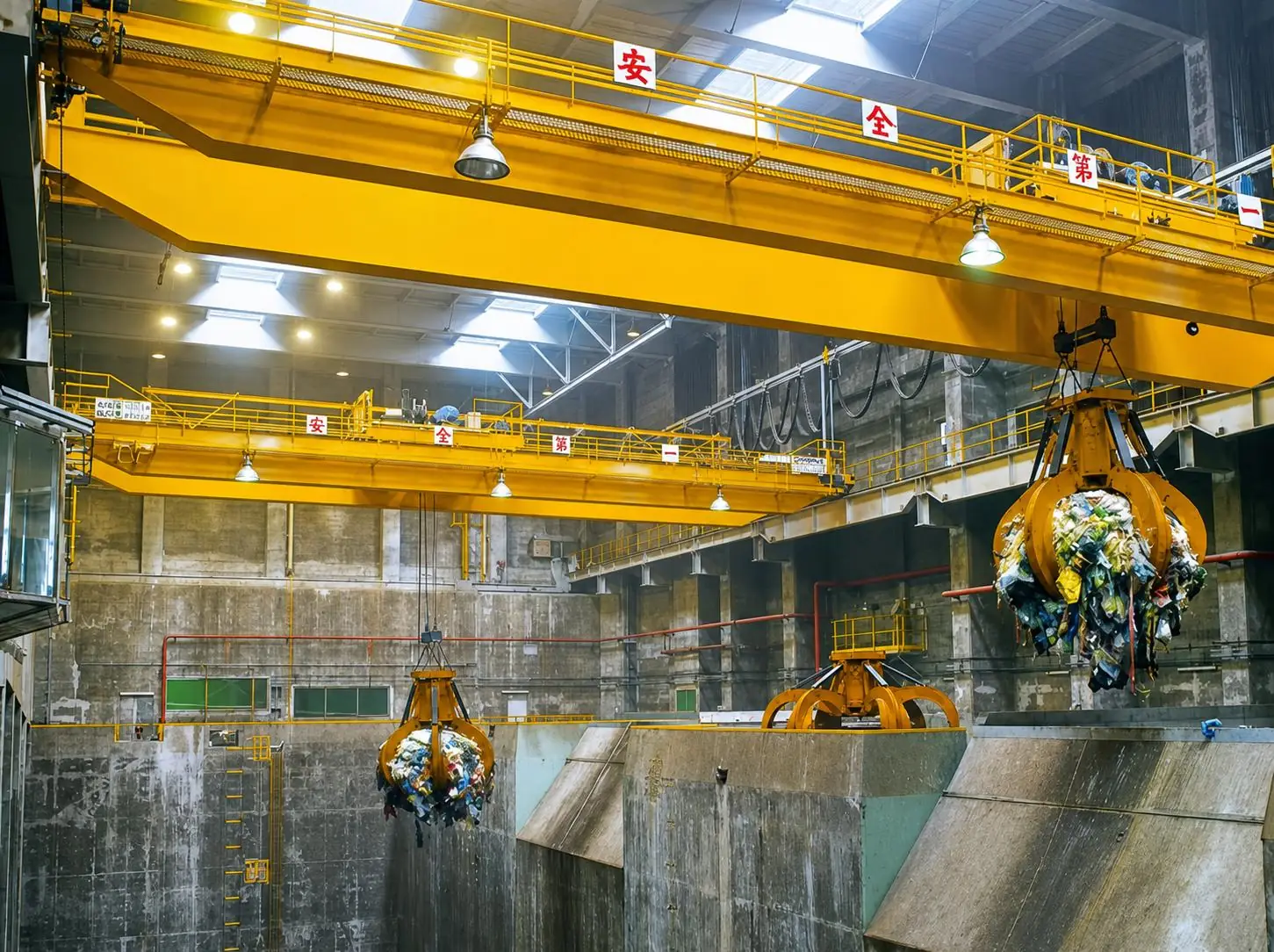
Steel billet, steel plate, and high-temperature material cranes are mainly used in hot-rolling workshops and steel forming workshops to lift high-temperature steel billet, sheet, and profile at 600℃-1200℃ to deal with the risk of continuous thermal radiation and contact with high-temperature materials.The equipment structure is both lightweight and rigid, and adopts an optimized box-type main beam structure, which has excellent thermal deformation and fatigue resistance, and is not easy to deform and deviate during long-term operation.In view of the hoisting characteristics of high-temperature materials, the equipment is equipped with special high-temperature-resistant spreaders and heat insulation fixtures to prevent the annealing failure of components caused by direct contact with the spreader of high-temperature materials.The bottom of the fuselage is fully covered with a thermal insulation shielding layer to isolate the heat accumulated by the thermal radiation of the material, and the transmission and electrical systems are equipped with a forced air cooling system to quickly dissipate the heat of the operation.The operation of the equipment is extremely stable, which can avoid the shaking and collision of high-temperature materials, adapt to the continuous hoisting operation of the assembly line, and greatly improve the production efficiency of the hot-rolling workshop.
How to Select and Customize a High-Temperature Overhead Crane
Assess the working environment
For the selection and customization of high-temperature bridge cranes, the first step is to comprehensively survey and evaluate the operating conditions.It is necessary to accurately collect the core parameters of the normal temperature, extreme high temperature, thermal radiation distance, and operating time of the workshop, and distinguish between the three types of working conditions: air high temperature, radiation high temperature, and material contact high temperature.At the same time, investigate additional risks such as slag sputtering, high temperature dust, and corrosive gases, and verify spatial parameters such as plant span and lifting height.Scientific environmental assessment can accurately match equipment protection and design levels, avoid insufficient protection or excessive redundancy, and balance equipment practicality and procurement cost performance.
Define crane requirements
Relying on the measured working condition parameters, the core customization requirements of high-temperature cranes can be accurately clarified.Basic parameters such as rated lifting weight, operating span, and lifting height need to be determined first. For high-temperature and heavy-duty scenarios, the special working level for A5-A8 metallurgy is preferred.Then according to the intermittent, 24-hour continuous, high-frequency start-stop and other operating modes, match the adapted motor, transmission and cooling system.At the same time, safety functions such as dual braking, precise speed regulation, remote control, and fault early warning are configured on demand, and the intelligent configuration of the equipment is determined based on the operation and maintenance requirements, so that the equipment can be fully adapted to the production line operating standards.
Build a complete protection strategy
For high-temperature working conditions, a layered integrated protection system needs to be built to ensure the stable operation of the crane in all directions.At the basic level, thermal deformation and fatigue damage of the structure are avoided through high-temperature-resistant materials, structural optimization, and reserved thermal expansion margin.The middle layer relies on thermal insulation and shielding, and closed accessories to protect it from high temperature erosion and physical damage.The core scene matches the air-cooled and water-cooled cooling system as needed to maintain the constant temperature of the core components.It is equipped with a global temperature monitoring and intelligent early warning protection system to achieve preventive protection, and a dedicated maintenance plan to effectively extend the service life of the equipment and ensure safe production under high temperature conditions.
Henan Mine Crane Factory Custom
The core of the design and selection of bridge cranes in high-temperature industrial environments is to revolve around the three core points of high-temperature deformation resistance of the structure, high-temperature failure resistance of the components, and global safety protection, and to make customized optimizations for different subdivided high-temperature working conditions.Unlike general-purpose cranes, every structure, protection, cooling, and intelligent design of Henan Mine Crane Factory cranes is designed to solve various operating pain points under extreme working conditions.In the process of equipment procurement and transformation, enterprises should not apply general equipment standards. They need to customize the exclusive crane plan of Henan Mine Crane Factory in accordance with their own workshop conditions and operating requirements to avoid high-temperature failures and safety risks from the source, reduce long-term operation and maintenance costs, and maximize the production value of high-temperature lifting equipment.