
Steel Mill Crane Solutions: Choosing The Right Equipment For Heavy Manufacturing
Cranes are the core equipment of the whole process of steel manufacturing, and their selection directly determines the efficiency of the production line, operation and maintenance costs, and operation safety.Steel mills have extreme working conditions such as high temperature radiation, high dust, high frequency continuous operation, and heavy irregular loads. The structural performance, safety configuration and working condition level requirements of cranes far exceed ordinary industrial equipment.
Most steel mill equipment failures, production shutdowns and safety hazards are due to the mismatch between crane selection and actual working conditions.This article systematically combs the application scenarios, equipment selection, core parameters, safety configuration and common misunderstandings of steel mill cranes, and provides professional landing selection solutions for steel companies.
Why Crane Selection Is Critical in Steel Mill Operations
Steel production is a continuous, high-intensity, and high-risk heavy-duty manufacturing process. As the core equipment for material transfer and process matching, cranes are adapted to extremely harsh operating environments throughout the process, and the fault tolerance rate of selection is extremely low.Every selection deviation will be directly transmitted to the production, cost and safety levels. The difficulties of specific working conditions and the consequences of selection errors are as follows:
Harsh operating conditions
- Heavy-duty and irregular loads: steel mill hoisting loads cover 100-ton steel ladles, heavy steel billets, steel coils, bulk scrap steel, etc. The load has a large weight span, an irregular center of gravity, and irregular shape. The structural stability and load adaptability requirements of the crane far exceed ordinary lifting equipment.
- High-frequency continuous operation mode: The steel production line runs without interruption, and the crane needs to operate continuously in multiple shifts. The frequency of start-stop, lifting, and translation cycles is extremely high. It is under full load conditions for a long time, which is a great test for the wear-resistant, fatigue-resistant, and continuous operation capabilities of the equipment.
- High-temperature radiation operation area: There is high-intensity thermal radiation in steelmaking furnaces, continuous casters, and molten steel transfer areas. The ambient temperature can reach 50-80℃. High temperature will accelerate the failure of lubricating oil, the aging of electrical insulation, and the deformation of structural parts. Ordinary cranes are prone to failure.
- Multi-impurity, strong corrosion and harsh environment: the factory area is filled with metallurgical dust, iron oxide, and steam all year round. With high-frequency vibration of production equipment, it is easy to invade the core components of the equipment, causing wear, caton, and corrosion of parts, greatly reducing the service life of the equipment.
Problems caused by improper selection
- Loss of production downtime: Steel production is a continuous process, and crane failure will directly cause the entire production line to stagnate, causing problems such as scrap of molten steel, interruption of the casting process, and damage to the lining of the furnace body, resulting in huge production capacity losses.
- Early aging and loss of parts and components: Cranes with small selection and mismatched working conditions will be overloaded for a long time, which will cause rapid wear of core components such as motors, brakes, wire ropes, and gears, far exceeding the normal loss rate.
- Operation and maintenance costs continue to rise: frequent equipment failures will break the rhythm of planned maintenance, and enterprises need to continue to invest a lot of manpower and funds for parts replacement and emergency maintenance, greatly increasing the cost of equipment throughout the life cycle.
- Major safety operation risks: Molten steel and heavy steel hoisting are high-risk operations. Brake failure, structural deformation, and load overload caused by improper selection can easily cause major safety accidents such as material fall and equipment collapse, threatening the safety of personnel and the plant.
Common Crane Applications in Steel Mills
The hoisting requirements, working conditions, environment, and accuracy requirements of each process of steel production vary greatly, and dedicated crane equipment needs to be matched in a targeted manner in order to achieve efficient and safe operation.The following are the crane application scenarios and adaptation equipment for the four core production links of steel mills:
Raw material treatment
The raw material yard is the first process of steel mill production. It is mainly responsible for the loading, unloading, stacking, and loading of bulk raw materials such as scrap steel, iron ore, coke, and limestone.This kind of material is loose, irregular in shape, and has a large volume span. It cannot be hoisted by conventional spreaders, and special gripping equipment is required.
Core operations: scrap steel sorting and transshipment, ore and other bulk material handling, charge filling and loading, the overall operation is characterized by high-frequency circulation, large-volume transshipment, and no precise positioning requirements.
Suitable equipment: grab crane, general purpose bridge crane, special material hoisting crane, can be used with hydraulic, mechanical grab or electromagnetic suction cup, suitable for efficient transportation of various bulk raw materials.
Steelmaking and furnace body operations
The furnace area is the core area with the highest temperature and the greatest risk in steel mills. The crane is close to the electric arc furnace, converter furnace, and ladle furnace operation, facing the risk of high-temperature thermal radiation and molten steel splashing, and the heat resistance, safety, and stability of the equipment are extremely stringent. Requirements.
Core operations: furnace body raw material filling, high temperature molten steel transfer above 1500℃, ladle handling, molten steel pouring and transfer, the fault tolerance rate of the operation is zero, and any equipment out of control is prohibited.
The core requirements of the equipment: standard heat-resistant structure, thermal insulation protective layer, redundant safety braking system, and high-temperature protection treatment of electrical components to eliminate the risk of high-temperature failure.
Casting and continuous casting
The continuous casting process determines the forming quality of billet and ingot. The crane mainly serves the transfer of ladle and tundish, as well as the transfer of hot and cold billet and slab. The core requirements have shifted from “heavy-duty and heat-resistant” to “precise positioning + stable operation”.
Core operations: The fully loaded ladle is transferred to the continuous casting rotary table, the tundish is installed and preheated, and the cast billet/slab is transferred to the cooling zone and rolling zone.
The core requirements of the equipment: ultra-high positioning accuracy, smooth start and stop without jitter, avoid offset of molten steel pouring, misalignment of billet, and eliminate production defects and equipment collisions.
Rolling and finished product processing
The rolling and finished product section is responsible for the finishing of steel, producing finished products such as steel coils, steel plates, shaped steel, steel rods, etc. The core requirements of hoisting are high-speed circular operation, stable and non-destructive transportation, and ensuring the appearance quality of finished products.
Core operations: horizontal/vertical transfer of various steel coils, handling of finished steel plates, steel beams, and steel rods, and high-frequency flow of finished materials, it is necessary to avoid deformation and surface scratches of finished products.
Suitable for spreaders: C-hook, special steel coil grab, electromagnetic spreader, with high-speed and stable lifting equipment, suitable for the high-frequency operation rhythm of the assembly line.
Choosing the Right Steel Mill Crane Type
In view of the differentiated needs of different processes in steel mills, the industry has formed six major special lifting equipment systems. Each equipment has its own design advantages and adaptation scenarios, which accurately match all kinds of heavy lifting needs.
Heavy bridge crane
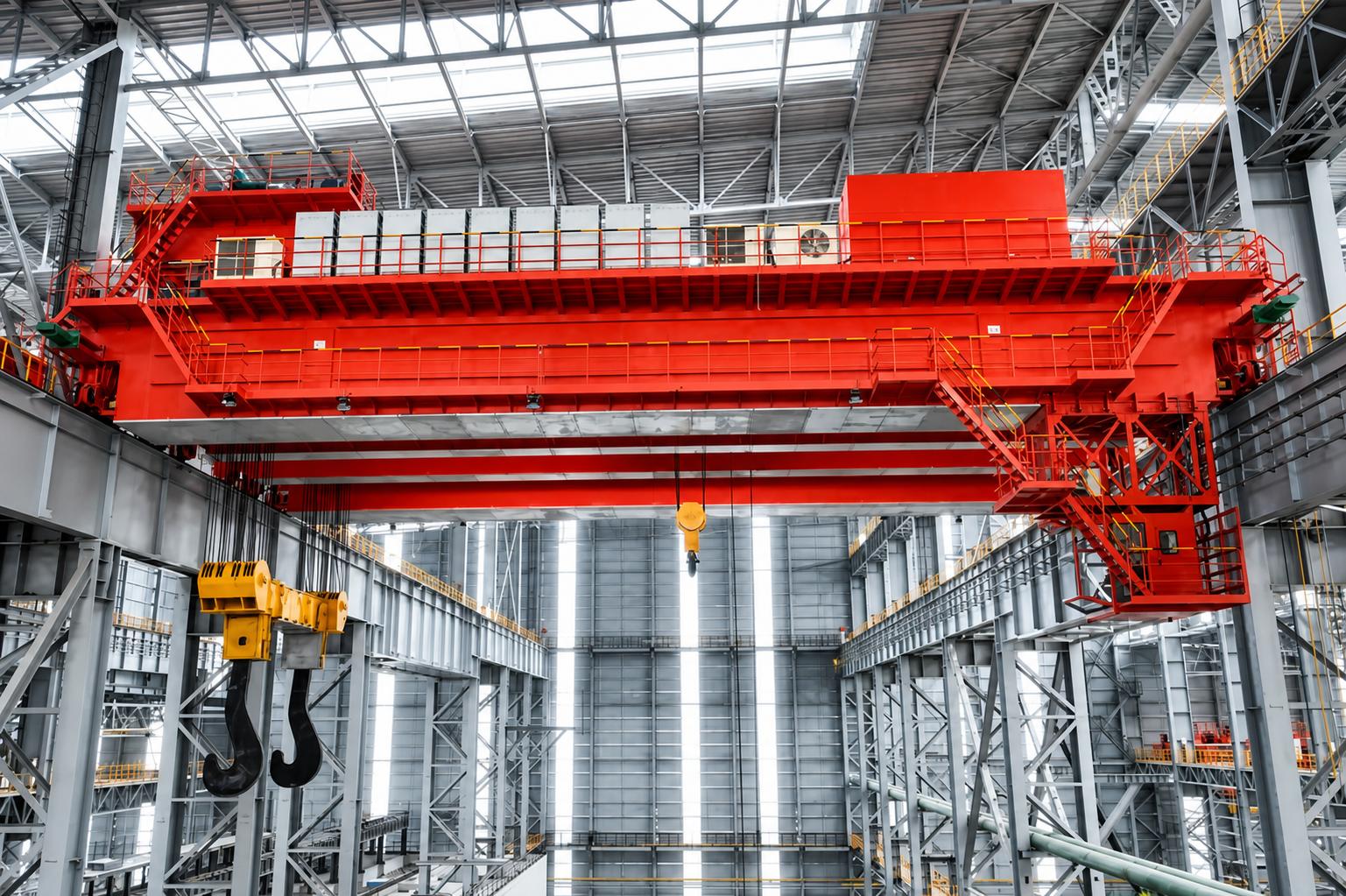
As the main general-purpose equipment of steel mills, heavy-duty bridge cranes are suitable for most heavy-duty general-purpose hoisting scenarios in the factory area, covering the whole process of auxiliary transportation of raw materials, finished products, and workshops, and are extremely versatile and adaptable.
Core advantages: wide load coverage, stable operation, adaptability to a variety of spreaders, strong adaptability to working conditions, can meet the needs of heavy-duty manufacturing normalization hoisting.
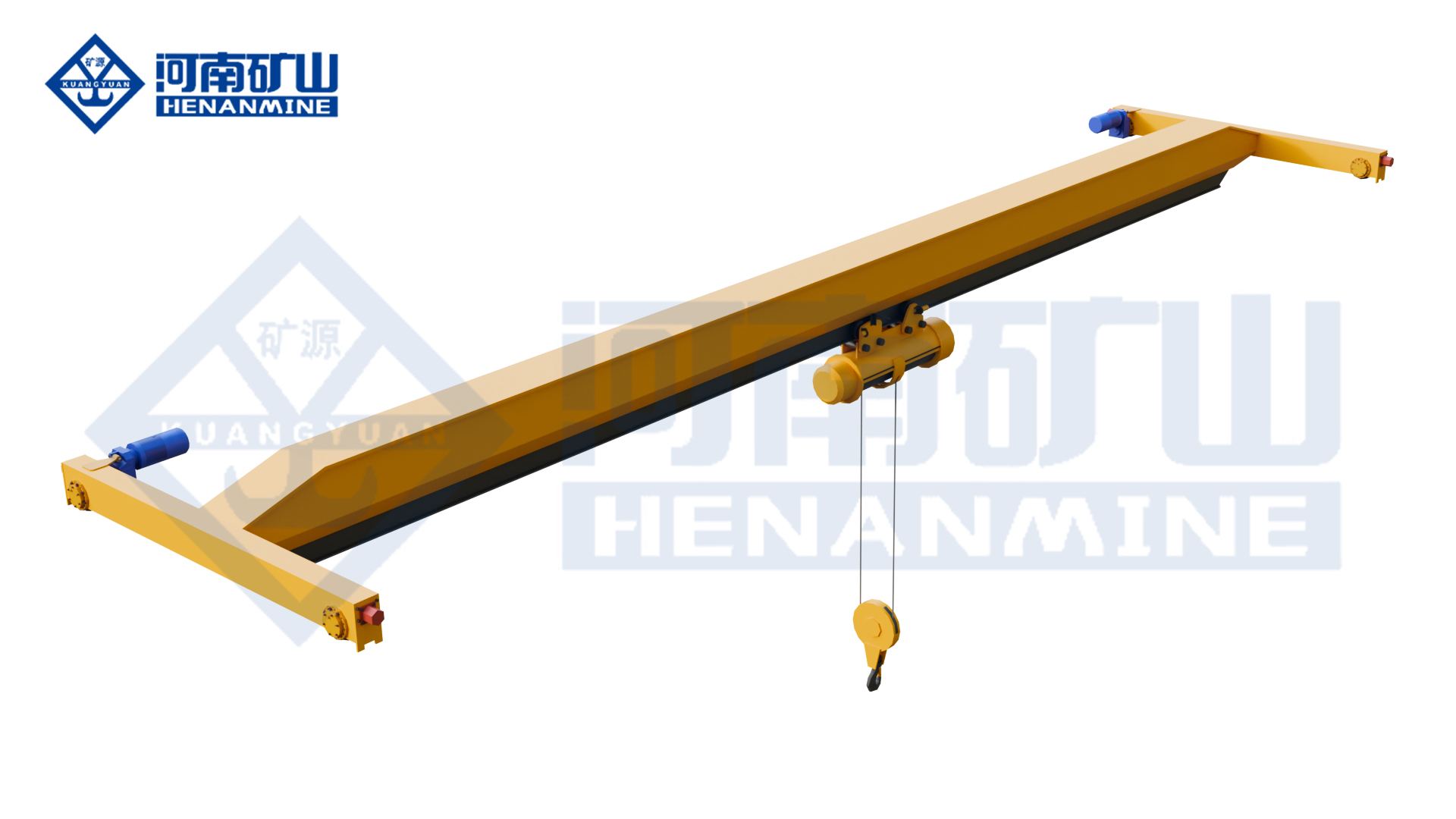
Structure selection: Double-girder bridge cranes are preferred for the core production processes of steel mills. They have stronger structural rigidity, higher carrying stability, and larger hook stroke. They can be equipped with large-scale hoist equipment and safety protection devices; single-girder cranes are only suitable for light auxiliary operations in the workshop, not for heavy-duty conditions on the main production line.
Ladle crane
The special core equipment with the highest safety level in steel mills is specially designed for the transfer of high-temperature molten steel. It is an indispensable special crane for high-risk operations in the steelmaking section and belongs to the first-class safety-level lifting equipment.
Core configuration and advantages: equipped with a 100-ton super-large load design, standard dual independent lifting mechanisms and multiple redundant braking systems, a single system failure can independently carry a full load of molten steel; the whole machine is equipped with thermal insulation protection, cab thermal insulation shielding, high temperature resistant electrical components, all-round resistance to high temperature damage, to ensure the safety of operations under extreme working conditions.
Feeding crane
Focusing on the filling of raw materials in steelmaking furnaces, it is suitable for high temperature, high dust, and high frequency operating conditions in the furnace area. It is the key equipment for connecting raw materials and steelmaking processes.
Core advantages: high positioning accuracy, can accurately complete the alignment and filling of the furnace mouth; strong impact resistance of the structure, can withstand the dynamic impact of hopper loading and unloading; the whole sealing protection is in place, high temperature resistance, dust resistance, suitable for the harsh environment of the furnace area, high-frequency cycle operation without pressure.
Special crane for slab/billet
It is specially designed for the transfer of hot and cold steel billets and thick plates, and is suitable for the transfer of materials in the continuous casting and rolling sections. It can be equipped with exclusive spreaders according to the material temperature and shape.
Core configuration: it can be equipped with special spreaders such as electromagnetic suction cups and mechanical clamps, which are suitable for the transfer of steel billets at room temperature and high temperature; it has accurate positioning and stable operation, and can be accurately connected to heating furnaces and rolling equipment to ensure the continuous operation of the production line and avoid material offset and caton.
Special crane for steel coil
Specially designed for the circular structure of steel coils, easy to deform, and afraid of scratches, the core guarantees the appearance quality and structural integrity of finished steel coils, and is widely used in cold-rolled and hot-rolled finished product workshops.
Core configuration: suitable for three types of spreaders: C-hook, steel coil special grab, and lifting magnet, and supports two types of steel coil transfer modes: horizontal and vertical; the control system starts and stops softly and runs smoothly, which can effectively disperse the load and eliminate quality problems such as steel coil collapse, surface wear, and deformation.
Bulk material grab crane
The exclusive equipment of the raw material yard focuses on the loading, unloading and stacking of loose materials such as scrap steel, ore, slag, coke, etc., to solve the problem that bulk materials cannot be hoisted routinely.
Core selection points: the capacity of the grab needs to be matched according to the material density and accumulation volume to avoid overload or inefficient operation; it is divided into hydraulic grab and mechanical grab. The hydraulic grab has accurate opening and closing, stable clamping force, and is suitable for refined material transfer; the mechanical grab has a simple structure, low operation and maintenance costs, and is suitable for extensive bulk material operations.
Key Specifications to Evaluate Before Buying
After the equipment type is determined, the parameter selection is the key to ensure that the equipment is adapted to working conditions and long-term stable operation.It is necessary to combine the layout of the factory area, production rhythm, and working conditions to verify the five core parameters one by one to eliminate the problem of parameter mismatch.
Rated lifting weight
It is necessary to strictly distinguish between the rated load and the actual working condition load. The rated lifting weight of the equipment must reserve sufficient margin, which not only includes the weight of the material, but also includes the weight of the spreader and tooling.At the same time, consider the dynamic impact load in the hoisting process to avoid instantaneous overload damage to the equipment.In addition, the margin for capacity upgrade needs to be reserved to meet the needs of future capacity expansion.
Span and lifting height
The crane span needs to accurately match the track spacing of the plant to eliminate structural adaptation problems caused by dimensional deviations.The lifting height, headroom size, and hook stroke need to be combined with the comprehensive accounting of plant floor height, equipment layout, and material transfer height to eliminate blind spots and dead ends in hoisting and ensure barrier-free operations in the entire area.
Work level and operating conditions
The working level is the core index of crane selection in steel mills. According to ISO 4301 and FEM industry standards, the main production line cranes of steel mills need to be adapted to A6-A8 heavy-duty working conditions, corresponding to high-frequency start-stop and full-load cycle operating modes.
All core components such as motors, brakes, gears, steel structures, etc. must match the corresponding working condition level. It is strictly forbidden to replace high-level equipment with low-level equipment to avoid equipment fatigue and failure.
Running and lifting speed
Balancing production efficiency and positioning accuracy is the core of speed selection.High-speed operation can improve the efficiency of material transfer, and low-speed fretting can ensure accurate alignment and smooth blanking.At present, the industry comes standard with a VFD frequency conversion speed control system, which can realize flexible start-stop and stepless variable speed, greatly reduce mechanical impact and extend the service life of equipment, while meeting the dual needs of high-speed transportation and precise positioning.
Temperature and environmental adaptability
For high-temperature and high-dust working conditions in steel mills, electrical components need to be equipped with high-temperature insulation configuration of grade F and above, and the protection level of the electric control cabinet is not lower than IP54, and it is equipped with dust-proof, heat-insulating and heat-dissipating devices.Equipment in high-temperature areas needs to be equipped with thermal insulation shields, high-temperature steel wire ropes, and special high-temperature greases to prevent equipment failures caused by dust erosion and high-temperature aging.
Essential Safety Features for Steel Mill Cranes
Steel mill lifting operations are high-risk industrial operations, and safety configuration is the bottom line guarantee for equipment operation. All main production line cranes must be equipped with multiple protection systems to eliminate safety hazards.
- Redundant dual braking system: For high-risk working conditions such as molten steel hoisting, the equipment is equipped with an independent dual braking mechanism as standard.When a single set of braking devices fails, the backup system can instantly lock the load, effectively prevent vicious safety accidents such as molten steel falling, and build a solid safety bottom line for high-risk operations.
- Intelligent overload protection device: equipped with a real-time load monitoring module, it dynamically collects hoisting load data. Once the overload threshold is triggered, the system automatically alarms and locks the equipment action to eliminate hidden dangers of overload operations from the source and protect the equipment structure and operation safety.
- Full-stroke limit switch: precise limit control of the operating stroke of lifting, cart, and trolley, to avoid equipment over-range operation, track derailment, and structural collision problems, and to ensure the stable operation of the crane in a safe zone.
- Multi-point emergency stop system: Multi-point emergency stop switches are configured in the cab, equipment fuselage, and remote console. In case of sudden failure or abnormal working conditions, all power can be cut off with one key, and it can be stopped quickly to avoid risks and minimize accident losses.
- Intelligent anti-collision system: adapted to multi-machine common rail operation scenarios, real-time identification of equipment spacing through sensing equipment, automatic early warning, intelligent deceleration, effectively avoid the risk of collision between multiple cranes, and ensure the safety of multi-equipment collaborative operation.
- Real-time load monitoring system: dynamic display of hoisting weight and equipment operating parameters throughout the process, allowing operators to grasp the operating conditions in real time, realize standardized and refined hoisting operations, and avoid human operation errors.
- Fault self-locking safety control system: It has the functions of voltage loss and fault self-locking. When the equipment is powered off or the system is abnormal, all operating actions are automatically locked, and the suspension load is stabilized to prevent the load from getting out of control, falling and other safety hazards, and realize the protection of the bottom of the fault pocket.
- Thermal insulation protection and remote control system: The high-temperature section is equipped with a closed thermal insulation cab, and at the same time supports a remote unmanned control mode, allowing operators to stay away from high temperature, dust, and high-risk operating areas, and improve the overall operating safety from the human-machine operation level.
Common Crane Selection Mistakes to Avoid
The misconceptions about crane selection in steel mills are mostly concentrated in the one-sided pursuit of low prices and ignoring the adaptation of working conditions. Short-term savings will cause long-term high-cost and high-risk problems. The eight high-frequency misunderstandings need to be avoided.:
- Only the misunderstanding of tonnage selection: Many companies only select the type based on the rated lifting weight, ignoring key parameters such as working condition level, high temperature resistance, and operating speed, resulting in equipment that does not match the actual production conditions and cannot be adapted to the continuous and high-intensity operation needs of steel mills.
- Underestimating the operating condition level: blindly selecting low-level cranes to deal with high-frequency start-stop and full-load cycle operations in steel mills, long-term overload and fatigue operation of equipment, it is prone to premature aging of parts, frequent failures, and significant shortening of equipment service life.
- Ignoring the adaptability of high-temperature working conditions: putting ordinary industrial cranes into high-temperature radiation areas such as steelmaking and casting can easily cause electrical insulation aging, high-temperature grease failure, equipment structure deformation, and cause continuous equipment failure.
- Standard parts replace special accessories: the use of general standard motors, electronic control and sealing accessories under harsh working conditions of high temperature, high dust, and strong vibration cannot withstand industrial erosion and high-frequency losses, and the stability and durability of the equipment are greatly reduced.
- Insufficient safety redundancy of high-risk equipment: high-risk core equipment such as ladle cranes are not equipped with redundant braking systems, and only rely on a single braking structure to operate, and there are major safety production hazards such as runaway molten steel loads and falling.
- Ignoring the adaptability of the spreader system: After the crane selection is completed, non-standard spreaders are randomly matched, resulting in uneven lifting force and poor load stability, which is not only likely to cause damage to finished products such as steel coils and billets, but also cause safety accidents.
- No long-term capacity reservation design: the selection only meets the current production capacity, and the load, span and working condition margin are not reserved. The equipment needs to be replaced as a whole when the production line is upgraded and the production capacity is expanded in the later stage, resulting in extremely high transformation and replacement costs.
- Ignore maintenance and convenience of accessories: Ignore the difficulty of equipment maintenance and the supply system of accessories when selecting models, choose equipment with complex structure and scarce accessories, and cannot be repaired quickly after failure, resulting in long-term downtime of the production line, resulting in serious loss of production capacity.
Conclusion
The selection of steel mill cranes is a system engineering that takes into account process adaptation, working conditions and environment, safety redundancy and full life cycle costs. It is by no means a simple tonnage and size matching.Enterprises need to abandon the thinking of low-cost single-point selection and accurately match models, parameters and safety systems according to the working conditions of each process in order to adapt to the high-strength and continuous production characteristics of the steel industry.
For different working conditions such as raw material processing, steelmaking casting, and finished product rolling, Henan Mine Crane can provide customized special lifting solutions for steel mills, which are accurately adapted to complex and harsh working conditions, helping enterprises to improve production efficiency, reduce failure rates and operation and maintenance costs, and achieve safe and efficient production.