
20t Gantry Cranes: Spreader Beam Hydraulics for Long Pipe Bundles
The lifting operation of 12-18 meters long pipelines in steel pipe, oil and gas, infrastructure, ports and other industries is extremely difficult and risky.Traditional single-hook hoisting is prone to uneven load, pipe deformation, slippage and fall, which seriously affects operating efficiency and can easily cause pipe loss and safety accidents.
The 20-ton gantry crane equipped with hydraulic telescopic hoisting beams is a special and efficient equipment for hoisting long pipelines. With the advantages of precise hydraulic adjustment, multi-point balanced force, and stable and controllable hoisting, it completely solves the problem of long-span pipeline handling.
This article systematically explains the structure configuration, working principle, design points, safety specifications, application scenarios, selection standards and operation and maintenance plans of the equipment, and provides a professional reference for the selection and on-site operation and maintenance of pipeline hoisting equipment in industrial enterprises.
What Is a 20t Gantry Crane for Long Pipe Bundles
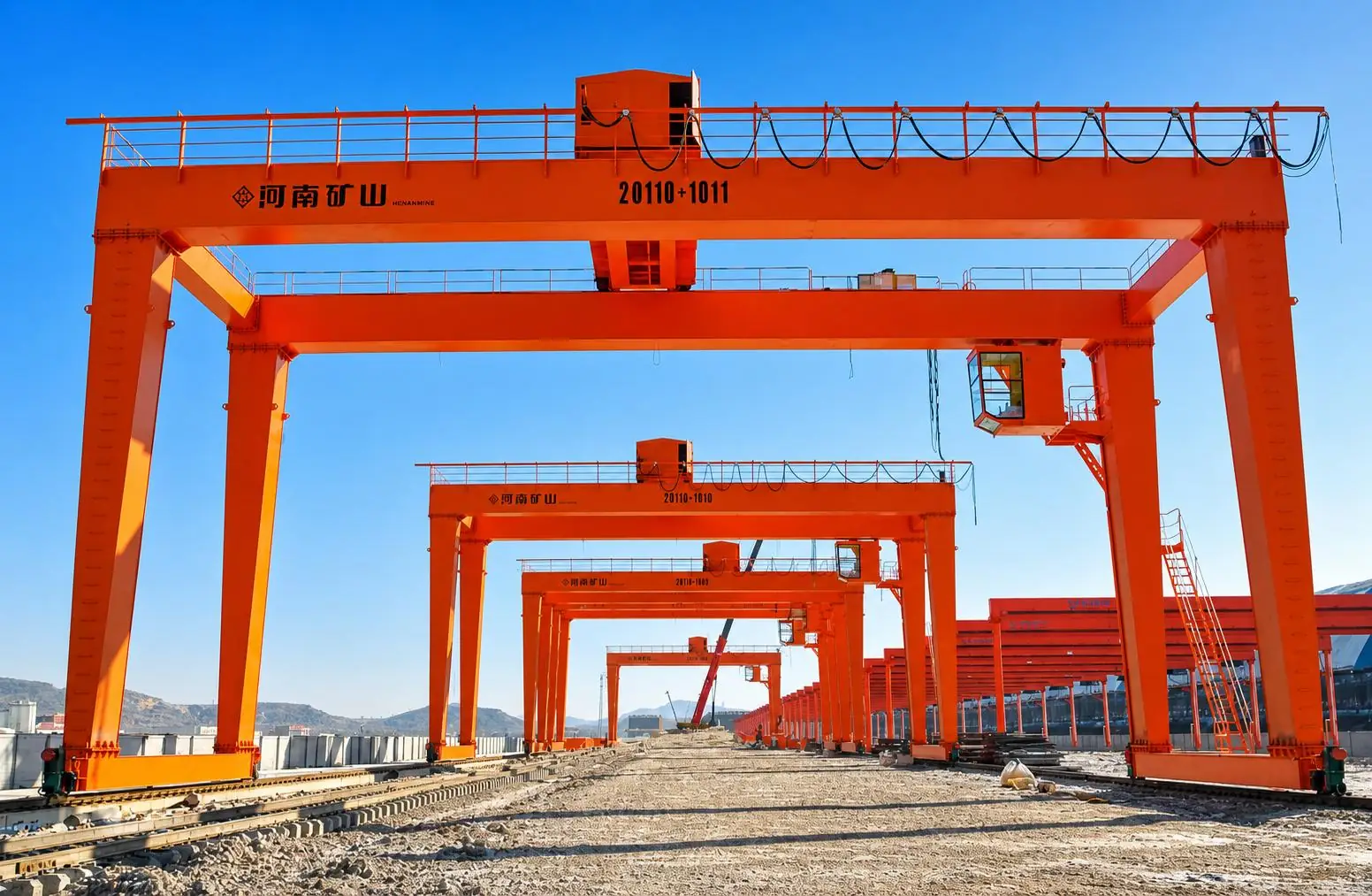
The special gantry crane for the 20-ton long pipeline is a self-supporting load-bearing structure, which does not need to rely on the support of the plant building, and is suitable for indoor and outdoor multi-scene operations. The core structural components have a clear division of labor and operate in concert to form a stable and efficient hoisting system.:
- Main beam: As the core load-bearing component, the 20-ton equipment adopts a double main beam design as a priority. It has strong bearing capacity, large lifting height and high structural stability. It can be perfectly adapted to the installation and heavy-duty operation requirements of long hanging beams and special spreaders for pipelines, and effectively resist the lateral stress caused by long loads.
- Outriggers: A double-sided vertical support structure, connecting the main beam and the end beam walking mechanism, which can evenly transmit the lifting load and equipment weight to the ground or track foundation to ensure that the whole machine operation has no offset and no overturning.
- End beam and walking system: equipped with walking wheels, driving devices and braking mechanisms, it supports multiple walking modes of orbital and wheeled, which can realize fixed-point start-stop and smooth travel of the whole machine, and is suitable for a wide range of material transfer needs in pipeline depots.
- Lifting mechanism: equipped with core components such as wire rope winches and lifting trolleys, it can be adapted to different lifting speeds and lifting heights according to operating conditions to meet the diversified operation needs of stacking pipeline bundles, vehicle loading and unloading, and precise alignment.
- Control system and safety device: it supports three modes of flashlight, wireless remote control, and cab control. It comes standard with a frequency conversion speed control system, overload protection, travel limit, emergency braking and other safety configurations to avoid hoisting risks in all directions.
The rated lifting weight of 20 tons is the golden parameter range for long pipeline hoisting. It can cover the self-weight load of most steel pipes, oil and gas pipelines, and municipal pipelines on the market. It takes into account the cost performance of the equipment and the versatility of the operation, and is suitable for the normalization of small and medium-sized heavy-duty pipeline yards and production lines.
Reasons for the abandonment of single hook hoisting for long pipes
Conventional single-hook hoisting can be used for short-length and light-weight pipes, but the structural characteristics of ultra-long pipe bundles determine that single-hook hoisting has unavoidable technical defects and cannot meet safe operating standards at all.:
- Load concentration: Single-hook single-point hoisting will concentrate the weight of the entire bundle of pipes in a small force area, and the force of the pipe at the edge of the bundle is unbalanced, which is prone to slippage, loose bundles, misalignment and other problems, resulting in pipe collision damage.
- Rod deflection: Long pipes have a large span and long torque. When there is no support at both ends of the pipe when lifting at a single point, there will be significant sagging and deflection, resulting in deformation of the overall geometry of the pipe bundle, which can cause bending and cracking of the pipe in severe cases.
- Lateral force: When a single hook is used with an oblique sling, it will produce a strong lateral extrusion force, squeezing the overall structure of the pipe bundle, destroying the arrangement structure of the pipe, and greatly increasing the risk of overturning and falling of the hoisting.
- Therefore, the hoisting of long pipeline bundles must rely on a multi-point uniform force mode, and the hoisting beam equipment is the core device to achieve multi-point balanced hoisting.
Core role and operational advantages
The hanging beam is the core supporting tooling of the gantry crane, and it is also the key equipment for the safe hoisting of long pipeline bundles. It can completely subvert the force defects of single-hook hoisting. The core value is reflected in four aspects.:
- Dispersed hoisting stress: The multi-point distributed force structure is adopted, which can evenly distribute the concentrated load to the whole of the pipeline bundle, eliminate the problem of local stress concentration, effectively avoid pressure damage to the pipe, and maximize the protection of the workpiece. Intact.
- Stabilize the shape of the pipe bundle: accurately locate the lifting force point, so that the force of the whole bundle of pipes is balanced and arranged in a regular manner, effectively eliminate the problems of pipe displacement, loose baling, and misalignment during the lifting process, and ensure the integrity of the hoisting.
- Optimize the force state of the sling: open the spacing between the sling points to keep the sling in a vertical force state, greatly reduce the tilt angle of the sling, eliminate the lateral extrusion force and the lateral load, and avoid the risk of pipeline extrusion deformation.
- Improve the controllability and stability of hoisting: ensure the horizontal lifting and smooth movement of the pipeline bundle throughout the process, and the load attitude can be controlled, effectively reducing the probability of load swing and overturning, and reducing the difficulty of operation and control of operators.
How Hydraulic Spreader Beam Systems Work
Principle of hydraulic drive and expansion
The traditional fixed hanging beam has a fixed size and non-adjustable hanging point. It can only be adapted to a single-specification pipe bundle, and its versatility is extremely poor.The hydraulic hanging beam is equipped with a fully automatic hydraulic telescopic system, which does not require manual disassembly, assembly and debugging, and can be quickly adapted to pipe bundles of different lengths and diameters, and the adaptability is greatly improved.
The core of the system consists of a hydraulic power unit, a two-way hydraulic cylinder, a telescopic beam body, and a control valve body: the hydraulic power unit provides stable high-pressure hydraulic oil, controls the flow direction of hydraulic oil through the valve body, drives the cylinder to expand and expand, and drives the main body of the hanging beam to achieve stepless expansion and adjustment.
The operator can accurately adjust the total length of the hanging beam and the spacing between the hanging points through the control system, and quickly match the pipe bundles of different lengths and diameters of 9-18 meters. There is no need to manually disassemble the pin shaft and re-fix the hanging point, which greatly saves debugging time.
Load balancing hoisting principle
The most common problem with long pipe bundle hoisting is that the lifting at both ends is out of sync and the load is tilted and offset, which in turn leads to deformation of the pipe and unstable hoisting.The hydraulic hanging beam has an automatic load balancing function, which perfectly solves this pain point.
Each hydraulic cylinder of the equipment has equal force and interoperable pressure, which can automatically balance the load.When the force of the pipeline bundle is uneven, the hydraulic system compensates for the pressure difference in real time and evenly distributes the load at each lifting point to ensure the smooth horizontal lifting of the pipe, effectively avoiding partial load and pipe warping deformation.
Control method and operating characteristics
The hydraulic hoisting beam system is integrated with the main control system of the gantry crane, which is convenient to operate and accurate to control, and is suitable for industrial high-frequency operations.:
- Proportional hydraulic control: The use of proportional control valve can accurately control the expansion speed and stroke of the cylinder, realize stepless speed regulation, eliminate the expansion and contraction of the hanging beam, the caton and jitter during load lifting, and ensure the stability of the operation.
- Diversified control methods: it supports two modes of wired control of the flashlight door and wireless remote control. The operator can stay away from the load-bearing operation area and observe the posture of the pipeline throughout the process to avoid safety risks.
- Integrated collaborative control: the functions of lifting beam telescopic, load lifting, walking of the whole machine, and braking start and stop can be operated cooperatively, without switching the control system, and the whole process of hoisting can be completed with one click, and the operating efficiency is greatly improved.
Key Design Considerations for 20t Pipe-Bundle Gantry Cranes
Load adaptation design
20 tons is the rated safe working load (SWL) of the equipment. When selecting and operating, it is not only necessary to refer to the static weight of the pipeline, but also to fully consider the impact of dynamic loads.Equipment start-up acceleration, walking braking, and load swing will all produce additional dynamic impact.
Therefore, in actual operations, it is recommended that the maximum lifting weight be 20%-30% lower than the rated load, and a safety margin be reserved.At the same time, the equipment design is fully compatible with dynamic load stress, and can be normalized to cope with high-frequency start-stop and continuous transfer operations, so as to avoid structural fatigue and component damage caused by long-term heavy-duty shocks.
Hanging beam size and adjustable design
The effective span of the hanging beam must match the length of the pipe. If the hanging beam is too short and the load is concentrated in the middle of the pipe, it will still cause the pipe to flex and deform.The hydraulically adjustable hanging beam can flexibly adjust the span according to the specifications of the pipeline bundle, which is suitable for multi-size pipe operations.
Compared with fixed hanging beams, hydraulic telescopic hanging beams do not require replacement of tooling or manual transformation. They can be adapted to all types of pipeline strapping and hoisting in the factory area, greatly improving the reuse rate of equipment and reducing the cost of enterprise equipment procurement.
Hanging point layout specification
The equipment supports two-point and four-point hoisting modes, which are adapted to the needs of different working conditions: short-length and light-weight pipe bundles can be hoisted at two points, with simple structure and efficient operation; long and heavy-duty pipe bundles over 12 meters need to be hoisted at four points.
The stress is further dispersed through distributed hanging points to avoid pipe deflection and deformation to the maximum extent possible.Before operation, it is necessary to accurately calculate the position of the center of gravity of the pipeline bundle, standardize the placement of the sling, ensure that the center of gravity of the load coincides with the lifting center, and eliminate the risk of partial load hoisting.
Door machine span and lifting height
The span of the equipment needs to match the maximum stacking width of the pipeline yard to ensure that the whole machine can span the working area without interference between the hanging beam and the pipe.The lifting height needs to meet the working conditions of pipeline stacking, truck loading and unloading, and ship transshipment. The double main beam structure can provide a larger effective lifting stroke, which is suitable for high stacking and high drop hoisting scenarios, and meets the safe lifting space of ultra-long pipeline bundles.
Work area adaptation design
The walking stroke of the whole machine needs to cover the entire operating range of the yard, and the customized design is carried out in combination with on-site ground hardening and track basic forms to achieve no dead-end transfer of the yard.At the same time, it combines the indoor and outdoor operating environment and the layout of material stacking to plan the walking path, and adapts to the needs of multiple operations such as normalized batch transfer, fixed-point stacking, and loading and unloading alignment.
Why Hydraulic Spreader Beams Improve Long Pipe Handling
Compared with traditional fixed hoisting beams and single-hook hoisting methods, hydraulic telescopic hoisting beams have outstanding advantages in load balance, operating stability, adaptability to working conditions and operating safety, completely solving many shortcomings of traditional hoisting, and greatly improving overall operating efficiency and economy.
Load balancing ability
It is difficult for traditional hoisting structures to achieve uniform force at multiple points, and problems such as partial load and local overload can easily occur during operation, and the stability is insufficient.The hydraulic lifting beam is equipped with an automatic load balancing system, which can balance the force state of each lifting point in real time, avoid the hidden dangers of partial load from the source, and ensure that the lifting force is always uniform and stable.
Long size load stability
The traditional hoisting method has limited support for ultra-long pipe bundles, and the pipes are prone to problems such as tilt, deflection, and misalignment of loose bundles, and the scrap rate is high.The hydraulic hanging beam adopts a multi-point balanced support structure, which can lock the load attitude throughout the process, effectively suppress the deformation and shaking of the pipe, and make the lifting of ultra-long components stable and controllable throughout the process.
Hanging point adjustment efficiency
The traditional single-point, narrow-domain hoisting force is concentrated, which can easily produce a large lateral extrusion force, resulting in pipe extrusion deformation, coating damage, and pipe bump damage.The hydraulic hoisting beam can effectively disperse the hoisting stress, weaken the lateral extrusion load, maximize the protection of the appearance and structural integrity of the pipeline, and reduce material loss.
Pipe protection performance
Traditional fixed hanging beams can only be adapted to a single-size pipe bundle, with poor versatility and low equipment reuse rate. Multi-specification production requires multiple sets of tooling and high input costs.The hydraulic telescopic hanging beam supports stepless telescopic adjustment, and can be flexibly adapted to pipe bundles of different lengths and diameters. One machine is suitable for all types of pipe operations, and it is extremely adaptable.
Multi-specification adaptation performance
The traditional hoisting control accuracy is limited, and the load attitude is easily offset, which requires frequent manual correction by the operator.The hydraulic system is equipped with a proportional and precise control module, which makes the lifting beam telescopic, load lifting, and equipment start and stop smooth and smooth throughout the process, greatly reducing manual intervention, reducing the difficulty of operation, and improving the alignment accuracy.
Hoisting control accuracy
In view of the factory conditions of mixed production of multi-specification pipes and high-frequency continuous transportation, the hydraulic hoisting beam completely abandons the cumbersome process of traditional manual replacement and manual adjustment of parameters, greatly compressing the single hoisting cycle, and the on-site operation efficiency can be increased by more than 30%.Under long-term operation, the comprehensive utilization rate of equipment is higher, the labor cost is lower, and the economic benefits are significant.
The hoisting of ultra-long pipeline bundles has a large span, large inertia, and easy to slip, which is a high-risk lifting operation.Standardizing and standardizing operating procedures and implementing all-round safety control are the core keys to avoiding pipe falls, equipment overturning, and personnel injuries.
Safety Considerations When Lifting Long Pipe Bundles
Special spreaders and slings need to be matched according to pipeline material, pipe diameter size, and surface anticorrosive coating. Priority is given to lifting and basket hoisting structures, and single-point clamp hard hoisting is prohibited.Thoroughly check the fastening status of the pipe bundle and the wear of the sling before the operation, and match non-slip cushioning accessories for galvanized and anticorrosive coated pipes to prevent pipe slippage, loosening, and shedding during the hoisting process.
Prevent pipe slippage and loose bundles
Sling tooling is selected according to pipe material, pipe diameter, and coating, priority is given to lifting and basket hoisting, and single-point clamp hoisting is disabled.Before operation, make sure that the hanging point is firm and the pipe binding is reliable. Galvanized and anticorrosive coated pipes are equipped with non-slip cushioning parts to prevent the pipe from slipping and falling off.
Stable hoisting posture
The equipment is equipped with frequency conversion drive (VFD) to achieve flexible start-stop, stepless speed regulation, and reduce load swing.Hoisting maintains a uniform speed of lifting and walking, and high-speed start-stop and forced alignment are prohibited; long-distance transportation plans the path in advance and slows down and buffers to maintain a stable load attitude.
Overload safety protection
The equipment is equipped with a high-precision load limiter and an intelligent overload protection system. The lifting load overrun can automatically alarm and cut off the lifting power to avoid the risk of overload from the hardware level.Before operation, the total weight of the pipe bundle must be accurately calculated, including the weight of ancillary equipment such as hanging beams and spreaders. Illegal operations such as overloading, partial loading, and cable-stayed crooked hoisting are strictly prohibited.
On-site vision and safety control
Priority is given to wireless remote control, the operator maintains a good field of vision, and monitors the status of both ends of the tube bundle.The ultra-long pipe hoisting equipment is equipped with full-time signal command, unified instructions and gestures, and a warning zone is delineated, and unrelated personnel are prohibited from entering the area under the load and the passage of equipment to prevent the risk of falling and bumping.
Applications of 20t Gantry Cranes With Hydraulic Spreader Beams
Steel pipe manufacturing workshop
It is suitable for the whole-process transfer operation of steel pipe production lines, and can complete the transfer of finished pipes after forming, welding, anticorrosion, and spraying, connect various production processes, realize the automated flow of materials in the workshop, and adapt to the needs of mass production and high-frequency operations.
It can safely carry 12-18 meters of ultra-long oil and gas high-pressure pipeline bundles, and stably complete high-frequency operations such as stacking, sorting, loading, and unloading.The equipment is resistant to high and low temperatures, dust, wind and rain, and can adapt to harsh outdoor working conditions. It is the core lifting equipment of the oil and gas pipeline storage yard.
Oil and gas pipeline storage yard
For oil and gas engineering, 12-18 meters of ultra-long high-pressure pipeline equipment can safely complete stacking, sorting, loading and unloading operations. The equipment can adapt to harsh environments such as outdoor high temperature, dust, wind and rain. It is the core hoisting equipment of oil and gas pipeline yard.
Municipal infrastructure projects
It is widely used in municipal pipeline projects such as water supply and drainage, pile foundations, electric power, and gas. It can accurately complete on-site pipe hoisting, alignment, laying, and storage operations, taking into account the needs of temporary construction sites and fixed yard operations, and has strong adaptability and high stability.
Port logistics and transshipment
It is suitable for port pipe loading and unloading, ship cargo transshipment, and yard stacking operations. It can quickly switch between different specifications of pipeline strapping and hoisting modes, efficiently connect trucks, ships, and yard material flow, greatly improve the efficiency of port cargo turnover, and adapt to large-volume export pipe operation scenarios.
Pipe processing and assembly workshop
It can accurately locate the position of ultra-long pipes, provide stable support for pipeline welding, beveling processing, coating repair, and assembly joints, and has a controllable hoisting attitude and high alignment accuracy, which can effectively improve the quality of pipe processing and the pass rate of finished products, and adapt to the needs of refined processing and production.
How to Specify a 20t Gantry Crane for Long Pipe Bundles
When purchasing and selecting models, enterprises need to clarify the core parameters in accordance with on-site working conditions to avoid insufficient equipment adaptability and redundant parameters. The core selection parameters are as follows:
- Rated load: The standard safety load of 20 tons of equipment includes a full set of tooling weight, combined with the dynamic working conditions of long pipeline hoisting to reserve the impact load margin, which can offset the instantaneous impact force generated by start-stop, walking, and load swing, effectively avoiding the risk of overload, and ensuring the stability and safety of high-frequency heavy-duty operations.
- Pipe adaptation parameters: The selection needs to accurately confirm the parameters such as the weight of the on-site pipe bundle, the pipe diameter interval, and the maximum length of the 12-18-meter pipe, so as to match the load-bearing, lifting point and hydraulic system performance of the equipment, so as to avoid the problem of insufficient bearing capacity or redundant waste of equipment parameters, and fit the actual operating conditions.
- Hanging beam parameters: The basic length and telescopic stroke of the hanging beam are selected according to the span of the mainstream pipe, to ensure that the adjustable span is adapted to various pipe specifications, to achieve multi-point balanced force, to prevent the deformation of the pipe caused by the concentration of the load, and the long hanging beam causes interference in the operation, so as to give full play to the advantages of equipment adaptation.
- Operating size parameters: combine the layout of the yard, loading and unloading conditions to customize the span, lifting height and walking stroke of the door machine, fully cover the operating area, no dead ends of hoisting, and adapt to multi-scene operations such as pipe stacking, truck and ship transshipment to avoid space and travel restrictions.
- Operating speed parameters: The lifting and walking operating speed can be customized as needed, the fine chemical conditions are adapted to the low-speed smooth mode, and the large-volume transportation is adapted to the high-efficiency mode to balance the operating efficiency and hoisting stability, and prevent the pipe from shaking, shifting, and bumping. Damage.
- Environmental parameters of working conditions: distinguish between indoor and outdoor operation scenarios and match the protection configuration. Outdoor equipment is equipped with anti-corrosion, windproof, dustproof, and high and low temperature resistant structures to resist harsh environmental erosion, delay the aging of equipment components, and improve the durability and stability of outdoor operation of equipment.
- Control system configuration: support wired and wireless multi-mode control, with frequency conversion speed regulation and intelligent anti-swing system, to achieve flexible start-stop, smooth speed regulation, effectively suppress pipe shaking, wireless control allows operators to stay away from dangerous areas, taking into account the convenience of control and operational safety.
- Safety protection configuration: The equipment is equipped with safety modules such as overload protection, stroke limit, emergency braking, and hydraulic voltage regulation as standard, which can monitor the load in real time, avoid over-range collisions, quickly emergency shutdown, and stabilize the lifting force. , All-round prevention of hoisting safety hazards, to ensure the safety of man-machine operations.
- Qualification and customization: The equipment complies with GB, ASME, CE and other domestic and foreign standards, can provide compliance qualifications, and is suitable for domestic construction and foreign trade projects; supports OEM/ODM personalized customization, and can optimize the equipment configuration for special working conditions, sites, and pipe requirements.
How to Improve Efficiency in Long Pipe Bundle Handling
- Standardize the standardized specifications of pipe bales: Unify the binding method, stacking size and forming standards of pipe bales in the factory area, organize the material specifications, reduce the frequency of frequent expansion and commissioning of hanging beams, greatly reduce the adaptation and commissioning time of a single hoisting, and improve the efficiency of batch operations.
- Curing optimal hoisting parameters: According to the conventional pipe specifications in the factory area, the core parameters such as optimal hoisting point spacing and hydraulic telescopic stroke are documented to form a standardized parameter library.On-site operations can directly retrieve the adaptation parameters, without repeated calculation and debugging, to achieve rapid alignment and hoisting.
- Popularize hydraulic adjustable hoisting beams globally: give full play to the core advantages of stepless expansion and multi-specification adaptation of hydraulic hoisting beams, comprehensively replace traditional fixed hoisting beams, realize universal hoisting of all types of pipes, greatly improve the reuse rate of equipment, and reduce redundant investment in tooling.
- Optimize the movement line of on-site operations: combine the material layout of the yard and the loading and unloading points to plan the optimal walking path of the door machine, avoid redundant operations such as invalid displacement and repeated alignment, streamline the hoisting operation process, and improve the fluency of site transfer.
- Linkage of the logistics rhythm of the factory area: deeply match the operation rhythm of production line discharge, truck loading and unloading, and ship transshipment, do a good job of process convergence, reduce the standby, waiting, and idling time of equipment, and realize the integrated and efficient linkage of logistics hoisting and hoisting.
- Implement a preventive maintenance mechanism: establish a normalized and periodic equipment maintenance ledger, investigate hidden dangers in hydraulic, electrical, walking and other systems in advance, prevent sudden equipment failures and shutdowns, and ensure the continuous and stable development of hoisting operations.
- Carry out special operation training: in view of the load characteristics, operating difficulties and safety risks of long-span pipeline bundle hoisting, carry out special skills training for personnel, standardize and standardize operating procedures, and improve the practical ability of operators and the level of emergency response to sudden working conditions.
Conclusion
A 20-ton gantry crane equipped with hydraulic telescopic hoisting beams is suitable for hoisting and transshipment of heavy pipes such as long pipes and steel pipe bundles.Through a stable door structure, hydraulic telescopic adjustment and load balancing design, problems such as uneven force, pipe damage and specification adaptation in traditional hoisting can be improved.
While ensuring the safety of hoisting, it improves operational efficiency. It is suitable for steel pipe manufacturing, oil and gas storage, ports and pipe processing scenarios.Henan Mine Crane can provide corresponding gantry crane configuration and technical support according to different working conditions to help users optimize pipe hoisting solutions.