
150t Heavy Engineering Bridge Cranes: Multi-Drive Redundancy for Turbine Hall Installations
Fire, nuclear, hydroelectric and steam turbine plants have extremely high standards for the accuracy, stability and safety of lifting equipment.A special bridge crane for a 150-ton power station, equipped with a double-beam heavy-duty structure and multi-drive redundancy technology, is suitable for large-load, high-precision, and restricted space hoisting scenarios in the plant, which can avoid traditional crane failures, uneven loads, positioning deviations and other disadvantages.
Ensure the smooth and accurate installation and full-cycle maintenance of heavy and valuable equipment such as steam turbine rotors and generator stators.This article analyzes the structural parameters, redundancy principle, performance advantages, safety configuration and key points of selection and maintenance of this model, and provides a professional reference for the selection of lifting equipment for steam turbine plants of electric power enterprises.
What Is a 150t Heavy Engineering Bridge Crane
The 150-ton heavy-duty engineering bridge crane is a large-tonnage bridge lifting equipment specially customized for high-end heavy industry and power station scenarios. The rated main lifting load is 150 tons. This rated parameter does not simply refer to the equipment's own weight carrying capacity.
It is a comprehensive lifting upper limit that includes hoisting components, hoisting beams, spreaders, wire ropes and dynamic load margins. 10%-25% safety redundancy is reserved in actual operations, which can effectively resist hoisting fluctuations, weight deviations and dynamic impact forces, and adapt to heavy precision equipment hoisting conditions.
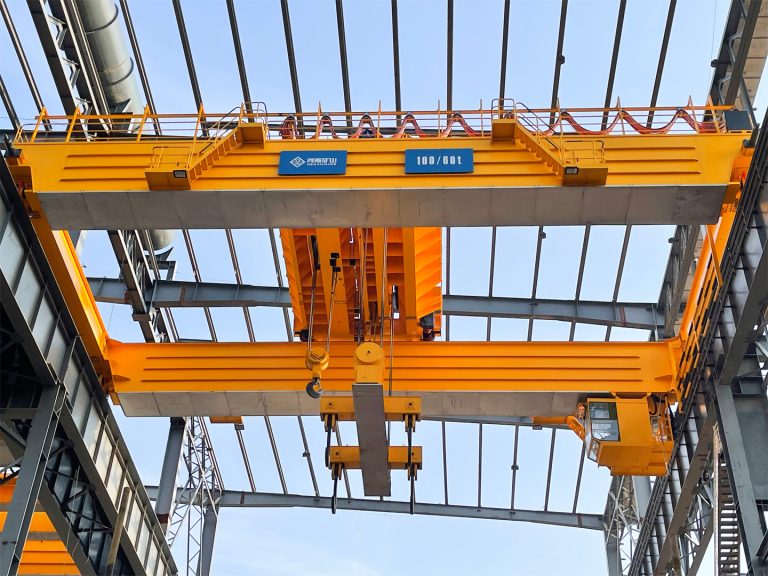
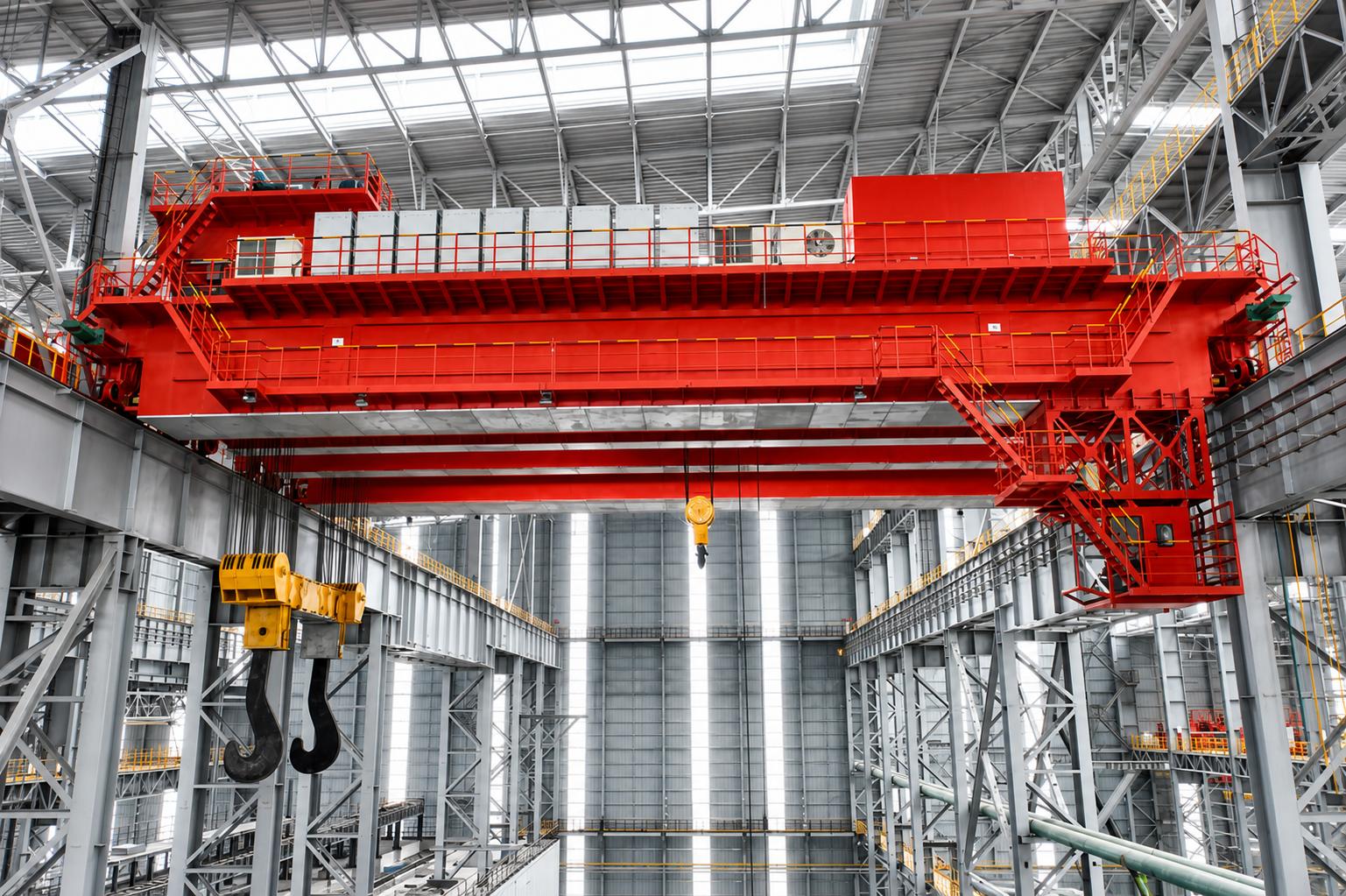
The core of the equipment adopts a double-beam bridge structure, which spans the span of the steam turbine plant as a whole, and relies on the top track system to achieve global coverage. It is the preferred structural form for large-tonnage precision hoisting scenarios.The complete set of equipment consists of five core subsystems, each performing its own duties and operating in concert to ensure the stable operation of the whole machine.:
- Main lifting mechanism: core load-bearing components, which undertake the task of 150-ton rated heavy-duty hoisting, and are suitable for the core large-scale hoisting of steam turbines and generators.;
- Auxiliary lifting mechanism: auxiliary lifting unit for small and medium loads, used for lightweight operations such as parts transfer, equipment alignment, auxiliary maintenance, etc., to improve operational flexibility;
- Lifting trolley: equipped with a lifting mechanism, it walks laterally along the main beam to achieve accurate lateral displacement and positioning of the load;
- End beam walking mechanism: connect the main beam and the track, carry the load of the whole machine and drive the crane to walk vertically and globally;
- Track operation system: The dedicated elevated track infrastructure of the plant provides support for the stable operation of the crane and the uniform transmission of the load.
Unlike high-frequency cranes for metallurgy and heavy industry, 150-ton cranes for steam turbine plants are low-frequency and highly reliable models, and most of the core large-piece hoisting is annual maintenance and unit overhaul phased operations.
Therefore, the CMAA A-level working level is adopted to ensure the performance of extreme working conditions while greatly improving the service life and operating stability of the equipment.All series are equipped with frequency conversion drive system, which can realize millimeter-level micro-speed alignment and meet the installation requirements of precision equipment.
Why Turbine Hall Installations Demand High-Reliability Crane Systems
The steam turbine plant is the core area of the power unit. The value of the hoisting operation object is extremely high, the working conditions and environment are complex, and the fault tolerance rate is extremely low. Ordinary industrial cranes cannot meet the operating requirements. It is necessary to rely on a special 150-ton bridge crane with high reliability, high accuracy and high safety.
Overweight lifting load
The core components such as steam turbine rotor, generator stator, and cylinder body can weigh up to 100 tons per unit, and the cost of a single set of unit equipment is often tens of millions. It is the core fixed asset of a power plant.The fault tolerance rate of hoisting such high-priced heavy equipment is zero.
Once there are problems such as unstable load, positioning offset, shaking and tilting, it will not only cause permanent damage to the equipment, but may also cause safety accidents, delay the production and maintenance cycle of the unit, and cause huge economic losses.Highly reliable lifting equipment is the basis for ensuring equipment safety and avoiding operational risks.
Rigorous precision hoisting
The core components of the steam turbine are not only heavy in weight, but also extremely precise. The assembly gap accuracy of the rotor and stator can reach the millimeter level, which requires extremely high lifting stability and positioning accuracy.Ordinary cranes have a large impact on start and stop, obvious shaking in operation, and uncontrollable speed, which can easily cause wear and alignment deviation of precision contact surfaces.
The dedicated 150-ton crane is equipped with a frequency conversion speed control system, which can realize stepless variable speed and flexible start and stop. Through smooth acceleration, deceleration and micro-speed walking, mechanical shocks are completely eliminated, and heavy-duty equipment is guaranteed to be smoothly controlled throughout the process, and the positioning needs of precision assembly are met.
Limited working space in the plant
The internal equipment of the steam turbine plant is dense, the layout of pipelines, platforms, and fixed units is complex, the working space is narrow, and the hoisting path is severely restricted.During the hoisting process, heavy-duty components need to avoid all kinds of fixed equipment and accurately travel through small spaces, which requires extremely high crane walking accuracy, operating range, and geometric adaptability.
The customized design of the 150-ton bridge crane can optimize the hook stroke, end distance and lifting height, adapt to restricted space operations, and eliminate the risk of collision.
Full-cycle maintenance and adaptation requirements
The 150-ton bridge crane is not only used for one-time hoisting during the construction phase of the unit, but is the core equipment that runs through the decades-long operation cycle of the power plant.For daily maintenance, regular overhaul, and component replacement of the unit, it is necessary to rely on the crane to complete the work of rotor extraction, cylinder disassembly, and parts replacement.
This means that the reliability of the crane is just needed in the whole life cycle. A single failure and shutdown will lead to the postponement of the maintenance of the unit and the shutdown of the power plant to reduce production. Therefore, the equipment must have the characteristics of long-term stability, low failure, and easy maintenance.
Multi-Drive Redundancy: The Core Technology Behind Reliable 150t Cranes
The lifting mechanism of the 150-ton crane adopts multiple redundant safety designs and is equipped with multiple sets of independent lifting, braking, and transmission units. The braking bearing capacity reaches 150%-180% of the hoisting load, which meets international safety standards.
The electronic control system of the equipment synchronizes the operating parameters in real time to avoid problems such as partial load and stress concentration.Relying on the fail-safe braking mechanism, the load can be automatically locked in the event of failure or power failure, the risk of slipping hooks and falling objects can be thoroughly prevented, and the safety of hoisting can be guaranteed.
Cart walking
The end beams of both ends of the 150-ton crane cart are equipped with multiple sets of independent drive motors and reducers, and the distributed load sharing design is adopted.During normal operation, multiple sets of drive units operate synchronously and evenly distribute the walking load, reducing the operating load of a single component and extending the service life of the equipment.
The technology is equipped with multiple sets of independent drive units such as motor, brake, PLC control, etc. to share the equipment load.It relies on the systematic collaborative design of fault adaptation under working conditions, rather than the simple stacking of equipment, which can ensure non-stop equipment failure, balanced load, and controllable operation.
Lifting system
The lifting mechanism of the 150-ton crane adopts multiple redundant safety designs and is equipped with multiple sets of independent lifting, braking, and transmission units. The braking bearing capacity reaches 150%-180% of the hoisting load, which meets international safety standards.
The electronic control system of the equipment synchronizes the operating parameters in real time to avoid problems such as partial load and stress concentration.Relying on the fail-safe braking mechanism, the load can be automatically locked in the event of failure or power failure, the risk of slipping hooks and falling objects can be thoroughly prevented, and the safety of hoisting can be guaranteed.
Drive synchronization and intelligent control
The stable operation of multi-drive redundancy, relying on the collaborative support of a full set of intelligent electronic control systems, the core configuration includes three core modules: frequency conversion drive (VFD), encoder feedback, and PLC centralized control.:
- Variable frequency drive system (VFD): The core is responsible for speed and power control, supports stepless speed regulation and flexible start-stop throughout the process, effectively eliminates mechanical shocks during equipment start-stop and variable speed, and ensures smooth and smooth heavy-duty hoisting. At the same time, it has energy-saving cushioning effect.
- High-precision encoder feedback: As a “perception sensor” of the equipment, it collects accurate position data such as crane cart walking, trolley displacement, and lifting height in real time, and dynamically feedback the operating status of the equipment to provide core data support for accurate correction and synchronous control.
- PLC central controller: assumes the function of the system's “central brain”, coordinates and dispatches all drive units, and completes core logic operations such as torque equalization distribution, operating speed synchronization, fuselage anti-deviation correction, and equipment failure monitoring in real time.
The linkage of the three can correct the operation problems of the cart skew, uneven load, speed deviation, etc. in real time, to ensure that multiple sets of independent drive units work together and operate stably with high precision.
How Multi-Drive Redundancy Improves Turbine Hall Crane Performance
- Equipment reliability is greatly improved: the multi-drive redundant design gets rid of the dependence of a single component and eliminates the hidden danger of a single point of failure.With the real-time fault monitoring function, abnormal motors, brakes, and loads can be identified in advance, sudden shutdowns during critical periods of overhaul and maintenance can be avoided, and the continuous and stable operation of the power plant can be guaranteed.
- More balanced load distribution and lower operation and maintenance losses: traditional single-drive models have concentrated loads and serious wear.The multi-unit load sharing structure can evenly disperse the heavy-duty pressure, reduce the local load of the motor, reducer, wheel and rail, reduce rail gnawing, deformation, structural fatigue and other problems, and extend the life of the equipment and plant structure.
- Smoother operation and protection of precision equipment: Relying on VFD flexible speed regulation and multi-drive synchronous control, the equipment realizes impact-free start and stop, uniform speed operation and precise braking, effectively suppresses load shaking and inertial offset, and protects high-precision core components such as steam turbines and generators to the greatest extent to avoid assembly damage.
- Significant upgrade of precise positioning capabilities: through PLC collaborative control and encoder high-precision feedback, the cart and trolley linkage corrects the walking deviation and fuselage skew, supports millimeter-level micro-speed alignment, adapts to the precision assembly conditions of the power station, and greatly improves the hoisting accuracy and installation efficiency.
Electrical and Control Systems for High-Capacity Bridge Cranes
The 150-ton heavy-duty crane is equipped with a full set of intelligent electronic control system, with PLC as the core, VFD as the drive, sensor as the perception, and remote operation and maintenance as the auxiliary, to achieve intelligent control of the whole process.:
- PLC centralized control system: As the control core of the whole machine, it co-ordinates and manages the whole process of walking, lifting, and safety protection, receives operating instructions and sensing signals in real time, and realizes precise logic control and fault linkage protection.;
- VFD frequency conversion drive system: supports stepless speed regulation, flexible start-stop and regenerative braking, effectively cushioning mechanical shocks, reducing operating energy consumption, and ensuring stable and controllable heavy-duty hoisting and no setbacks throughout the process.;
- Encoder position feedback: high-precision real-time collection of equipment walking and lifting position data, to provide accurate data support for drive synchronization, anti-skew correction, and millimeter-level accurate alignment to ensure equipment operation accuracy;
- Multiple overload protection: equipped with high-precision load sensors, real-time dynamic monitoring of hook load, overload conditions automatically trigger early warning and lock the lifting action to eliminate the safety hazards of overload operations from the root cause;
- Limit and emergency stop system: full coverage of two-way limit protection for lifting and walking, with multi-point emergency stop device, which can quickly cut off power and emergency braking under sudden failure conditions to achieve safe shutdown;
- Brake condition monitoring: monitor brake operating conditions and brake pad wear status in real time around the clock, predict and warn of brake hidden dangers in advance, and ensure the long-term stable and reliable operation of the brake system;
- Remote intelligent diagnosis and operation and maintenance: automatically record data such as equipment operation, hoisting load, fault log, etc., support remote monitoring, fault prediction and predictive maintenance, and can be seamlessly connected to the factory automation operation and maintenance platform.
Safety Features for 150t Heavy Engineering Cranes
Overload safety protection
Equipped with a high-precision load sensor, the hook load is dynamically monitored in real time. When the load is close to the rated limit, the system automatically triggers an early warning; when the rated load is exceeded, the lifting action is immediately locked to prevent structural deformation, component damage, falling objects and other risks caused by overloading and hoisting, and the safety of operation is guaranteed throughout the process.
Redundant protection of lifting brake
All systems adopt a dual-channel independent electromagnetic braking system, which has fail-safe characteristics, and automatically locks the brake and locks the load under power failure, failure, and emergency conditions.The brake redundancy design eliminates slip hook accidents caused by a single brake failure, multiple guarantees the safety of high-priced equipment hoisting, and adapts to the high-level safety requirements of power stations.
Anti-swing system
The intelligent anti-swing algorithm can correct the action in real time according to the load state and walking speed, suppress the swing of lifting heavy objects, and maintain the load stability without manual precise control.The anti-skew system compares the walking position of the end beams at both ends in real time, dynamically adjusts the driving speed, keeps the fuselage perpendicular to the track, and eliminates problems such as deviation, rail gnawing, and structural stress damage.
Fault emergency stop and failure
Emergency stop devices are configured in the cab, handheld remote control, and multiple locations along the track. In emergency conditions, all power can be cut off and all braking systems can be closed with one key.The equipment is equipped with ISO 13849-1 standard safety relay circuit, automatic fault alarm, controllable shutdown, to eliminate the risk of out-of-control.
Visual operation and communication system
The cab adopts a panoramic field of view design to cover the core hoisting operation area; it is equipped with an on-board surveillance camera to make up for the blind spot of the restricted space field of view.It supports three operating modes of cab operation, suspension handle, and wireless remote control, which are adapted to different operating scenarios to improve operation convenience and safety.
Designing a 150t Bridge Crane for Turbine Hall Installation
Clarify the full cycle load requirements
In the early stage of the design, it is necessary to co-ordinate the hoisting requirements of the unit construction, overhaul, and maintenance process, calculate the maximum hoisting weight, equipment center of gravity, spreader weight and dynamic load, and reserve sufficient safety margin to ensure that the equipment is adapted to heavy-duty working conditions throughout the life cycle, and avoid problems such as insufficient load and insufficient safety redundancy.
Accounting for span and lifting height
Determine the crane span according to the opening size of the steam turbine plant, and customize the lifting height based on the lifting height of the equipment, the travel of the spreader, and the safety clearance to ensure that the hook can cover all core lifting points, without operating blind spots, and adapt to the lifting needs of restricted spaces.
Match and adapt to the work level
Combined with the low-frequency and high-reliability operating characteristics of the power station, the CMAA A-level operating level is preferred, which is suitable for the core large-piece hoisting and normalization of lightweight maintenance operations several times a year, balancing equipment performance, service life and cost, and avoiding the problem of redundant waste of high-frequency models and insufficient performance of low-frequency models.
Adapt to the building structure of the plant
In the design stage, the soil construction and structural engineering teams are linked to accurately calculate the track load, column load-bearing, and roof clearance size, optimize the track installation accuracy, equipment walking clearance, and reserve sufficient maintenance and operation space to achieve seamless adaptation of equipment and plant infrastructure.
Maintenance Strategies for 150t Turbine Hall Cranes
A scientific maintenance system is the key to ensuring the stable operation of the crane throughout its life cycle. Combined with the characteristics of equipment structure and working conditions, it is necessary to establish a preventive + predictive dual maintenance mechanism.:
- Normalized preventive inspection: Establish a standardized inspection ledger, regularly investigate core components such as motors, reducers, braking mechanisms, wire ropes, hooks, wheels and rails, and find potential hidden dangers such as wear, loosening, and aging in a timely manner to ensure the basic operating status of the equipment.
- Special testing of key components: regularly carry out brake performance verification, wire rope nondestructive testing, wheel and rail wear measurement and electrical insulation testing, and conduct accurate verification of vulnerable and high-risk components to eliminate the risk of structural and functional failure.
- Special maintenance of the electronic control system: regularly clean the electrical cabinet, calibrate the operating parameters of the VFD, and verify the accuracy of the encoder and sensor to ensure the stability of the control system signal and accurate operation, and maintain the high-precision control level of the whole machine.
- Standardized lubrication and maintenance: strictly follow the manufacturer's technical specifications, and regularly lubricate the moving parts such as transmission, walking, and rotation at fixed points to reduce mechanical friction losses and extend the service life of the equipment.
- Intelligent predictive maintenance: relying on multi-dimensional data such as equipment load, temperature, vibration, and running time, the working condition of the equipment is dynamically judged, and hidden faults are predicted in advance to achieve on-demand maintenance, effectively reducing invalid downtime and excessive maintenance.
How to Choose a 150t Heavy Engineering Bridge Crane Manufacturer
Steam turbine plant cranes are customized high-end heavy industry equipment. The selection of manufacturers directly determines the performance and operation and maintenance guarantee of the equipment. The core selection criteria are as follows:
- Practical experience in mature industries: with mature design, production and project landing cases of special cranes for 100-ton power plants, deep cultivation of complex working conditions in steam turbine plants, familiar with power station hoisting specifications and on-site construction requirements;
- Professional engineering R&D capabilities: with finite element structure verification, fatigue strength verification, and redundant drive system customization design capabilities, personalized working condition adaptation design can be completed according to plant span, load characteristics, and space constraints.;
- Core complete set of technical reserves: proficient in core key technologies such as multi-drive synchronous load, intelligent anti-skew, VFD frequency conversion, precise speed regulation, remote condition monitoring and predictive operation and maintenance;
- Standardized quality control system: Holds a full set of ISO9001 quality system certification, and strictly implements the whole process of quality inspection standards such as factory factory testing, rated load testing, on-site commissioning and acceptance.;
- One-stop full-process service: it can provide integrated closed-loop services for working condition survey, custom design, intelligent manufacturing, on-site installation, commissioning and acceptance, spare parts matching, and after-sales maintenance.;
- Long-term operation and maintenance guarantee capabilities: equipped with a professional and rapid response after-sales team, it can provide technical support, equipment maintenance and system upgrade iteration services for the whole life cycle of the project.
Conclusion
The 150-ton steam turbine plant bridge crane, relying on double-beam heavy-duty structure, multi-drive redundancy technology, intelligent control and full-dimensional safety protection, is perfectly adapted to the heavy-duty, precision and restricted space hoisting conditions of the power station, and can efficiently complete the installation and maintenance of the core equipment of the unit.
The multi-drive redundant design effectively avoids a single point of failure, balances the load, and improves the stability and service life of the equipment.Henan Mine Crane can customize exclusive 150-ton bridge crane solutions according to the requirements of plant span, lifting height, operating accuracy and other working conditions to ensure the long-term safe and stable operation of power station equipment.