
Gantry Crane Wheel Selection: Polyurethane Wheels vs. Steel Rail Wheels
The choice of gantry crane wheels is not only related to the carrying capacity of the equipment, but also directly affects the operating stability, ground wear and late maintenance costs.Polyurethane wheels have the advantages of low noise, good cushioning performance, and ground protection. They are suitable for some indoor light and medium-load handling scenarios; steel track wheels are more suitable for heavy-duty and fixed track operation due to their high carrying capacity and wear resistance.However, the two types of wheels are not simply divided into advantages and disadvantages. The actual selection also needs to be combined with the lifting weight, ground or track conditions, operating frequency and working environment to make a comprehensive judgment.Only by choosing the right wheel material can unnecessary maintenance and downtime be reduced, and the long-term operation of the gantry crane can be more stable and economical.
Why Does Wheel Material Matter for Gantry Cranes?
Wheel material and performance
The wheel material of the Henan Mine Crane Factory manufactured gantry crane directly determines the operating efficiency and safety boundary of the whole machine.We have seen too many cases in the workshop. After the gantry crane of the same tonnage is replaced with the wrong wheel material, either the ground is pressed out of a deep rut mark, or it shakes violently during operation, causing the crane to swing.As the core component of load-bearing and walking, the wheel's coefficient of friction, compressive strength, wear resistance and impact toughness will all be converted into electricity expenses, maintenance hours and downtime losses in your daily use.The wrong material is selected, and every subsequent assignment is paying for this error.
Floor-running vs. rail-running cranes
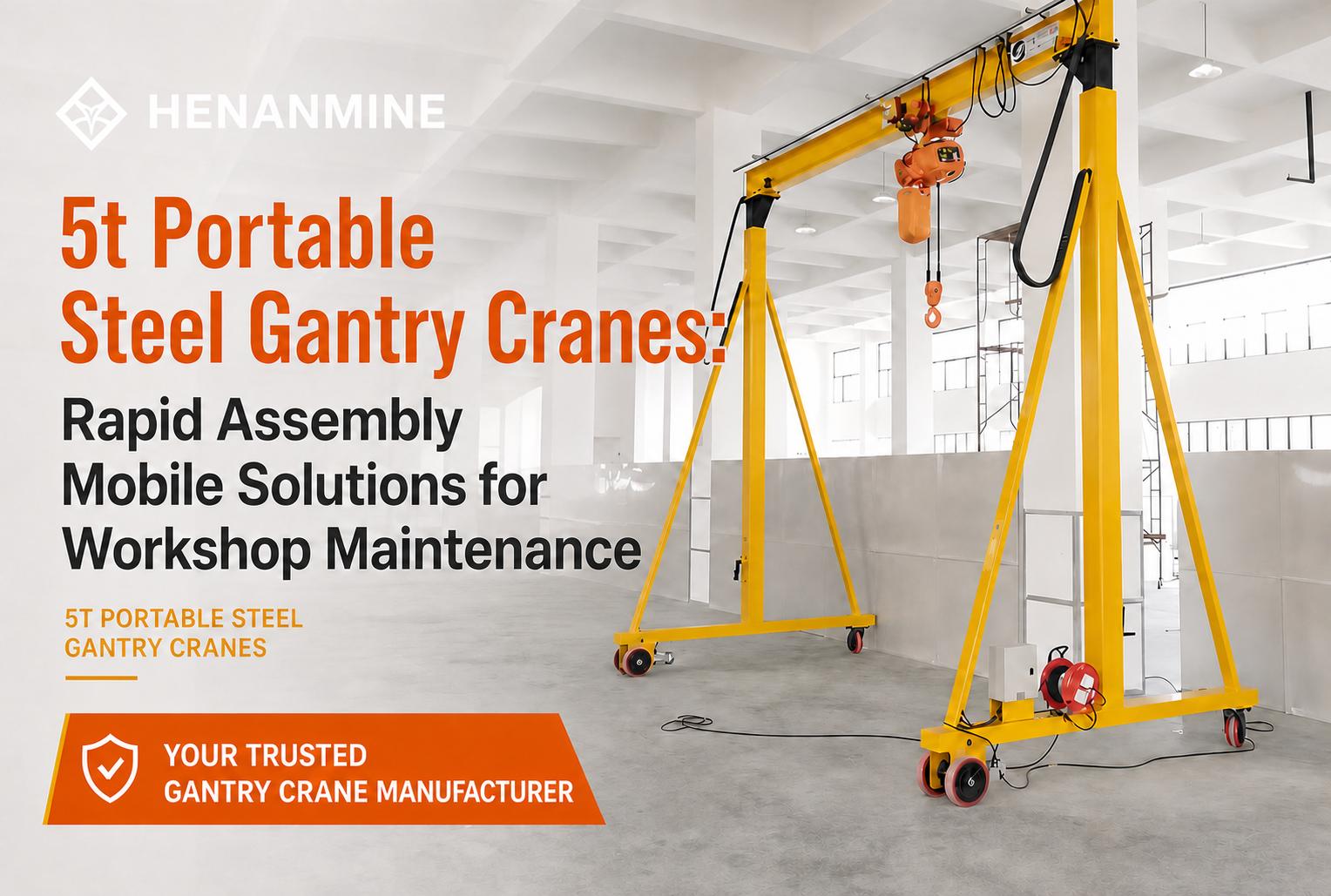
The requirements for the wheels of ground mobile gantry cranes and orbital gantry cranes are almost two tracks.Gantry cranes walking on the ground operate directly on the floor of the plant or on the open-air site. The wheels need to be responsible for protecting the ground and dispersing pressure. Polyurethane coated wheels are more common in such scenes.The orbital gantry crane runs along a preset steel rail, and there is hard metal contact between the wheel and the top of the rail, which requires the rim to have precise guidance ability and extremely high compressive strength. Steel wheels are almost the only choice.Distinguishing which way of walking your equipment belongs to is the first step in choosing the right wheel.
Polyurethane Wheels vs. Steel Rail Wheels: Which Performs Better?
Load capacity and deformation
The advantages of polyurethane wheels are good elasticity and strong cushioning, but significant deformation will occur under heavy loads, and the rolling resistance will increase as the contact area increases.We have made actual measurements. If a 10-ton gantry crane adopts all polyurethane wheels, when the wheel pressure exceeds 12 tons per wheel, the flattening deformation will increase the load of the walking motor by nearly 10%.Steel wheels are almost not deformed, and the wheel pressure can be easily achieved with a single wheel of more than 30 tons. Under heavy-duty conditions, the dimensional accuracy and trajectory stability far exceed polyurethane wheels, but the cost is that the ground needs steel rails to carry it.
Noise, vibration, and floor damage
This one is the home of the polyurethane wheel.When steel wheels walk on steel rails, the noise generated by the impact of the wheels and rails is usually above 85 decibels, and complaints are often made in surrounding residential areas during night operations.Because of the elastic cushioning of the polyurethane wheel, the noise can be reduced to less than 70 decibels at the same speed, and the communication of workers in the workshop is not affected.More importantly, ground protection. Steel wheels will cut out cracks when they walk directly on the concrete floor, while the pressure on the contact surface of polyurethane wheels is evenly distributed, which will not damage the epoxy floor and emery floor. This is a hard requirement for clean workshops and food and pharmaceutical factories.
Wear resistance and service life
From the perspective of pure wear resistance, the life of forged steel wheels on the track can usually reach 5 to 8 years, and the surface has a higher hardness after quenching.The life span of polyurethane wheels on indoor smooth ground is about 2 to 4 years, but if there is gravel, welding slag or sharp metal shavings on the site, the coating layer will be quickly split, and the life span may be shortened to a few months.If there is hard debris in the working environment, either do a good job of cleaning the ground or go directly to the steel wheel. Don't let the polyurethane wheel carry it hard in harsh working conditions.
Traction and running stability
In terms of traction, polyurethane wheels are not easy to slip on smooth ground because of their large coefficient of friction, and they are easier to start and brake.The coefficient of friction of steel wheels on the rail is low, especially when there is water film on the open-air track on rainy days, the braking distance will be significantly longer, and rail clamps or anti-skid devices need to be installed.In terms of operating stability, because of the good rigidity of the steel wheel, the partial load caused by the wheel diameter error when walking at high speed is easier to control.Polyurethane wheels are greatly affected by temperature, and the rubber coating softens at high temperatures in summer, and more detailed installation and debugging are required when multiple wheels are running synchronously.
When Should You Choose Polyurethane Wheels?
Indoor workshops and warehouses
Indoor workshops and warehouses are the most comfortable application scenarios for polyurethane wheels.Such scenes are usually in a closed environment and densely populated, with strict requirements for noise and ground protection.The ground in the machining workshop is covered with an epoxy floor, and next to it is a precision CNC machine tool. If you use a steel wheel to walk directly on the ground, the vibration will affect the machining accuracy.The gantry cranes we equip for many auto parts manufacturers all use polyurethane rubber-coated wheels. The workers operating the equipment next to them can't feel the vibration of walking at all, and the ground is still intact after five years of use.
Light to medium loads
Henan Mine Crane Factory manufactured Gantry cranes with a tonnage between 5 tons and 20 tons are the sweet zone of polyurethane wheels.Within this load range, the elastic deformation of polyurethane will not be large enough to affect the operating efficiency, but the cushioning characteristics can absorb the impact load during braking.If you are in the business of warehousing and logistics, equipment assembly, and light industry manufacturing, the lifting weight of a single hook is not large, but the shifts are dense and the goods are scattered, the comprehensive use experience of polyurethane wheels will be better than that of steel wheels.However, once the tonnage exceeds 32 tons, or there is a need for frequent full-load hoisting, the steel wheel plan needs to be carefully evaluated.
Smooth concrete floors
Polyurethane wheels are very sensitive to ground flatness.If the concrete floor is newly poured, treated with light, and the flatness is controlled within 3 mm of the error every two meters, the polyurethane wheel will run smoothly and quietly.However, if the ground cracks, sand is raised, there is a wrong expansion joint, or the site is depressed by the forklift for a long time, the polyurethane wheel will quickly fall off the rubber coating due to repeated rolling of the bumps.We will let customers take pictures to confirm the condition of the ground before shipping. If the ground is not good, we would rather recommend that customers do the transformation of the track foundation than push the polyurethane plan hard.
Low-noise material handling
For noise-sensitive industries, such as machinery factories located near residential areas, hospital logistics warehouses, and material handling areas in cultural and creative parks, it is basically not wrong to choose polyurethane wheels.We have calculated that at the same speed of the gantry crane of the same specification, the noise value of the steel wheel scheme is 15 to 20 decibels higher than that of the polyurethane wheel. This gap is especially obvious during night operations.Some customers used steel wheels cheaply at first, but after they were put into production, they were rectified by environmental complaints. In the end, they came back to us to change the wheels again, but they spent a lot of money.
When Are Steel Rail Wheels the Better Choice?
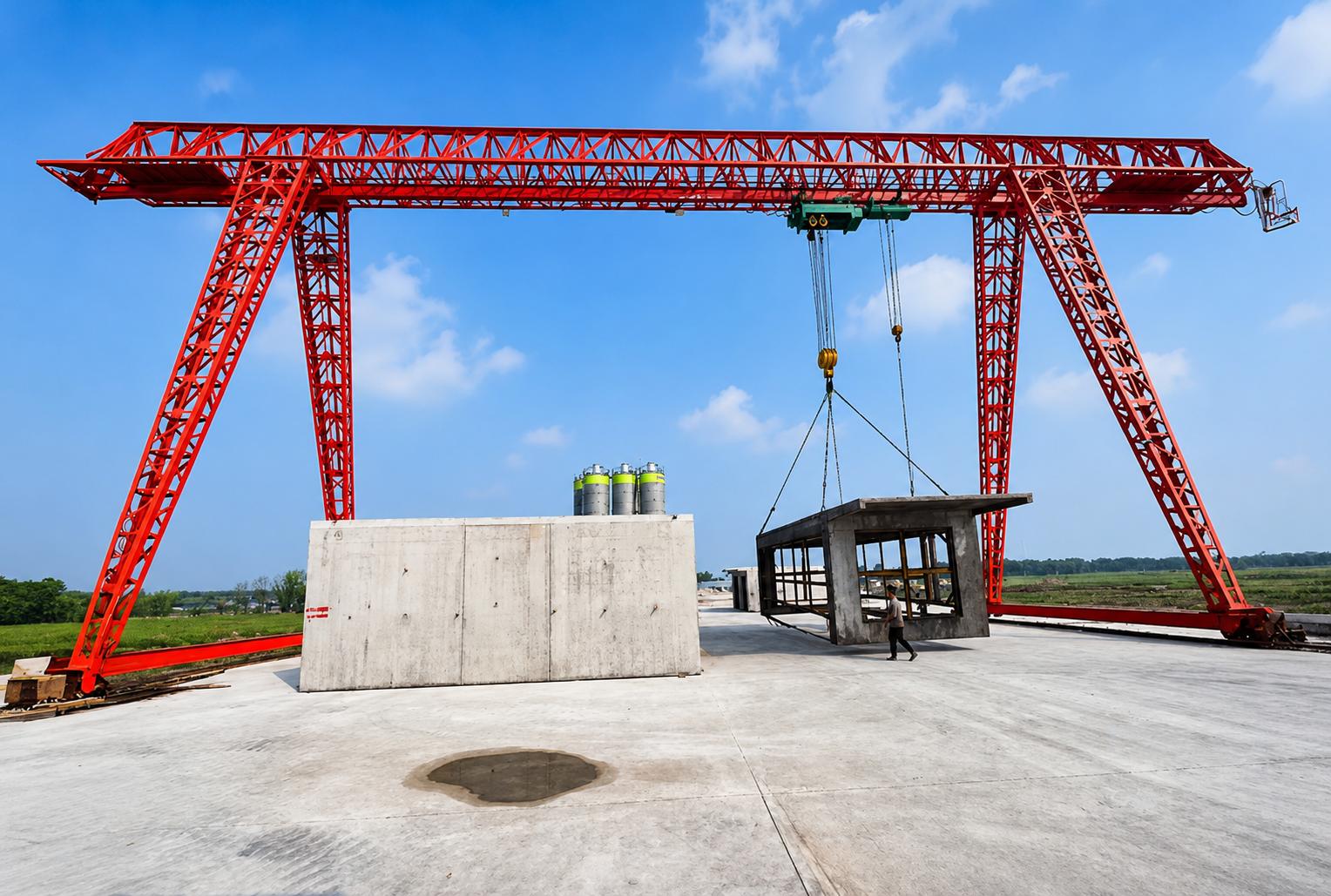
Heavy-duty gantry cranes
When the tonnage of the gantry crane enters the range of more than 50 tons, steel wheels are a must.Gantry cranes for shipbuilding, gantry cranes for casting in metallurgical workshops, and gantry cranes for gate hoisting in hydropower stations. In these scenes, the pressure of a single wheel often starts at 40 tons, and the physical limit of a single wheel cannot be carried at all.The 90-ton shipbuilding gantry crane we made for a shipyard uses forged alloy steel wheels, which are hardened and tested for defects. Each wheel can withstand a static load of more than 60 tons.There is no point in discussing polyurethane wheels under this working condition. The basic laws of material mechanics are there.
Fixed rail systems
If you have already planned the rail foundation, whether it is the P38 rail in the factory or the QU80 rail in the open-air site, then the steel wheel is the supporting plan.The advantage of orbital operation lies in the high positioning accuracy, which can be used with the automated storage system to achieve fixed-point grasping, and the cooperation between the rim and the steel rail controls the walking deviation at the millimeter level.Polyurethane wheels cannot be used on fixed tracks because they do not have the concept of wheel-rail guidance.As long as your equipment is on steel rails, the wheel material can only be selected from cast steel, forged steel, and ductile iron.
Outdoor yards and ports
Outdoor scenes such as open-air depots, container terminals, and sand and gravel yards have large dust, high humidity, and large temperature differences, and the polyurethane coating layer will accelerate aging.Long-term exposure to ultraviolet light will harden and crack the polyurethane. RAINWATER and sediment mixed into the wheel surface will form an abrasive effect, and the coating layer will crack and peel off in a few months.Our port gantry cranes and yard gantry cranes are all equipped with steel wheels as standard, and the wheel surfaces are treated with anticorrosive coatings. The maintenance is simple and the service life is calculated in years.Choosing a polyurethane wheel for outdoor scenes is basically tantamount to finding yourself the trouble of late maintenance.
High-frequency industrial operations
Henan Mine Crane Factory manufactured Gantry cranes in some factories run for more than 20 hours a day, such as the material distribution gantry crane next to the automobile welding line and the gantry crane of the raw material yard of the steel plant.Under this kind of high-frequency working conditions, the wear rate of polyurethane wheels will be very fast. The wear of the wheel diameter must be checked in three or four months, and the rubber coating layer must be replaced as a whole when it is worn to the cordon.Although the steel wheels also wear out at the same frequency, the surface hardening layer can last for several years, and the labor cost and downtime loss of replacing the wheels once are much lower than that of frequent replacement of polyurethane wheels.Calculate the general ledger, and steel wheels in high-frequency working conditions are more economical.
How Do You Match Gantry Crane Wheels to Actual Working Conditions?
Wheel load and crane capacity
The first step in the selection is to calculate the wheel pressure of the list wheel.The total load of the gantry crane includes the lifting weight, the weight of the trolley, the weight of the main beam, the weight of the outriggers and the weight of the operating mechanism, multiplied by the dynamic load coefficient and the wind load coefficient, and finally apportioned by the number of wheels.When our technical team gives the customer a plan, the wheel pressure calculation book will be delivered along with the drawings, and the customer can clearly see the actual force of each wheel.Choose the wheel diameter and material based on this value, rather than patting your head based on tonnage.Many customers come up and ask what wheels are used for 10-ton gantry cranes. This question itself is not established.
Floor strength and rail alignment
The carrying capacity of the ground or track determines whether the wheels can land.If the grade of the concrete floor is lower than C25, or the thickness is not 150 mm, the polyurethane wheel will press the ground out of tapered cracks under heavy load.The track system should pay attention to the straightness and gauge deviation. We recommend that the elevation difference and lateral offset of every 10 meters be retested after the track is installed. The deviation of more than 3 mm will cause the wheels to grind.We have attached track acceptance standards to the delivery of many domestic projects. Customers use this standard as the basis, and the wheel life will be extended by at least 30% in the later stage.
Travel speed and operating frequency
The higher the walking speed, the greater the centrifugal force and dynamic load on the wheel.If the door crane trolley is running at a speed of more than 30 meters per minute, or the cart is walking at a speed of more than 25 meters per minute, we usually recommend the use of steel wheels and the installation of rail sweepers.The operating frequency should also be converted into accumulated mileage. Running for 8 hours a day and running for 2 hours a day, the wheel wear curve is completely different.We will let customers provide the daily operating time and hoisting times, and then combine these data to recommend the appropriate wheel diameter and material margin to avoid small cars pulling large trucks.
Dust, moisture, and temperature
The chemical factors in the working environment are often ignored.There is high temperature radiation and metal dust in the foundry workshop, sawdust and adhesive volatiles in the wood processing workshop, and salt spray corrosion in coastal ports.The impact of these environments on polyurethane wheels is much greater than that of steel wheels. Salt spray will corrode the surface of steel wheels, but it can be solved by changing to stainless steel or spraying.However, polyurethane will soften at high temperatures and swell when soaked in grease, and there is almost no low-cost protection solution.When choosing a model, listing environmental factors is much more important than simply price.
What Affects Gantry Crane Wheel Life and Replacement Costs?
Wheel wear and maintenance
Whether the daily maintenance is done well or not directly determines how long the wheels can run.During the return visit of our after-sales service engineer, it was found that 80% of the wheels that wear out abnormally fast are due to poor lubrication or debris on the track.Wheel bearings need to be filled with grease regularly, the rims and rail sides should be checked regularly for rail gnawing, and the welding slag and large pieces of metal debris on the ground should be cleaned in time.These tasks are not complicated, but the wheel life of customers who persevere is generally more than twice that of customers who never maintain.The wheel is not a consumable, it is a durable piece after being raised.
Material and manufacturing quality
The same is for steel wheels, the price of cast parts and forged parts can be doubled, and the life span can be tripled.Our wheels are made of integral forging technology, the material is 65Mn or 42CrMo, and the intermediate frequency quenching hardness of the wheel surface reaches more than HB300. Ultrasonic flaw detection is done before each wheel leaves the factory.Some low-cost wheels on the market are sand-cast, with pores and slag inside, and the rear wheel surface will peel off and crack after a period of heavy-duty operation.The customer saved a few thousand yuan in the early stage, and the money spent on changing the wheels and the loss of downtime in the later stage had already exceeded the difference.The selection of wheels is essentially the selection of manufacturing processes.
Replacement frequency and downtime
Changing the wheels is not as simple as unplugging and installing them.To change the wheels of the Henan Mine Crane Factory manufactured gantry crane, the whole machine needs to be topped up, the end beam connecting bolts are removed, the old wheel set is hoisted out, the coaxiality and wheel track of the new wheel are calibrated, and the falling beam is reset.A wheel change and commissioning usually take one to two days, during which the entire production line must be stopped.When we calculate the cost of the whole life cycle for our customers, we will fold in the loss of downtime. A production line with a daily output of one million is stopped for two days, and the loss is much higher than the price of the wheel itself.So when choosing a model, don't just look at the wheel quotation, but the overall replacement cost.
Custom wheel selection for your crane
The working conditions of each gantry crane are unique, and copying the standard configuration is often not the optimal solution.Our team of engineers will customize the wheel diameter, wheel width, material and surface treatment plan according to the site conditions, hoisting frequency, cargo characteristics and budget range provided by the customer.Some customers need to transition between smooth epoxy ground and outdoor gravel sites, so we designed a plan that can switch wheel sets.Some customers need to use it in explosion-proof workshops, so we will equip them with copper rims and anti-static polyurethane layers.Tell us your working conditions, and we will calculate the most suitable wheel.
Henan Mine Crane Factory Custom
Henan Mine Crane Factory not only provides standard tonnage gantry cranes, but also specializes in customizing wheel walking systems according to customers' specific working conditions, from 5 tons of light and small mobile door cranes to 500 tons of ultra-large shipbuilding door cranes, from indoor clean workshops to port open-air depots, we all have mature supporting solutions.Our wheel supply covers a full range of materials such as forged steel wheels, cast steel wheels, polyurethane coated wheels, nylon wheels, etc. Each wheel has undergone dimensional testing, hardness testing and non-destructive testing before leaving the factory.If you are choosing or replacing the wheels of a gantry crane, please contact our technical team to provide your lifting weight, walking method, ground conditions and operating frequency. We will issue a wheel pressure calculation book and wheel selection suggestions for free to help you avoid pits with the wrong material selection.