
What Are the Structural Characteristics of Metallurgical Electric Hoists?
The lifting equipment in the metallurgical workshop can not only withstand lifting, but also be affected by thermal radiation, dust and repeated start and stop.The structural characteristics of Metallurgical electric hoists are to configure the carrying components, lifting drives, wire rope systems, braking devices and thermal insulation protection around these conditions, so that the mechanical and electrical systems can work in harmony under the specified working conditions.The real difference is reflected in the complete load transfer path and failure protection capabilities, not just thicker housings or greater motor power.
This name is also not a substitute for a specific purpose description.The risks of hoisting spare parts at room temperature, handling hot solids, and directly hoisting molten metals in metallurgical plants are different.The following is the main discussion object of wire rope metallurgical electric hoist; when molten metal is involved, the equipment must have the design basis and applicable configuration for the corresponding purpose.
Main Structural Components of a Metallurgical Electric Hoist
Reinforced Load-Bearing Structure
The load is transmitted from the hook through the pulley block, wire rope and reel to the support shaft, the bearing frame and the connecting parts of the trolley.Therefore, the reliability of the bearing structure depends on the strength, stiffness and connection quality of the entire path.The protective cover is mainly used to isolate external influences, and the actual carrying capacity cannot be judged by the thickness of the cover alone.
Repeated lifting will form cyclic stress in the structure, and starting, braking, and load swing will also bring dynamic effects.Reasonable frame layout, material selection, welding details and fastening connections help control local stress concentration.Insufficient stiffness is not only manifested as deformation, but may also affect the alignment of the shaft system, gear meshing and wire rope operation, so that the problems that were originally limited to the structure are gradually transmitted to the mechanical system.
Heavy-duty design does not mean that it allows unlimited continuous operation.The bearing structure still has corresponding load spectrum, working level and design life conditions.Long-term frequent proximity to the rated load, and occasional lifting of the same weight, the consumption of fatigue life is different; structural strengthening must match the actual use strength.
Specialized Lifting Motor
The lifting motor needs to overcome the load torque and complete the acceleration, lifting and stopping within the specified number of starts and operating cycles.Frequent start-up will increase heat generation, while higher ambient temperatures will compress the heat dissipation margin.Therefore, the selection of motors for metallurgical purposes usually considers the insulation system, temperature rise, cooling method and working system at the same time, and cannot only compare the rated power.
A higher insulation heat resistance level can improve the ability of the insulation system to withstand heat, but it does not mean that the entire hoist can work at the same temperature.Bearings, brakes, cables, and control components have their own use boundaries, and the allowable environmental conditions of the motor are also related to the load and cooling conditions.Thermal protection is used to detect abnormal heating and cannot replace suitable motor capacity and effective heat dissipation.
For metallurgical electric hoists, the cooperation between the motor and the brake is also very critical.There needs to be a reasonable connection between the establishment of the lifting torque, the release of the brake and the parking brake to avoid unexpected movement of the load during the conversion process.When using frequency conversion drive, the heat dissipation conditions and braking control logic of low-speed operation are also part of the system design content.
The working system also affects the heat accumulation of the motor.A long standing time may allow the equipment to cool down, while intensive short-distance jog, although each trip is not long, may bring frequent start-up and braking.Therefore, when evaluating the lifting task, the running time and starting frequency need to be described separately, and the motor burden cannot be inferred only from the total weight of the lifting every day.
Heavy-Duty Wire Rope and Drum Assembly
The choice of wire rope involves breaking ability, rope core structure, bending fatigue and environmental adaptability.When approaching high-temperature materials, the rope core and lubrication state are especially important.For example, the U.S. OSHA stipulates for applicable bridge and gantry cranes that under temperature conditions sufficient to damage the fiber rope core, independent wire rope core, steel wire strand core or other rope core resistant to corresponding thermal damage should be used.This is the requirement of a specific jurisdiction, and it also shows that high strength and heat resistance are different indicators.
The reel cannot be evaluated only by how many meters of wire rope it can hold.The shape of the rope groove, the diameter of the reel, the effective winding length, the fixing of the rope end and the number of reserved turns at the lowest position of the hook jointly affect the reliability of the system.The geometric matching between the pulley and the wire rope will affect the bending stress and contact wear.The safety factor should be determined according to applicable standards and actual design, and a fixed value for all models should not be applied.
The rope guide mechanism helps to arrange the wire ropes along a predetermined trajectory, reducing messy ropes and abnormal stacking, but it cannot correct all problems such as cable-stayed, blocked hooks, or loose wire ropes.When the rope groove is worn, the rope guide piece is damaged, or the rope end is abnormal, continued operation may damage the reel and the wire rope at the same time, and the rope guide cannot be regarded as a device that can individually ensure the safety of the rope.
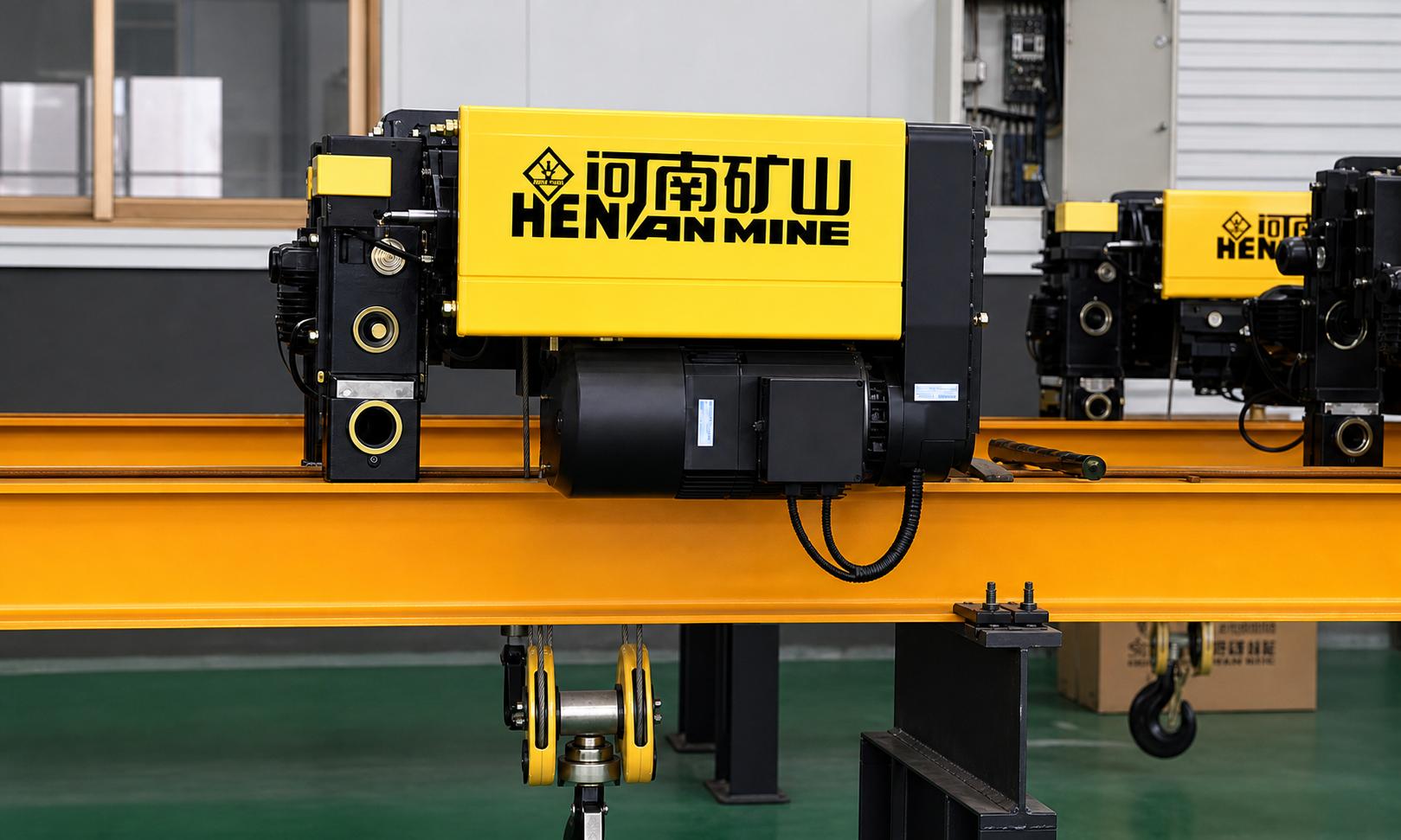
Similarly, increasing the diameter of the wire rope is not a general strengthening method.The replaced rope diameter and structure will change its cooperation with the rope groove, pulley and rope guide mechanism, and the original winding arrangement may not be applicable.Heat resistance selection, load-bearing calculation and geometric matching must be established together; sufficient nominal breaking capacity does not mean that the wire rope can ignore thermal damage and repeated bending.
High-Performance Gearbox and Transmission System
The reducer converts the high-speed rotation of the motor into the speed and torque required for the reel.Heavy loads, frequent start-stop and load changes will affect tooth surface contact, tooth root force and bearing life.Gear material and heat treatment, shaft support, box stiffness and assembly accuracy need to be combined to meet the design working conditions; increasing the hardness of the tooth surface alone cannot solve all transmission problems.
The high temperature environment will also affect the viscosity of the lubricating oil, the state of the seal and the heat dissipation of the box.The role of the lubrication system is to maintain the appropriate oil film and control wear. Its effect depends on the oil product, oil volume, cleanliness and actual temperature.Insufficient oil levels, pollution, or inappropriate lubricants may offset the advantages of heavy gears and reinforced bearings, so refueling, oil discharge, and condition inspection locations are also of practical value.
High-Temperature-Resistant Braking System
The lifting brake needs to distinguish between the two functions of maintaining the load and controlling the descending speed.The holding brake is responsible for preventing the load from moving when it stops or loses power; the speed control brake limits the speed during descent.The regeneration or dynamic braking of the motor can participate in the speed control, but it cannot be determined that the suspension load can still be maintained independently after the power is lost.
The common power-loss brake structure relies on the spring to apply braking force and release power.Its reliability still depends on the state of the friction pair, braking torque, release clearance and action coordination.High temperature comes not only from external radiation, but also from the heat generated by repeated braking. Therefore, heat-resistant materials, heat capacity and heat dissipation conditions must be considered together.The retention ability after the emergency stop also needs to be verified in the whole machine plan.
Molten metal hoisting is particularly sensitive to the consequences of failure and may require double braking or other prescribed redundancy measures.The U.S. OSHA stipulates that at least two holding brakes are configured for the independent lifting mechanism of hot metal cranes that use power-controlled braking within its scope of application.This requirement cannot be directly extended to a unified configuration standard for all regions and all metallurgical electric hoists.
The significance of dual braking also depends on the installation location and independence.If both brakes are located on the same upstream drive shaft, some downstream drive failures may still bypass the holding effect of the two.Therefore, when evaluating redundancy, it is necessary to understand which failures are covered, and the number of brakes cannot be directly equivalent to the complete anti-fall ability.
Coordination is also required between protection actions.When the motor overheating protection stops the drive, the suspension load still needs to be reliably maintained; if the load still needs to be transferred to the designated location, there should be a designed abnormal disposal plan.Thermal protection, emergency stop, and mechanical maintenance each solve different problems, and one of the functions cannot be used to replace the other links.
Hook Assembly and Safety Devices
The hook group is usually composed of hooks, beams or support parts, bearings, pulleys and connecting parts.Forged hooks that have been properly manufactured and inspected are a common configuration, but the material strength cannot replace the control of the deformation, cracks and force position of the hook mouth.The anti-release device mainly restricts the accidental sliding out of the sling. It is not a force component that can withstand normal lifting, nor can it compensate for incorrect mounting.
Overload protection, lifting limit and other monitoring devices are aimed at different anomalies.Overload protection cannot cover all impact and cable-stayed risks; the rising limit is used to prevent the hook group from colliding with the roll, and cannot be used as a conventional means of daily parking.When a second limit or other independent protection is required, the trigger method and control loop must also meet the corresponding design requirements.
Special Protective Structures for Metallurgical Working Environments
Thermal Insulation and Heat Protection
The air temperature and thermal radiation in the metallurgical site are not the same thing.Even if the average workshop temperature is not high, parts located above the ladle or hot billet may be strongly locally heated.The heat insulation panels and protective covers reduce the heat load of motors, brakes and electrical installations by blocking direct radiation and adjusting the heat transfer path between the heat source and the components.
The effect of the thermal insulation structure depends on the coverage, installation spacing, surface state and residence time.The protective plate covers the motor, but directly exposes the cable connector or brake, which may still leave weak points.Additional protection cannot block the necessary cooling air flow, and the design needs to strike a balance between reducing the external heat input and discharging the internal heat.
The temperature adaptability of Metallurgical electric hoists should be implemented throughout the working cycle.Suppose two devices lift the same hot workpiece, one quickly passes above the heat source, and the other needs to hover and wait. The continuous heat effect of the latter may be more severe.This shows that it is impossible to fully judge whether the heat-proof structure is applicable based on the temperature of the material or a short-term test hoisting.
Electrical Protection and Control System
Heat-resistant cables, connectors, and electrical boxes need to match the actual environment of their respective locations.The cable sheath is not only affected by heat, but may also experience repeated bending, drag, and local friction; reasonable routing, stress relief, and mechanical protection can avoid focusing the problem on the terminal and the inlet.The temperature rise of the components in the box is related to the installation density, load and heat dissipation conditions.
Overload, overheating, emergency stop and stroke limit should form a clear control logic, and the reset and recovery actions after the failure are also part of the design content.Simply cutting off the drive power supply does not automatically prove that the suspension load is in a safe state. It is also necessary to consider maintaining the action of the brake.When electronic monitoring or programmable control is used, ordinary process control functions and functions that assume a safety role should be realized according to their respective requirements.
Dust and Environmental Protection
Dust may be deposited on the cooling surface, enter the friction or transmission site, and may also affect the electrical connection.Proper sealing, joint surface design and incoming line protection can reduce intrusion, but increasing the degree of sealing sometimes increases the difficulty of heat dissipation.Therefore, the dust-proof structure and thermal management need to be designed together, rather than pursuing a higher level separately.
The IP rating describes the protection ability of the shell against solid foreign objects and water ingress, and does not directly indicate heat resistance, corrosion resistance or explosion-proof properties.When moisture, corrosive media, and combustible dust are present, corresponding materials, anti-corrosion, or special explosion-proof designs are also required.Ordinary metallurgical equipment cannot be regarded as suitable for all special environments because it is installed in a steel mill.
How Does the Structure Differ from a Conventional Electric Hoist?
Ordinary electric hoists can also have reliable braking, overload protection and a higher working level.The main differences between the two types of equipment lie in the thermal environment, working cycle and failure consequences covered by the design, as well as the added protection and redundancy for this purpose.The following comparison shows common design priorities, and the specific configuration is still affected by the manufacturer, rated capacity, work level and use.
| Comparison | Metallurgical Electric Hoist | Standard Electric Hoist |
| Motor | Thermal design matched to specified heat exposure and duty | Thermal design for declared general service conditions |
| Braking system | Additional thermal capacity and redundancy where required | Holding and control braking suited to the rated application |
| Electrical components | Heat-compatible components, routing and enclosure design | Components selected for specified industrial conditions |
| Wire rope assembly | Rope core, lubrication and reeving matched to heat and duty | Rope assembly matched to its declared application |
| Protective structure | Targeted heat shields and environmental protection | General guarding and environmental protection |
| Working conditions | Defined metallurgical duties; molten-metal use requires explicit suitability | General handling within stated operating limits |
Under the same rated lifting weight, two hoists may still have different cycle working capabilities and temperature boundaries.Adding heat insulation panels to ordinary models only changes part of the external heating conditions, and cannot simultaneously prove that its braking, wire rope, electrical system and bearing structure meet the new purpose.Whether the transformation is feasible needs to be re-evaluated according to the whole machine.
Key Design Requirements for Different Metallurgical Applications
Steelmaking and Molten Metal Handling
The core problems of molten metal hoisting include the serious consequences of uncontrolled load, swing and leakage.In addition to heat protection, the lifting mechanism should also be designed around retention capacity, applicable redundancy, spreader connection and disposal under abnormal circumstances.The applicability of the lifting system must cover the hoist, trolley, crane structure and power supply control interface, rather than just confirming the high temperature resistance of a certain component.
During starting, braking, and translation, load swing may also affect the stability of the container.Smooth driving and proper speed control can help reduce motion disturbances, but they cannot replace the reliability of the container, lug, and spreader itself.The model used for hoisting hot solids cannot be automatically transferred to molten steel or molten iron operations.
Foundries and Casting Workshops
There may be sand and dust, thermal radiation, local splashing and frequent transportation in the foundry at the same time.The focus of the protection design is not only the upper body, but also the wire ropes, cables and exposed connectors near the hook group.The geometry of the spreader matches the hanging point of the container or casting to avoid abnormal extrusion, partial load, or connection interference.
There are also obvious differences in the tasks of the casting site: the transfer of pouring packages, the handling of hot castings, and the loading and unloading of molds. The requirements for braking consequences and heat exposure are not the same.Define these tasks separately in order to determine which locations need to be insulated, which components need to be strengthened to prevent dust, and what kind of work cycle the equipment should be configured according to.
Steel Rolling Mills
The rolling area may not only lift hot materials, but also serve the replacement of rolls, guards, and other equipment.Production logistics pays more attention to repetitive cycles and beat convergence, while maintenance operations may pay more attention to low-speed positioning, accessibility and installation space.The similar working environment does not mean that the two tasks are suitable for exactly the same lifting speed and structural arrangement.
In continuous production, inconvenient maintenance will prolong the recovery time after the failure.Accessible brakes, clear lubrication locations, detachable protective parts, and traceable spare parts information help improve maintainability.However, reducing downtime depends on equipment configuration, maintenance resources and production arrangements, and cannot be guaranteed by heavy-duty structures alone.
Metallurgical Equipment Maintenance
Maintenance and hoisting often face problems such as insufficient headroom, changes in the position of the hoisting point, and limited internal space of the equipment.The structural height of the hoist, the arrangement of the trolley, the effective lifting stroke and the range of the hook can be reached are more illustrative of adaptability than the nominal lifting height alone.The center of gravity of the disassembled components and the arrangement of the sling will also change the space required on the site.
Even if the maintenance frequency is low, the equipment may still be exposed to heat sources and dust for a long time.Low frequency of use cannot be directly equivalent to low maintenance requirements; to resume operation after long-term shutdown, it is also necessary to confirm the status of the braking, electrical, and rope hook systems.The mobile arrangement within the allowable range can increase flexibility, but the cable-stayed pull cannot be used to compensate for the problem that the hanging point cannot be reached.
What Should Buyers Consider When Selecting a Metallurgical Electric Hoist?
The starting point for choosing metallurgical electric hoists is to transform the purpose into a clear working condition.The maximum actual lifting load should include the weight of the hanging beam, container and other spreaders included in the equipment definition; the working level needs to be determined in combination with the load size, the number of cycles and the cumulative operation.Simply increasing the rated tonnage may not be able to compensate for the mismatch in the working system or thermal design.
The temperature conditions should describe the ambient air, local radiation source, proximity distance and exposure time respectively.The lifting height and speed should be considered in combination with the headroom of the plant, the upper and lower limit positions of the hooks, and the process residence.The installation check also involves the form of the trolley, the condition of the track or I-beam, the wheel pressure, the power supply and the control interface to avoid the application of the equipment body and the mismatch of the support system.
For projects that directly lift molten metal, the technical review needs to clarify the applicable standards, corresponding uses, braking structure and necessary independent protection, and check the verification documents of the whole machine.Maintenance channels, inspection locations, and spare parts support should also be included in the technical solution, because inaccessible key components will affect the execution quality of subsequent inspections and status judgments.
Maintenance Practices for Long-Term Structural Reliability
- The goal of maintenance is to discover the deterioration of the carrying path and protection function.Wire rope inspection focuses on broken wire, wear, corrosion, deformation and thermal damage, and combines the status judgment of rope ends, reels and pulleys; hook inspection focuses on cracks, deformation, abnormal wear and connection parts.Scrap standards and inspection methods should correspond to the actual rope type, components and applicable regulations, not just whether the equipment can still be lifted.
- Brake inspection includes not only friction parts and gaps, but also action response and holding functions.The reducer needs to pay attention to changes in oil level, leakage, abnormal sound, vibration and temperature rise.For metallurgical electric hoists, frequent thermal protection actions, changes in the state of the rope, or abnormal braking distance are all clues for further diagnosis, and should not be covered up by repeated resets or random adjustments.
- Electrical inspections include insulation status, wiring fastening, contactors and limiting devices, and check the heating, wear and bending parts of the cables.Deformation of the heat insulation board, loosening of the fixing parts, or damage to the dust-proof seal may precede the failure of the host.When removing dust accumulation, electrical and friction components should also be protected to avoid the introduction of moisture, oil or mechanical damage during the cleaning process.
- The inspection cycle should be formulated in accordance with the manufacturer's requirements, local regulations and actual use rigor, and status records should be kept.After cracks, obvious slippage, or other abnormalities affecting safety are found, the evaluation should be discontinued; repairs involving braking, limiting, or carrying components should be carried out under safe isolation conditions, and operation should be resumed after verification in accordance with regulations.
- The record should also be associated with the task changes experienced by the device.After the process is adjusted, if the lifting load is heavier, the heat source stays longer or the circulation is more intensive, the original maintenance arrangements may no longer be sufficient.Analyzing wear and protection actions together with changes in working conditions can help determine whether the problem comes from aging components, insufficient maintenance, or whether the equipment has exceeded the originally defined conditions of use.
Conclusion
The structural feature of Metallurgical electric hoists is to adapt the carrying, driving, winding, braking and heat protection systems to the specified metallurgical tasks.Reinforced materials, heat-resistant insulation, or dual braking all have their own functions and boundaries. The reliability of the whole machine depends on the matching between these components and whether follow-up inspections and maintenance can be continuously implemented.
Before determining the technical plan, form a complete working condition description of the lifting type, actual weight, working cycle, thermal exposure and installation conditions, and then check the applicable use and verification data of the corresponding model so that the structural configuration can truly serve the production needs.