
What Is an RMG Crane? Definition, Features, and Applications
In heavy cargo operation scenarios such as port container terminals, railway intermodal freight yards, and large logistics hubs, gantry cranes are the core loading and unloading equipment, while RMG rail gantry cranes have become the mainstream equipment of modern smart depots with the advantages of high precision, high production capacity, and easy automation.
Many practitioners often confuse RMG cranes with ordinary tire gantry cranes. This article will comprehensively explain the definition, core structure, working principle, performance characteristics, and core advantages of RMG cranes. At the same time, compare the popular RTG tire gantry cranes, attach selection techniques and applicable scenarios to help you understand RMG cranes in all directions.
What Is an RMG Crane?
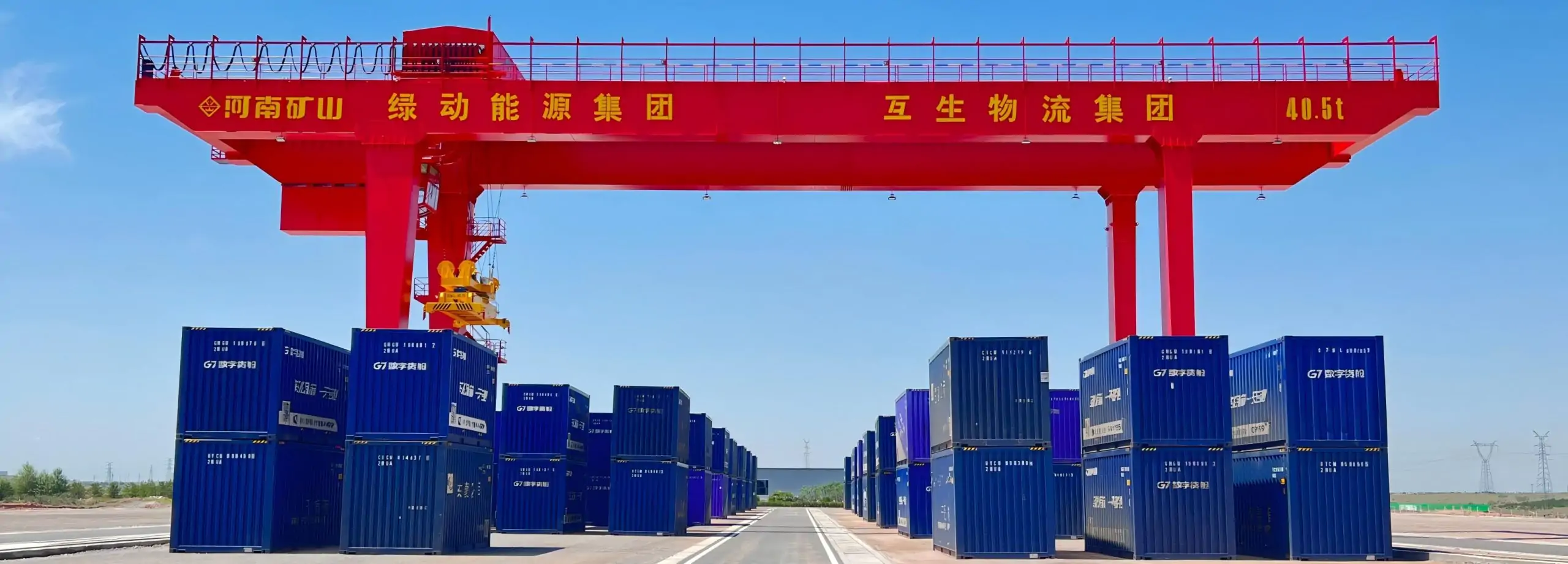
The full name of RMG crane is Rail-Mounted Gantry Crane (Rail-Mounted Gantry Crane), also often referred to as rail-mounted container gantry crane, is a kind of heavy industrial lifting equipment equipped with a fixed rail walking system, specially adapted for standardized container loading, unloading, stacking, and transshipment operations.
Unlike mobile lifting equipment, RMG cranes must rely on precision steel rails laid on a concrete foundation to operate, and the operating path is fixed. They are mainly used in standardized and large-volume cargo operation scenarios such as port container terminals, railway intermodal depots, and inland logistics hubs, and can efficiently complete the whole process of container lifting, handling, stacking, and alignment transshipment operations.
Its core basic characteristics can be summarized as three points:
- Orbital walking design: The whole machine runs in a straight line along a fixed steel rail, and the walking path is limited, but the stability, positioning accuracy, operating speed and energy saving far exceed that of tire cranes, eliminating ground slippage, offset and other problems.
- Long-span rigid steel structure: it adopts bridge-type gantry steel frame structure, which can span multiple rows of container storage areas, and is equipped with laterally movable lifting trolleys, lifting mechanisms and special container spreaders, which are suitable for large-area yard operations.
- Modular customized configuration: the equipment span and cantilever structure (single cantilever, double cantilever, and no cantilever) can be customized according to the yard layout and operation needs, and adapted to the operation planning of different sites.
Main Components of an RMG Crane
The overall structure of the RMG crane is specially designed for heavy-duty, high-frequency and accurate container operations. The core components work together to ensure the stable and efficient operation of the equipment. The main components are as follows:
- Gantry steel frame main body: The core load-bearing structure is made of high-strength steel (Q235, Q345, etc.), including vertical outriggers, horizontal main beams, end beams and beams. It is extremely rigid and can span multiple rows of container stacking areas to support the load of the whole machine and resist harsh environments such as high winds and humidity in ports and outdoor depots.
- Track walking system: it consists of fixed steel rails embedded in the concrete foundation, crane steel walking wheels, bogies, track clamps and windproof braking devices. It is the core of RMG's high-precision positioning to ensure the smooth longitudinal walking of the whole machine.
- Lifting trolley: it can move at a uniform speed laterally along the main beam, and is equipped with a complete lifting mechanism, which is responsible for accurately adjusting the horizontal position of the spreader and adapting it to container pick-and-place operations in different positions.
- Lifting mechanism: it includes core components such as drive motor, reducer, reel, wire rope, pulley block, etc., which is responsible for the vertical lifting of containers and is the core power unit for cargo hoisting.
- Special spreader for containers: Standard Twist-lock structure, which can accurately lock the four corners of the container, firmly fix the box body, prevent offset and falling off during hoisting, and support single-box and double-box hoisting modes.
- Power and control system: it adopts full electric drive, powered by sliding contact wire, cable reel or busbar, and is equipped with PLC programmable controller, sensor, and frequency conversion drive system.It supports three modes of manual operation, remote control, and fully automatic operation of the cab, and can be connected to the intelligent management system of the yard.
- Safety auxiliary system: including anti-collision sensors, overload protection devices, wind speed monitors, windproof anchoring devices, ladders, maintenance platforms, lighting systems, etc., to ensure the safety of equipment and operations in all directions.
How Does an RMG Crane Work?
The core working logic of RMG crane is to realize the precise alignment, pick-up, transshipment, and stacking of containers through three-dimensional linkage of vertical track walking, horizontal trolley movement, and vertical lifting. With anti-swing technology, the operation is stable and efficient.
Three core exercise methods
- Vertical walking (operation of the whole machine): The entire RMG crane walks in a straight line before and after the embedded fixed steel rail, which can quickly complete the alignment of the whole machine, accurately reach the target container operation area, and fully cover the vertical operation area of the yard, laying the foundation for subsequent precise operations.
- Horizontal walking (trolley operation): The lifting trolley equipped with the lifting mechanism moves smoothly laterally along the main beam, which can fine-tune the horizontal position of the spreader with high precision and accurately align the center point of the container, effectively making up for the slight deviation of the longitudinal positioning of the whole machine, and ensuring zero alignment error.
- Vertical lifting (lifting operation): The lifting mechanism drives the special spreader to lift smoothly, completing the container grabbing, lifting, lowering and precise placement.The equipment is equipped with a multi-rope anti-swing structure, which can effectively suppress the shaking of the box and greatly improve the operating stability and safety factor.
Standard operating cycle process
- The whole machine travels accurately along the embedded steel rail to the container station to be operated, completes the initial positioning of the locked area, and accurately locks the operating range, laying a solid foundation for subsequent refined operations.;
- The lifting trolley is accurately fine-tuned laterally along the main beam, and the special spreader is driven to align the standard positioning points of the four corners of the container to achieve precise alignment at the millimeter level and eliminate operating deviations.;
- The spreader is smoothly lowered to fit the box body, and the four-corner rotary locking mechanism automatically and accurately bites the corners of the container. After the locking verification is completed, the box body is smoothly lifted so that it is completely separated from the container stacking or transportation carrier.;
- Through the collaborative linkage between the vertical walking of the whole machine and the horizontal movement of the lifting trolley, the container is smoothly suspended and transported to the target storage area, directly above the designated drop-off point of the freight truck or railway carriage.;
- The control system controls the spreader to descend at a uniform speed and slowly. After the container is completely and safely landed, the rotary lock mechanism is unlocked to complete the standardized unloading and landing operation.;
- The spreader is reset and lifted at no load, and the equipment quickly returns to the standby state, seamlessly connecting the next round of operation cycle, ensuring continuous and efficient operation of the yard around the clock.
The modern intelligent RMG crane (ARMG fully automatic rail gantry crane) can rely on the terminal operating system to realize unattended continuous operation and greatly improve the throughput efficiency of the yard.
Key Features of RMG Cranes
Compared with traditional lifting equipment, the design of RMG cranes is fully adapted to the needs of modern high-density, high-throughput, and intelligent depots, and its core advantages and characteristics are very prominent.:
High work efficiency
The rail walking speed of the RMG crane can reach more than 45m/min, and the lifting speed can reach 30m/min at full load. With precise linkage control, it can complete 28-40 container operations per hour, and the automated model is more efficient.At the same time, it supports the hoisting of double 20-foot containers and single 40/45-foot large containers, and the throughput of a single operation is greatly improved, which can meet the 24-hour uninterrupted continuous operation of the yard.
Accurate positioning
Fixed rail guidance completely eliminates the problem of walking offset, and with a high-precision sensing and positioning system, the alignment error is very small.Rigid steel structure + multi-rope anti-swing technology can effectively suppress the shaking of the box during hoisting, and it can operate stably even in windy weather. It is perfectly adapted to the needs of multi-layer high-density stacking of containers, and can achieve up to 6-8 layers of stacking.
Energy-saving and low-carbon
The whole machine is driven by pure electricity, has no diesel exhaust emissions, and meets the standards of green port construction.Equipped with a regenerative braking energy recovery system, excess electrical energy can be recovered during container decentralization and equipment deceleration, and the energy consumption and utilization rate can be greatly improved.At the same time, the equipment has no vulnerable parts such as tires and diesel engines, and the daily maintenance workload and maintenance cost are much lower than that of fuel-fired tire cranes.
Intelligent adaptability
The fixed track operation path can be entered into the system in a programmable manner, which is the optimal equipment for the automated transformation of the yard.It can be seamlessly connected to the TOS terminal management system of the yard, and supports remote centralized control, automatic unmanned operation, intelligent obstacle avoidance, and automatic container identification and positioning. It is widely used in international smart ports such as Rotterdam, Hamburg, and Singapore.
Strong durability
The whole machine adopts heavy-duty anticorrosive steel structure, which is suitable for harsh working conditions such as high salt spray in ports, outdoor wind and rain. The standardized industrial design allows the service life of the equipment to reach more than 25 years, far surpassing ordinary lifting equipment, and the long-term use is extremely cost-effective.
Advantages of RMG Cranes
Combining the dimensions of operating performance, cost, safety, and environmental protection, RMG cranes have a comprehensive competitive advantage over traditional yard lifting equipment.:
- Production capacity advantage: The multi-agency high-speed linkage operation mode is adopted, which supports 24-hour uninterrupted and stable operation, and the throughput of operations under automated working conditions is greatly improved, which is perfectly adapted to the high-intensity and high-frequency operation needs of large logistics hubs and core ports.
- Accuracy advantage: Relying on the precise guidance of fixed steel rails, the problem of equipment walking offset and trajectory drift is completely eliminated, and the container stacking is extremely regular, which can maximize the effective storage space of the yard.
- Space advantage: The equipment has the core capabilities of long-span coverage and high-rise stacking, supports high-density intensive stacking of containers, and significantly improves the storage capacity and land utilization rate of the unit site.
- Cost advantage: The energy consumption of the whole machine's pure electric drive is low, and it is equipped with regenerative braking energy-saving technology to effectively reduce power consumption; the equipment has no vulnerable components such as tires and diesel engines, and the structural wear rate is low, which greatly reduces the later operation and maintenance costs.
- Environmental protection advantages: the operation has zero exhaust emissions, low operating noise, and a green and energy-saving operation mode, which is fully in line with the construction standards and environmental protection compliance requirements of green ports and low-carbon logistics parks.
- Intelligent advantages: It is natively adapted to the intelligent control system of the yard, which can seamlessly realize remote centralized control and unattended automatic operation, effectively reducing labor costs and avoiding the operational risks caused by human operation errors.
- Safety advantages: It is equipped with multiple safety protection systems such as anti-collision, overload protection, windproof anchoring, and real-time fault self-inspection as standard. The automated operation mode greatly reduces the entry of personnel into high-risk operation areas and guarantees the safety of yard operations in all directions.
- Durability advantages: It adopts heavy-duty industrial-grade steel structure design, has excellent wind resistance, anti-corrosion, anti-vibration, and anti-vibration properties, and is suitable for harsh outdoor working conditions in ports. The service life of the equipment can reach more than 25 years, and the durability is extremely strong.
- Adaptation advantages: It supports the rapid replacement of special spreaders, which can not only meet the batch operation of standard containers, but also adapt to heavy-duty and special cargo hoisting and transshipment, taking into account the needs of standardized operations and diversified special working conditions, and is extremely versatile.
RMG Crane vs RTG Crane
RMG rail gantry crane and RTG tire gantry crane are the two mainstream equipment in the port yard. The functions are similar, but the adaptation scenarios, performance, and cost are greatly different. They are the core comparison items for the selection of yard equipment:
| Contrast dimension | RMG rail gantry crane | RTG tire gantry crane |
| Walking style and flexibility | Fixed steel rail walking, fixed path, low flexibility, unable to move across areas at will | Rubber tires walk, can move freely, the site is flexible to adapt, and the working area can be quickly adjusted |
| Power source | Pure electric drive, energy saving and zero emissions | Diesel/hybrid/electric drive, traditional models have high fuel consumption and pollution |
| Work efficiency and accuracy | Fast speed, accurate positioning, high stacking density, and excellent automation efficiency | The speed is medium, the road surface is uneven and easy to offset, and the accuracy and stability are slightly poor. |
| Initial input cost | High, steel rails need to be laid, foundations need to be retrofitted, and supporting power facilities need to be installed. | Low, no rail infrastructure is required, and the equipment can be operated when it enters the field |
| Late operating costs | Extremely low, energy saving, low wear and easy maintenance | Higher, tires are easy to wear, diesel consumables are large, and parts are lost. |
| Service life | About 25 years | About 15 years |
| Automation adaptability | Excellent, it is the preferred equipment for smart yard automation | Generally, the movement is random, and the automatic transformation is difficult. |
| Environmental adaptability | Strong wind resistance, seismic resistance, stability, and excellent operating ability in bad weather | Windproof and weak stability, operation needs to be restricted in windy weather |
Selection summary: RMG cranes are preferred for large-scale fixed depots that pursue long-term efficient, intelligent, and high-density operations; the site is flexible, short-term operations, and small-scale depots are suitable for RTG cranes.
Common Applications of RMG Cranes
Relying on the core advantages of high precision, high production capacity, and easy automation, RMG cranes focus on standardized, high-volume, high-frequency, and fixed-layout cargo operation scenarios. The core application areas are as follows:
- Port container terminal: As the core application scenario of RMG crane, it is mainly responsible for the automated storage, orderly dispatching, interval transshipment and consolidation of containers in the port area. It is perfectly adapted to the high-intensity, high-throughput, and all-weather large-scale operation needs of large ports. It is the core equipment of smart port yard.
- Railway intermodal yard: it can efficiently complete the rapid transfer and alignment of containers between railway carriages, freight trucks, and storage depots, open up public railway and sea railway multimodal transport links, and greatly improve the turnover efficiency of intermodal transport hubs and the speed of cargo movement.
- Inland logistics hub/container yard: adapt to inland standardized container warehousing and turnover yard operations, relying on the advantages of high-precision positioning and high-density stacking, maximize the use of limited site resources, and improve the storage floor area ratio and intensive operation level of inland yard.
- Large-scale industrial freight yard: The equipment is extremely scalable. Through the replacement of special customized spreaders, it can be adapted to multi-category heavy-duty hoisting and transshipment operations such as heavy steel, modular engineering equipment, and structured bulk cargo, so as to get rid of the restrictions of single container operations and adapt to diversified industrial freight scenarios.
How to Choose the Right RMG Crane
The purchase of suitable RMG cranes needs to be considered in combination with site conditions, operating requirements, and long-term planning. The core selection points are as follows:
Matching rated lifting weight
According to the selection of cargo for the operation, 40-50 ton models are selected for conventional container operations, and 51-65 ton and above heavy-duty models are selected for heavy-duty high-box and special containers to avoid cost waste caused by excess parameters and prevent insufficient load from affecting the operation.
Adapt to yard span and layout
The conventional span of RMG cranes is 20-60 meters, and the mainstream is 30-50 meters. It needs to be determined according to the number of container rows in the yard and the width of the lane. It can be equipped with a single-sided/double-sided cantilever of 0-10 meters to adapt to the corner operations of the site, while reserving space for future site expansion.
Determine the stacking and lifting height
The stacking height of conventional operations is 4-7 layers, the automated yard can reach 8 layers, and the lifting height range is 9-27 meters. The type needs to be selected according to the storage density requirements of the yard. The higher the height, the higher the site utilization rate, and the higher the requirements for equipment structure stiffness and control accuracy.
Choose the automation level as needed
- Small and low-throughput yard: manual operation models are preferred, with simple configuration and excellent cost performance, which can fully meet the needs of daily basic container loading, unloading and storage operations.
- Medium-sized conventional yard: adapted to semi-automatic ARMG models, relying on remote monitoring + automatic walking and collaborative operation, balancing operating costs and operating efficiency, and adapting to medium and high-frequency yard operation scenarios.
- Large-scale smart yard (annual throughput of more than 500,000 TEU): Fully automated ASC unattended models are selected to support uninterrupted and continuous operation around the clock, and are suitable for high-throughput, high-density, and intelligent modern ports and hub yards.
Optimize performance and energy consumption configuration
Priority is given to the configuration of frequency conversion speed regulation and regenerative braking energy-saving models to accurately match the on-site power supply load conditions; combined with the actual operating intensity of the yard, scientifically match the lifting, trolley and walking operating speed, while ensuring efficient operation, energy consumption and consumption are effectively reduced, and a two-way balance between efficiency and energy saving is achieved.
Pay attention to safety and compliance standards
The equipment must comply with FEM, EN, and ISO international lifting equipment standards, and be equipped with a full set of safety systems such as anti-swing, anti-collision, overload protection, wind monitoring, and emergency braking. The marine anticorrosive coating structure needs to be selected for port scenes to adapt to harsh environments.
Consider infrastructure and long-term costs
Plan the rail foundation and power supporting infrastructure in advance, and give priority to modular design models to facilitate later maintenance and upgrading; comprehensively compare equipment purchase prices, infrastructure costs, operation and maintenance costs, and service life to calculate the long-term return on investment.
Conclusion
RMG rail gantry crane is an efficient, intelligent and energy-saving core equipment of a modern container yard. With the core advantages of precise track positioning, high stacking density, high operating efficiency, easy automation, long life, and low operation and maintenance costs, it has become the preferred lifting equipment for ports, railway intermodal transportation, and large logistics hubs.
Although its initial infrastructure investment is higher than that of RTG tire cranes, from the perspective of long-term operation, in the yard scenario of fixed layout, high throughput, and intelligent upgrading, the comprehensive price ratio and operating advantages of RMG cranes are irreplaceable. It is the core equipment for the construction of smart ports and green logistics parks.