
The Basic Ways and Skills of Single Girder Crane Purchase
Single-girder bridge cranes are suitable for light and medium-sized working conditions, with a load of 1-32 tons, suitable for low-rise factories, and the operation and maintenance cost is better than that of double-girder cranes.Many purchases only rely on peak load or price selection, which is prone to poor equipment adaptation.This article explains the procurement skills of single-girder cranes from the aspects of working conditions, selection, parameters, manufacturers, quotations, etc., to help enterprises choose suitable and reliable lifting equipment.
Understand Your Lifting Requirements Before Purchasing
Before comparing equipment models, prices, and manufacturers, the primary core task is to sort out their actual operating needs.The basis for the selection of all single-girder crane parameters is derived from on-site working conditions. Accurate approval of basic requirements is the key to avoid overkill of equipment and small cars.
Determine the heavy load
Lifting load is the primary selection parameter of single girder crane, and it is easy to choose the wrong one.Procurement cannot only set the tonnage according to the occasional peak load, but the conventional load and the maximum load must be calculated at the same time to prevent the selection from being too large and wasteful, or too small to cause accelerated wear and tear of components.The selection should also reserve the load margin to predict the future demand for capacity improvement, and the crane life can reach 15-20 years to avoid equipment replacement in the short term.
Verify the lifting height
The lifting height is the vertical stroke of the hook, which is related to the usable working space of the plant. Estimation errors are very common.The selection of the type cannot only look at the nominal parameters of the equipment. It is necessary to calculate the headroom of the plant, the height of the main beam and the hoist, and the safety margin, and distinguish the installation height of the whole machine from the effective lifting height.The low-rise plant should also be included in the height occupied by the spreader to prevent insufficient lifting stroke after installation.
Measuring span and operating stroke
The span, cart travel, and on-site space determine the coverage of crane operations, which is the basis for customizing the specifications of single-girder cranes.The span is the distance between the centerline of the track, which is usually 5-30 meters. Non-standard customization is required when the on-site dimensions do not match.It is also necessary to determine the longitudinal walking distance of the cart, investigate obstacles such as columns and pipelines, and reasonably plan the track and the whole machine plan.
Confirm the operating environment
The operating environment determines the crane material, protection level, electrical and anti-corrosion and explosion-proof scheme.Distinguish between indoor and outdoor installation, and outdoor models need to be windproof, rainproof and rustproof.At the same time, evaluate temperature and humidity, dust, corrosive media, and explosive gases; the working conditions of different industries such as steel mills, chemical industry, and papermaking require targeted configuration, and ordinary standard cranes cannot be directly applied.
Choose the Right Type of Single Girder Crane
Single-girder cranes are divided into a variety of structure and configuration types. The installation methods, space adaptability, operating performance, and applicable scenarios of different models are significantly different. Selecting the right model based on on-site working conditions can greatly improve operating efficiency and reduce procurement and operation and maintenance costs.
Upper rail and lower suspension single girder cranes
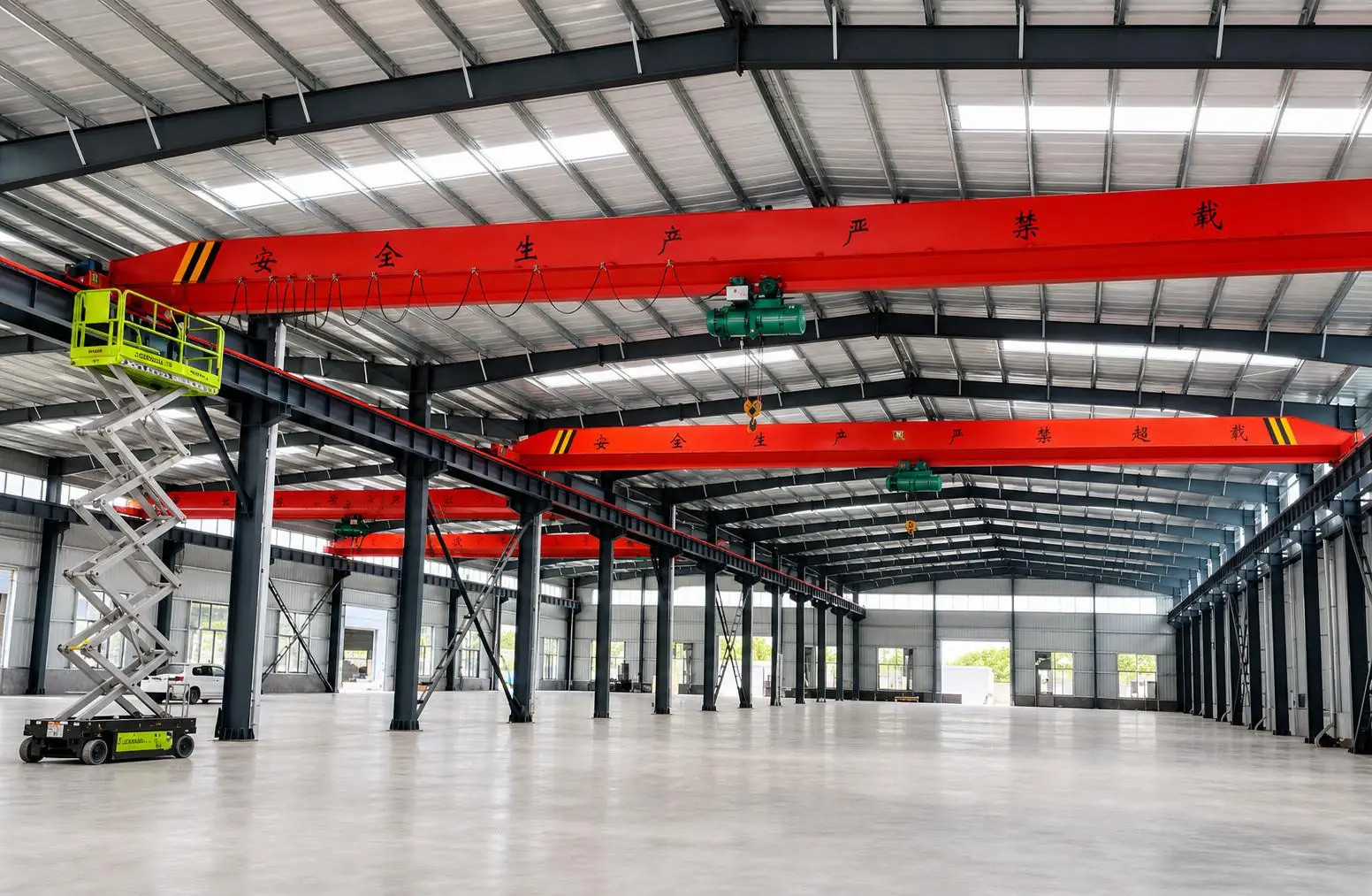
According to the installation structure, the core of single-girder cranes is divided into two categories: upper rail type and lower suspension type (underslung). The core basis for selection is the headroom of the plant, the track structure, and the span requirements.
The upper-rail single-girder crane installs the track on the upper flange of the driving beam. The structure has strong bearing capacity, wide span adaptation range, and high operating stability. It can be adapted to large-span, medium- and high-frequency operation scenarios. It is mostly used for new factories, heavy-duty material handling, and work spaces with a span of more than 12 meters. There are no special restrictions on the structure of the track beam. It is the mainstream choice for industrial scenarios.
The under-suspension single-girder crane track is installed on the lower flange of the driving beam. The biggest advantage is to save the top space of the plant, effectively increase the lifting height of the hook, and perfectly adapt to the transformation scenes of low-rise factories and old workshops.
This model can be installed directly on the steel structure of the original building, without the need to build a special column, and is mostly used in assembly workshops, maintenance workshops, and light material handling scenes, but the upper limit of load-bearing and span is slightly lower than that of the upper rail type model.
Electric hoist configuration selection
The electric hoist is the core lifting component of a single-girder crane. Its configuration directly determines the lifting speed, operating accuracy, service life and operation adaptability of the equipment. It is the core guarantee of the carrying capacity and operating efficiency of a single-girder bridge crane.
Commonly used hoists are divided into wire rope electric hoists and chain electric hoists:
- The wire rope hoist has large bearing capacity, stable operation, wear-resistant and durable, and is suitable for medium- and heavy-duty and high-frequency continuous operation scenarios. It is the main industrial configuration.;
- The chain hoist has a compact structure, compact size and high cost performance. It is mostly used in light load, low frequency, precision assembly, and equipment maintenance scenarios.
At the same time, it is necessary to reasonably match the lifting speed and operating speed: a single-speed configuration can be selected for conventional operations, and a two-speed or frequency conversion speed control configuration can be selected for scenarios that pursue precise positioning and precision hoisting.
Frequency conversion drive (VFD) can achieve stepless speed regulation, reduce the impact of equipment start and stop, protect the motor and steel structure, and extend the service life of the equipment. It is the preferred configuration for medium and high frequency operations.
Selection of standard and customized models
Standard single-girder cranes are suitable for conventional span, standard lifting height, and ordinary indoor room temperature and dust-free working conditions. Mass production is cost-effective and fast delivery speed, which can meet the basic handling needs of most ordinary warehouses and conventional workshops.
When the working conditions exceed the standard parameters, the crane needs to be customized, such as non-standard span, special lifting height, special power supply, explosion-proof and anti-corrosion, and special control scenarios.The design is tailored according to the working conditions of the plant, and the space is better adapted to reduce failures and improve equipment utilization.
Key Technical Parameters to Compare Before Buying
The core of screening the advantages and disadvantages of equipment and comparing the product differences of different manufacturers lies in checking the parameters of the single girder crane. All key parameters must be clearly marked in the quotation and contract to avoid vague and shoddy parameters.The core comparison parameters are as follows:
- Rated lifting weight: represents the maximum safe operating load of the equipment. When purchasing and selecting models, it is necessary to match the daily conventional operating load and the instantaneous peak load at the same time to ensure reasonable tonnage selection and avoid long-term overload operation or redundant waste of equipment performance.
- Crane span: Refers to the centerline spacing of the equipment's operating track, which is the core size parameter. It needs to be checked according to the actual width of the plant to confirm the selection of standard sizes or customize non-standard spans as needed to ensure that the equipment is accurately adapted to on-site installation conditions.
- Lifting height: For the effective vertical working stroke of the crane hook, it is necessary to reserve the space occupied by spreaders, fixtures, hanging beams and other accessories when selecting the type to ensure that the actual lifting height fully meets the needs of production operations.
- Work level / work system: strictly refer to FEM, ISO, and CMAA industry standards to distinguish between different work levels of A1-A8, and match the corresponding working condition level with the daily working time, operating frequency, and load rate of the equipment to adapt to the long-term working intensity of the equipment.
- Lifting and operating speed: it covers the three speed parameters of hook lifting, vertical operation of the cart, and horizontal operation of the trolley. According to the requirements of the operation accuracy, choose ordinary single-speed or frequency conversion speed regulation configuration, taking into account the operation efficiency and smooth operation.
- Power supply method: Check the voltage, phase, and frequency standards of on-site industrial electricity, confirm whether the power supply configuration of the equipment matches, and confirm in advance whether transformer equipment needs to be installed for non-conforming working conditions to avoid power failure.
- Control method: At present, the mainstream is divided into three forms: wired control of the handle, wireless remote control control, and cab control. It can be flexibly selected according to the operating scene, operating distance, and operating accuracy.
- Hooks and lifting mechanisms: including ordinary hooks, rotating safety hooks and other types, it is necessary to focus on verifying the material technology and structural design of the lifting core mechanism to ensure the safety of hoisting and the durability of the structure.
- Track and installation requirements: check the adapted track model and the carrying parameters of the driving beam, confirm the end limit, buffer device, installation reference and other supporting requirements, and ensure the equipment installation specifications and stable operation.
The work level is often ignored.Ordinary single-girder cranes are mostly A3-A5 grade, and A6 and above should be selected for high-frequency continuous operation; low-level equipment can easily produce structural, motor, and brake failures due to heavy loads, which shortens the life of the equipment.
How to Evaluate a Single Girder Crane Manufacturer
High-quality equipment is inseparable from reliable manufacturers. Parameter matching is only the basis. The manufacturer's R&D production capacity, quality control system, customization ability, and after-sales guarantee directly determine the quality of equipment and long-term use experience.
Production and industry experience
Give priority to manufacturers with many years of special crane production experience, and focus on verifying whether manufacturers have landing cases in the same industry and under the same conditions.The production experience of ordinary warehouse cranes cannot replace the production capacity of equipment under special working conditions such as explosion-proof, high temperature, corrosion, etc.
At the same time, investigate the manufacturer's self-research and design capabilities, whether it has finite element analysis, non-standard structural design capabilities, as well as its own production workshop and assembly line, and eliminate small manufacturers that are purely OEM and outsourced processing.
Quality control system
Regular manufacturers have a complete full-process quality control system: the welding process of core structures such as main beams and end beams must meet industry standards, and key welds need to be tested for non-destructive testing; electrical components such as motors, switches, brakes, etc. need to be tested one by one before leaving the factory, and they have formal qualification certification.;
The equipment must complete full load and overload testing and debugging of the whole machine before leaving the factory, and a complete test report, quality inspection documents, and certificate of conformity can be provided.
Customization ability
High-quality manufacturers can realize full-dimensional customization according to on-site needs: non-standard structure size, special hoist configuration, customized control system, electrical components adapted to special environments, explosion-proof, anti-corrosion and dust-proof special protection, etc.Perfect customization capabilities are a direct manifestation of the manufacturer's engineering and technical strength, and can accurately solve the procurement problems of various complex factories and special working conditions.
After-sales service guarantee
Cranes are special equipment, and installation, commissioning and post-maintenance are essential.Before purchasing, it is necessary to confirm that the manufacturer can provide professional installation guidance, on-site commissioning, and equipment acceptance services.;
Verify the inventory and delivery cycle of commonly used accessories to ensure convenient late maintenance and replacement; confirm that manufacturers provide lifetime technical support, regular maintenance return visits, and rapid response to failures to eliminate after-sales unprotected “one-shot sales”.
Common Single Girder Crane Purchasing Mistakes
Combined with industry procurement cases, summarize the eight high-frequency procurement misunderstandings to help companies accurately avoid pits:
- Only rely on the selection of rated load tonnage, ignoring the working level: for single-girder cranes of the same tonnage, there is a huge gap in the operating intensity and service life of the whole machine that can be adapted to different working levels.If low-level equipment is selected in high-frequency and continuous operation scenarios, various types of failures can easily occur frequently under long-term operation, greatly shortening the service life of the equipment.
- Ignoring the calculation of the headroom height of the plant: The height occupied by the crane's main beam, electric hoist, spreader and other structures was not comprehensively accounted for during the selection of the type. After the equipment is installed, the effective lifting height does not meet the production requirements, and the whole machine cannot be put into production normally.
- Failure to accurately measure the original track parameters: When purchasing the crane for the renovation project of the old workshop, the key parameters such as the original track model and load-bearing capacity were not carefully checked, and the walking mechanism of the new equipment cart did not match the track, causing it to be unable to be installed or the operation was stuck.
- One-sided pursuit of low-cost procurement: only compare the procurement quotation, ignoring the steel material, component configuration, welding technology, and after-sales guarantee. Low-cost equipment has frequent failures in the later stages and high maintenance frequency, but the overall operation and maintenance cost is higher.
- Ignore the on-site power supply conditions: the on-site voltage, phase, and frequency have not been verified in the early stage of procurement, and the equipment cannot be directly powered on and operated after it arrives. Additional procurement and installation of transformer equipment are required, which will increase the additional construction period and cost.
- Ignoring the special requirements of the operating environment: using ordinary standard cranes in special working conditions such as corrosion, high dust, flammable and explosive, the equipment will accelerate corrosion and aging, and the electrical components will have safety risks and bury safety hazards.
- Failure to verify the manufacturer's after-sales service capabilities: the manufacturer's maintenance response and spare parts inventory were not confirmed before the purchase, technical support was lacking after the equipment was delivered, the parts delivery cycle was long, and the failure could not be repaired in time, resulting in workshop downtime losses.
- The contract does not specify the technical parameters: the equipment specifications are only communicated verbally, and the key parameters such as load, span, and configuration are not implemented in the written contract. Once the goods are not on the board, there is a lack of basis for rights protection.
A Practical Single Girder Crane Purchasing Checklist
In order to facilitate the standardized selection of purchasing personnel, organize a complete set of procurement verification lists, and check them item by item before placing an order to eliminate omissions.:
- Operating conditions: Sort out the type of materials hoisted on site, the frequency of daily operations and the moving line planning of material handling, and determine whether the crane is installed indoors or outdoors.Comprehensively collect on-site environmental data, including environmental temperature and humidity, dust concentration, corrosive media, and whether there are explosion-proof requirements, as the basic basis for the overall configuration and selection of equipment.
- Load requirements: Carefully calculate the maximum peak load of hoisting and the long-term stable daily operating load, and reserve sufficient load margin in combination with the company's subsequent capacity expansion plan.The selection cannot only look at the tonnage. It needs to be determined comprehensively based on the dual indicators of operation frequency and actual load to avoid long-term overload of equipment or redundant performance.
- Span parameters: Accurately measure the span size between the center lines of the two operating tracks of the plant, and determine whether to choose a standard model or a non-standard customization.At the same time, investigate the location of obstacles such as plant columns, pipelines, and other equipment, and investigate the risk of interference in advance to ensure the normal operation of the crane.
- Lifting height: Calculate the actual effective lifting height available for the hook, and reserve a safety margin based on the headroom height of the plant, the height of the main beam and the hoist itself.For low-rise plant scenarios, priority is given to matching low-headroom electric hoists to maximize the use of limited headspace.
- Work level: Refer to FEM and ISO industry standards to match the corresponding crane work level, and select the appropriate level according to the actual work intensity and load cycle frequency on the site to prevent low-level equipment from being used for high-frequency operations, causing premature damage to the equipment.
- Environmental protection: Determine the electrical IP protection level according to the working conditions and environment. When there are special requirements, special protection programs such as explosion-proof, anti-corrosion, and high temperature resistance are provided to improve the operating stability of the equipment under harsh working conditions.
- Hoist configuration: Select the wire rope hoist or chain hoist based on the lifting weight and operation requirements, determine the lifting operation speed, and choose ordinary fixed speed or frequency conversion speed control scheme as needed, taking into account the smooth operation and operating efficiency.
- Control system: According to operating habits and operating scenarios, choose wired handle, wireless remote control or cab control method.Check the voltage and phase parameters of the on-site power supply in advance to ensure that the electrical system matches the on-site power supply conditions.
- Safety configuration: Itemize the complete set of safety accessories such as hook safety locks, overload protection, stroke limit switches, and end buffer devices, and require manufacturers to provide complete equipment quality inspection and inspection reports to ensure the safety of hoisting operations.
- Manufacturer qualification: Carefully verify the factory's landing project cases in the same industry, evaluate its quality control system, non-standard customization design capabilities, and complete after-sales service system, and give priority to regular manufacturers with their own production workshops.
- Quotation contract: Implement all technical parameters, parts configuration, quality assurance scope, delivery cycle, etc. into the written contract, refuse to rely only on oral agreements, and avoid disputes over misplaced goods in the later period.
- After-sales guarantee: Clarify detailed service rules such as installation and commissioning, on-site acceptance, regular maintenance, spare parts supply, and technical support during the procurement phase, and determine the timeliness of fault response to avoid after-sales unsecured situations.
Conclusion
Single girder crane procurement is not a simple equipment purchase and purchase, but a systematic selection that needs to be combined with the long-term production needs of the enterprise.As a commonly used lifting equipment in light and medium-sized industrial scenarios, its lifting weight, span, lifting height, working level and operating mode will affect the actual use effect of the equipment and the later maintenance cost.
Professional procurement needs to combine working conditions, equipment parameters, manufacturer strength and full life cycle costs, calculate the plant, load, operating frequency and environment, and match the configuration of single-beam bridge cranes.Henan Mine Crane can provide customized design, production and quotation solutions according to the needs of the plant and hoisting, to help customers choose suitable lifting equipment.