
What Slewing Range Is Suitable for a Portal Slewing Crane in Dock?
Slewing range determines how much of the dock a portal slewing crane can reach without repositioning , and that single spec has an outsized effect on cargo handling efficiency and operational safety. A crane with too little rotation forces constant rail repositioning between picks. A crane with unnecessary full rotation in a tight, multi-crane berth can introduce collision risk it doesn't need to carry.
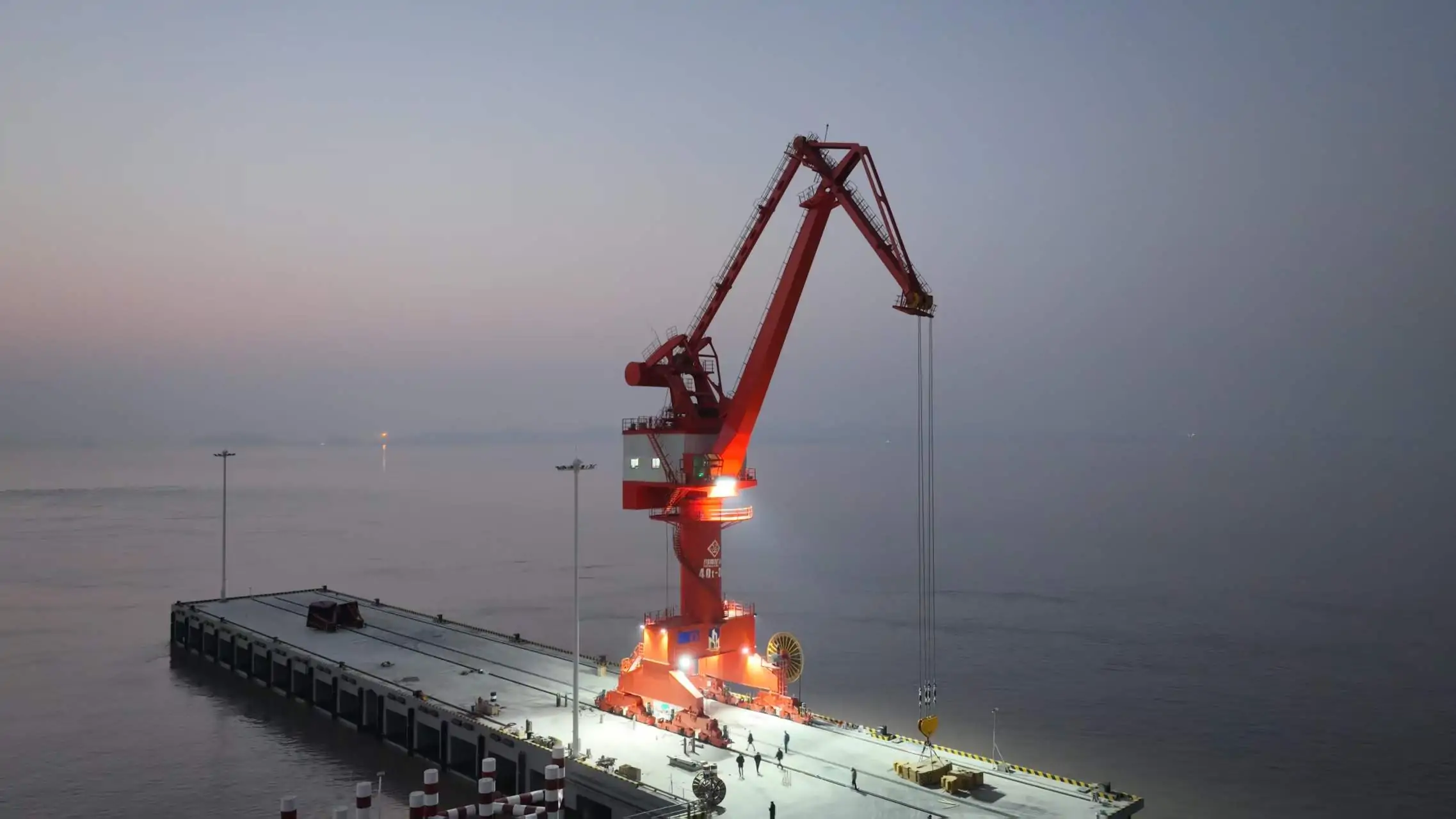
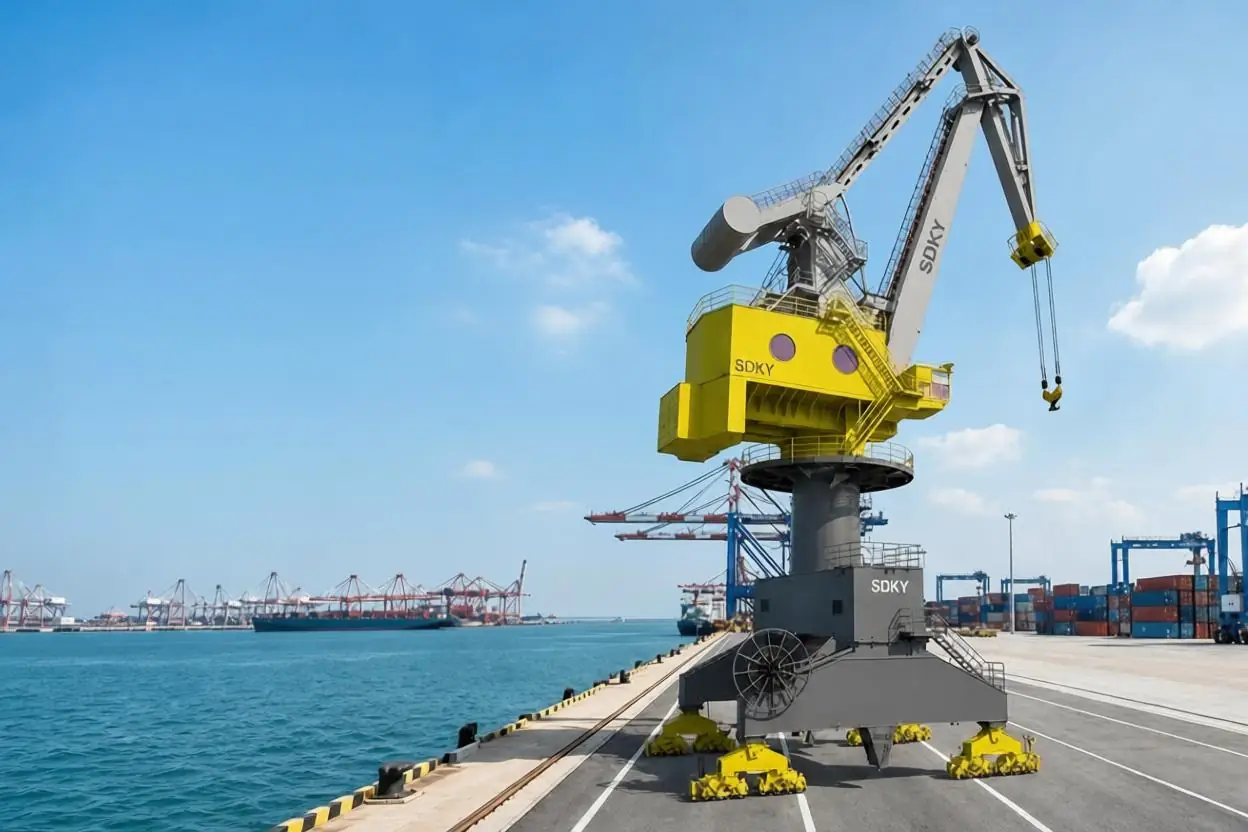
Portal slewing cranes are core equipment across modern ports, shipyards, and bulk cargo terminals. Their gantry base, rotating upper structure, and luffing boom let a single unit serve both the vessel side and the land-side stockpile or storage yard from one rail position, cutting the crane movements needed per handling cycle.
The right slewing range isn't a fixed number , it depends on dock layout, vessel type, cargo characteristics, and how many cranes share the berth. This guide walks through how slewing range works, what drives the ideal figure for different dock applications, and how to specify it correctly when ordering a crane.
What Is the Slewing Range of a Portal Slewing Crane?
Definition of Slewing Range
Slewing range is the total horizontal angle through which a crane's upper structure and boom can rotate around its vertical axis, measured in degrees. It works alongside , but is distinct from , working radius, which is the horizontal distance from the slewing center to the load, controlled by luffing the boom in or out. Slewing range defines how far around the crane can turn. Working radius defines how far out it can reach at any given rotation. The two specs are always read together on a load chart, because a crane's rated capacity at a given radius can shift slightly depending on which side of the portal the boom is slewed toward, especially on asymmetric quay layouts where one side faces open water and the other faces a fixed structure.
Slewing angle is the term used for the specific arc a Henan Mine Crane manufactured crane is built or limited to , 180°, 270°, or 360° , while working radius is expressed as a distance, typically in meters, from the crane's centerline. Buyers sometimes confuse the two because both appear on the same specification sheet, but they answer different operational questions: slewing angle answers "which directions can the crane turn," and working radius answers "how far can it reach once turned."
Continuous and limited slewing systems differ in more than just the maximum angle. Continuous (360°) systems use a slip-ring or cable-reel arrangement to carry power and control signals across an unlimited number of rotations in either direction, which adds cost and a maintenance item but removes any need to "unwind" the crane. Limited-slewing systems can route cables directly, since the boom never completes a full turn, which simplifies the electrical design but requires the operator or control system to respect the mechanical or electronic stop points at all times.
How the Slewing Mechanism Works
Four components work together to deliver controlled rotation, and each has its own role in both performance and long-term reliability:
- Slewing bearing: a large-diameter rolling-element bearing connecting the rotating upper structure to the fixed portal frame. It carries the full vertical load of the boom and hoisted cargo, plus the overturning moment created whenever the boom is extended out from center. Because it takes both radial and axial loads simultaneously, the slewing bearing is one of the highest-stress components on the entire crane and is usually the first place inspectors look during periodic structural surveys.
- Slewing drive: electric or hydraulic motors, geared down through a pinion and large ring gear, that rotate the upper structure at a controlled, adjustable speed. Multiple drive units are often used in parallel on larger cranes to distribute torque evenly around the ring gear and avoid uneven wear on one side of the gear teeth.
- Boom movement (luffing): raises or lowers the boom to change working radius independently of rotation, using either a wire-rope luffing system or hydraulic cylinders depending on the crane's size and duty class.
- Coordinated lifting and rotation: modern PLC-based control systems let hoisting, luffing, slewing, and rail travel run simultaneously rather than one motion at a time. This is what actually shortens cycle times in practice , a crane with a wide slewing range but a control system that only permits one motion at a time will still be slower than a modest-range crane with fully coordinated motion control.
Why Does Slewing Range Matter in Dock Operations?
Improving Cargo Handling Efficiency
A wider slewing range lets one crane transfer cargo directly between the ship's hold and shore-side receiving points , conveyors, stockpiles, trucks, or rail cars , without repositioning along the quay for each cycle. This matters most on repetitive-cycle work like bulk discharge, where the crane may complete a pick-swing-drop-return cycle every 60–90 seconds; even small reductions in wasted travel compound quickly across a full shift.
Maximizing Working Coverage
Combined with rail travel and boom luffing, slewing range extends a crane's effective footprint well beyond the area directly beneath it, letting a single unit serve a long stretch of berth from a small number of fixed rail positions. In practice, port planners often model the "coverage envelope" of each crane position as an arc-and-radius footprint, then space rail stopping points so envelopes overlap slightly , full slewing range reduces the number of stopping points needed to cover a given quay length.
Reducing Vessel Turnaround Time
Every repositioning move , braking, traveling, re-aligning , adds non-productive time to a lift cycle. A slewing range matched to the actual pick-and-place geometry of a berth reduces the number of these moves per shift, and because vessel turnaround time directly affects port fees, berth scheduling, and vessel operating costs, even a modest reduction in repositioning frequency can have a measurable commercial impact over a full port call.
Enhancing Operational Safety
Slewing systems are paired with rotary limit switches that track angular position and automatically stop rotation at a preset boundary, preventing the boom from over-rotating into adjacent structures, other cranes, or restricted zones. These switches are especially important where multiple cranes operate close together or near fixed structures, since they play a direct role in collision avoidance and site coordination. On busy multi-crane berths, slewing limit devices are frequently combined with radar, laser, or camera-based anti-collision systems that detect other cranes or obstacles and issue warnings or automatically stop the crane before contact occurs. Together, these systems mean that a wider slewing range does not have to come at the cost of reduced safety, provided the limit and detection systems are specified and commissioned correctly.
Minimizing Equipment Repositioning
Henan Mine Crane manufactured crane that can reach both the vessel and the storage or transfer point from one slewing arc removes the need to reposition along the rail between nearly every lift , a meaningful driver of daily lift-cycle counts on high-volume berths. Fewer repositioning moves also mean less wear on the travel drive and rail wheels, which can extend maintenance intervals on that part of the crane even as slewing-system wear increases slightly with higher rotational duty.
Factors That Determine the Ideal Slewing Range
Dock Layout and Available Space
Berths with tight clearances to adjacent cranes, buildings, or overhead structures may need a restricted slewing arc, or a slewing range paired with software-defined "no-go" zones, rather than unrestricted 360° rotation. Older ports retrofitted with newer cranes often face this constraint directly, since the original quay layout was rarely designed with full-circle crane rotation in mind, and moving fixed structures to accommodate a new crane is usually far more expensive than specifying a restricted slewing angle from the start.
Vessel Size and Berthing Position
Larger vessels with a wide beam and multiple hatch positions generally benefit from full rotation, since the crane needs to reach across the entire vessel width as well as swing back to the shore side. Terminals that serve a mix of vessel sizes , from small coasters to larger bulk carriers , also tend to favor full slewing, since a fixed berthing position that works well for one vessel class may put a different vessel's hatches at an angle that a restricted-arc crane cannot reach without moving.
Cargo Type
- Bulk cargo(coal, ore, grain) : favors continuous slewing paired with grab attachments for high-throughput, repetitive-cycle discharge, since the crane is typically swinging between the same two or three points hundreds of times per shift and any restriction on the arc directly limits achievable tonnage per hour.
- General cargo: benefits from full rotation combined with precise hook control for placement accuracy, particularly when handling steel coils, machinery, or palletized goods that need to be set down in a specific orientation rather than simply released.
- Heavy project cargo: priority is a stable working radius and load chart at the required angle over slewing speed, since project cargo lifts are typically slower, more deliberate operations where positioning accuracy matters more than cycle time.
- Containers: slewing flexibility matters less than consistent hook height and spreader alignment, since container terminals typically rely on rail-mounted or ship-to-shore cranes for the highest-volume moves, with portal slewing cranes more often used for smaller berths or as supplementary equipment.
Lifting Capacity and Boom Length
Load charts change with radius and slew angle: as boom length and rated capacity increase, the achievable combination of radius and full-circle rotation is constrained more by structural and stability limits than by the drive system itself. A longer boom carrying a heavier rated load creates a larger overturning moment at full radius, which can mean the crane's rated capacity is lower at certain points in the slew arc even on a mechanically unrestricted 360° design , buyers should always check the full load chart across the entire rotation, not just the headline maximum capacity figure.
Operating Radius Requirements
The interaction between slewing range and radius determines total working coverage , a crane can have full 360° rotation but still be limited in practical usefulness if its radius doesn't reach both the vessel hold and the shore-side stacking area. Port planners should map both dimensions against the actual dock geometry before finalizing a specification, since a crane specified with generous slewing range but insufficient radius will still require rail repositioning to reach key pick or drop points.
Number of Cranes Operating Simultaneously
Where two or more portal cranes share a berth or travel the same rail, slewing ranges are sometimes intentionally restricted on the inboard side, backed by anti-collision sensors, to prevent boom overlap during simultaneous operation. This is a common design compromise on multi-crane quays: rather than relying solely on operator judgment and anti-collision electronics to prevent contact, some terminals build in a mechanical slewing limit as a hard backstop, accepting a small reduction in coverage in exchange for a simpler, more predictable safety envelope.
Recommended Slewing Ranges for Different Dock Applications
Bulk Cargo Terminals
Full or near-full rotation (270°–360°) is standard, since bulk terminals need the crane to swing repeatedly between the vessel hold and shore-side hoppers, conveyors, or open stockpiles at high cycle rates. Terminals handling coal, ore, or grain typically prioritize continuous slewing specifically because throughput is measured in tonnes per hour, and any repositioning between cycles directly reduces that figure.
General Cargo Ports
270°–360° slewing supports the mixed handling patterns typical of general cargo , steel coils, machinery, bagged goods, and break-bulk freight moving between varied pick and drop points. Because general cargo terminals rarely have a single repetitive cycle, the flexibility of a wide slewing arc tends to matter more here than raw slewing speed.
Shipyards
180°–360° is common. Full rotation supports hull block turning and section transfer around a dry dock from a single rail position, letting the crane reach every point around the dock without repositioning, which cuts crane movement time during assembly. Where the crane works close to fixed shore structures , outfitting halls, cable gantries, or adjacent slipways , a restricted arc paired with limit switches is used instead, since shipyard layouts are often denser and more permanent than open bulk terminal yards.
Offshore Engineering Bases
360° is typically specified, since offshore fabrication and load-out work requires maximum positional flexibility around large, irregular components such as jacket structures, modules, and topside equipment that cannot always be approached from a predictable angle.
Multi-Purpose Ports
360° slewing supports the widest range of cargo types , bulk, general, and project cargo , on the same crane without reconfiguration between shifts, which is particularly valuable for smaller or mid-sized ports that cannot justify dedicated single-purpose cranes for each cargo stream.
Slewing Range by Dock Application
| Application | Typical Slewing Range | Main Advantage |
| Bulk Cargo Terminal | 270°–360° | Wide cargo coverage, high-cycle discharge |
| General Cargo Port | 270°–360° | Flexible handling of mixed cargo types |
| Shipyard | 180°–360° | Precise component positioning around dry dock |
| Offshore Base | 360° | Maximum operational flexibility |
| Multi-Purpose Port | 360° | Handles multiple cargo types efficiently |
270° vs. 360° Slewing: Which One Is Better?
Advantages of 270° Slewing
A restricted arc reduces the risk of boom interference with adjacent structures, other cranes, or overhead cable routing, and can simplify the design of trailing cable or hose management systems since the Henan Mine Crane manufactured crane never has to complete a full rotation. It can also reduce upfront cost slightly, since the electrical system does not need slip rings or a cable-reel assembly rated for continuous rotation, and it gives site planners a simpler, more predictable safety envelope to design around when other fixed infrastructure sits close to the crane.
Advantages of 360° Continuous Slewing
Unrestricted rotation lets a single crane position serve the full working arc , both vessel and land side , without ever needing to reposition, which is the main reason full slewing is the default specification for most dock portal cranes. It also gives operators more flexibility to approach a load from whatever angle is most convenient, rather than always having to work within a fixed sector, which can reduce operator fatigue and improve placement accuracy over a long shift.
Limitations of Each Design
270° designs limit coverage on the restricted side and can force additional rail travel to reach positions outside the arc, which partially offsets the cost savings if the terminal's cargo flow regularly requires reaching both sides of the crane. 360° designs require more robust cable management (slip rings or cable reels) and typically depend more heavily on limit switches and anti-collision systems when working in close proximity to other equipment, adding a recurring maintenance and calibration requirement that a restricted-arc crane avoids.
Which Option Delivers Better Productivity?
For most dock applications , bulk, general cargo, and multi-purpose berths , 360° slewing delivers higher productivity because it removes repositioning almost entirely. 270° is the better choice specifically where site geometry, adjacent cranes, or fixed structures make full rotation impractical or unsafe, not as a general-purpose alternative. In other words, the productivity comparison should be made against the specific berth layout in question rather than treated as a universal rule , a 270° crane perfectly matched to its site can outperform a poorly positioned 360° crane on the same throughput target.
How Slewing Range Affects Crane Performance
Operating Efficiency
Wider slewing range generally shortens average cycle time by reducing the number of rail repositioning moves per shift, provided the drive system and control logic support smooth, simultaneous slew-and-luff motion. Terminals that track cycle-time data often find that the gap between a well-specified 270° crane and a 360° crane narrows considerably once cargo flow is properly matched to the crane's arc , the biggest efficiency gains come from matching range to layout, not simply maximizing the angle.
Load Stability
Rated capacity typically decreases as working radius increases, regardless of slew angle , the load chart, not the slewing range itself, is what governs safe lifting at any given position. Stability is also affected by wind loading on the boom and load, which is why dock cranes typically carry reduced capacity ratings, or operating restrictions, above certain wind speed thresholds regardless of which direction the boom is slewed.
Positioning Accuracy
Variable-frequency slewing drives allow smooth, low-shock rotation, which is what enables precise load placement rather than slewing range alone; a full 360° crane with poor speed control will place loads less accurately than a well-tuned 270° unit. Fine positioning near the end of a slew movement , bringing a load gently into its final position over a stockpile or vessel hatch , depends on the drive's ability to decelerate smoothly, a control-system characteristic that is independent of the crane's maximum slewing angle.
Maintenance Requirements
The slewing bearing and ring gear are subject to continuous wear proportional to total rotational cycles, so higher-utilization full-slewing cranes generally need closer inspection intervals for the bearing and drive train than limited-arc units doing the same duty cycle. Lubrication schedules for the slewing bearing and gear teeth also become more critical as rotational duty increases, and terminals running 360° cranes at high utilization should budget for more frequent non-destructive testing of the slewing bearing and its mounting bolts as part of routine structural inspections.
Energy Consumption
Continuous slewing at high duty cycles draws more cumulative energy than a restricted arc doing an equivalent number of lifts, though the difference is generally small relative to hoisting energy demand on most dock cranes. For terminals tracking energy costs closely, the marginal difference in slewing energy use is rarely the deciding factor in choosing between 270° and 360° , hoisting speed, duty cycle, and cargo weight typically account for a much larger share of total energy consumption.
How to Select the Right Portal Slewing Crane for Your Dock
Evaluate Port Throughput
Match slewing range and speed to your target lifts-per-hour figure , a high-throughput bulk terminal justifies the extra cost of full continuous slewing more readily than a low-volume, occasional-use berth. Modeling expected cycle times against actual dock geometry before finalizing a specification helps avoid over- or under-specifying the crane relative to real operational demand.
Match the Crane to Cargo Types
Confirm slewing range against your actual cargo mix (bulk, general, project, or container) rather than defaulting to the maximum available spec. If cargo mix is expected to change over the crane's service life, it's worth discussing with the manufacturer whether the base design can accommodate a future range or capacity upgrade.
Consider Future Expansion Plans
Specifying 360° slewing even where current operations don't strictly require it can preserve flexibility if the berth's cargo mix or layout changes later, since retrofitting a limited-arc crane for full rotation is a major structural and control-system change involving new slewing bearings, cable management, and control logic rather than a simple adjustment.
Check Safety and International Standards
Confirm the crane's duty classification, slewing limit switches, and , where applicable , anti-collision systems meet the relevant structural and safety standards for your region and site conditions. Duty classification in particular should reflect actual expected usage rather than a generic default, since a crane under-rated for its real duty cycle will show premature wear in the slewing bearing and drive components well before its expected service life.
Choose an Experienced Crane Manufacturer
Slewing range, boom configuration, lifting capacity, and control systems all need to be engineered together for your specific dock geometry , work with a manufacturer that will model your actual berth layout rather than quoting a standard catalog configuration. A manufacturer familiar with port and shipyard applications can also advise on classification society requirements, spare parts availability, and long-term maintenance planning specific to your slewing system design.
Frequently Asked Questions (FAQ)
Q: Is a 360° slewing crane always the best choice?
No. 360° is the right default for most bulk, general cargo, and multi-purpose berths because it removes repositioning. But in tight, multi-crane berths or sites with fixed overhead structures nearby, a restricted 180°–270° arc paired with limit switches can be the safer and more practical choice.
Q: What is the standard slewing angle for a portal slewing crane?
Most dock portal slewing cranes are built for full 360° continuous rotation, since it lets one crane position serve both the vessel and shore-side storage without repositioning. Restricted ranges are specified as exceptions for site-specific space or safety constraints, not as the default.
Q: Does a larger slewing range improve productivity?
Generally yes, because it reduces rail repositioning between lifts. But productivity also depends on slewing speed, control system responsiveness, and how well slewing range is matched to the actual cargo flow , a wider arc with a slow drive won't outperform a well-specified narrower one.
Q: How does slewing range affect maintenance costs?
Full 360° cranes operating at high duty cycles put more cumulative wear on the slewing bearing and ring gear than restricted-arc cranes performing the same number of lifts, which can mean shorter inspection intervals for the slewing system over the crane's service life.
Q: Can the slewing range be customized?
Yes. Manufacturers can configure slewing range, along with lifting capacity, boom length, and control systems, to match a specific dock layout, and can adjust limit switch settings to define a restricted operating arc even on a mechanically full-rotation crane.
Henan Mine Crane Factory Custom
The right slewing range is determined by the unique requirements of each dock rather than a one-size-fits-all specification. Factors such as berth layout, vessel dimensions, cargo types, operating frequency, and future expansion plans should all be evaluated together to ensure the crane delivers the best balance of productivity, safety, and long-term operating efficiency.
As a professional manufacturer of heavy-duty lifting equipment, Henan Mine Crane Factory provides customized portal slewing cranes engineered for the specific needs of ports, shipyards, and bulk cargo terminals. From slewing range and boom configuration to lifting capacity, intelligent control systems, and complete project support, our engineering team works closely with customers to deliver reliable, high-performance crane solutions that improve operational efficiency, reduce lifecycle costs, and ensure dependable performance in demanding marine environments.