
How to Choose the Right Gantry Crane for Your Material Handling Needs
Gantry cranes are the core material handling equipment for factory production, warehousing and logistics, port construction sites and other scenarios. The selection of advantages and disadvantages is directly related to production efficiency, operation safety, equipment life and production costs.Many companies only choose models based on experience when purchasing, which is prone to problems such as poor equipment adaptability, frequent failures, and wasted costs.Relying on professional lifting and lifting manufacturing experience, this article systematically disassembles the core logic of gantry crane selection, covering all working conditions and scenarios, and helps enterprises accurately select models, avoid misunderstandings, reduce costs and increase efficiency.
Define Your Material Handling Requirements
The first step in the selection of gantry cranes is not to look at the equipment parameters, but to accurately sort out the requirements of their own handling conditions.All equipment parameters, model configuration, and function customization must revolve around the actual material handling scenario.The vague definition of requirements is the primary cause of selection errors. Only by accurately targeting the core requirements can the problems of poor equipment adaptability and mismatched production capacity be avoided from the root cause.
Load type and maximum weight
First of all, it is necessary to clarify the types of materials to be transported daily, including solid finished products, steel profiles, containers, sand and gravel materials, precision equipment, heavy molds, etc.The shape, center of gravity, and hoisting methods of different materials vary greatly, which directly affects the structural design and accessory selection of gantry cranes.For example, precision equipment handling requires a smooth and non-shaking lifting configuration, bulk material handling needs to be equipped with special grapple, suction cups and other auxiliary aids, and heavy steel handling requires higher load-bearing rigidity of the main beam.
At the same time, the maximum lifting weight must be approved, and a reasonable safety margin must be reserved.The general selection standard in the industry is that the rated load of the equipment must be greater than 1.25 times the maximum daily hoisting weight, and long-term full load and overload operation is strictly prohibited.Many enterprises only select the type according to the weight of conventional materials, ignoring the occasional heavy-duty material hoisting requirements, which leads to overload operation of the equipment in the later stage, deformation of the main beam, and motor burning, greatly shortening the service life of the equipment.
Lifting frequency and workflow
The hoisting frequency directly determines the working level and working condition adaptability of Henan Mine Crane manufactured gantry cranes, which is the core basis for distinguishing light, medium and heavy work equipment.If it is intermittent light-duty handling in the workshop, the number of hoisting times per day is small and the intermittent time is long, you can choose a lightweight conventional model.If it is supporting the factory assembly line, high-frequency turnover in warehousing, continuous loading and unloading at the port, hundreds of hoisting times a day, and continuous operation for a long time, a special model for heavy-duty work must be selected.
In addition, it is necessary to sort out the complete operating process, clarify the whole process of lifting, translation, landing, and stacking of materials, and determine whether special operating modes such as fixed-point hoisting, reciprocating handling, and cross-regional transportation are required, so as to provide a basis for the subsequent span, walking speed, and control mode selection, so as to ensure that the equipment is perfectly adapted to the rhythm of the production line and improve the overall operating efficiency.
Material movement requirements
The material movement requirements of different scenes vary significantly. Some scenes only need to be hoisted vertically, some need to move horizontally, vertically, and horizontally simultaneously, and some scenes need to be accurately aligned and fine-tuned. Positioning.For example, mold installation and equipment maintenance scenarios require high-precision fine-tuning and movement.The storage and stacking scene requires a wide range of covered movement.At the same time, it is necessary to clarify the distance, height, and positioning accuracy requirements of the material movement, whether it needs to move smoothly at a uniform speed, and whether it needs a low-speed fretting function. These requirements directly determine the walking mechanism, speed regulation system, and limit device configuration of Henan Mine Crane manufactured crane to ensure accurate, efficient, and collision-free material handling, and adapt to the needs of refined operations.
Determine the Required Gantry Crane Capacity and Dimensions
After clarifying the basic handling requirements, the core parameters of the equipment need to be accurately approved, including core hard indicators such as lifting tonnage, span, lifting height, and operating area size.The deviation of the parameters will directly lead to the inability of the equipment to be installed, insufficient operating range, and waste of space. It is the most critical quantitative link in the selection process.
Lifting capacity
The lifting capacity of the gantry crane is the rated lifting weight, which is the most core parameter of the equipment. The unit is tons (t), and the common specifications cover the full range of 1t-200t.The core principle of selection is to select the type reasonably according to the actual working conditions, and reserve certain safety surplus parameters in advance, not only to avoid safety accidents caused by overloading of small-tonnage equipment, but also to prevent waste of costs caused by idle large-tonnage equipment.
Light-load intermittent operation scenarios (workshop small-piece handling, equipment maintenance), optional 1t-10t light gantry crane.Medium-load conventional operation scenarios (steel processing, storage and material turnover), suitable for 10t-50t medium-sized gantry cranes.For heavy-duty continuous operation scenarios (heavy-duty manufacturing, port loading and unloading, hoisting of large components), heavy-duty gantry cranes above 50t are required.At the same time, combined with the weight of the material, the weight of the hoisting aids, and the loss of eccentric hoisting, the rated load is comprehensively approved to ensure the safety and redundancy of the operation.
Span and lifting height
The span refers to the distance between the centers of the outriggers on both sides of the gantry crane, which determines the horizontal operation coverage of the equipment, and strictly matches the width of the site, the width of the material stacking, and the size of the operation channel.If the span selection is too small, it will lead to incomplete job coverage, and if it is too large, it will increase the weight of the equipment and the procurement cost, and it will also reduce the operating stability of the equipment.Lifting height refers to the vertical distance from the lowest position of the hook to the highest lifting position. When selecting the type, you cannot only refer to the height of the material itself. It is necessary to comprehensively consider the height of the material stacking, the height of the working platform, the length of the lifting aids, and the height of the obstacles at the top of the site. At the same time, reserve a safe buffer distance to avoid problems such as material collision with the top structure and the failure of the limiting device during the lifting process, so as to ensure sufficient vertical working space.
Working area and clearance
It is necessary to comprehensively survey the on-site operating area, including the available space on the ground, the walking passage of the equipment, the safe distance on both sides, the height of the top clearance, and the size of the track installation area.During the operation of the gantry crane, the outriggers, main beams, and walking mechanisms need to maintain a standard safe net distance from obstacles such as plant columns, walls, equipment, and pipelines to eliminate hidden dangers of operating collisions.At the same time, it is necessary to plan the walking range of the equipment, the material stacking operation area, and the personnel operation buffer area to ensure that the operation area is reasonably laid out, which not only meets the full range of material handling needs, but also complies with safety production specifications, and reserves sufficient space for equipment installation, commissioning, and later operation and maintenance.
Choose the Right Gantry Crane Configuration
Gantry cranes have a variety of structural configurations, and the applicable scenarios, operating flexibility, load-bearing capacity, and cost performance of different configurations vary greatly.Choosing the appropriate structure based on its own working conditions and site conditions can greatly improve the practicality of equipment and reduce operation and maintenance costs. It is the core link of accurate selection.
Fixed vs. mobile gantry cranes
Fixed gantry cranes need to be fixed and installed on embedded tracks or concrete foundations. The whole machine has strong stability, high load-bearing upper limit, and high operating accuracy. It is suitable for scenarios where the work area is fixed, there is no need for frequent displacement, and long-term continuous operation, such as fixed production line hoisting, fixed-point stacking of large warehouses, and construction of fixed work areas on construction sites. It is the mainstream choice for industrial heavy-duty scenarios.The mobile gantry crane is equipped with rubber walking wheels, no embedded track is required, and the whole machine can be shifted manually or electrically. It is flexible in deployment, easy to install, and can operate across sites. It is suitable for light loads, multi-area scattered operations, temporary construction, and flexible handling scenarios in workshops.The disadvantage is that the heavy-duty stability is slightly lower, which is not suitable for high-frequency and large-tonnage continuous operation, focusing on lightweight and flexible operation requirements.
Single-girder vs. double-girder gantry cranes
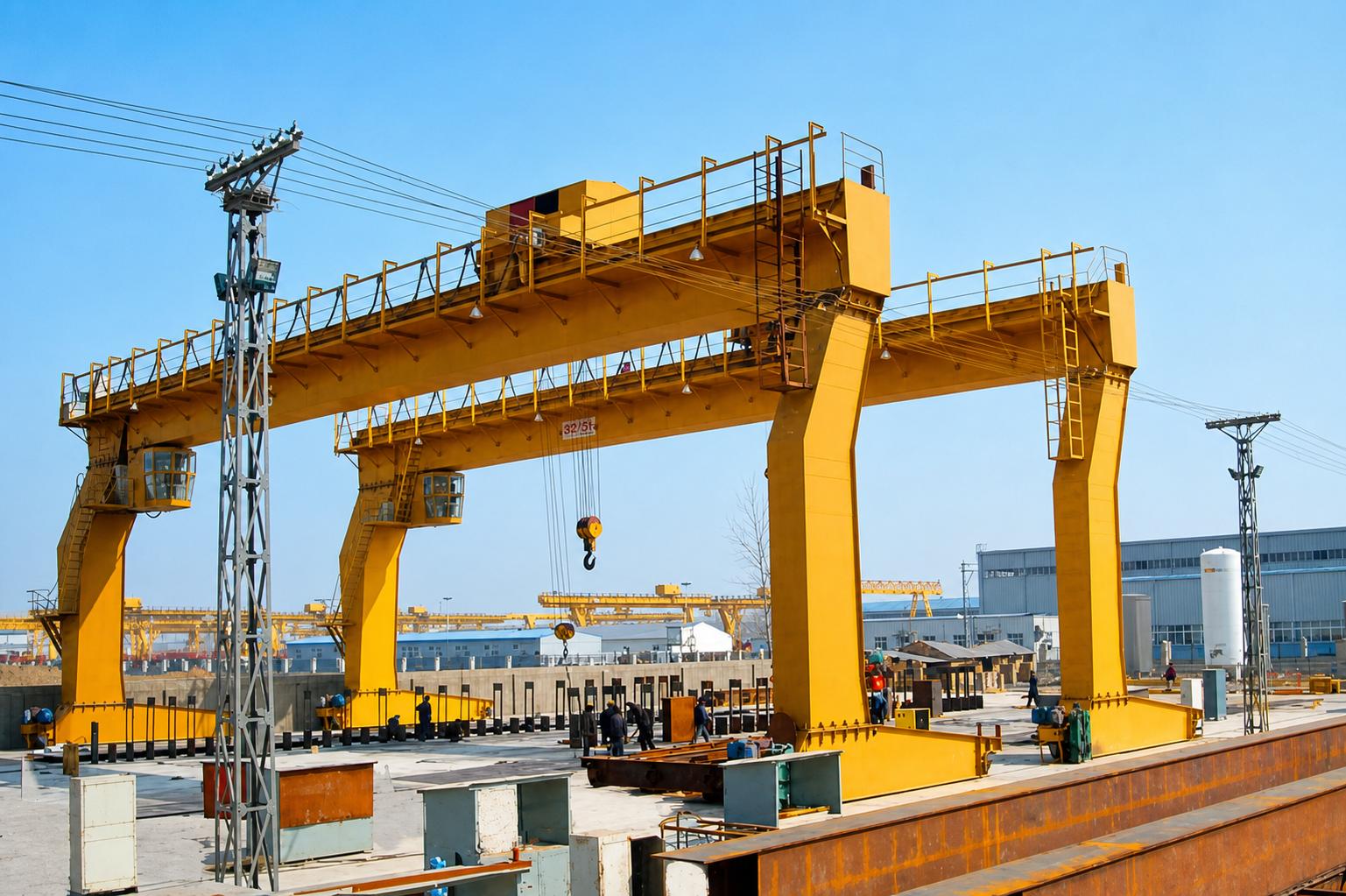
Henan Mine Crane manufactured single-girder gantry crane has a simple structure, light weight, low cost, low energy consumption, and convenient operation and maintenance. It is mainly suitable for 1t-32t medium and light load operations, indoor and outdoor scenes with medium operating frequency and simple working conditions, such as small workshops, warehousing, and light material handling. It is extremely cost-effective and is a common choice for small and medium-sized enterprises.The double-beam gantry crane adopts a double-main beam structure, which has stronger rigidity, greater load-bearing capacity, smoother operation, and excellent fatigue resistance. It can be adapted to large tonnage loads above 32t, supports high-frequency, long-term, and high-intensity continuous operation, and has a wider range of lifting heights and spans. It can be used with various complex lifting aids, suitable for heavy-duty manufacturing, large-scale steel structure processing, ports and docks, large-scale infrastructure and other heavy-duty conditions.
Full gantry vs. semi-gantry configurations
The full gantry crane adopts a double-sided symmetrical outrigger structure. The whole machine has balanced force, excellent stability, and comprehensive operation coverage. It is not limited by the side conditions of the site. It can independently complete the material handling of the whole area, and is suitable for all kinds of open outdoor venues, large factories, and operating scenarios without wall support. It has the strongest versatility.The semi-gantry crane is an asymmetric structure with one-sided legs and one-sided support on the wall/column of the plant. The biggest advantage is to save site space and adapt to indoor and outdoor scenes where the site is narrow, there is a building structure on one side, and the passage is limited, such as the workshop side work area and the material stacking area against the wall.It is extremely targeted and can effectively solve the problem of equipment installation in small sites, but it is not suitable for unsupported and wide-open operation scenarios.
Consider the Operating Environment and Duty Cycle
The operating environment and working system are the key hidden factors that affect the service life, operating stability and maintenance costs of gantry cranes.Most enterprise selection only focuses on parameters and structure, ignoring environmental adaptability, which leads to corrosion, aging, and frequent failures of equipment in the short term, greatly shortening the service life. Therefore, it is necessary to customize the adaptation plan in combination with the on-site environment.
Indoor vs. outdoor applications
The indoor operating environment is relatively stable, free of wind, rain, sand, exposure, rain and snow erosion. Gantry cranes with conventional anti-corrosion configuration and electronic control by ordinary motors can be selected. They are mainly lightweight, cost-effective, and low-noise operation, and are suitable for workshops, factories, indoor storage and other scenarios.Outdoor operations need to face wind and rain, exposure, rain and snow, and changes in temperature difference between day and night, and special outdoor adaptation treatment must be done.The whole equipment needs to be coated with outdoor anticorrosive coating, and the motors, electronic controls, and electrical accessories need to be specially designed for rain, dust, and sun protection. At the same time, they are equipped with windproof anchoring devices, track stops, and lightning protection devices to prevent equipment sliding in windy weather, electrical short circuits, structural corrosion, etc., and are suitable for outdoor scenes such as construction sites, ports, and open-air yards.
Lifting frequency and duty requirements
The working system of lifting equipment (A1-A8 level) corresponds to different lifting frequencies and load continuity rates, which directly determines the durability and service life of the equipment.The A1-A3 light-level work system is suitable for low-frequency, intermittent, and short-term operations, and is suitable for equipment maintenance and scattered hoisting.The A4-A6 intermediate work system is suitable for daily normalization and intermediate frequency continuous operation, and is the mainstream selection for general industrial scenarios.The A7-A8 heavy-duty work system is suitable for ports, heavy-duty assembly lines, and high-frequency continuous operation scenarios at full load.When selecting models, it is strictly forbidden to replace heavy-duty equipment with light-duty equipment. Long-term high-frequency and heavy-duty operation will cause fatigue deformation of the main beam, overheating and burning of the motor, and accelerated wear of the reducer, greatly increasing the probability of failure and operation and maintenance costs. The corresponding work level must be matched in strict accordance with the operation frequency.
Temperature, wind, dust, and corrosive conditions
Special and harsh working conditions need to be specially customized and adapted. High-temperature motors and electronic controls need to be selected for high-temperature environments, and heat dissipation devices are equipped to avoid high-temperature equipment downtime.The low-temperature and cold environment requires the use of low-temperature antifreeze steel and antifreeze lubricating grease to prevent the structure from cracking and the accessories from getting stuck.In dusty and gravel scenes, the electrical system, walking mechanism, and transmission components need to be fully enclosed and dust-proof to prevent dust from entering the interior of the equipment and causing caton, short circuit, and wear.In chemical industry, coastal salt spray, and humid corrosive environments, heavy anticorrosive spraying, galvanized anti-rust treatment, and corrosion-resistant accessories are selected to enhance the corrosion resistance of the equipment and extend the service life of the equipment.At the same time, outdoor windy scenes need to strictly match the corresponding windproof level, and be equipped with professional windproof devices to ensure the safety of extreme weather operations.
Select the Right Hoist and Crane Controls
The lifting hoist mechanism and control system are the core execution components of Henan Mine Crane manufactured gantry crane, which directly determine the operating accuracy, smooth operation, ease of operation and safety of the equipment.High-quality accessories matching and control solutions can greatly improve operating efficiency, reduce operating difficulty, and reduce safety issues caused by human operation errors.
Hoist type and lifting speed
Commonly used hoist mechanisms are divided into two categories: electric hoists and standard hoists.The electric hoist has a compact structure, light weight and energy saving, and stable start and stop. It is suitable for 1t-32t medium and light gantry cranes with moderate lifting speed and is suitable for smooth hoisting of conventional materials.The heavy-duty hoist has strong load-bearing capacity, sufficient power, and good overload resistance. It is suitable for heavy-duty gantry cranes above 50t, which can meet the needs of stable lifting of large-tonnage heavy objects and continuous heavy-duty operation.The lifting speed can be customized according to the needs of the operation, and the standard uniform lifting speed is selected for conventional material handling.For precision equipment, fragile materials, and high-precision alignment operations, two-speed speed regulation and frequency conversion speed regulation configurations can be selected to achieve rapid lifting and low-speed fretting, taking into account operating efficiency and hoisting accuracy, and preventing material shaking and bumping damage.
Trolley and crane travel requirements
It is necessary to combine the translation needs of material handling to determine the speed and accuracy of the trolley walking horizontally and the whole machine walking vertically.Under normal working conditions, fixed-speed walking can be used to meet the needs.For refined operation scenarios such as assembly line matching, precise stacking, and equipment alignment, it is recommended to be equipped with a frequency conversion walking system to achieve smooth start-stop and stepless speed regulation to eliminate material shaking and offset caused by start-stop inertia.At the same time, according to the coverage of the operation, the walking stroke and track length are determined, and the adapted walking wheels, transmission mechanisms, and limit cushioning devices are selected to ensure the smooth operation of the equipment throughout the process, with precise limits and cushioning in place to avoid collision and impact damage to equipment and materials.
Pendant, remote, or cabin control
At present, the mainstream control methods of gantry cranes are divided into three types, which are adapted to different operating scenarios. The handheld button box is simple to operate, low cost, and fits close-range conventional operations. It is the basic configuration of small and medium-sized gantry cranes.The wireless remote control control is flexible and the wireless circuit is bound. The operator can stay away from the hazardous area of the operation and observe the hoisting status from multiple angles. The safety is higher, and it is suitable for most indoor and outdoor general scenes.The cab has a wide field of vision and comfortable operation. It is equipped with professional control handles and instruments. It is suitable for heavy gantry cranes with large tonnage, large range and long-term continuous operation. It can effectively reduce operator fatigue and adapt to high-intensity operation scenarios such as ports, large construction sites, and heavy industry factories.Enterprises can flexibly match control methods according to operating distance, complexity of working conditions, and safety requirements. Some scenarios can support dual control switching to improve equipment practicality.
What to Check Before Ordering a Gantry Crane
After completing the selection of models, parameters, and configurations, the final verification before ordering is the last level to avoid procurement errors and ensure the adaptation of equipment on the ground.Most companies have problems such as equipment cannot be installed, working conditions are not matched, and there is no after-sales guarantee after purchasing. They all ignore the preliminary verification link. The following six core points must be confirmed one by one.
Applicable safety standards
Gantry cranes are special equipment. The production, manufacturing, installation and acceptance must strictly follow national and industry safety standards. The equipment must have complete production qualifications, test reports, certificates of conformity, and special equipment certification certificates.Before ordering, it is necessary to confirm that the manufacturer's products comply with the current lifting machinery safety specifications, and are equipped with a full set of safety protection devices such as overload limit, height limit, stroke limit, buffer, windproof device, and emergency brake.Resolutely eliminate non-standard three-no equipment, avoid problems such as equipment acceptance failure, failure to file for the record, and penalties for operating violations, and ensure equipment compliance and operation safety from the source.
Site conditions and installation requirements
Accurately survey the ground bearing capacity, basic construction conditions, track installation conditions, power supply conditions, site clearance size, and surrounding obstacle distribution of the installation site in advance.Confirm in advance whether it is necessary to do concrete foundations, embedded tracks, retrofit power supply lines, and clean up obstacles, and clarify the installation and construction conditions, construction period, and site adaptability.At the same time, confirm the equipment installation process, commissioning standards, and entry conditions with the manufacturer, and prepare the site in advance to avoid problems such as inability to install, rework, and delay production after the equipment arrives, saving time and transformation costs.
Future material handling needs
The purchase of gantry cranes cannot only meet the current operating needs. It needs to be combined with the company's capacity expansion, material upgrading, and site expansion planning in the next 1-5 years to reserve equipment upgrade margin.If there are needs for material weight gain, expansion of operation range, increase in hoisting frequency, and new operation scenarios in the future, tonnage, span, and height margins can be appropriately reserved during the selection process to support later functional upgrades and parameter adjustments.Predicting the long-term demand in advance can effectively avoid the problem of insufficient equipment production capacity and secondary procurement and replacement in the short term, significantly reduce the input cost of enterprise equipment, and improve the long-term cost performance of equipment.
Henan Mine Crane Factory Custom Custom
The selection of gantry cranes is not a simple parameter matching, but a combined systematic engineering.From clarifying basic material handling requirements, to approving precise equipment parameters, to matching and adapting models, adapting to working conditions and environments, optimizing control accessories, and finally completing pre-order compliance and site verification, the six steps are progressive layer by layer, which can completely avoid selection misunderstandings.
As a professional large-scale crane manufacturer, Henan Mine Crane Factory has a full range of customized gantry crane production capacity, which can provide standardized and customized one-stop material handling solutions for all scenarios such as indoor and outdoor, light and heavy loads, special corrosion, high and low temperature, and high-frequency operations. Equipment compliance, stable performance, and perfect after-sales service help enterprises reduce costs and increase efficiency and produce safely.