
Outdoor Marine Slewing Jib Cranes: Corrosion-Resistant Port Maintenance Solutions
In the open-air operation and maintenance scenario of the port, ordinary lifting equipment can easily rust quickly in the salt spray, high humidity and sea breeze environment. Frequent downtime for maintenance and replacement of parts will directly disrupt the operation rhythm of the pier and increase long-term operating costs.Henan Mine Crane Factory supply Outdoor Marine Slewing Jib Cranes is specially developed for strong marine corrosion conditions, equipped with a full set of anti-corrosion protection system, and stably undertakes the daily maintenance and hoisting tasks of ships and terminal supporting facilities. It is the preferred lightweight lifting solution for coastal ports, ship-building bases, and coastal operating platforms.This article focuses on its application value, corrosion risk, anticorrosive configuration, selection points, and maintenance specifications. At the same time, it introduces the customized delivery capabilities of Henan Mining Crane Factory.
What Makes Outdoor Marine Slewing Jib Cranes Essential for Port Maintenance?
Common port maintenance tasks
There are a large number of decentralized, high-frequency, and changeable load-span hoisting operations in the daily maintenance of the port. This kind of working condition is a typical application scenario of Outdoor Marine Slewing Jib Cranes, and it is not suitable for large-scale door machines and shore bridges.Typical operations include ship outboard spare parts hoisting, pipeline valve disassembly and replacement, fender and bollard maintenance, dock steel structure flaw detection, small pump set and electric control cabinet transfer, life-saving equipment loading and unloading, and beacon pontoon accessories replacement.The operating points are scattered, and the single lifting distance is short. They are often carried out in small spaces such as the side of the berth and the corner of the platform. There are strict requirements for the flexibility of the crane and the adaptability of the site.
Benefits of slewing jib cranes
The core advantage of Outdoor Marine Slewing Jib Cranes (rotary cantilever cranes) is its small footprint and flexible layout. Large-angle rotation can cover the entire operating area, and a single equipment can meet the scattered maintenance needs of a berth.Compared with large-scale port aircraft, it has lower procurement investment, short installation cycle, simple operation, and can be hoisted independently by a single person.The equipment starts and stops smoothly, and has less impact on precision maintenance accessories. It can be fixed and installed on the berth platform, barge or beside the maintenance walkway, and can be used and started at any time. There is no need to repeatedly dispatch large-scale lifting equipment, which effectively compresses the waiting time for maintenance and improves the efficiency of berth turnover.
Outdoor operating challenges
The open-air operating environment of the port is very different from that of the inland plant. The outdoor Marine Slewing Jib Cranes equipment is exposed to the complex and changeable marine climate all year round.In addition to the persistent salt spray corrosive medium, it must also withstand strong gusts of wind, heavy rains, thunder and lightning, and material stress changes caused by temperature differences between day and night. The splash of seawater caused by the rising and falling tides will continue to wet the steel structure.Many docks still have problems such as narrow operating areas, limited basic space, and limited power supply conditions. After long-term use, ordinary cantilever cranes are prone to rotation stagnation, bolt rust, electrical short circuit, coating peeling, and buried hoisting safety risks. This is why the port needs to choose outdoor marine slewing Jib Cranes. The reason.
Key Corrosion Risks for Marine Jib Cranes
Salt spray and humidity
Salt spray is the most important corrosion cause of outdoor Marine Slewing Jib Cranes. After the chloride ions in the sea breeze attach to the surface of the steel, it will destroy the metal passivation film, and electrochemical corrosion will continue to occur in a high humidity environment, gradually forming pitting and rust pits.This kind of corrosion has a strong concealment. It is only manifested as fine rust spots in the early stage. It spreads inward along the welds and stress concentration areas in a short period of time, weakening the structural strength of the main beam and rotary support. It is also the core reason for the early failure and scrap of a large number of port lifting equipment.
Coastal wind and rain
Strong coastal winds will accelerate the spread of salt spray, allowing corrosive media to penetrate into crevices, bolt holes, bearing mating surfaces, junction boxes and other hidden dead corners.Heavy rain scouring cannot completely take away the salt on the surface of the component. After the water evaporates, the salt is enriched on the surface again, and the alternating cycle of dry and wet will exponentially speed up the corrosion rate.At the same time, the continuous sea breeze will apply alternating loads to the cantilever, and the protective coating will be more likely to crack and peel under the action of vibration, opening intrusion channels for chloride ions and water vapor, and accelerating the corrosion and damage of internal components.
Continuous outdoor exposure
The equipment is placed in the open air unobstructed all year round, and the continuous exposure of ultraviolet rays will gradually age the topcoat, causing the coating to powder and lose the ability to close and protect.Condensation at night and frost in autumn and winter will maintain the moist state of the surface of the components for a long time. Even if the crane is suspended, the corrosion reaction will not be interrupted.In difficult-to-clean locations such as the inside of the rotary bearing, the flange butt gap, and the cable inlet, salt continues to accumulate, and the corrosion rate is much higher than that of the steel structure visible on the outside. It is also a weak part that can be easily ignored in daily inspections.
Corrosion-Resistant Features of Marine Slewing Jib Cranes
Marine-grade steel structures
The main steel structure of Henan Mine Crane Factory supply Outdoor Marine Slewing Jib Cranes is made of marine-grade high-strength steel, and the raw materials are tested for defects before entering the factory to avoid congenital defects such as internal slag and cracks.In the structural design stage, water-stagnant grooves and dead corners are avoided as much as possible. All welds are continuously welded and polished smoothly to reduce stress gaps that are prone to water and salt accumulation.Important force components are designed with thickened margins to reserve the amount of corrosion loss, so as to meet the long-term use standards of C5-M marine high-corrosion environments from the substrate level.
Protective coating systems
The complete set of outdoor Marine Slewing Jib Cranes anticorrosive coating strictly follows the marine heavy anticorrosive construction process, and the overall steel structure is sandblasted and rust-proof, and the cleanliness reaches Sa2.5 or higher.The primer adopts epoxy zinc-rich primer, which relies on the zinc layer to protect the base steel by sacrificing the anode.The middle layer is equipped with epoxy cloud iron paint to strengthen the anti-penetration barrier ability.The topcoat is made of polyurethane or fluorocarbon topcoat that is resistant to salt spray and ultraviolet rays, and the total thickness of the dry film is controlled to adapt to the working conditions of the port.The coating has excellent adhesion and is resistant to long-term erosion by rain. After local collision damage, it can also be quickly patched and repaired at the dock site.
Stainless steel components
All exposed small pieces that require frequent disassembly and assembly are preferred to be made of 304 or 316 stainless steel, including safety guardrails, lugs, limit brackets, pins, pipeline clamps and other accessories.This kind of parts is not large in size, but the replacement process is cumbersome after the rust is stuck, which will directly interrupt the port maintenance operations.The configuration of stainless steel accessories can significantly reduce the frequency of replacement of parts, reduce the cost of purchasing spare parts, and reduce the downtime and waiting time caused by small failures.
Sealed electrical systems
A full set of electrical components of Outdoor Marine Slewing Jib Cranes is equipped with a waterproof and dustproof sealed box, and the protection level of electric hoist electronic control, rotary drive motor, and terminal blocks reaches IP65 and above.The cable adopts marine-specific weather-resistant rubber-sheathed cables, and the outer layer is sheathed with anti-salt spray and anti-aging sheaths. A sealed gland is installed at the entry position of the cable to prevent rain and salt spray from following the cable into the interior of the electric control box.This set of sealing design can effectively eliminate electrical failures such as leakage, short circuit, and signal loss of control that occur frequently at sea, and ensure the stable control of the crane on the humid coast.
Corrosion-resistant fasteners
The standard fasteners of the whole machine are uniformly hot-dip galvanized or stainless steel anticorrosive bolts, nuts, and washers, and are used with sealing gaskets.Key force positions such as the base feet, boom docking, and slewing bearing connection are additionally equipped with anti-loosening structures to not only resist the continuous corrosion of salt spray, but also offset the risk of loosening caused by the alternating vibration of the sea breeze.Anticorrosive fasteners take into account anti-rust performance and detachability, which is convenient for operation and maintenance personnel to disassemble and inspect the internal structure regularly, so as to avoid the late bolt rust and cannot be disassembled.
How to Choose the Right Outdoor Marine Slewing Jib Crane
Load capacity and lifting radius
When selecting models for Henan Mine Crane Factory supply Outdoor Marine Slewing Jib Cranes, first sort out the conventional hoisting weight of the port maintenance, reserve sufficient safety margin on the basis of the conventional load, and do not directly select the rated tonnage according to the instantaneous peak load.At the same time, the effective working radius of the cantilever is determined based on the coverage of berth maintenance, taking into account the lifting of small pieces at the remote end and the heavy-duty operation close to the column.If the radius is too long, the stability coefficient of the crane will be reduced, and if the radius is insufficient, the coverage will be incomplete. It is necessary to combine the layout of the terminal platform and the comprehensive balance of the ship's docking location to match the real maintenance needs.
Slewing angle and coverage
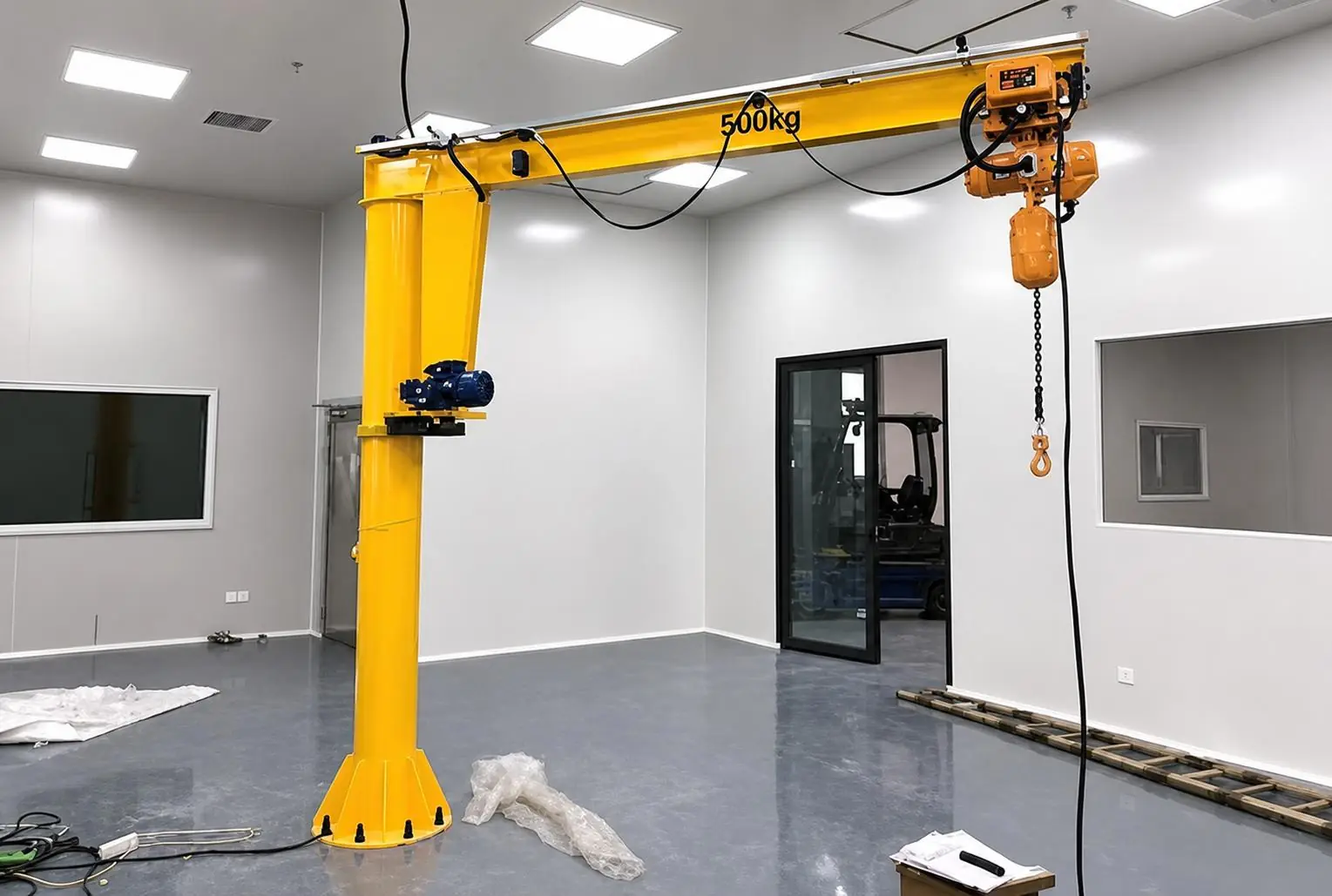
The rotary cantilever crane determines the rotation angle of the crane according to the layout of the berth and the distribution of surrounding facilities. There are commonly 180°, 270°, and 360° full-rotation versions.180° or 270° rotation schemes can be used for narrow and long berths, and 360° rotation models are preferred for areas with open space and areas that need to take into account operations on both sides.When planning the rotation coverage, it is necessary to avoid obstacles such as dock guardrail, pipelines, and other port machinery to prevent collisions when the cantilever rotates, maximize the effective operating area of the crane, and improve the flexibility of maintenance scheduling.
Mounting and foundation
The rotary cantilever crane has a variety of installation forms such as fixed base type, flange base type, and column type. The selection should match the existing basic conditions of the dock.Concrete platforms need to account for the carrying capacity of the foundation, and the installation of barges and floating platforms must also consider the additional loads caused by hull deformation and wave shaking.The installation base needs to be matched with anti-corrosion treatment simultaneously, and the embedded feet should be sealed and anti-seepage to avoid seawater from eroding the foundation along the gap of the base, reduce the hidden dangers of corrosion from the source of installation, and ensure the long-term stability of the whole machine.
Wind and weather resistance
In coastal areas, the parameters of the maximum wind gusts and typhoons in the local area all year round should be adjusted, and the models corresponding to the wind resistance level should be selected.The crane structure and cantilever cross-section have been verified by wind load, and are equipped with windproof anchoring devices or windproof wedges, which can lock the cantilever in windy weather.In addition to wind resistance, the protection of the whole machine should also be adapted to climates such as heavy rain, exposure, and frost. The protection standards of coating, electrical, and bearing should be upgraded simultaneously to avoid structural deformation or electronic control failure of the Henan Mine Crane Factory supply crane after extreme weather. Problems.
Power and control options
According to the power supply conditions of the terminal, the power plan is selected, which is divided into 380V industrial mains power supply, battery power supply and other types. The maintenance platform away from the fixed power supply point can give priority to the battery version.The control method supports two types of wired handle control and wireless remote control. The wireless remote control is more suitable for complex scenes in the port, and the operator can stand in a position with a better field of view to command the hoisting.The electronic control system comes with overload protection, limit protection, and emergency stop functions, taking into account the convenience of operation and the safety regulations of offshore operations.
Marine Jib Crane Maintenance for Long-Term Performance
Routine corrosion inspections
Establish a fixed-point inspection list for Outdoor Marine Slewing Jib Cranes, focusing on areas with high corrosion such as welds, bolt positions, coating surfaces, rotary bearing gaps, and electronic control sealing interfaces.During inspection, pay attention to early signals such as rust spots on the surface, water seepage in the coating bulge, and cracking of seals, and use endoscopy to inspect dead corners that are difficult to observe with the naked eye such as bearings and the inside of flanges.For docks with severe salt spray, it is recommended to increase the frequency of inspections and dispose of the corrosion in time before it develops to damage the main steel structure to avoid structural safety risks.
Lubrication and component checks
According to the maintenance cycle, fill the moving parts such as slewing bearings, lifting pulleys, wire ropes, pins, etc. with seawater-resistant greases suitable for the marine environment.Each maintenance synchronously checks the broken wire of the wire rope, pulley wear, the sensitivity of the limit device, and the stability of the remote control signal.Lubrication can reduce the friction and wear of components. At the same time, the grease forms an isolation film, which prevents the salt spray and water vapor from directly contacting the metal friction surface, avoids the rust and stagnation of the moving pair, and ensures the smooth and reliable rotation and lifting of the crane.
Coating repair and replacement
After the inspection finds that the coating is bumped, peeling, and pulverized, local repainting operations should be carried out as soon as possible, and large areas of rust should not be treated.Before repairing, it is necessary to polish and clean up the rusted area, clean up the salt and oil stains, and apply primer, intermediate paint and topcoat in turn in accordance with the original anticorrosive system.When a large area of aging fails, it is necessary to remove the paint as a whole and re-sandblast to do a full set of heavy anticorrosive coating.A intact protective coating is the first anticorrosive barrier, and continuous maintenance of the coating can greatly extend the service life of the crane.
Preventive maintenance schedules
The maintenance cycle is divided according to the local salt spray level, the lightly corroded area is maintained on a monthly basis, and the high salt spray terminal is shortened to weekly key inspections.Incorporate corrosion inspection, lubrication filling, fastener re-inspection, electrical sealing testing, and coating repair into the standardized schedule, and make a record of each maintenance.With the help of preventive maintenance, hidden dangers are eliminated in advance, which is different from the passive mode of emergency repair after failure, reduces sudden downtime, and controls the cost of maintenance and spare parts throughout the life cycle.
Henan Mine Crane Factory Custom
Henan Mine Crane Factory has a mature outdoor Marine Slewing Jib Cranes customized production capacity, and is familiar with the marine corrosion conditions of coastal ports and ship repair platforms.We can customize the anticorrosive scheme, structure size, power supply and control configuration of the whole machine according to the load, radius, rotation angle, installation foundation and local salt spray level given by the customer, from steel selection, anticorrosive coating, stainless steel accessories to the integrated matching of sealed electrical systems.Complete load testing and salt spray simulation inspection before leaving the factory, support drawing docking and on-site technical submission, and provide stable and durable anti-corrosion outdoor marine rotary cantilever cranes for port operation and maintenance.