
How to Upgrade an Existing Port Crane Without Stopping Port Operations for Too Long
Shore container cranes, tire-type gantry cranes, and rail-type gantry cranes are the core equipment of container terminals, which directly affect port throughput, ship turnover efficiency, and operating income.Crane transformation is a necessary means to improve the efficiency of equipment, but the operation interruption and economic losses caused by the shutdown are the key problems of the port.
This article will explain in detail the upgrading and transformation plan of port cranes with low downtime and zero major operating interruptions. From the necessity of transformation, pre-evaluation, plan selection, landing planning to effect acceptance, the core strategy of non-stop port upgrading will be dismantled in all directions to help the port complete the modernization and upgrading of old cranes under the premise of ensuring production capacity.
Why Port Crane Upgrades Must Minimize Downtime
As the core production equipment of the terminal, port cranes, once they are shut down for maintenance and upgrading, will directly cause chain-type operation problems, bringing high operating and economic costs. This is also the key reason why modern port transformation has always taken “minimum downtime” as the core principle.
- Operating economic losses caused by downtime: Prolonged downtime of the main crane will cause ship delays, reduced loading and unloading efficiency, and chaotic operation plans, resulting in demurrage, overtime and default compensation costs.The shutdown of large terminals in just a few days can cause huge losses and damage the reputation of the port.
- Disadvantages of the whole machine replacement plan: Many ports believe that the old crane can only be replaced by the whole machine.The cost of the new shore bridge is 8-15 million US dollars, and the foundation and power support must be retrofitted. The project cycle is 18-36 months. The construction occupies berths, which can easily cause large-scale port closures, high costs, long downtime, and high operational risks.
- Advantages of modular upgrading and transformation: precise modular modernization, with only short downtime, can repair equipment defects, improve operating performance, and extend the service life of the crane for 10-20 years.
- The core goals of crane upgrade: minimize downtime, improve equipment operating capabilities, improve safety protection, improve operational efficiency, extend equipment service life, and complete equipment iteration on the basis of ensuring stable terminal production capacity.
Assess the Existing Port Crane Before Planning an Upgrade
A complete pre-equipment evaluation is the basis for short-term downtime and transformation.The delay in the construction period and poor effect of most crane retrofits are due to insufficient detailed evaluation.Before formulating a plan, it is necessary to carry out a comprehensive inspection from the three aspects of mechanical structure, electrical control system, and operation bottleneck.
Mechanical structure inspection
The mechanical structure is the carrying foundation of the crane, which determines the feasibility and safety of the transformation.The inspection includes the main beam, door leg, trolley, wheel, track, boom and weld connection points, focusing on fatigue cracks, concealed corrosion, structural deformation, wheel and rail wear and fastener status.
With the help of non-destructive testing, ultrasonic thickness measurement, and finite element analysis, the remaining life of the steel structure is evaluated to determine whether it can carry new components such as high-power motors and automated spreaders.The main steel structure is intact and can be partially modified; if a large area is cracked, severely corroded or the structure is outdated, it needs to be rebuilt or replaced.
Electrical control system evaluation
The electrical and control system are the main shortcomings of the old crane, and they are also the core sectors of the upgrade and transformation.The evaluation process requires a comprehensive inventory of the equipment's existing motors, transmission devices, programmable logic controllers, control cabinets, sensors, power cables and switchgear.
Old cranes that have been in service for more than ten years are mostly equipped with discontinued PLCs, old-fashioned transmission and relay control modules. Spare parts are difficult to purchase, high costs, frequent failures and weak diagnostic capabilities.During the evaluation, it is necessary to verify the compatibility of old and new equipment, compare communication protocols, and investigate problems such as voltage, feedback devices, and installation size mismatches to avoid the risk of modular upgrades.
Troubleshooting job bottlenecks
Combine operation data, operation and maintenance records and operator feedback to sort out crane pain points and locate production capacity shortcomings.Common bottlenecks are slow lifting/trolley speed, long spreader alignment time, spreader shaking, unplanned downtime, high energy consumption, lack of remote and automated functions, frequent maintenance and high cost.Quantify shortcomings through operation cycle calculation and energy consumption audit, and give priority to upgrading the modules with the highest benefits.
Choose Between Partial Modernization and Full Crane Replacement
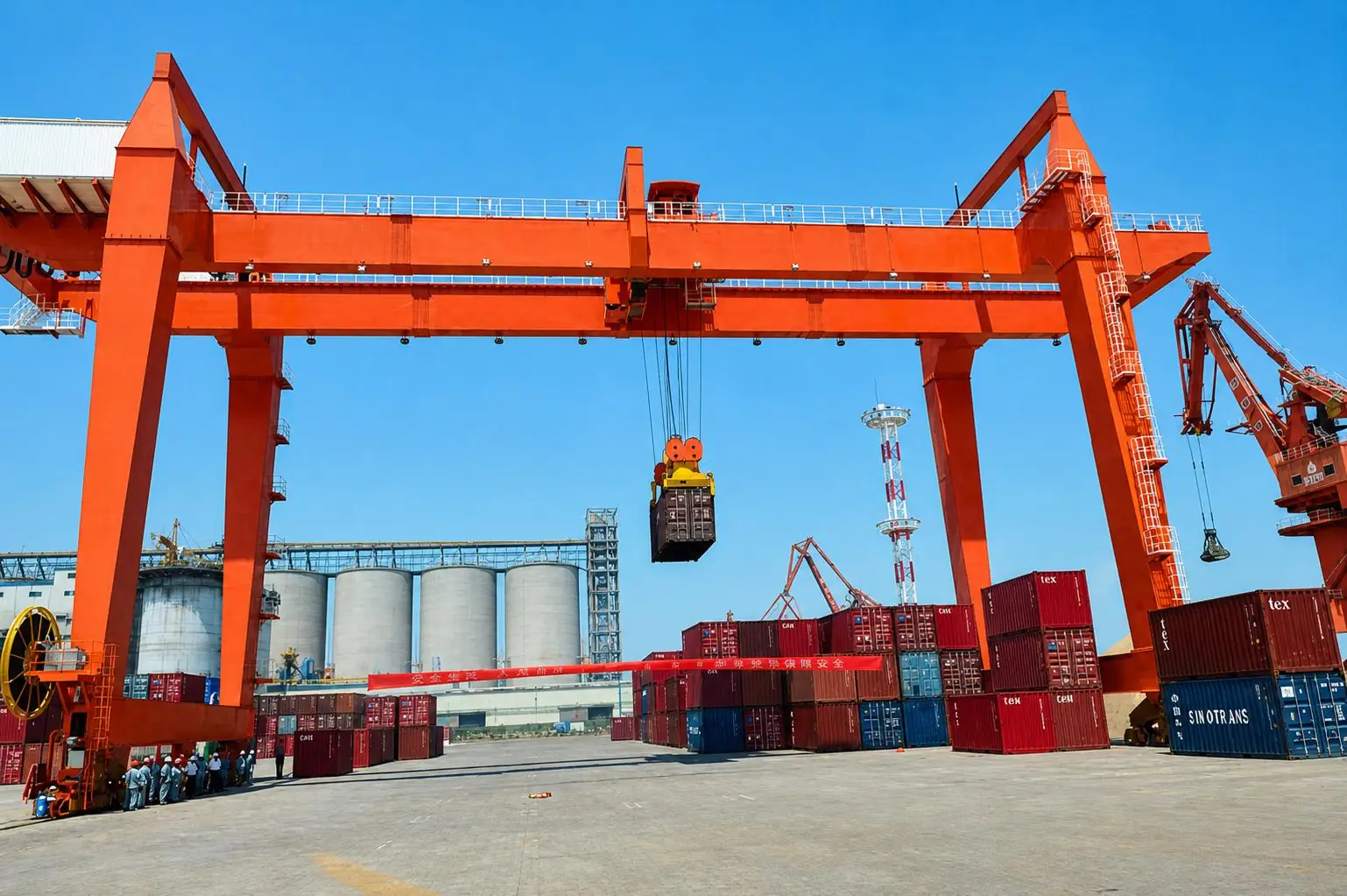
There is no need to blindly replace the whole machine for the upgrade of port cranes. It is necessary to combine equipment working conditions, operating requirements, transformation costs and downtime cycles to reasonably choose local modular transformation, structural reconstruction or whole machine replacement plans.
- Suitable for local system transformation scenarios: the main steel structure of the crane has sufficient life span, and the dimensions can meet the existing ship and yard operations. Only the electrical and transmission systems are aging, and the level of automation is insufficient.The cost of retrofitting is only 20%-50% of the purchase of new aircraft, and the downtime is from a few days to several weeks. There is no need to retrofit the foundation infrastructure to ensure the continuous operation of the port.
- Scenarios that require structural reconstruction or replacement of the whole machine: the steel structure of the equipment is fatigued and corroded in a large area; parameters such as extension distance and lifting height cannot be adapted to ultra-large container ships; the foundation and power conditions cannot support the upgrade.
Comparing the three core dimensions of comprehensive cost, downtime, and equipment service life, cranes with intact main structure should give priority to the phased upgrade model, and complete the transformation system by system and equipment by equipment to avoid long-term port suspensions caused by one-time large-scale construction, effectively reduce the risk of operation interruption, and extend the service life of the equipment for more than 10 to 15 years after the transformation.
Plan the Upgrade Around the Port’s Operating Schedule
To achieve “non-stop port upgrading", the core is to deeply adapt the transformation construction to the rhythm of port operations, avoid peak operating periods, maximize the compression of on-site construction time, and realize both construction and production.
Arrange construction at the wrong peak
Accurately docking the ship's berthing plan and the port's quarterly throughput regulations, and arranging the upgrade construction at night, weekends, off-season freight and other operating trough periods.At the same time, the large-scale renovation project will be disassembled into multiple small maintenance and construction windows, and equipment operations will be resumed immediately after the phased renovation is completed to avoid one-time long-term downtime.In-depth coordination with the terminal operation department, shipping company, and loading and unloading team throughout the process to ensure the seamless connection between construction and scheduling.
Off-site prefabrication
Most of the assembly, wiring, and commissioning work will be transferred to the workshop or supplier's factory to complete, and brand new control cabinets, transmission modules, operating platforms, and integrated equipment components will be prefabricated in advance.
After completing the equipment assembly, line docking, and preliminary commissioning off-site, it will be transported to the terminal site for direct installation and replacement.This mode can greatly reduce the amount of on-site ignition, hoisting, and wiring operations, and greatly compress the on-site construction and commissioning cycle.
Shutdown emergency plan
Clarify in advance the equipment functions, downtime, and operation alternatives that need to be suspended during the upgrade process, and prepare construction tools, replacement accessories, hoisting equipment, and professional construction personnel in advance.
At the same time, a complete rollback emergency plan is formulated. If the equipment fails during commissioning, it can be quickly switched back to the original control system, restore basic operating capabilities, and completely avoid the risk of unplanned long-term downtime. At the same time, daily construction progress assessment standards are set to ensure that the project lands on schedule.
Upgrade High-Impact Components Without Rebuilding the Entire Crane
Focus on the precise upgrading of the core components that are cost-effective and high-capacity improvement. Without disassembling and rebuilding the whole machine, the performance of the equipment can be improved by leaps and bounds, and the downtime can be controlled to the maximum extent possible.
- Replace the aging lifting and walking transmission system: replace the old transmission with a closed-loop vector frequency conversion system, which moves smoothly and reduces mechanical wear; regenerative braking can save energy by 20%-40%, and improve fault diagnosis capabilities and operating stability.
- Upgrade programmable logic controllers and control systems: eliminate old PLC and IO hardware, replace modern industrial control platforms, support intelligent diagnosis, remote operation and maintenance, and connect to terminal systems; try to retain the original adapted equipment, compress the cost of transformation, and realize digital control.
- Update sensors and equipment monitoring systems: add load, position, anti-collision, temperature vibration and structure monitoring sensors to achieve status maintenance, early warning of failures, reduce unplanned downtime, and provide data for automation transformation.
- Optimize the operator's control system: update the cab control components and man-machine interface, add remote control and blind spot video monitoring; reduce operator fatigue and improve control accuracy without changing the main structure, and the transformation will be effective quickly.
Add Automation Without Completely Replacing the Crane
There is no need for port cranes to blindly pursue fully unmanned automated transformation. The cost of fully automatic transformation of the whole machine is high, the commissioning cycle is long, and the adaptation is difficult.Through gradual automation upgrades, superimposing automation functions on the basis of existing equipment is the optimal solution that takes into account cost, efficiency and stability.
The lightweight automation upgrade functions that can be landed include: semi-automatic trolley and lifting positioning, automatic control of spreader and linkage of locking pins, electronic anti-swing system, remote control of the central control room, and data linkage and docking of the terminal operating system.
All automation modules can be installed and debugged synchronously during the control system upgrade window without additional downtime.The gradual upgrade mode is easier to debug and land, which is convenient for operators and maintenance personnel to gradually adapt to the intelligent operation mode, and steadily improve the level of terminal automation operations.
Upgrade Safety Systems During the Same Retrofit Project
Relying on the construction window period for electrical and control system upgrades, the iteration of the safety system is completed simultaneously to avoid secondary downtime due to subsequent individual retrofits, and to meet the latest industry safety standards and insurance compliance requirements at once.The core upgrade content includes:
- Safety hardware upgrades: redundant emergency stop circuit, safety PLC, overload torque protection, intelligent limit and soft limit, regional anti-collision, wind speed monitoring, storm warning, channel protection and personnel location monitoring system
- Transformation benefits: Relying on this upgrade, a full set of safety system integration transformation is completed simultaneously, without additional downtime for construction.It can improve the protection level of crane operations in all directions, effectively avoid safety accidents caused by equipment failures and operating errors, fully adapt to the latest port safety regulations, and meet industry compliance and operation and maintenance risk control requirements.
How to Reduce the Actual Crane Shutdown Time
Adopt modular plug-in replacement scheme
- Adopt standardized, plug-and-play equipment modules to complete the pre-wiring of the control cabinet, the multi-pin fast docking interface, and the design of standardized transmission components in advance. Only the alignment installation and quick docking need to be completed on site, without the need for complex wiring and debugging, which greatly shortens the on-site construction time.
- Multi-process parallel construction: coordinate the simultaneous operation of multiple teams of machinery, electrical, control, and commissioning, formulate an integrated construction scheduling and operation permit system, abandon the traditional serial construction model, and advance multiple processes in parallel, greatly compressing the overall transformation period.
- Full-dimensional testing before leaving the factory: Complete the factory acceptance test before the upgrade module leaves the factory, covering PLC logic, transmission, sensors, communication, working conditions and fault simulation, and investigate hidden dangers in advance to reduce on-site downtime and rework.
- Hierarchical commissioning and commissioning in stages: follow the step-by-step testing of single-item, no-load, low-load, full-load, and trial production.Support phased recovery operations, adapt to port production, and ensure stable operation after the transformation.
Common Mistakes That Can Extend Port Crane Downtime
- Inspection, evaluation and working condition analysis: comprehensively verify the crane structure, electrical system, control module and operating data, calculate the remaining life of the equipment, and sort out the core shortcomings and upgrade needs.
- Customized transformation plan design: select suitable upgrade components, define the original equipment that can be retained, clarify the scope of transformation, construction process and construction period, and output complete construction drawings and technical plans.
- Off-site prefabrication and pre-testing: complete the processing, assembly, wiring and factory testing of all upgraded modules to ensure that the components can be installed directly after they arrive at the terminal.
- Planned short-term shutdown construction: relying on the trough window period of port operations, quickly dismantle old parts and replace prefabricated modular equipment.
- Hierarchical and step-by-step debugging: carry out single-component functional testing and joint adjustment of the whole machine in turn, verify the performance of the equipment step by step, and investigate potential hidden dangers.
- Commissioning and long-term monitoring: carry out controlled production commissioning, establish equipment performance benchmarks, complete commissioning acceptance, and continuously track the operating status of the equipment.
When Should a Port Consider a Crane Retrofit
Not all old cranes need to be replaced by the whole machine. If the following scenarios are met, the upgrade plan is preferred.:
- The steel structure of the main body of the crane is intact, and there is no serious corrosion, large-area fatigue cracks and permanent deformation of key load-bearing components such as the main beam and door legs.After testing and load-bearing verification, the remaining service life is sufficient, the structural strength meets the requirements of port loading and unloading loads, and it has the conditions for continuous service.
- The original electrical and control system hardware models are old, and the original equipment factory has stopped the production and supply of this series of products. It is difficult to purchase original accessories, and supporting technical maintenance and fault diagnosis support are no longer provided.;
- The procurement channels for equipment supporting spare parts are limited, the supply cycle of original parts is long, the supply of some scarce parts is tight, and the market purchase prices continue to rise, resulting in the long-term high cost of parts procurement.
- At present, there are bottlenecks in the operating performance of cranes, and the original operating efficiency and processing capacity of the equipment are limited. It is difficult to adapt to the increasing cargo throughput of the terminal year by year, and it cannot meet the needs of high-intensity and high-density loading and unloading operations.
- The terminal has put forward upgrading requirements for the digitization capabilities of the equipment, and it is necessary to add functional modules such as remote control, intelligent monitoring of equipment status, and automated operations to the crane to help the terminal promote the construction of a smart port.
- With the increase of the service life of the equipment, the maintenance cost continues to rise year by year, and various electrical and mechanical failures occur frequently, which can easily cause sudden unplanned shutdowns, disrupt the established loading and unloading operation plans of the pier, and affect the efficiency of berth turnover.
- The port hopes to extend the service life of the equipment with lower investment and shorter downtime cycles, so as to avoid the huge investment brought about by the replacement of the whole machine and the production risk of long-term berth decommissioning.
Conclusion
The upgrading and transformation of port cranes is a system project that takes into account equipment performance, production capacity, cost and safety, not simply replacing parts.Relying on pre-evaluation, module upgrade, off-site prefabricated testing, and phased construction of peak faults, the impact of downtime can be reduced.The transformation needs to be based on the current situation of the equipment to determine the scope of the upgrade, focusing on ensuring the compatibility of drive, control, safety and intelligent modules.
High-quality solutions can improve crane efficiency, safety and maintainability, and extend the service life.Henan Mine Crane can provide crane upgrading and technical services based on on-site working conditions and transformation goals to achieve stable and controllable equipment updates.