
Cantilever Gantry Cranes: Overhang Calculation & Application Guide
Cantilever gantry cranes have strong site adaptability and flexible operating range, and are mostly used in factories, depots, shipyards and other scenes.Its external cantilever structure breaks through the limitations of traditional door machine operations and can complete hoisting operations in special areas such as obstacles and site edges.
Mastering the structural characteristics, cantilever design calculation and selection working conditions of cantilever gantry cranes is the key to equipment safety, quality improvement and cost reduction.This article systematically expounds its structural design, application scenarios, cost points and safety specifications, avoids selection misunderstandings, and provides technical reference for equipment customization, selection, and operation and maintenance.
What Is a Cantilever Gantry Crane
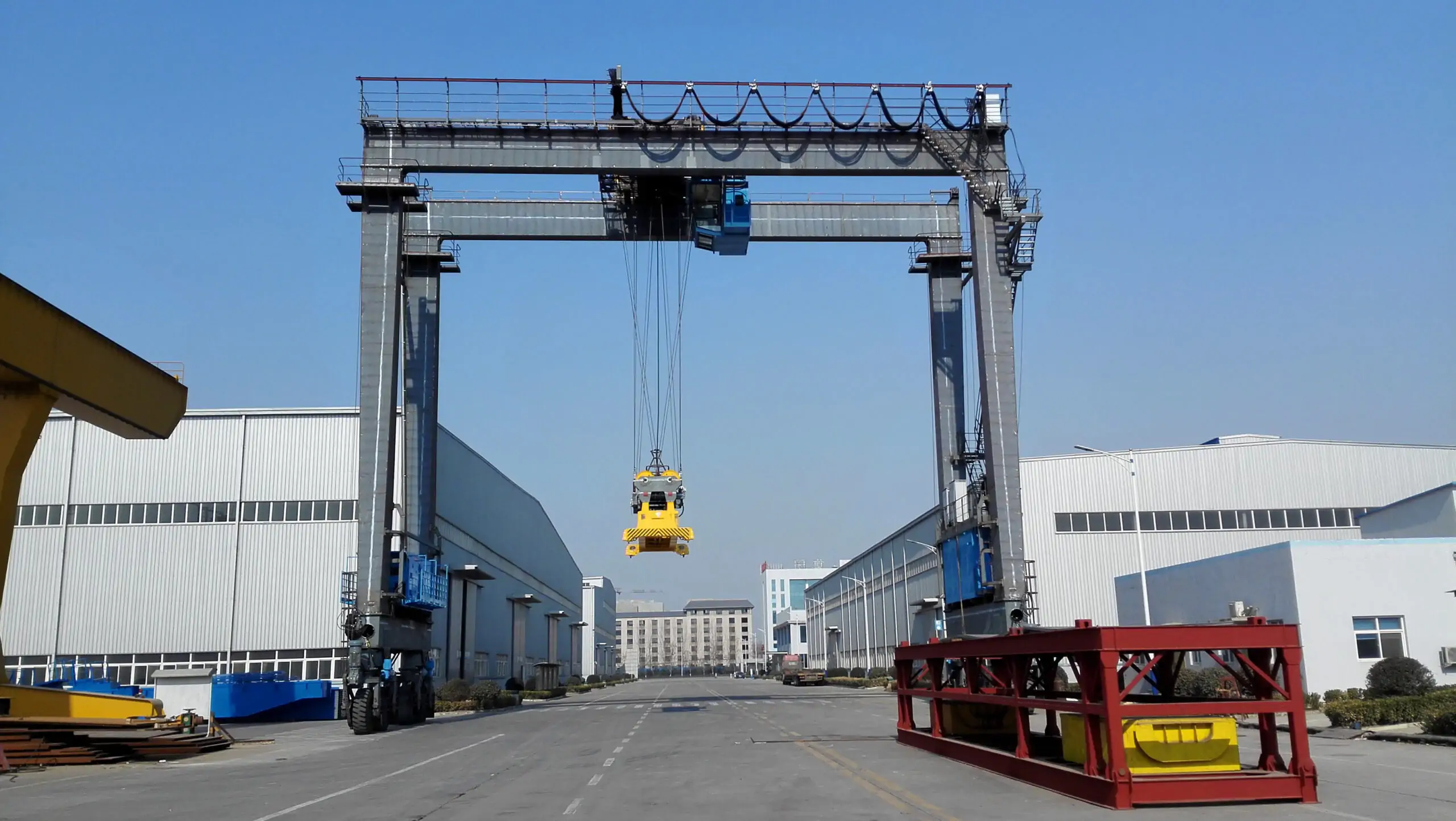
Cantilever gantry crane is a special lifting equipment optimized on the basis of standard gantry crane. The core feature is that the main beam exceeds the support legs on one or both sides to form a cantilever operation section, thereby expanding the hoisting coverage.Its complete structure is composed of five core modules, and each component cooperates to ensure equipment stability and operating accuracy.:
- Main beam and cantilever section: It is the core load-bearing structure of the equipment. The main beam carries all operating loads, and the cantilever has no lower support and is responsible for expanding the scope of operation.The structure mostly uses high-strength profiles, which can effectively resist structural bending and deformation by optimizing the cross-section to take into account strength and light weight.
- Gantry outriggers and end beams: the outriggers are the vertical support structure of the whole machine, which accepts the load of the main beam and transmits it to the ground foundation and track; the end beams are equipped with walking wheels and are installed at the bottom of the outriggers to cooperate with the track or ground walking system to realize the smooth movement of the crane and adapt to the needs of a wide range of operations in the factory.
- Lifting trolley and hoist system: the trolley walks laterally along the main beam track, and is equipped with an electric hoist to complete the lifting and translation of materials.For the operation scenario of the cantilever section, the system is equipped with precise speed regulation and anti-swing functions, which can effectively solve the load shaking problem of the cantilever end operation and ensure the accuracy of hoisting.
- Electrical and control system: it includes modules such as frequency conversion drive, operation console, limit protection, overload early warning, etc., supports manual, remote control and other operating modes, accurately controls lifting, walking, and luffing actions, and adapts to complex indoor and outdoor operating environments.
- The walking track system is divided into track type and tire type: the track type is suitable for high-frequency operation in fixed factories and has good stability; the tire type does not require track laying and is flexible in movement, and is suitable for temporary and multi-site rotation construction.The cantilever of the equipment is equipped with a buffer and a stroke limit switch, which can effectively prevent the risk of over-range operation.
Difference between cantilever gantry crane and standard gantry crane
The core difference between the two lies in the scope of operation and the form of structural force, and the adapted operation scenario is very different from the economy, which is the core basis for equipment selection.:
Standard gantry crane: the operating range is strictly limited to the span of the outriggers on both sides, with no extendable structure, symmetrical load and force, strong structural stability, simple design, and lower cost.It is only suitable for basic handling scenarios where materials are organized, work areas are concentrated, and cross-domain hoisting is not required.
Single cantilever gantry crane: The main beam extends on one side to form an outer extension section, and the operating range is only expanded on one side, and the structural force is asymmetrical.The advantage lies in the strong adaptability of the site and the low cost of transformation. It is suitable for scenarios where the factory area is loaded and unloaded on one side, operated against the wall, and the site space is limited, and it can solve the needs of single-sided over-span hoisting in a targeted manner.
Double cantilever gantry crane: The main beam extends symmetrically on both sides, and the cross-leg operation can be achieved on both sides. The operation covers the broadest range and the structural force is relatively balanced.It is suitable for large-scale factories, shipyards, and prefabricated component factories with open factory areas, multiple operating areas in parallel, and materials that need to be loaded and unloaded on both sides.
The core logic of selection: the standard gantry crane is suitable for operations within the conventional span; the single cantilever is suitable for unilateral expansion needs and the pursuit of high cost performance; the double cantilever is suitable for global coverage and high-frequency multi-regional operation scenarios.

Common configuration types
According to the main beam structure and walking mode, it can be divided into four mainstream models, which accurately match different loads, sites and operating conditions.:
- Single-beam cantilever gantry crane: simple structure, light weight, low cost, easy installation, rated load is mostly 1-20 tons, suitable for light-duty, low-frequency material handling, widely used in small processing plants, warehouses, workshops.
- Double-girder cantilever gantry crane: The double-girder structure has stronger bearing capacity, better rigidity, and minimal deformation. The rated load can reach more than 100 tons. It can be adapted to heavy-duty, high-frequency, and long-span operations. It is the main model of shipyards, steel structure factories, and large prefabricated component factories.
- Tire-type cantilever gantry crane: it adopts rubber tires to walk, without embedded tracks, and the site is not bound. It can be freely turned and flexibly shifted. It is suitable for temporary construction sites, outdoor depots, and multi-site rotation operations, and its mobility is full.
- Orbital cantilever gantry crane: walking in a straight line along a fixed track, it has stable operation, accurate positioning, strong carrying capacity and low failure rate. It is suitable for industrial scenarios with fixed operating areas, high-frequency continuous operations, and high-precision hoisting.
What Is Gantry Crane Overhang
The extension of the cantilever refers to the horizontal distance from the centerline of the crane's outrigger to the outermost end of the main beam, which is the core design parameter of the cantilever gantry crane.In the selection and design of the project, the following four items need to be clearly distinguished. It is easy to confuse the key dimensions and avoid the misuse of parameters.:
- Crane span: The horizontal distance between the outriggers on both sides or the centerline of the track determines the width of the basic operation of the equipment;
- Cantilever extension: The effective length of the main beam extending to the outside of the outrigger directly determines the coverage of the span hoisting;
- The total length of the main beam: the sum of the span of the crane and the outer elongation of the single-sided/double-sided cantilever;
- Lifting height: The maximum vertical working height of the hook is an independent vertical parameter and is not related to the outer elongation of the cantilever.
The role and importance of cantilever extension
The amount of extensibility is not a simple dimensional extension, it directly determines the operating capacity, structural safety and cost of use of the equipment. The core impact is reflected in four dimensions:
Expand the coverage of operations: no need to move the whole machine, no need to expand the track foundation, you can complete the hoisting of materials on the outside of the outriggers, on the edge of the factory area, and next to obstacles, which perfectly solves the problem of blind spots in standard crane operations and greatly improves the utilization rate of the site.
Change the force state of the structure: The cantilever section has no support structure, and when the load is applied to the outer extension end, it will produce a huge bending torque and shear stress at the root of the main beam.The longer the outer elongation, the greater the structural force, and the higher the requirements for the material and cross-section strength of the main beam.
Affect the stability and wheel pressure of the whole machine: When the load is offset to the end of the cantilever, the wheel pressure of the outriggers on both sides is unbalanced, the wheel pressure on the near cantilever side is greatly increased, and the wheel pressure on the far side is reduced. Under extreme working conditions, there may be a risk of rail lifting and derailment, which directly affects the anti-overturning stability of the whole machine.
The weight and cost of related equipment: The greater the amount of extension, the stronger the rigidity of the main beam and the greater the weight of the structure. At the same time, the carrying requirements of the walking system and the basic track are higher, which directly pushes up the cost of equipment manufacturing, installation and infrastructure.
Key parameters
The design of the length of the cantilever is not arbitrarily set. It needs to be iteratively verified based on all working condition parameters. The core parameters include: rated lifting weight, crane span, outer elongation of the cantilever, trolley and hoist weight, load operating position, maximum lifting height, equipment working level (operating frequency), wind load and outdoor environmental conditions, track and ground foundation bearing capacity.All parameters restrict each other and jointly determine the safety and practicality of the cantilever structure.
Cantilever Gantry Crane Overhang Calculation
Load and geometric model basics
The core principle of the calculation of cantilever cranes: the harshest working conditions are used as the design benchmark, rather than the conventional working conditions in the span.The most dangerous load state is: the trolley fully loaded with the rated load walks to the outermost end of the cantilever.
The bending torque, wheel pressure and overturning risk generated at this time are the greatest, which is the core basis for structural design and strength verification.Different from the standard crane symmetrical force model, the force asymmetry of the cantilever structure is the core difficulty of all calculations.
Basic bending torque calculation principle
The core simplified formula of the force of the cantilever structure is the general standard for preliminary estimation of the industry:
$$M = P \times L$$
Parameter interpretation:
M= Bending moment (kN·m), the core force index of the root of the main beam;
P = Total acting load (kN), including lifting materials, trolley, electric hoist weight;
L = The distance (m) from the centerline of the support to the point of action of the load, which is the effective force length of the cantilever.
Important: This formula is only used for preliminary estimates.The formal engineering design needs to take into account the comprehensive working conditions such as the weight distribution load of the main beam, the dynamic impact load of the starting and braking, the horizontal inertial force, and the wind load, and strictly follow the industry design standards.
Load distribution and support reaction force changes
When the trolley moves from the middle of the span to the end of the cantilever, the load distribution of the whole machine will be significantly offset: the vertical wheel pressure of the near-cantilever side outriggers increases sharply, and the wheel pressure of the far-side outriggers continues to decrease. In severe cases, upward pull-up force (upward lift reaction force) will occur, causing derailment and overturning hidden dangers.
Excessive cantilever extension will cause one-sided foundation load to exceed the standard, causing track deformation and foundation settlement, which directly affects the service life of the equipment and operation safety.Therefore, all designs must verify the reaction force and wheel pressure values of the outriggers under extreme operating conditions.
Structural deflection deformation verification
Meeting the standard of structural strength does not mean that the equipment is safe and available, and deflection deformation is the core index to ensure the accuracy of the operation.The cantilever structure will undergo vertical deformation under load.
The longer the outer elongation, the more obvious the deflection deformation.Excessive deformation will cause the trolley to travel stuck, the accuracy of hoisting and positioning will decrease, and the fatigue of the structure will accelerate. Long-term operation will cause the main beam to crack, weld damage and other failures.
The industry has strict limits on the deflection of crane cantilevers (commonly used L/180 and L/240 standards), and it needs to pass the deflection formula verification.:
$$\delta = \frac{P \times L^3}{3 \times E \times I}$$
Ensure that the actual deformation amount is lower than the allowable value of the specification, taking into account the structural strength and equipment performance.
Check the stability and anti-overturning of the whole machine
Anti-overturning design is the core safety bottom line of cantilever cranes.In the design process, key verification is required: the overturning torque generated by the full load of the cantilever end, the balanced anti-overturning torque generated by the crane's own weight, and the minimum wheel-rail contact pressure (to prevent derailment).
Outdoor operating equipment also needs to superimpose lateral wind loads to avoid the risk of overturning caused by the coupling of wind load and eccentric load, and to ensure that the stability coefficient of the whole machine is up to standard under extreme working conditions.
How to Determine the Maximum Practical Overhang
Actual job coverage requirements
The length of the cantilever is designed to give priority to the working conditions on the site, and the extension size is determined according to the farthest lifting point, obstacle location, and loading and unloading operation area on the site, so as to prevent blindly lengthening the cantilever.There is no need to deliberately increase the amount of extension for the redundant operating range to avoid structural redundancy, cost waste and safety risks.
Rated load and operating conditions
All cantilever designs must follow the most demanding operating conditions where the maximum load matches the maximum extension.The structural stress of the full-load operation at the cantilever end is much greater than that of the cross-medium and light-load operation.
The working level of the equipment and the frequency of the operation (load spectrum) directly determine the fatigue life of the structure.General preliminary experience value in the industry: The outer elongation of the cantilever is recommended not to exceed 1/3 of the main span of the crane, and the final size needs to be verified by professional mechanical calculations.
Comprehensive verification of main beam strength and deflection
After determining the initial extension size, it is necessary to fully verify the cross-section modulus of the main beam, the structural geometry, and the yield strength of the steel, and at the same time investigate local compression buckling, fatigue damage in high-frequency operations, etc.By optimizing the cross-section of the main beam and selecting high-strength steel, the weight, strength and deformation of the structure are balanced to ensure long-term stable operation.
Door frame stability and wheel pressure verification
Strictly check the outrigger support reaction force and wheel wheel pressure under extreme working conditions to ensure that the values meet the track, wheel and foundation bearing standards.In view of the eccentric load characteristics of cantilever operations, anti-derailment devices are designed and the track foundation is reinforced to avoid problems such as foundation settlement, track offset, and equipment instability.
Optimized design
A longer cantilever does not mean better equipment performance.Every increase in the elongation of 1 meter will simultaneously increase the weight of the main beam, bending stress, wheel pressure and infrastructure costs.Professional engineering design takes "precise adaptation to working conditions" as the core, and finds the optimal balance between operating scope, structural weight, manufacturing cost, and operating safety to eliminate over-design.
Cantilever Gantry Crane Applications
Shipyard and Offshore engineering manufacturing
There are a large number of cross-platform and cross-hull hoisting needs in shipyard operations, and standard gantry cranes cannot cover the outer side of the ship and the edge of the platform.The cantilever gantry crane can complete the cross-domain hoisting of hull components, steel plates, and marine equipment through the extension structure, and is suitable for dry dock and dock edge operations, greatly improving the space utilization rate and construction efficiency of the shipyard.
Steel structure manufacturing and heavy-duty processing
Steel structure factories often need to hoist ultra-long steel beams, steel columns, pipelines and other components, and both ends of the materials can easily exceed the main span of the equipment.The cantilever crane can easily complete the material loading, unloading and transportation at the end of the production line and at the edge of the factory area, without moving the whole machine, and is suitable for the normal handling of heavy and long components.
Precast concrete component factory area
The prefabricated component factory includes multi-area operations such as mold placement, steel bar binding, component pouring, maintenance, and finished product stacking, and the site is clearly zoned.The cantilever gantry crane can cover the maintenance area and stacking area outside the main span, complete the transfer and hoisting of molds, prefabricated wall panels, beams and column components, and adapt to the regularization and zoning operation mode of the factory area.
Construction and infrastructure engineering
The construction site is complex, with obstacles, foundation pits, and restricted spaces often present, and the scope of conventional crane operations is limited.Cantilever gantry cranes can cross obstacles and complete the precise hoisting of steel structures, prefabricated components, and construction equipment, adapting to the flexible operation needs of outdoor infrastructure and temporary work sites.
Yard outdoor material handling
The edge of the freight yard and storage plant area is adjacent to the road and loading and unloading parking spaces. The cantilever extension structure can directly cover the truck parking area. There is no need to expand the track and plant foundation to complete the loading and unloading of goods and the transfer of materials. It is the core equipment for cost reduction and efficiency enhancement of small and medium-sized depots.
Selection recommendations: single cantilever is preferred for fixed loading and unloading on one side, limited budget, and narrow site; double cantilever models are preferred for open factory areas, parallel operations in multiple areas, and long-term stable and efficient operations.
How Overhang Affects Crane Cost
Steel structure consumables
After the extension span of the cantilever is increased, in order to meet the requirements of high load-bearing and structural stability, the main beam needs to strengthen its bearing capacity by expanding the cross-section, thickening the plates, and adding reinforced structures, so that the overall weight of the equipment is significantly increased, and the cost of raw materials and consumables and processing and manufacturing increases simultaneously, which is the core factor in the increase in equipment cost.
Walking and driving system
The ultra-long extension of the cantilever will produce a large wheel pressure load. In order to ensure the safety of equipment operation and bearing stability, the core walking drive components such as end beams, walking wheels, bearings, and driving motors need to be upgraded to high load adaptation specifications.The comprehensive upgrading and upgrading of core accessories has directly pushed up the procurement cost of the equipment.
Track and infrastructure
The ultra-long cantilever operation will form an eccentric load, which will cause the centralized pressure and force load of the foundation on one side of the equipment to be greatly increased.
In order to offset the safety risks caused by eccentric force, this type of equipment needs to adopt enhanced measures such as thickened concrete foundation, reinforced track bearing structure, and upgraded grounding protection scheme, which directly leads to a significant increase in the cost of civil infrastructure in the early stage of the project.
Full life cycle cost of use
Compared with standard models, large cantilever equipment not only has a higher initial input cost, but also has a larger weight and higher operating energy consumption.At the same time, the parts of the equipment structure where the stress is concentrated are prone to fatigue loss, which greatly increases the operation and maintenance costs of daily inspection, maintenance and replacement of accessories, and the overall life cycle use cost is significantly higher.
At the same time, the parts where the structural stress is concentrated are prone to fatigue loss, which leads to higher costs for daily inspection, maintenance and replacement of accessories, and the overall life cycle cost is much higher than that of conventional standard models.
Key Safety Considerations for Cantilever Gantry Cranes
Cantilever gantry cranes have the structural characteristics of eccentric force, and the safety risk is higher than that of ordinary gantry cranes. Therefore, in the process of operation and daily operation and maintenance, the following safety regulations need to be strictly implemented.:
- Strictly control the rated load and prohibit overloading of the cantilever.The carrying capacity of the cantilever end of the equipment is lower than that of the trans-central area, and the rated load parameters of the two cannot be mixed. It must be operated strictly according to the calibrated load to prevent illegal operations such as overload and partial load.
- It is forbidden to transform the cantilever structure privately.It is strictly prohibited to lengthen, cut, or repair the main body of the cantilever without authorization. Any structural changes or dimensional adjustments must be verified by professional mechanics and can only be implemented after confirmation of compliance to eliminate the structural risks caused by non-standard retrofits.
- Regularly check the track and basic working conditions.Normalize the detection of track flatness, straightness and foundation settlement, and promptly investigate hidden dangers such as foundation deformation, offset, and settlement, so as to avoid safety issues such as equipment tilting and unstable operation caused by unstable foundation.
- The whole process of operation must ensure that safety protection devices such as stroke limits, buffer devices, overload protection, and emergency shutdown are intact, effective, and put into use normally, so as to accurately prevent various operational risks such as over-range operation and hard collisions.
- Outdoor operations need to monitor changes in environmental wind speed in real time. In case of severe weather such as high winds and strong winds, the cantilever end hoisting operation should be stopped immediately to effectively prevent safety hazards such as equipment shaking and overturning caused by wind-borne disturbances.
- Carry out inspections of normalized equipment, focusing on key parts such as main beam welds, structural connection nodes, walking wheels and braking systems, and accurately investigate hidden faults such as fatigue deformation, structural cracks, and loose components of the cantilever section to ensure the stable operation of the equipment.
Cantilever Gantry Crane Selection Checklist
Before equipment selection, it is necessary to check the core technical parameters and working conditions one by one to ensure that the equipment is accurately adapted to the on-site operation scene, and to avoid problems such as selection deviation and insufficient adaptation from the source. The specific check items are as follows:
- Rated lifting weight and working level (A3-A8): The rated lifting weight is approved according to the maximum lifting load and operating frequency of the site, and the working level of the equipment is matched as needed.A3-A5 is selected for conventional intermittent light-load conditions, and A6-A8 is adapted for high-frequency heavy-duty continuous operation to ensure the stability and durability of the equipment.
- Main span and cantilever extension dimensions: Combine site layout and hoisting coverage to determine the main span and single/double-sided cantilever extension dimensions to avoid operating blind spots, while strictly controlling the amount of cantilever extension to prevent problems such as excessive eccentric force and insufficient structural stability.
- Trolley stroke and effective lifting height: determine the trolley walking stroke according to the layout of the site to eliminate dead ends in the operation; determine the lifting height based on the actual lifting requirements and space constraints, and reserve a safe margin to meet the requirements of vertical lifting operations.
- Material size and center of gravity (special-shaped eccentric load): The regular material is selected according to the standard load. For ultra-long, ultra-wide, and eccentric special-shaped materials, the center of gravity needs to be accurately approved, and the impact of partial load on the structure, wheel pressure and stability of the whole machine should be checked to avoid the risk of excessive force.
- Operating environment conditions: distinguish between indoor and outdoor operating scenarios, and adapt outdoor equipment to wind-resistant protection design; combine on-site temperature and humidity, corrosion, dust and other working conditions, match the corresponding materials and protective coatings, and improve the weather resistance and corrosion resistance of the equipment.
- Track specifications and basic bearing capacity: according to the matching of equipment weight and operating wheel pressure, adapt to the track model and installation standards, verify the on-site foundation strength, bearing capacity and settlement parameters to ensure that the foundation and track can stably carry the operating load of the equipment.
- Power supply standard and control mode: match the on-site power supply parameters, and flexibly choose the remote control, ground operation, and cab control modes in combination with the operation scene. Complex working conditions can be combined with dual control modes to take into account the flexibility of operation and the safety of operation.
- Safety configuration and design standards: The equipment is equipped with safety devices such as limit, buffer, overload protection, emergency braking, windproof anchoring, etc. The design, manufacture, and acceptance of the whole machine strictly follow the general specifications of FEM, ISO, ASME and other industries to meet the requirements of safe production.
Conclusion
The value of cantilever gantry cranes lies not only in expanding the scope of operations, but also in improving site utilization, hoisting efficiency and equipment adaptability through reasonable cantilever design.The amount of cantilever extension directly affects the structural force, the stability of the whole machine and the cost of equipment, so it is impossible to blindly pursue a larger operating range.
Regardless of single cantilever or double cantilever, enterprises should combine lifting weight, span, extension, operating frequency and on-site conditions for comprehensive selection, and verify structural safety and operational stability through professional engineering calculations.
As a professional lifting equipment manufacturer, Henan Mine Crane can provide cantilever gantry crane design, parameter configuration and customized manufacturing services according to actual working conditions.If you are planning a cantilever gantry crane project, please contact us for professional selection suggestions and customized quotations.