
How to Choose a Gantry Crane for Container Stacking?
The efficient operation of modern ports, logistics parks and railway hubs is highly dependent on standardized container stacking operations. High-quality stacking mode can greatly improve the site utilization rate and cargo turnover efficiency, while the traditional simple lifting mode is inefficient and insufficient in safety, which has long been unable to meet the needs of large-scale and high-frequency modern logistics operations. Professional gantry crane has become the core equipment for improving the quality and efficiency of the yard.
Different types of Henan Mine Crane manufactured container stacking gantry cranes have significant differences in performance, adaptation scenarios and costs. Blind selection is easy to cause problems such as insufficient efficiency, cost waste and inability to expand capacity. Combined with the yard conditions, operation requirements and intelligent trends, this paper comprehensively explains the key points of gantry crane selection, model differences and pit avoidance skills, and helps enterprises accurately purchase and adapt equipment.
Why Choosing the Right Gantry Crane Matters for Container Stacking
Storage efficiency
Yard land resources are the core fixed cost of logistics operation, especially in coastal core ports and suburban logistics parks. The available storage space is very limited. How to improve container storage capacity in fixed space is the core breakthrough point for cost reduction and efficiency improvement. Suitable gantry crane can realize standardized and high-density container stacking operation, completely solve the problems of traditional stacking disorder, low stacking layers and serious space waste.
Relying on the accurate vertical lifting and regular stacking capacity of gantry cranes, the storage yard can realize multi-layer and dense container arrangement, fully excavate the value of vertical space, and greatly improve the storage density per unit area. Compared with simple lifting equipment, professional container stacking gantry crane can increase the storage capacity of the yard by 30%-80%, and can carry more container storage needs without expanding the site.
Handling performance
The operation speed and stability of container stacking directly determine the overall throughput capacity of the yard. Gantry crane suitable for working conditions, equipped with professional container lifting tools, can quickly complete the whole process of container grabbing, shifting, lifting, stacking and setting, greatly shortening the single operation time. The equipment runs smoothly and accurately, which can effectively avoid the inefficient problems of container alignment deviation and repeated adjustment.
Stable and efficient lifting operation can greatly improve the daily container handling capacity of the yard, reduce the waiting time of trucks, container ships and railway cars, and optimize the circulation efficiency of the entire logistics transit link. For high-frequency port hubs, high-quality gantry cranes can significantly reduce the congestion rate, improve customer performance efficiency, and create an efficient logistics transit system.
Operation cost
Henan Mine Crane manufactured container gantry crane belongs to heavy long-term operation equipment, equipment reliability, maintenance convenience directly affect the whole life cycle operation cost. High-quality compliance gantry crane, using high-strength steel, mature transmission system and stable electronic control system, low failure rate, slow wear, can maintain stable operation for a long time, greatly reduce the downtime caused by failure shutdown and emergency maintenance.
At the same time, scientific selection can perfectly balance the initial investment of equipment and long-term operating benefits. In the long run, compliant equipment has lower energy consumption, lower maintenance cost and longer service life, which can continuously create stable economic benefits for enterprises and avoid hidden cost loss caused by blind procurement.
Understand Different Types of Gantry Cranes for Container Stacking
RMG crane
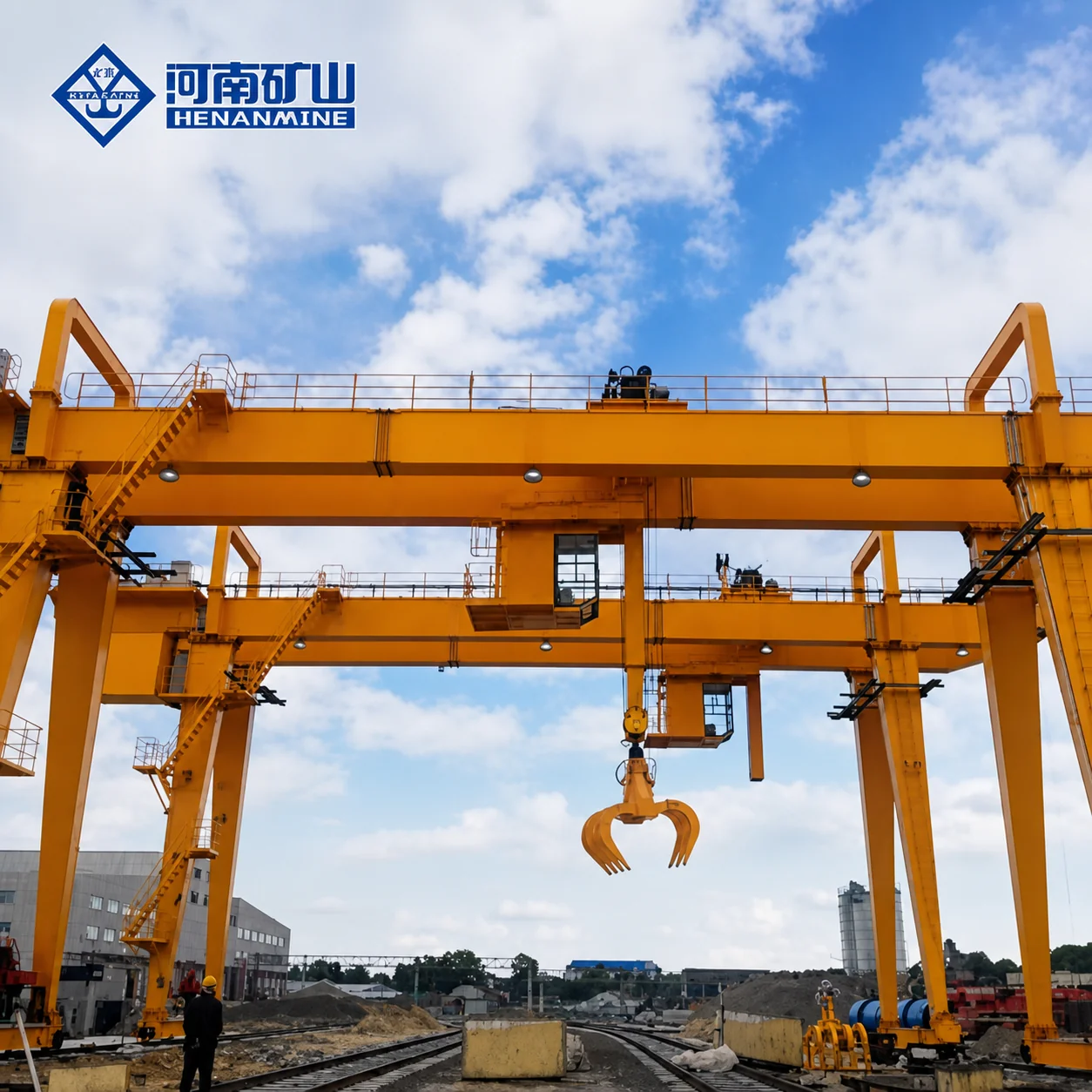
Henan Mine Crane manufactured rail-mounted container gantry crane (RMG) is the core operation equipment of high-end container yard. It runs on fixed track on the ground, with strong operation stability, high positioning accuracy and stacking capacity far exceeding conventional equipment. This model supports regular stacking of high-rise containers, up to 9 layers of container stacking, stacking regularity, operation safety, space utilization rate ranks among the top in the industry.
RMG crane can be deeply adapted to automatic and intelligent operation transformation, and can be connected with intelligent storage yard management system to realize unmanned automatic stacking, accurate alignment and intelligent dispatching without manual intervention in the whole process. It has stable operation load, strong continuous operation capability and long service life. It is mainly suitable for large-scale port terminals, large-scale automatic container yards, multimodal transport core hubs and other large-throughput and highly standardized operation scenarios. It is the standard equipment of modern intelligent ports.
RTG crane
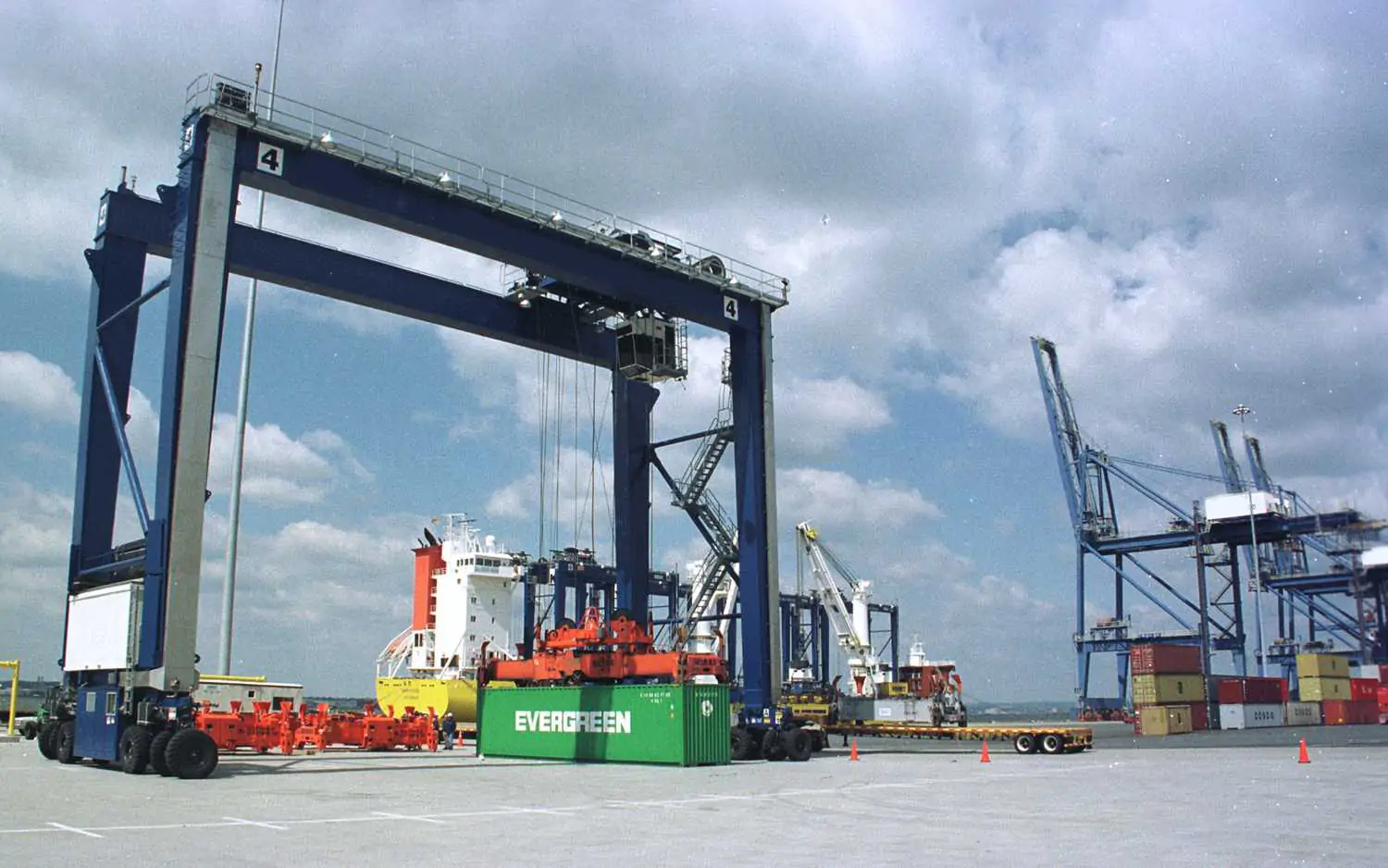
Tire type container gantry crane (RTG) adopts tire walking structure, without laying fixed track, site adaptability is very strong, flexible movement, can freely adjust the operation area according to the operation requirements of the yard, break through the operation limit of fixed track. Equipment installation and commissioning is convenient, without large-scale transformation site, short production cycle, and can quickly adapt to the operation requirements of temporary storage yard and reconstruction yard.
At the performance level, RTG cranes give consideration to both operational efficiency and cost performance, meeting the needs of conventional 3 - 7-storey container stacking, and fully adapting to the operating standards of inland logistics parks, small and medium-sized container terminals, railway transit stations, and regional freight yards. Compared with RMG equipment, its initial investment is lower, the site reconstruction cost is almost zero, and the operation and maintenance difficulty is smaller. It is the preferred model for small and medium-sized container stacking scenarios.
ASC crane
Automatic stacking crane (ASC) is a high-end intelligent equipment specially developed for intelligent container terminals, integrating a full set of intelligent functions such as automatic positioning, intelligent identification, automatic stacking, fault self-test, intelligent obstacle avoidance, etc. Relying on high-precision sensing systems, visual recognition systems and intelligent control systems, the equipment can independently complete full-process operations such as container classification, grabbing, layered stacking, and inventory statistics.
ASC crane does not need manual field operation, can achieve 24 hours of uninterrupted stable operation, operation accuracy, operation efficiency, safety factor have reached the top level of the industry, completely solve the manual operation error, low efficiency, safety hazards and other problems. At present, the equipment is mainly used in highly intelligent and unmanned operation scenarios such as large smart ports, fully automatic container bonded yards, high-end intelligent logistics hubs, etc.
Key Factors to Consider When Selecting a Container Stacking Gantry Crane
Lifting capacity
Lifting tonnage is the core basic parameter of gantry crane selection, which directly determines whether the equipment can meet the needs of various container operations, and is also the key to ensuring operation safety. When selecting, it is necessary to accurately match the container type of daily operation. The weight of 20-foot ordinary container, 40-foot standard container, 45-foot super high container and special heavy load container varies greatly, and the corresponding equipment lifting requirements are completely different. In the industry conventional standard, the standard 40-foot container needs to match the equipment with lifting capacity of 40t and above, including the safety redundancy reserved for the weight of the spreader.
At the same time, it is necessary to plan the operation mode in advance, and make clear whether it is necessary to lift single box and double box synchronously. For storage yard with high-frequency double-box operation, special gantry crane supporting double spreaders and large tonnage shall be selected to avoid failure of operation due to insufficient equipment tonnage, or equipment failure and potential safety hazard caused by long-term overload operation. Reasonable matching of lifting capacity can not only ensure operation compliance and safety, but also avoid energy consumption and capital waste caused by excess tonnage.
Stacking height
Stacking height directly determines the vertical storage capacity of the yard, and the type selection should be determined in combination with the yard height limit, fire protection specifications and operation standards. The stacking requirements of different operation scenarios vary significantly. Small and medium-sized inland yards are usually suitable for 3 - 5 layers of container stacking, medium-sized terminals can achieve 5 - 7 layers of stacking, and large automated port yards can support 7 - 9 layers of high-rise stacking.
Sufficient safety margin shall be reserved for lifting height of equipment, which shall not only adapt to basic stacking height, but also take into account container height error, spreader operation space and safe buffer distance. Reasonable stacking height configuration can maximize the vertical space of the excavated yard, greatly increase the total storage volume of containers without increasing the site area, ensure the stacking stability, and avoid the risk of toppling and collision of high-rise stacking.
Working span
Working span refers to the coverage width of Henan Mine Crane manufactured gantry crane in a single operation, which directly corresponds to the layout planning of container blocks in the yard. It is a key parameter to determine the operation efficiency and space utilization rate of the yard. The type selection shall strictly match the column number of container stacking blocks, channel layout and operation line to ensure that the equipment span can completely cover the target operation area without operation blind area and space waste.
Common spans of conventional container yards include customized spans of 18m, 22m, 25m, 30m and above, and different spans adapt to different block arrangement modes. Too small a span results in incomplete job coverage, frequent equipment movement, and reduced job efficiency. Too large span will increase equipment weight, energy consumption and procurement costs, resulting in resource redundancy. Accurate matching of working span can realize efficient coverage of fixed operation blocks by single equipment and optimize the overall operation layout of the yard.
Operation volume
Daily container throughput and operation frequency of storage yard are important basis for equipment selection, which directly determine the working level, configuration standard and quantity ratio of equipment. The daily throughput of small inland storage yard is relatively low, so the standard gantry crane of conventional working level can meet the demand. Medium-sized terminals and logistics parks have large daily turnover, so medium and high frequency working equipment shall be selected. Large-scale core port high-frequency uninterrupted operation, must be equipped with high-level, high-intensity, 24-hour continuous operation of special equipment.
If the equipment performance cannot match the operation volume, long-term high-frequency overload operation will accelerate the aging of equipment and frequent failures, resulting in shutdown and congestion of the yard. If the equipment is excessively high, it will cause investment waste. Combined with the daily average operation volume, peak operation demand and the difference in turnover between light and peak seasons, the accurate matching of equipment performance and operation demand can be realized to ensure stable and efficient high-frequency operation.
RMG vs RTG: Which Gantry Crane Is Better for Container Stacking?
Performance comparison
In terms of mobile performance, RTG tire gantry crane does not need track constraints, free movement, flexible transition, can adapt to multi-block, multi-scene rotation operation. RMG rail-type gantry crane runs along a fixed track, the range of movement is fixed, and it cannot be flexibly transferred, but the running stability is far superior to RTG. In terms of automation capability, RMG equipment has stronger adaptability, can easily connect with full-automatic intelligent system, and has high unmanned operation maturity. RTG only supports semi-automatic and remote control, and the automatic intelligent transformation is difficult and costly.
In terms of stacking efficiency and accuracy, RMG positioning error is extremely small, high-level stacking has high regularity, stable operating speed, and high-density stacking has significant advantages. RTG is affected by tire running characteristics, positioning accuracy is slightly lower, stacking layers and regularity are slightly weaker. In terms of investment cost, RTG has lower initial procurement and site reconstruction cost, simple operation and maintenance and low cost. RMG equipment purchase price is higher, and need to invest track laying, foundation reconstruction costs, initial overall investment is higher, but long-term energy consumption and operation and maintenance costs are lower.
Application differences
Henan Mine Crane manufactured RMG crane mainly focuses on large-scale, high-density and intelligent operation, and its core is suitable for large coastal ports, fully automatic container hubs and high-throughput fixed storage yards. This kind of scenario has high operation standard, fixed site and large turnover volume, and has strict requirements on stacking density, operation stability and intelligent level. RMG equipment can perfectly match its long-term high-intensity operation requirements and maximize the storage capacity.
RTG tire gantry crane mainly flexibility, cost performance, versatility, adapt to inland logistics parks, small and medium-sized container terminals, railway freight yards, temporary turnover yards. This kind of scene site is not fixed, the operation scale is moderate, the budget is limited, and there is no need for super high-level automation configuration. RTG equipment can be put into production quickly and flexibly, giving consideration to operation efficiency and cost control, and adapting to the needs of small and medium-sized stacking operations.
Selection tips
The selection should be based on the yard size and site conditions: large fixed yard, planned intelligent upgrading, and the pursuit of long-term high productivity scenarios, RMG gantry cranes are preferred. RTG gantry crane is preferred for flexible site, temporary operation, small and medium-sized storage yard and limited budget. Secondly, it is necessary to give consideration to budget and full-cycle cost. RTG is optional for short-term low-cost operation, long-term large-scale and normal operation. RMG has the advantages of low operation and maintenance and high production capacity, which is more cost-effective.
At the same time, long-term development space must be reserved, combined with the business expansion planning and selection of the enterprise in the next 3 - 5 years, to avoid equipment performance and adaptability failing to match the subsequent capacity upgrading needs, and to reduce the high cost of secondary transformation and equipment replacement.
Automation Features to Consider for Modern Container Stacking
Anti-sway system
Anti-sway system is the core safety and efficiency configuration of modern container stacking gantry crane. In the process of container lifting, affected by equipment start-up and stop, wind force and ground vibration, it is easy to swing and deviate between spreader and box, which not only reduces alignment accuracy and prolongs operation time, but also easily causes hidden dangers such as box collision, cargo damage and equipment wear.
The high-precision anti-swing system can monitor the lifting state in real time, automatically correct the swing amplitude through intelligent electronic control algorithm, quickly stabilize the box, and greatly improve the stability and positioning accuracy of lifting, shifting and falling. This configuration can effectively reduce container collision loss, reduce operation error rate, especially adapt to high-rise stacking and windy weather operation scenarios, and comprehensively improve the safety and regularity of yard operation.
Remote control
Remote control function is the basic configuration of modern gantry crane intelligent upgrade, completely breaking the limitation of traditional cab manual operation. Operators can complete stacking operations through real-time control of equipment through remote terminals, without close contact with heavy operation equipment, avoiding safety risks of aerial operation and heavy lifting from the root.
The remote control system is convenient to operate and sensitive to response, which can adapt to all-weather operation requirements, greatly reduce manual labor intensity, reduce on-site operation personnel allocation, and save labor costs. At the same time, the system supports multi-person rotation and remote duty, which can ensure 24-hour uninterrupted operation of the yard, effectively improve the overall operation efficiency and meet the needs of efficient operation of modern logistics.
Smart management
Intelligent management system is the core configuration of intelligent storage yard, which can realize real-time acquisition, full-process monitoring, intelligent scheduling and integrated management of data statistics of Henan Mine Crane manufactured gantry crane operation. The system can automatically record equipment operation time, operation volume, energy consumption data and fault information, monitor equipment operation status in real time, predict equipment wear and failure hidden dangers in advance, and realize preventive maintenance.
At the same time, the intelligent management system can be connected with the storage management system of the storage yard, automatically count the stacking position, quantity and status of containers, realize intelligent traceability and accurate scheduling of goods, optimize the operation line of the storage yard and reduce invalid operations. Through digital and intelligent management and control, the extensive mode of traditional manual management will be completely changed, and the overall operation of the yard will be refined, standardized and intelligent.
Common Mistakes When Choosing a Gantry Crane for Container Stacking
Future demand
The core error of most enterprises is to focus only on the current operation demand and ignore the long-term business expansion and industry upgrading trend. Some storage yards currently have small throughput and low stacking demand, so they blindly select simple equipment with low configuration, small span, and low working level, which can meet basic operations in the short term. However, with the expansion of logistics business and the increase in container turnover, equipment performance Will quickly fall behind the job requirements.
Equipment replacement and transformation not only require high procurement costs, but also cause long-term downtime loss, which seriously affects the operation rhythm of the yard. Therefore, when selecting equipment, it must combine the production capacity planning, business expansion and intelligent upgrade requirements in the next 3 - 5 years, reserve sufficient performance redundancy, select equipment that can adapt to long-term expansion and upgrade, and ensure long-term availability of equipment and steady adaptation to business development.
Yard layout
The mismatch of site layout parameters is a high-frequency type selection error. Many enterprises fail to accurately measure the yard size, channel width, height limit, foundation bearing capacity and track installation conditions before purchasing equipment, resulting in such problems as inconsistent span, limited stack height, blocked traffic and unable foundation bearing capacity after equipment mobilization, which cannot be installed and used normally, requiring secondary site reconstruction or equipment replacement, resulting in great waste of funds and time.
In the early stage of type selection, it is necessary to comprehensively survey the working conditions of the storage yard, accurately check the core parameters such as site length, width, height limit, foundation strength, operation channel, container block layout, vehicle moving line, etc., ensure that the equipment span, lifting height, walking mode and shape size fully adapt to the site conditions, realize efficient production of equipment upon mobilization, and avoid the problem of mismatch between site and equipment parameters.
Purchase cost
Many purchasers have the misunderstanding of emphasizing low price and light value. Simply compare the initial purchase price of equipment, blindly select low-priced and low-equipped products, and ignore the operation cost of the whole life cycle of equipment. Low-cost equipment mostly uses inferior steel, ordinary electronic control system, simple transmission accessories, equipment failure rate is high, energy consumption is high, maintenance is frequent, service life is short, short-term seems to save procurement funds, long-term failure shutdown, maintenance replacement, energy consumption loss hidden costs are extremely high.
Professional container stacking gantry crane selection, the core consideration is the comprehensive value of the whole life cycle, need to take into account equipment quality, stability, energy consumption, maintenance convenience, service life, manufacturer after-sales guarantee. Equipment from large compliant factories, mature processes, and high configuration standards is preferred. Although the initial investment is slightly higher, it is stable and efficient in the long term, with low failures and low energy consumption. It can continue to reduce costs and increase efficiency for enterprises. The comprehensive cost performance is much higher than the low price and low configuration. equipment.
Henan Mine Crane Factory Custom
Every container yard has different requirements for lifting capacity, stacking height, working span, and automation level. A suitable gantry crane solution should be designed according to the actual working conditions instead of using a standard model for every project. Henan Mine Crane Factory provides customized gantry crane solutions for container stacking operations, helping customers select the right equipment configuration for ports, railway terminals, logistics parks, and other applications.
With years of manufacturing experience and professional engineering support, Henan Mine Crane Factory focuses on producing reliable crane systems with stable performance and long service life. From project design and equipment manufacturing to installation and technical support, the company works closely with customers to deliver practical lifting solutions that improve container handling efficiency, reduce operating costs, and support the long-term development of modern logistics operations.