
50 Ton vs 100 Ton Gantry Crane for Industrial Applications
In heavy industry manufacturing, steel structure processing, infrastructure and heavy equipment loading and unloading scenarios, gantry cranes undertake the key tasks of material transfer, equipment installation and component hoisting.50-ton and 100-ton gantry cranes are mainstream medium and large-scale lifting equipment, and they are often purchased and selected by the person in charge of the project.Many projects are prone to misjudgment during the equipment procurement phase, and blindly choose large-tonnage models to increase the overall investment, or insufficient tonnage is difficult to cope with heavy-duty working conditions, thereby reducing operating efficiency, bringing safety risks, and slowing down the progress of the project.Combining the carrying capacity, structural configuration, applicable industry, operating performance and project cost, the differences between the two gantry cranes can be sorted out, and the suitable tonnage can be selected based on the lifting load, site conditions and production capacity planning.
What Is the Difference Between 50-Ton and 100-Ton Gantry Cranes?
The core differences between 50-ton and 100-ton gantry cranes are concentrated in the three dimensions of carrying capacity, structural design, and configuration of core accessories. The two are not a simple doubling of tonnage, but a comprehensive upgrade of overall equipment specifications, load-bearing standards, and operating configurations to adapt to completely different industrial operation intensities and working conditions. Requirements.The following is a detailed breakdown of the differences from the four core dimensions.
Lifting capacity
The rated lifting weight is the most important difference between the two gantry cranes, and it is also the basic basis for selection.Henan Mine Crane Factory supply 50-ton gantry crane has a rated maximum lifting load of 50 tons. It is suitable for the lifting and transportation of medium-weight workpieces, equipment, and components. It allows short-term and small overload operations and meets the operating standards of medium-sized lifting equipment. It mainly serves conventional heavy industry production lines.The rated lifting weight of a 100-ton gantry crane reaches 100 tons. It is a heavy-duty industrial lifting equipment. The carrying limit is directly doubled. It can not only easily lift heavy-duty components of the 100-ton class, but also adapt to the overall lifting of large-size and large-weight integrated equipment without splitting components. Operation.At the same time, the 100-ton gantry crane has greater safety load redundancy, stronger impact resistance and overload resistance, can cope with heavy-duty and irregular heavy-duty material hoisting conditions, and completely avoid the safety risks caused by overload operations.
Crane structure and dimensions
The difference in tonnage directly determines the overall structural specifications, material standards and dimensions of the gantry crane, and the structural design of the two equipment is fundamentally different.The 50-ton gantry crane adopts the standard double-beam gantry structure, and the truss structure can be selected for some lightweight working conditions. The overall weight is light, the footprint is small, and the column spacing is flexible.The overall steel thickness of the equipment and the cross-section size of the main beam are moderate, and the height and width of the whole machine are suitable for conventional factories and open-air work sites, and the basic carrying requirements are low.
In order to meet the heavy-duty load-bearing needs of the 100-ton gantry crane, all heavy-duty thickened double-beam solid structures are used, and the lightweight truss design is eliminated. The steel thickness and cross-sectional area of the main beam, end beam, and column have been greatly increased. The weight of the whole machine is 1.8-2.2 times that of the 50-ton gantry crane.At the same time, the overall dimensions of the equipment are larger, the height of the column, the width of the fuselage, and the specifications of the walking mechanism are fully upgraded, and the structural rigidity, stability, and wind and seismic resistance are stronger. It can adapt to open-air high winds and high-frequency heavy-duty operating environments, but it covers a larger area and requires extremely high operating site space and ground foundation carrying capacity, which requires special infrastructure construction.
Hoist and trolley configuration
The lifting hoist and trolley walking system are the core operating components of the gantry crane, and the configuration level of the 50-ton and 100-ton models is significantly different.The 50-ton gantry crane is equipped with a medium-sized industrial electric hoist or a standard lifting trolley. The lifting motor power and walking motor parameters are moderate. It adopts a conventional deceleration and braking system, which starts and stops smoothly, and meets the needs of medium-frequency and medium-load operations. The accessories are versatile and easy to replace.
Henan Mine Crane Factory supply 100-ton gantry crane is equipped with a heavy-duty special lifting mechanism and an enhanced walking trolley, equipped with a high-power frequency conversion motor, a heavy-duty reducer, a dual-brake protection system, and an overload limit protection device. Some high-end models are equipped with a synchronous lifting control system.Its trolley wheel track, wheel pressure, and walking track specifications are fully upgraded, which can withstand the huge impact force during heavy-duty movement, and eliminate the problem of slippage, offset, and caton of the trolley.At the same time, the lifting speed and walking speed control accuracy of the 100-ton model are higher, and the heavy-duty alignment accuracy far exceeds that of the 50-ton model, which is suitable for high-precision heavy-duty hoisting operations.
Where Are 50-Ton and 100-Ton Gantry Cranes Used?
Based on the differences in carrying capacity, structural performance, and operating accuracy, the industrial application scenarios of 50-ton and 100-ton gantry cranes have clear subdivision boundaries, accurately matching the operating loads and production needs of different industries. The following are the core application areas of the two models.
Steel and metal processing
In the steel and metal processing industry, the 50-ton gantry crane is the main equipment of small and medium-sized steel processing plants and profile processing workshops. It is mainly used for the handling, stacking, and hoisting of steel plates, sections, steel pipes, and medium-sized steel components. It is suitable for batch conventional profile processing, semi-finished product transportation, and finished product loading operations. The operation frequency is high, the load is stable, and the cost-effective advantage is outstanding.The 100-ton gantry crane focuses on large-scale steel mills and heavy-duty steel structure processing plants, and is specially used for the hoisting and assembly of heavy-duty steel box girders, large-scale steel structure trusses, thick steel plates, and complete sets of metal heavy-duty components.For the processing and transportation of 100-ton heavy-duty products such as steel structures for large-scale factories, steel components for bridges, and metal parts for wind power, the 100-ton gantry crane can be hoisted as a whole without splitting the components, greatly improving the machining accuracy and production efficiency of large-scale steel structures. It is the core equipment for deep processing of heavy metals.
Machinery manufacturing
In the machinery manufacturing industry, 50-ton gantry cranes are widely used in general machinery, small and medium-sized construction machinery, agricultural machinery and equipment, and mold manufacturing workshops. They are mainly responsible for the hoisting, assembly, and transportation of medium-sized machine tool bodies, complete sets of molds, small and medium-sized equipment assemblies, and component assemblies. They are adapted to the assembly conditions of conventional machinery manufacturing, taking into account efficiency and economy.The 100-ton gantry crane mainly serves heavy machinery, construction machinery, mining machinery, and large generator set manufacturing enterprises.The core products of such enterprises, such as large excavator fuselage, crusher equipment, generator set assembly, and large machine tool equipment, all weigh more than 50 tons, and must rely on a 100-ton gantry crane to complete the overall assembly, flip, shift, and factory loading operations. It is a just-needed equipment for heavy machinery manufacturing.
Construction and heavy equipment handling
In the field of infrastructure engineering, 50-ton gantry cranes are mostly used for small and medium-sized infrastructure projects, municipal projects, and prefabricated component factories. They mainly lift medium-weight materials such as concrete prefabricated panels, small bridge components, construction auxiliary equipment, template brackets, etc., which are suitable for normal hoisting operations on small and medium-sized construction sites. The equipment is flexible in movement and easy to deploy.The 100-ton gantry crane is the core equipment for hoisting large-scale infrastructure, road and bridge projects, and large-scale equipment. It is widely used in large-scale bridge construction sites, high-speed rail station infrastructure, port depots, and large-scale equipment disassembly and assembly projects.Mainly responsible for the hoisting and shifting of large-scale bridge box girders, heavy-duty infrastructure modules, large-scale construction machinery, and port heavy equipment, which can meet the needs of heavy-duty construction with large loads, large spans, and high precision, and adapt to the high-intensity operating conditions of large-scale key projects.
How Do 50-Ton and 100-Ton Gantry Cranes Compare?
In addition to the differences in structure, configuration, and application scenarios, the two gantry cranes have obvious differences in core operating parameters such as operating span, lifting height, working level, and operating performance, which directly determine the operating efficiency, service life, and adaptability of the equipment. The comprehensive performance of the two models can be clearly distinguished by all-round comparison.
Span and lifting height
The conventional operating span of the 50-ton gantry crane is 18-40 meters, the maximum customized span does not exceed 45 meters, and the standard lifting height is 6-12 meters, which can be slightly customized according to the needs of the plant and site.The parameter design is adapted to the space size of conventional industrial plants and small and medium-sized open-air depots, which can meet the span and lifting needs of most medium-sized industrial scenes, and the space adaptability is flexible.
The standard span of a 100-ton gantry crane can reach 20-50 meters, and the large-span customized models can be adapted to operating scenarios above 55 meters. The lifting height is generally 10-18 meters, and the ultra-high customized models can meet the lifting operations above 20 meters.The larger span and lifting height can cover the large-space operation requirements of large factories, large depots, bridge projects, and port sites, and can complete the hoisting of heavy-duty components with high positions and large spacing, and the operation coverage far exceeds the 50-ton model.
Working class and operating frequency
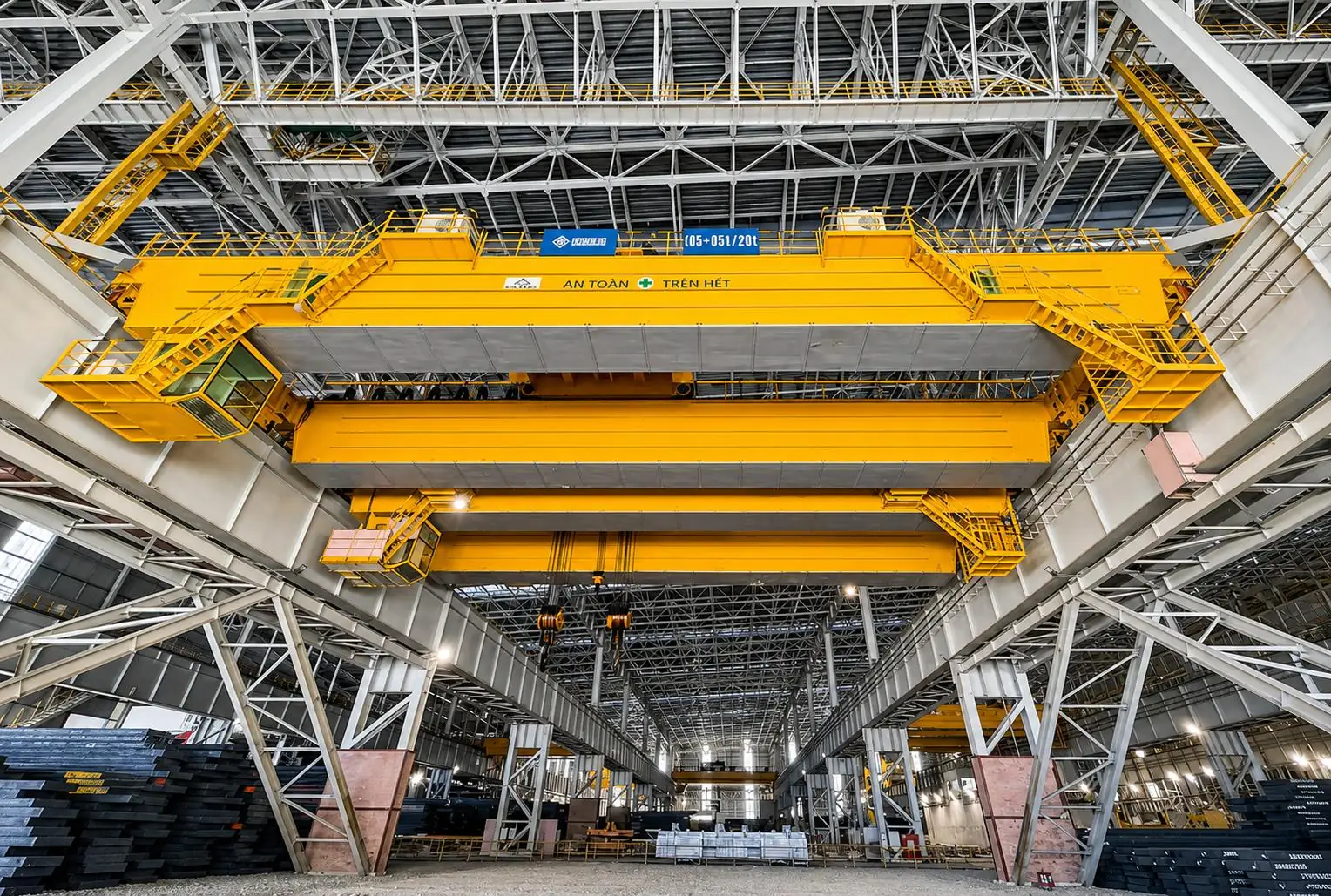
The work level is the core indicator to measure the durability and work intensity of gantry cranes.The conventional working level of the 50-ton gantry crane is A5-A6, which is a medium-sized work system, suitable for medium-frequency and intermittent operation scenarios, and the effective daily operation time is 8-10 hours. It is suitable for factory normalized production and intermittent hoisting operations, and can be stably adapted to the supporting production conditions of the assembly line.The standard working level of the 100-ton gantry crane is A7-A8, which belongs to the heavy-duty working system and is a special level for industrial heavy-duty. It supports high-frequency, all-weather and continuous operation, and can achieve 24-hour uninterrupted rotation operation. It has strong anti-fatigue and anti-loss capabilities.In view of the high-intensity operation needs of large factories, key projects, and port depots, the 100-ton gantry crane can maintain stable operation for a long time, with low equipment failure rate and longer service life, and is fully adapted to heavy-duty continuous operation conditions.
Operating performance
In terms of operating performance, the 50-ton gantry crane has a moderate start-stop speed, stable operation and low difficulty in operation. Ordinary licensed operators can skillfully control it, low energy consumption, low noise in daily operations, and lightweight structure. The equipment is more flexible in walking and steering, and it is suitable for refined and normalized medium-sized hoisting operations.However, in heavy-duty, long-span, and windy environments, the stability of the equipment will decrease, and it cannot be adapted to the needs of super-heavy and high-precision hoisting.
The 100-ton gantry crane is equipped with frequency conversion speed regulation, intelligent limit, cushioning and shock absorption, and dual brake protection system. It has no shaking during heavy-duty operation and extremely high alignment accuracy. It can achieve precise alignment at the millimeter level to meet the needs of precision assembly of heavy equipment.At the same time, the equipment has excellent wind resistance, seismic resistance and overload resistance, stronger adaptability to harsh environments, and overall operating stability, safety and reliability are better than the 50-ton model.The only shortcoming is that the equipment is large, the steering flexibility is slightly weak, and the energy consumption is relatively higher. It is suitable for heavy-duty operations on fixed sites, and it is not suitable for lightweight working conditions with frequent shifts.
How Does Crane Capacity Affect Project Cost?
The tonnage of Henan Mine Crane Factory supply gantry crane directly determines the overall input cost of the project, covering the three core sectors of equipment procurement, infrastructure installation, and operation and maintenance.The cost gap between 50-ton and 100-ton models is not simply doubled, but a structural and long-term cost difference. When selecting models, companies need to consider the project budget and long-term benefits comprehensively.
Equipment purchase cost
The bare metal purchase price of equipment is the most intuitive cost difference.According to the market quotation of industrial lifting equipment in 2026, the bare metal price range of the standard double-beam 50-ton gantry crane is 65,000-120,000 US dollars, and the conventional configuration is extremely cost-effective, which is suitable for small and medium-sized enterprises to purchase in bulk.Due to the large amount of materials used, the high grade of core accessories, and the complex technology of the 100-ton heavy-duty gantry crane, the price range of bare metal is 85,000-205,000 US dollars, and the price of customized long-span, high-lift, and intelligent models will rise further.Compared with the 50-ton model, the procurement cost of 100-ton equipment is 30%-70% higher, and the difference between intelligent and high-configuration models can be more than doubled, and the threshold for equipment investment in the early stage is higher.
Installation and infrastructure
Infrastructure and installation costs are core expenditures that are easily overlooked.The 50-ton gantry crane has light weight and low wheel pressure, and has low requirements for the bearing capacity of the ground foundation. The installation needs can be met by simple reinforcement of conventional cement floors. The amount of track laying and foundation construction projects is small, the installation cycle is short, and the overall infrastructure installation cost is low. Small and medium-sized sites can be quickly deployed on the ground.The 100-ton gantry crane has a huge weight and high wheel pressure. Special heavy-duty infrastructure construction must be carried out. It is necessary to thicken the concrete foundation, lay heavy-duty special tracks, and strengthen the foundation carrying structure. Windproof anchoring devices and lightning protection systems need to be installed in some open-air scenes.The amount of infrastructure projects, construction cycle, and material costs have increased significantly, and the overall installation infrastructure cost is more than 50% higher than that of the 50-ton model. There are strict requirements for site infrastructure conditions, and the initial construction investment is higher.
Maintenance and operating costs
There is a significant gap in long-term operation and maintenance costs.The 50-ton gantry crane accessories have strong versatility, simple structure, and slow wear rate. Daily maintenance only requires conventional lubrication, fastening, and testing. The annual maintenance cost is about 4,500-6,000 US dollars. The energy consumption of the equipment is low, the daily operating expenses are small, and the late operation and maintenance pressure is minimal.The core accessories of the 100-ton gantry crane have large specifications, high precision and complex structure. The wear and loss of components under heavy-duty operations are relatively higher, and regular professional testing, precision calibration, and maintenance of accessories are required.Its annual maintenance cost is about 7,000-9,000 US dollars. At the same time, the motor power of the equipment is large and the whole machine consumes more energy. The electricity bill, operation and maintenance labor cost, and parts replacement cost of long-term continuous operation are much higher than that of the 50-ton model, and the total cost of long-term operation is higher.
How to Choose the Right Gantry Crane Capacity?
The core principles of gantry crane selection are not over-matched, not under-matched, adapted to working conditions, and taking into account future expansion.Combining the performance, scenario, and cost differences of 50-ton and 100-ton models, from the three dimensions of load requirements, operating environment, and long-term planning, the adapted tonnage can be accurately locked to maximize cost performance.
Maximum load and lifting frequency
First, clarify the maximum lifting load of the project and the frequency of daily operations.If the weight of the daily hoisting workpieces is concentrated at 20-50 tons, mainly intermittent and normalized operations, and the daily operation time is less than 8 hours, Henan Mine Crane Factory supply 50-ton gantry crane is preferred to fully meet the operation needs, which can significantly reduce equipment procurement and operation and maintenance costs, and the best price/performance ratio.If the maximum weight of the workpiece exceeds 50 tons, or the daily frequent hoisting of 40-50 tons of heavy loads requires 24 hours of continuous operation, and there is a need for the overall hoisting of heavy components, a 100-ton gantry crane must be selected.Avoid the premature aging of equipment, safety hazards and low efficiency caused by overloading of small-tonnage equipment and frequent full-load operation, and ensure the stable development of high-intensity heavy-duty operations.
Working environment and available space
The space and environment of the work site are the key constraints for selection.If the space of the factory area and yard is limited, the span and height of the plant are small, the bearing capacity of the ground foundation is general, and the wind speed for open-air operations is small, 50-ton gantry cranes are preferred. The equipment occupies a small area, is flexible in deployment, and is adapted to conventional site conditions. There is no need for large-scale infrastructure transformation.If the work site is open and there is sufficient space, the site can carry heavy infrastructure loads, and there are complex working conditions such as high winds, rain and snow in the open air, which require large-span and high-lifting operations, it is recommended to choose a 100-ton gantry crane.Its stronger structural stability, environmental adaptability and large operating coverage can be perfectly adapted to the heavy-duty operation needs of large-scale sites and complex operating conditions.
Future production requirements
The selection of models needs to take into account the long-term production planning of the enterprise to avoid the waste of short-term equipment iteration.If the enterprise focuses on the processing of medium-sized workpieces at this stage, there will be no heavy-duty production capacity upgrade, no large-scale component production, and no heavy-duty equipment hoisting requirements in the next 3-5 years. The 50-ton gantry crane is fully adapted to long-term production, and the input cost can be controlled.If an enterprise has plans to expand production capacity, upgrade products, and undertake large-scale engineering orders, it will add 100-ton component production, heavy equipment assembly, and large-scale infrastructure hoisting services in the future. It is recommended to directly select a 100-ton gantry crane.One-time investment can avoid the high costs of late equipment replacement, secondary infrastructure, and equipment disassembly and assembly, adapt to the long-term development needs of enterprises, and have a higher equipment service life and value utilization rate.
Henan Mine Crane Factory Custom
The 50-ton gantry crane mainly focuses on medium-sized loads, conventional working conditions, high cost performance, and low operation and maintenance costs. It is suitable for small and medium-sized steel structure processing, general machinery manufacturing, and small and medium-sized infrastructure projects.The 100-ton gantry crane mainly focuses on heavy-duty, high-frequency, high-precision, high-stability, and complex working conditions, and serves the fields of heavy-duty manufacturing, large-scale infrastructure, and deep processing of large-scale steel structures.
Industrial enterprises do not need to blindly pursue large tonnage in the selection of models. They combine their own maximum hoisting load, operating frequency, site conditions and future production capacity planning to accurately match tonnage equipment, which can not only ensure operation safety and efficiency, but also maximize project cost control, and achieve the optimal balance between equipment value and input cost.If you need customized solutions for gantry cranes with personalized span, lifting height, and intelligent configuration, you can consult Henan Mine Crane Factory at any time for professional one-to-one selection services.