
Double Trolley Overhead Cranes: When Do You Need Two Hoists
In the field of industrial lifting, single trolley bridge cranes have long undertaken conventional lifting tasks in workshops.However, when the length of the workpiece exceeds the range of conventional hanging points, the weight of a single piece approaches the rated upper limit, or it is necessary to complete a double-station operation within the same span, the single hook configuration is powerless.The double-trolley bridge crane is designed to cope with such complex working conditions. Two sets of independent lifting mechanisms are arranged on the same bridge frame, so that the whole machine has the ability of two-point lifting, synchronous lifting and division of labor at the same time.For steel structure processing, precast concrete, shipbuilding, heavy equipment and power plant maintenance industries, understanding the essential differences between double trolley and single trolley, double beam and single beam is directly related to the correctness of selection and long-term return on investment.
What Is a Double Trolley Overhead Crane?
Working principle
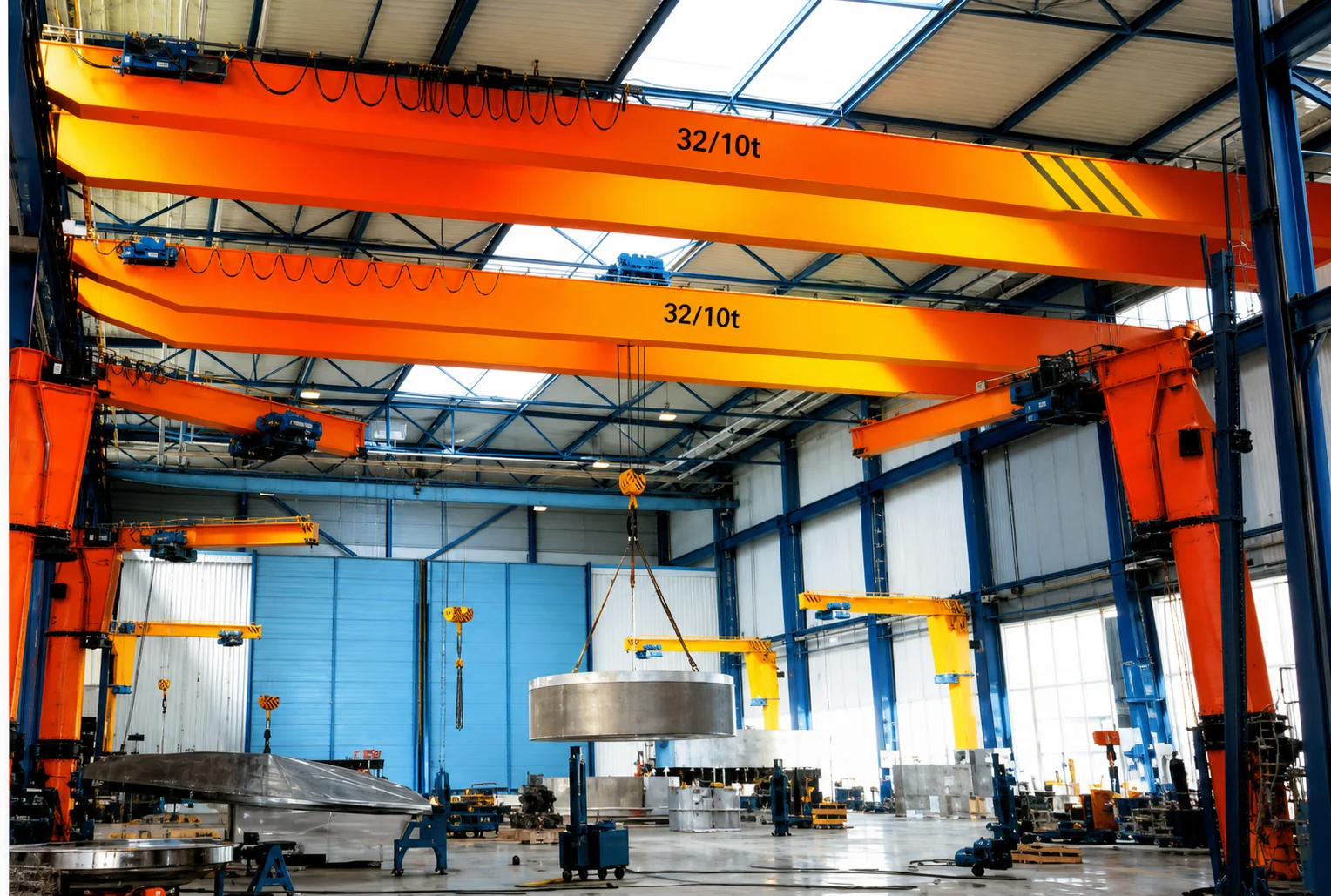
The Henan Mine Crane Factory supply double-trolley bridge crane arranges two trolleys that can operate independently or in linkage on the main beam of the bridge frame, and each trolley is equipped with a set of hoist-type lifting mechanism.During operation, the two trolleys move synchronously along the main beam to the designated station, and the spacing between them can also be adjusted according to the length of the crane, and both ends of the workpiece can be hung at the same time through their respective hooks.The cab or remote control system controls the lifting speed of the two lifting mechanisms through PLC to keep the synchronization, to ensure that the long workpiece is always horizontal during the lifting and translation process, and to avoid overturning caused by excessive height difference between the two ends.This collaborative mode allows one device to complete the operation that originally required the cooperation of two cranes.
Main components
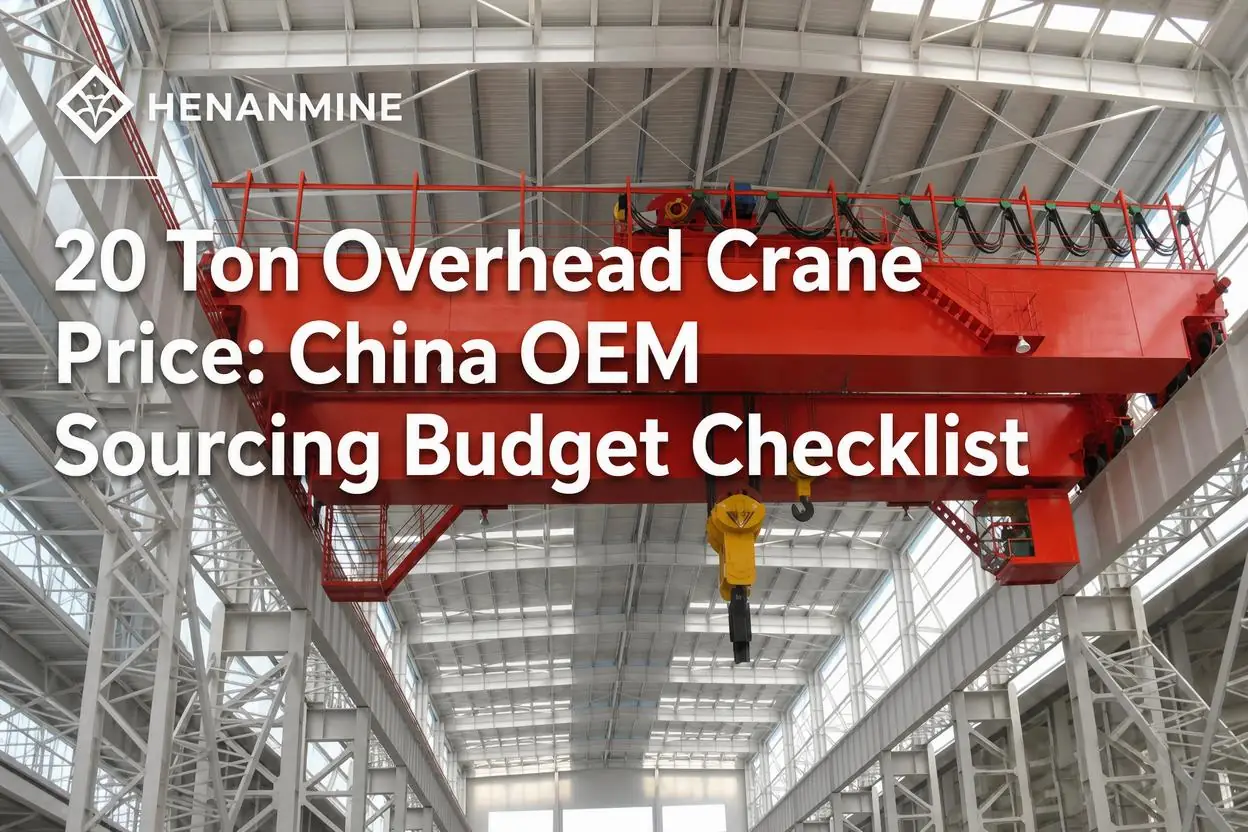
The complete set of double trolley bridge cranes is mainly composed of the main beam of the bridge frame, two operating trolleys, two sets of independent lifting mechanisms, trolley operating mechanisms, cabs or remote control operating platforms, electrical control systems and safety protection devices.The main beam usually adopts a box-shaped double-beam structure to carry double wheel pressure. The hoist mechanism, guide pulley and wire rope system are installed on the trolley frame, and the hook group is equipped with forged hooks or special spreader beams according to the lifting needs.The end beam of the cart is connected to the main beam and the track, and the whole machine is driven to run vertically along the plant.The electrical system includes a frequency converter, a synchronous controller, a weight limiter and a stroke limit switch to jointly ensure the precise alignment and safe operation of the double trolley under complex working conditions.
Single vs. double trolley
The single trolley bridge crane has only one set of lifting mechanism, which is suitable for lifting small and medium-sized single-piece cargo. The structure is simple and the procurement cost is low.The double-trolley bridge crane is equipped with two sets of independent lifting systems on the same bridge frame, and the two can operate separately or work together to lift.The most essential difference lies in the number of hoisting points and operational flexibility: a single trolley can only provide one hoisting point, and an additional balance beam is required for long strip workpieces; a double trolley directly forms two adjustable-pitch hoisting points on the main beam, and two-point hoisting can be completed without auxiliary spreaders.In addition, the double trolley can also serve two stations in the same span, reducing the total number of equipment and the occupied area of the track.
When Do You Need Two Hoists on an Overhead Crane?
Long load handling
When the lifting object is steel beams, prestressed concrete beams, wind power blades, large pipelines or long-size structural parts, single-point lifting will cause the middle part of the workpiece to sag and even plastic deformation.The double-trolley bridge crane applies force at both ends of the workpiece or at multiple predetermined lifting points at the same time, so that the elongated components maintain a horizontal attitude during the entire lifting process.The spacing between the two trolleys along the direction of the main beam can be flexibly adjusted according to the length of the workpiece, ranging from a few meters to more than ten meters, without the need to replace the hanging beam.This ability is particularly critical for the long-span roof panels of precast concrete plants, the H-shaped steel beams of steel structure workshops, and the segmented hull components of shipyards, which can significantly reduce the bending stress and safety risks in the lifting of long pieces.
Heavy load lifting
For oversized tonnage workpieces whose rated capacity of a single lifting mechanism is not enough to cover, the total lifting weight can be superimposed by synchronous lifting of the two trolleys.For example, two 50-ton trolleys each can work together to achieve a 100-ton joint lifting capacity, but if a 100-ton single-trolley crane is directly purchased, the wheel pressure of the main beam, the track foundation and the load-bearing capacity of the plant need to be greatly strengthened.The dual-trolley scheme increases the maximum lifting weight of the whole machine without changing the structure of the plant, while retaining the flexibility of the two trolleys to bear lighter loads separately.This configuration is widely used in heavy machinery plants, mining equipment manufacturing workshops and large transformer production lines, and can achieve a good balance between investment costs and operating capabilities.
Two-point lifting
Although the total weight of some workpieces is not large, the structure requires that they must be hoisted from two symmetrical positions at the same time to maintain balance, such as large machine tool beds, transformer cores, engine blocks, etc.If a single trolley is used with the balance beam, not only does it need to be replaced frequently with different specifications of spreaders, but it is also difficult to accurately control the synchronization of lifting at both ends.The double trolley bridge crane can align the two hooks at the designated lifting point of the workpiece separately, and the electrical synchronization system ensures that the lifting speed at both ends is consistent to avoid the workpiece tilting and colliding with the equipment.This two-point lifting method can also be used with special spreaders to achieve turning operations, which greatly improves the efficiency of turning and alignment of workpieces in machining workshops and assembly lines.
Production efficiency
In workshops that require frequent hoisting and have a compact pace of operation, double trolleys can take on the task of picking and placing two stations at the same time.When one trolley is hoisting the workpiece in place at Station A, the other trolley has been moved to Station B to prepare for the next batch. The two trolleys work alternately to make the crane waiting time approach zero.In contrast, a single trolley crane must complete a complete lifting cycle before it can start the next operation, and the utilization rate of equipment is strictly restricted by the cycle time.For automated production lines with high output requirements and large logistics volume, the dual-trolley configuration can nearly double the number of hoisting times per unit time without adding a second crane and a second set of tracks.
Double Trolley vs. Double Girder Overhead Crane
Structural differences
Double trolley bridge cranes and double girder bridge cranes are often confused, but the two belong to completely different classification dimensions.Double beam refers to the number of main beams of the bridge, that is, the bridge structure is composed of two parallel box beams, which is relative to the single beam.Double trolley refers to the number of lifting mechanisms, that is, two trolleys and two sets of hooks are arranged on the bridge.Double-girder bridge cranes are usually equipped with only one trolley and a set of lifting mechanisms, but the double-girder bridge itself can carry greater wheel pressure and heavier loads.The vast majority of double-trolley bridge cranes use a double-beam structure, because the stiffness of a single beam is difficult to withstand the superposition of wheel pressure caused by the simultaneous operation of two trolley cars.Understanding this helps not to confuse the number of main beams with the number of trolley cars when selecting models.
Lifting functions
From the perspective of lifting function, the core advantage of a double-beam single-trolley crane is to increase the lifting weight of a single machine and reduce the weight of the main beam. It still has only one lifting point and cannot complete two-point lifting or dual-station simultaneous operations.The double-trolley double-girder crane superimposes two sets of lifting systems on the basis of the double-girder structure, which not only retains the heavy-duty capacity of the double-girder, but also obtains the operating flexibility of the double-lifting point.If the lifting of goods in the workshop is based on a single piece of short and medium-sized size, choosing a double-beam single trolley is an economical enough solution.Only when the proportion of long-shaped components is high, there is a need for collaborative lifting of large tonnage, or two independent stations need to be served in the same span, the additional investment of the double trolley is reasonable.
Configuration selection
When selecting the type, it is first necessary to determine whether two lifting points are required for the most frequent lifting tasks in the workshop.If all workpieces can be safely hoisted by a single point plus sling, then a double-beam single trolley is a sufficiently economical solution.Only when the proportion of long-shaped components is high, there is a need for collaborative lifting of large tonnage, or two independent stations need to be served in the same span, the additional investment of the double trolley is reasonable.At the same time, the carrying capacity of the plant track and the leg of cattle should also be considered, because the wheel pressure generated when the double trolley is fully loaded at the same time is nearly twice that of a single trolley.In the actual project, it is recommended to provide the list of typical working conditions and the maximum size of the workpiece to the crane manufacturer, and the engineer will verify the load combination and determine the final configuration.
Key Factors When Selecting a Double Trolley Overhead Crane
Load capacity
The rated lifting weight of the double trolley crane needs to be marked with two parameters: single trolley load and joint lifting load respectively.When selecting the model, it is not only necessary to look at whether the combined lifting weight covers the heaviest parts, but also to confirm whether the rated capacity of a single trolley when operating separately meets the daily lighter load requirements.If the daily operation is dominated by small and medium loads, and joint lifting is occasionally required, then the rated capacity of a single of the two trolleys is too high, which will cause long-term waste of large-capacity trolleys.The reasonable approach is to count the weight distribution of the workpiece, so that the capacity of a single trolley covers more than 80% of the daily working conditions, and the joint lifting capacity covers the heaviest percentage of heavy parts.At the same time, the weight of the spreader and the beam itself under the hook must be considered, and this part must be deducted from the rated lifting weight.
Hoist spacing
The minimum and maximum spacing between the two trolleys directly determines the length range of the workpiece that can be hoisted.The minimum spacing is limited by the width of the trolley itself and the anti-collision limit, and the maximum spacing is determined by the effective length of the main beam.When selecting the type, it is necessary to compare the length of the longest workpiece in the workshop to ensure that the spacing between the two hooks can cover the position of the standard hanging points at both ends of the workpiece, and at the same time reserve a safety margin.If longer workpiece specifications may be introduced in the workshop in the future, it is recommended that the maximum spacing parameters be appropriately enlarged during the selection.In addition, the synchronous operation accuracy between the trolleys is also very critical. If the speed of the two trolleys deviates when the spacing is too large, it will cause the hook spacing to change, thereby changing the force state of the workpiece.
Lifting height and span
The lifting height determines the clearance distance between the highest position where the hook can rise and the ground. It needs to be determined in combination with the height of the equipment in the workshop, the number of layers of workpieces stacked, and the safe distance of the operators below.The span is the distance between the centerline of the crane cart track, which must accurately match the column distance of the plant.Since two trolleys are arranged on the main beam of a double-trolley crane, the height of the main beam is usually larger than that of a single beam or an ordinary double beam. Therefore, in factories with limited headroom, the limit height needs to be specially calculated to avoid the trolley colliding with the roof frame or the workpiece below colliding with the ground facilities when the hook rises to the highest position.If the plant has been built and the headroom is tight, the manufacturer can be required to provide a low-headroom dual-car solution.
Duty class
The work level is the core indicator to measure the busyness and load status of the crane, and it is usually divided into grades A1 to A8 according to FEM or ISO standards.If the double trolley crane is used in a dock yard, metallurgical workshop or automated production line with frequent loading and unloading, the working level should be above A5 or even A6 to A7; if it is only used occasionally in the machine repair workshop, you can choose A3 or A4.Mistakenly choosing a low working level will lead to fatigue cracks and increased component wear of metal structures and lifting mechanisms after short-term high-frequency use, and the later maintenance costs far exceed the original savings in procurement costs.When selecting the model, the manufacturer must be provided with the number of daily operating cycles, the load spectrum distribution and the number of working days in the year, and the recommended working level shall be calculated accordingly.
Control and safety systems
The control system of the double trolley crane is a key part that distinguishes it from ordinary cranes.Two sets of lifting mechanisms and two operating trolleys need to be precisely synchronized through PLC, and the synchronization accuracy is usually required to be in the millimeter level.In terms of safety, it should be equipped with dual trolley weight limiters, lifting height limits, travel terminal limits, trolley anti-collision buffers, high wind warning devices, and overload alarm functions.For cranes used in metallurgical environments, heat insulation panels, water-cooled reels and high-temperature steel wire ropes also need to be installed.The operation mode is recommended to keep the two modes of cab and wireless remote control at the same time, which is convenient to choose under different operating conditions.The emergency power-off button, sound and light warning and warning lights are standard and cannot be cut off as options during the selection.
Common Applications of Double Trolley Overhead Cranes
Steel manufacturing
The smelting and continuous casting workshops of steel mills need to lift scorching ladles, billets and large rolls. These workpieces are not only extremely heavy, but also require extremely high lifting stability.Double-trolley bridge cranes are commonly used in steel mills to lift two cranes in the ladle rotary table area together, or to lift ultra-long rolls and finished steel products in the steel rolling workshop.The simultaneous operation of the two trolleys can ensure that the ladle remains horizontal during the handling process and avoid the molten steel shaking and overflowing.Due to the high temperature of the operating environment, large dust and extremely high frequency of operations, double-trolley cranes for steel mills usually choose A7 or A8 working level. The lifting mechanism is equipped with high temperature sealing and water cooling devices, and the cab adopts a positive pressure design of heat insulation and air conditioning to ensure the safety and comfort of operators in harsh environments.
Precast concrete plants
The roof panels, T-beams, wall panels and pipe sheets produced by precast concrete component factories are often up to ten or even twenty meters long, and single-point lifting can cause the components to break.The double trolley crane undertakes the core lifting tasks in the demoulding, flipping and palletizing links of the prefabricated plant.The two trolleys are separated along the direction of the main beam to the position corresponding to the hanging point of the component, and at the same time the components are lifted smoothly out of the mold, and then the components are placed smoothly in the stacking area through the fine-tuning and alignment of the two trolleys.When it is necessary to flip large wall panels, the double trolley can also flip the components in the air through the cooperation of one ascending and one descending, without the need for additional configuration of flip machine equipment.Double-trolley cranes in prefabricated plants usually have a large span and moderate lifting height, but the work level is more demanding, because each production line has to complete dozens of mold release and transfer cycles every day.
Shipyards
The weight of the hull segments in the shipyard ranges from hundreds of tons to thousands of tons, and the size is so huge that it is almost impossible for a single crane to complete the lifting independently.Shipyards usually arrange large-span double-trolley or even multi-trolley bridge cranes above the dock, which are used to lift the hull segments from the assembly platform to the dock for closing.The two trolleys maintain a horizontal attitude in the air through precise synchronous control of the huge segments, and then slowly install them on the hull in alignment.In addition to hull segments, shipyards also need to lift heavy-duty components such as large marine diesel engines, propeller shafts and rudder blades.The advantage of double trolley cranes in shipyards is that they can not only co-lift ultra-large segments, but also lift lighter parts separately in daily operations. The equipment utilization rate is much higher than that of specially configured multiple small-tonnage cranes.
Heavy equipment factories
The parts of mining excavators, large presses, wind power gearboxes and shield machines produced in heavy machinery manufacturing workshops are all typical large and heavy parts.These equipment need to be frequently turned over, shifted and precisely aligned during machining and assembly.The double-trolley bridge crane with special spreaders can realize the two-point lifting and aerial flipping of the large bed, and the heavy-duty parts can be accurately landed on the mounting base on the assembly line.The two trolleys can also undertake the tasks of component hoisting and tool spreader transfer respectively, reducing the invalid waiting time of a single crane.Henan Mine Crane Factory supply Double-trolley cranes in heavy-duty equipment plants usually have a large lifting weight but medium operating frequency, and the working level is mostly between A5 and A6. The key requirements are lifting accuracy and positioning accuracy to meet the alignment needs of precision assembly.
Power plants
During the maintenance of the power plant, core equipment such as generator rotors, steam turbine blades, boiler steam drums and high-pressure heaters need to be hoisted.These components are of high value and have strict requirements for lifting balance, and once they tilt and collide, they will cause huge losses.The double trolley bridge crane plays a key role in the steam engine room and boiler of the power plant. The two trolley cars cooperate with special hanging beams to pull out the slender generator rotor horizontally and place it smoothly to the maintenance site.The synchronous operation accuracy of the two trolleys directly determines whether the rotor will scratch the stator during the extraction process.Double-trolley cranes for power plants usually do not run every day, but the intensity of use is extremely high during each overhaul. Therefore, the working level should be above A5, and the synchronous control accuracy and braking system reliability must be checked regularly.
Double Trolley Overhead Crane Cost and Selection Guide
Main cost factors
The purchase price of a double trolley bridge crane is mainly determined by the lifting weight, span, lifting height, working level, control method and configuration brand.In the case of similar basic parameters, the dual-trolley scheme is 30% to 60% more expensive than the single-trolley scheme of the same span, because it is necessary to add a second set of lifting mechanism, a second set of trolley operating mechanism and a synchronous control system.With every increase of one meter in span, the amount of steel used for the main beam has increased significantly, and the price has also jumped.Imported brand frequency converters, reducers and wire ropes will have several times higher budgets than domestic products of the same specifications.In addition, special working condition configurations such as high temperature resistance, explosion-proof, anti-corrosion and low headroom design will increase the base price.It is recommended that the manufacturer make an itemized quotation when inquiring, listing the main beam steel structure, lifting mechanism, electrical system, and transportation and installation costs separately.
Operating and maintenance costs
The long-term operating costs of double trolley cranes mainly include electricity bills, wire rope replacement, brake wear, reducer lubricating oil and regular maintenance costs.Since both sets of lifting mechanisms are working, the consumption of wearing parts is about twice that of a single trolley crane.The service life of wire rope depends on the frequency of operation and load spectrum, and it usually needs to be replaced once in one to two years in workshops with high-frequency use.The synchronous control system of the two trolleys needs to be calibrated with accuracy once a year to prevent synchronization deviations after long-term operation.Lubrication and maintenance must cover the wheel bearings, wire rope reels and reducers of the two trolleys.Although the maintenance cost is higher than that of a single trolley, the double trolley reduces the total number of cranes required in the workshop, and saves comprehensive operating costs in terms of track, electrical and driver labor.
Common selection mistakes
The most common mistake in the selection process is to focus only on the maximum lifting weight and ignore the working level, resulting in structural fatigue soon after the equipment is put into use.Another common problem is to underestimate the adjustable range of the spacing of the trolley. After buying it back, it is found that it cannot cover the position of the hanging point of the longest workpiece in the workshop.There are also customers who installed the double trolley crane on the original plant without accurately calculating the wheel pressure, and as a result, cracks appeared in the legs and track beams during operation.Some buyers are overly pursuing imported configurations. In fact, for most conventional working conditions, certified domestic core components have been able to provide sufficient reliability and cost performance.The last mistake that should be made is to place an order directly according to the sample parameters without an engineer performing the load combination verification. The load superposition effect of the double trolley needs to be professionally calculated to confirm the structural safety.
Choosing a reliable manufacturer
When choosing a manufacturer of double-trolley bridge cranes, priority should be given to examining its actual performance and cases in the same type of projects.Suppliers are required to provide a list of delivered customers with similar working conditions, and if necessary, they can go to the site to inspect the operating status of the equipment.Manufacturers must have corresponding lifting machinery manufacturing licenses and A-level qualifications, and steel structure welding should pass third-party non-destructive testing.In the technical docking stage, good manufacturers will take the initiative to ask about typical working conditions, workpiece size, plant parameters and use environment, rather than direct quotation.Henan Mining Crane has many years of R&D and manufacturing experience in the field of double trolley bridge cranes, and can be customized according to the specific working conditions of customers. It produces independently from the main beam steel structure to the synchronous control system, and provides installation and commissioning, operation training and lifelong after-sales service.
Henan Mine Crane Factory Custom
When choosing a double-trolley bridge crane, you can't just look at the rated lifting weight, but also consider the factors such as the spacing of the lifting points, the load distribution, the synchronization requirements of the double hooks, the lifting height and the working level.These parameters directly affect the stability, safety and production efficiency of the lifting process.Henan Mine Crane Factory can provide customized dual-trolley bridge crane solutions according to different needs such as long-size workpiece handling, heavy-duty component assembly and large-scale equipment maintenance, taking into account actual working conditions and operating requirements.
Whether you need double lifting points to work together to lift large workpieces, or you want to optimize the material handling process in the workshop, the right crane configuration can help reduce unnecessary operating links and improve operational efficiency.Henan Mine Crane Factory can provide you with selection suggestions, program design and customized manufacturing support.Welcome to provide the required lifting weight, span, lifting height, workpiece size and working environment and other information, to obtain a dual-trolley bridge crane plan and quotation that is more suitable for actual needs.