
How to Choose the Right Jib Crane
In industrial material handling, jib crane has become a commonly used industrial lifting equipment in workshops, warehouses and production lines by virtue of its flexibility, high efficiency and high cost performance. Compared with traditional large cranes, industrial jib cranes have simple structure and convenient operation, and are specially adapted to fine lifting operations of small range and high frequency. Enterprises choose the right model to adapt to the working conditions, which can not only optimize the handling process, improve the efficiency of operation, but also effectively avoid equipment failure and reduce the cost of later operation and maintenance.
The key to the safety of lifting operation lies in the precise selection. Most of the failures and hidden dangers of jib cranes are due to the unreasonable selection in the early stage. Tonnage does not match, the operation radius does not match, the installation method does not adapt, will cause equipment loosening, overload damage and even safety accidents. As a professional jib crane manufacturer, we are well aware of the importance of fitting the selection of working conditions and master the skills of how to choose a jib crane, which can help enterprises stabilize the operation of equipment, prolong the service life of equipment and build a solid bottom line of production safety.
Understand Different Types of Jib Cranes
Henan Mine Crane manufactured jib crane can be divided into four core types according to the installation mode, structure form and usage scene. the space conditions, operation requirements and usage frequency of different models of jib crane are significantly different. Accurately distinguishing the characteristics of various types of equipment is the first step in scientific selection, and it is also the key to avoid selection errors and improve equipment utilization.
Floor mounted jib crane
floor type jib crane is the most widely used type of industrial jib crane in industrial scenes. it adopts the fixed installation of ground column, does not need to rely on auxiliary structures such as walls and roofs, and has strong independent load-bearing and stability. The overall structure of the equipment is solid, strong carrying capacity, excellent anti-overturning performance, the working radius can be customized according to the needs, suitable for large tonnage, high frequency, high-intensity lifting operations. The floor-mounted jib crane is not limited by the wall structure and can be deployed in the open area of the workshop, the open-air operation area of the factory, the assembly station of large equipment and other scenes. Its core advantage is stable operation, wide adaptability, convenient maintenance, the disadvantage is that it needs to occupy a certain amount of ground space, more suitable for open space, fixed station long-term operation of the enterprise, is the preferred equipment for heavy-duty fine lifting scene.
Wall mounted jib crane
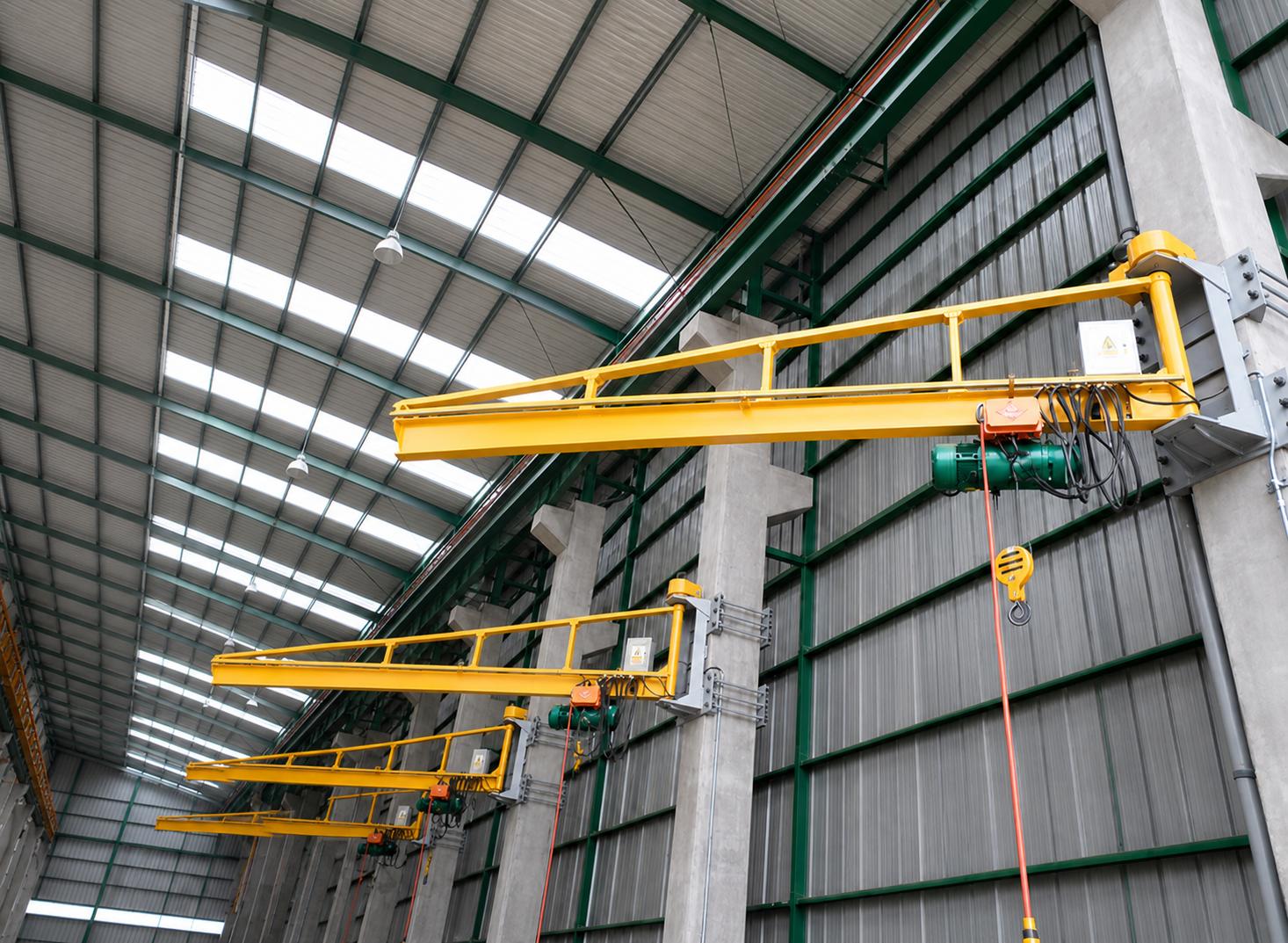
The wall-mounted jib crane relies on the load-bearing wall of the factory building and the steel structure column to complete the fixed installation without occupying the ground space, and is perfectly suitable for the operation scene of narrow workshop site, dense ground equipment and no redundant installation area. Henan Mine Crane manufactured wall mounted jib crane has compact structure, light weight and convenient installation. the boom can fit the wall surface and rotate. the operation scope is concentrated in the front area of the wall. it is mainly suitable for lifting operations of medium and small tonnage and fixed narrow and long working stations, such as material supply at the side of the production line, wall surface equipment maintenance, narrow area parts transfer, etc. The equipment has high cost performance, low installation and operation costs, and does not affect the traffic and equipment placement of vehicles in the workshop. It is the core supporting lifting equipment for compact workshops and assembly line operations. It should be noted that the bearing capacity of the wall should be confirmed before selection to avoid potential safety hazards caused by insufficient bearing capacity of the installation base.
Portable jib crane
Portable jib crane is the most flexible light lifting equipment, the bottom is equipped with mobile rollers, no fixed installation, according to the needs of the operation of the free transfer station, switching work area. portable jib crane has an overall lightweight design, simple operation and convenient handling. it can be used on the ground without professional installation and construction. it is mainly suitable for temporary lifting scenes with small tonnage, low frequency and multi-station switching, such as temporary equipment maintenance in workshops, temporary transfer of small materials, temporary lifting operations on construction sites, handling of scattered goods in warehouses, etc. Compared with the fixed jib crane, the mobile model adaptation scene is more flexible, can be multi-regional reuse, greatly reduce the cost of enterprise equipment procurement, suitable for small and medium-sized enterprises with non-fixed working conditions, scattered operating points, temporary lifting demand.
Articulating jib crane
Articulating jib crane is also called crank jib crane. It adopts double-section foldable boom design, which breaks through the operation limitation of traditional single-arm jib crane. It can bypass obstacles such as equipment, walls and workpieces and complete fine lifting in dead angle area. This type of jib crane has flexible rotation, adjustable angle and precise operation, and can adapt to complex working conditions, dense obstacles and working areas that ordinary cranes cannot cover, such as dense equipment workshops, narrow assembly spaces, mold maintenance stations and other scenes. Its core advantages are no dead angle, accurate positioning and adaptation to complex working conditions. It is mostly used for fine operations such as high-precision assembly, precision equipment maintenance and complex space material handling. It is a special lifting equipment for high-end manufacturing and precision processing industries.
Key Factors to Consider When Choosing a Jib Crane
After understanding the classification of jib cranes, if you want to accurately select the equipment suitable for your own working conditions, you need to consider comprehensively the core factors such as your own operation requirements, site conditions, and use intensity. The following 5 major core selection elements, covering key dimensions such as equipment performance, adaptation scenarios, service life, and operational safety, are the core basis of how to choose a jib crane.
Lifting capacity
Rated lifting weight is the primary core parameter of Henan Mine Crane Factory supply jib crane selection, which directly determines whether the equipment can meet the operation requirements, and is also the key to prevent overload safety accidents. When selecting an enterprise, it is necessary to accurately count the maximum load weight of daily operations and the tonnage of conventional hoisting materials. It is strictly prohibited to select according to conventional loads. A safety margin of 20%-30% should be reserved to avoid problems such as structural deformation of equipment, wire rope wear and motor damage caused by long-term full load and overload operation.
For example, the daily maximum lifting weight is 1 ton, and it is recommended to select an industrial jib crane of 1.2-1.5 tons, which can not only adapt to routine operations, but also cope with temporary overweight lifting requirements. At the same time, it is necessary to distinguish the rated load and the limit load, strictly follow the equipment marking parameters, prevent overload operation, and ensure the safety of operation and the service life of the equipment from the equipment performance level.
Working radius and coverage area
The working radius and coverage determine the effective working area of the jib crane, and the core is determined by the length and rotation angle of the boom. Before selection, it is necessary to accurately measure the horizontal distance and vertical coverage of the operation area, and define the distance between the farthest hoisting point and the installation base point, so as to determine the customized length of the boom. At the same time, it is necessary to confirm the rotation range of the equipment. The conventional jib crane can realize 180, 270 and 360 rotation, the floor type supports 360 full-angle rotation, and the wall-mounted type supports 180/270 rotation.
If the boom is too short to cover the entire operating area, it will result in limited operations and low equipment utilization. The boom is too long will cause waste of resources, while reducing the lifting stability. Accurate matching of the working radius can maximize the performance of the equipment, achieve full coverage, no dead angle operation, and improve the overall hoisting efficiency.
Installation environment
The spatial layout, installation conditions and environmental conditions of the installation site directly determine the installation type and material configuration of the jib crane. The first is the space conditions, the site is open, no wall support, give priority to the floor type jib crane. The ground is narrow, the wall bearing standard, suitable for wall-mounted jib crane. Station is not fixed, need to move frequently, choose mobile jib crane.
Followed by environmental conditions, indoor conventional dry environment, the use of standard material equipment can be. Outdoor open air, damp, dust, corrosion, high temperature and other special environment, need to customize anti-corrosion, dustproof, waterproof, high temperature resistant special model, to avoid environmental erosion caused by equipment corrosion, circuit failure, structural damage. At the same time, it is necessary to confirm the load-bearing strength of the installation floor and wall to ensure the firm installation and stable operation of the equipment.
Operation frequency
Operation frequency determines the operation mode selection of the equipment, which is divided into manual operation and electric operation. The manual jib crane has simple structure, low cost and convenient maintenance. It is suitable for low-frequency, intermittent and light lifting operations, such as daily scattered maintenance and occasional material transfer. It is simple to operate without professional training and has extremely low operation and maintenance costs.
Henan Mine Crane Factory supply electric jib crane is equipped with electric rotating and electric lifting systems, with labor-saving operation, efficient operation and stable start and stop. It is suitable for high-frequency, continuous, high-intensity assembly line operations, batch material transfer, heavy equipment assembly and other scenes. Enterprises need to match the corresponding operation mode according to their daily average operation time, lifting times and operation continuity, taking into account the operation efficiency and cost budget.
Duty cycle and durability
The working level and equipment durability determine the service life and long-term operation stability of the jib crane, and the core adapts to the working load of different strength. industrial jib crane is divided into three working levels: light, medium and heavy. light equipment is suitable for low-frequency and short-term and long-term operations to meet the conventional scattered hoisting needs of small and medium-sized enterprises. Medium-sized equipment is suitable for daily continuous operation and medium-load assembly line working conditions. The heavy equipment adopts thick steel, strengthened transmission structure and high-quality core accessories, which are suitable for high-strength working conditions of 24-hour intermittent continuous operation and large tonnage high-frequency lifting.
If light equipment is selected for high-intensity conditions, it will lead to rapid aging of equipment, frequent failures, and soaring maintenance costs. Low load conditions using heavy equipment, it will cause a waste of investment. As a professional jib crane manufacturer, Henan Mine Crane Factory can accurately match the working level of the equipment according to the actual working intensity of the enterprise to ensure the durability and cost performance of the equipment.
How to Select the Right Jib Crane Design
After clarifying the core selection parameters, it is necessary to complete the customized design and selection of equipment in combination with the working conditions, and optimize the scheme from the three dimensions of installation mode, rotation mode and supporting equipment, so that the jib crane can be fully adapted to the enterprise's exclusive operation scenario to achieve efficient, safe and low-cost operation.
Determine mounting method
The installation method is the basis of equipment design and is directly adapted to site conditions and operational requirements. Floor type installation independent load-bearing, strong stability, suitable for open field and large tonnage operation. Wall-mounted installation covers zero area and is suitable for narrow workshops and side operations of assembly lines. Mobile installation is flexible and portable, suitable for multi-station temporary operation. Enterprises need to combine the workshop layout, available space, fixed operating points, to determine the optimal installation method, without blindly pursuing high-end models, the design of the adaptation site is the optimal solution.
Choose manual or electric Rotation
The rotation mode directly affects the operation efficiency and labor cost. Manual rotation relies on manpower to push the boom to rotate, no power consumption, low failure rate, low cost, suitable for light, low frequency, small range of operations. The electric rotation is driven by a motor, with stable rotation, accurate positioning, labor saving and high efficiency, and can be adapted to high-frequency, large-scale and high-precision hoisting operations. Electric rotation is preferred for mass production and long-term continuous operation of assembly line. Manual rotation can be selected for temporary maintenance and scattered light operation to accurately match the operation efficiency requirements.
Consider hoist compatibility
As the core lifting equipment of jib crane, the adaptability of hoist directly determines the stability and safety of hoisting. When selecting the type, it is necessary to match the corresponding electric hoist, manual hoist, explosion-proof hoist and other supporting equipment according to the equipment tonnage, operation height and operation mode. Conventional indoor working conditions can be matched with standard electric hoist. Wet, dusty, flammable and explosive special working conditions, need to match the explosion-proof, anti-corrosion special hoist. Small tonnage light duty operation can be matched with manual hoist. At the same time, it is necessary to ensure that the hoist stroke, lifting speed, load-bearing parameters are perfectly matched with the Henan Mine Crane Factory supply jib crane body to avoid failures and potential safety hazards caused by incompatible supporting equipment.
Safety Considerations for Jib Crane Selection
Safety is the core criterion for the selection and use of jib cranes. In addition to adapting to working conditions, it is also necessary to focus on the safety of equipment structure, protection configuration, and later operation and maintenance conditions to avoid all risks of lifting operations.
Load stability and structural strength
The structural strength and load stability of the equipment are the basis for safe operation. When selecting the type, priority should be given to industrial jib crane with thickened national standard steel and integrated welding process to ensure that the structure of the core load-bearing parts such as boom, column and base is stable and free from hidden dangers of deformation and cracking. At the same time, the maximum lifting weight and working radius shall be combined to confirm the overturning resistance and deformation resistance of the equipment, eliminate the thin-walled inferior steel equipment, avoid structural instability and lifting deviation during heavy-duty operation, and ensure the stability and safety of the whole operation.
Safety features and protection systems
A high-quality jib crane must be equipped with a complete safety protection system, the core of which includes overload protection, limit protection, emergency stop device, buffer device, anti-decoupling device, etc. Overload protection can automatically identify the overload state, timely power shutdown, to eliminate the risk of overload operation. The upper and lower limit device can avoid over-travel operation of the hoist and collision damage of the equipment. The emergency stop device can stop quickly in case of sudden failure to avoid safety accidents. Special conditions can also be customized explosion-proof, dustproof, early warning alarm and other exclusive protection functions, all-round protection of the safe operation of the equipment.
Regular inspection and maintenance requirements
When selecting the type, the convenience of later operation and maintenance of the equipment should be taken into account, and the jib crane model with simple structure, universal accessories and simple maintenance should be preferred. At the same time, it is necessary to clarify the requirements for daily inspection and regular maintenance of the equipment, and check whether the wire rope, hook, limiting device, motor and transmission structure are normal. Regularly add lubricating oil to the lubrication parts, tighten the connecting bolts, detect the circuit system, and check the hidden dangers of the structure. Standardized operation and maintenance can effectively extend the service life of equipment, reduce the probability of failure, and ensure long-term safe and stable operation.
Henan Mine Crane Factory Custom
The selection of jib cranes suitable for working conditions is not simply concerned with tonnage and price, but a comprehensive selection process combining operation requirements, site conditions, frequency of use and safety standards. Enterprises need to first clarify their own lifting weight, working radius, installation environment and working intensity, and then accurately match the floor-mounted, wall-mounted, mobile and folding 4 categories of jib crane. At the same time, they need to optimize the equipment design scheme and complete the safety protection system, taking into account the working efficiency, operation safety and long-term operation and maintenance costs.
As a professional jib crane manufacturer, Henan Mine Crane Factory has a mature research and development, production, customization, installation and operation system, which can provide exclusive industrial jib crane customization scheme for different industries and different working conditions to accurately solve various material handling problems. We can rely on professional selection experience, avoid the misunderstanding of selection, and select the lifting equipment with the highest cost performance and the strongest adaptability, so as to protect the safe production and efficient operation of enterprises.