
Crane Configuration for Shipyard Final Assembly Workshops
One poorly designed crane can become a bottle neck to the entire end finishing line. When you have hull sections that can weigh hundreds of tons and tolerances to the millimeter then the crane is not just an ancilliary to the production process but is the capacity bottleneck determining how quickly that yard can turn steel into a launched vessel.
This is the stage where the risks are greatest. Block fabrication can be achieved with the assembles in separate bays (each ironically being assembled in a dry dock). But final assembly involves cranes lifting and rotating to and joining a number of huge sub-assemblies into a single hull. It involves more than one crane working together in perfect harmony, over what is inevitably an immense dry dock or slipway. If this experiment fails, components worth millions will be damaged.
This brochure is a detailed explanation of the parameters, crane types, and site factors that are applied in defining cranes for the final assembly workshops not the mortiing general shipyard cranes, but those geared toward hull erection.
What Is Crane Configuration in Shipyard Final Assembly?
Crane specification involves selecting a crane‘s structural design, lifting gear and control system to suit the particular requirements of a workshop‘s lifting applications. On a shipyard, it involves selecting and specifying a crane‘s capacity, span, lifting height, trolley arrangement, duty class and safety arrangements, in order that the machine can safely and reliably lift and mate hull sections, lift and place large equipment and do the necessary final pre-launch tasks.
Final assembly set-up is not particular to crane selection. The load is not like a standard component symmetrical and balanced. Hull blocks are irregular in shape, extremely heavy and very sensitive to the introduction of eccentric forces during lifting. This requires a crane that offers both the highest capacity and the highest level of precision in positioning, a combination unusual in the world of industrial lifting.
Why Final-Assembly Workshops Have Unique Crane Requirements
The hull section building workshop will complete the processing of deck, bulkhead, side and other independent hull sections one by one.There is an essential difference in the mode of operation of the hull assembly workshop: the workshop transfers all completed hull sections and assembles them into complete and coherent hulls, most of which are carried out in dry docks or berths.
The difference in operation mode makes three key changes in crane operation requirements:
- Synchronous lifting of multiple large components.Bow section, stern section and engine room module often need to be hoisted in sequence or in parallel, which requires multiple cranes to work together without interference.
- Assembly tolerance standards have been significantly tightened.Relying on programmable logic controller and frequency conversion speed regulation system to realize multi-lifting point synchronous lifting, the synchronous accuracy of lifting trolley and each lifting point can reach millimeter level, and the overall accuracy can be controlled within 3 mm or less.With this high precision, the two sections of the hull can be welded accurately without rework.
- The workshop undertakes the single heaviest lifting task in the whole shipbuilding process.After the main structure of the hull is closed, the crane shall hoist the heavy marine equipment such as main engine, generator set and boiler to their original positions, and hoist and lay the superstructure modules onto the deck at the same time.
Based on the above characteristics, shipyards generally allocate cranes with the largest tonnage and the highest degree of automation to the final assembly process, while light lifting equipment is reserved for the section production and outfitting processes.
Core Crane Types for Final Assembly
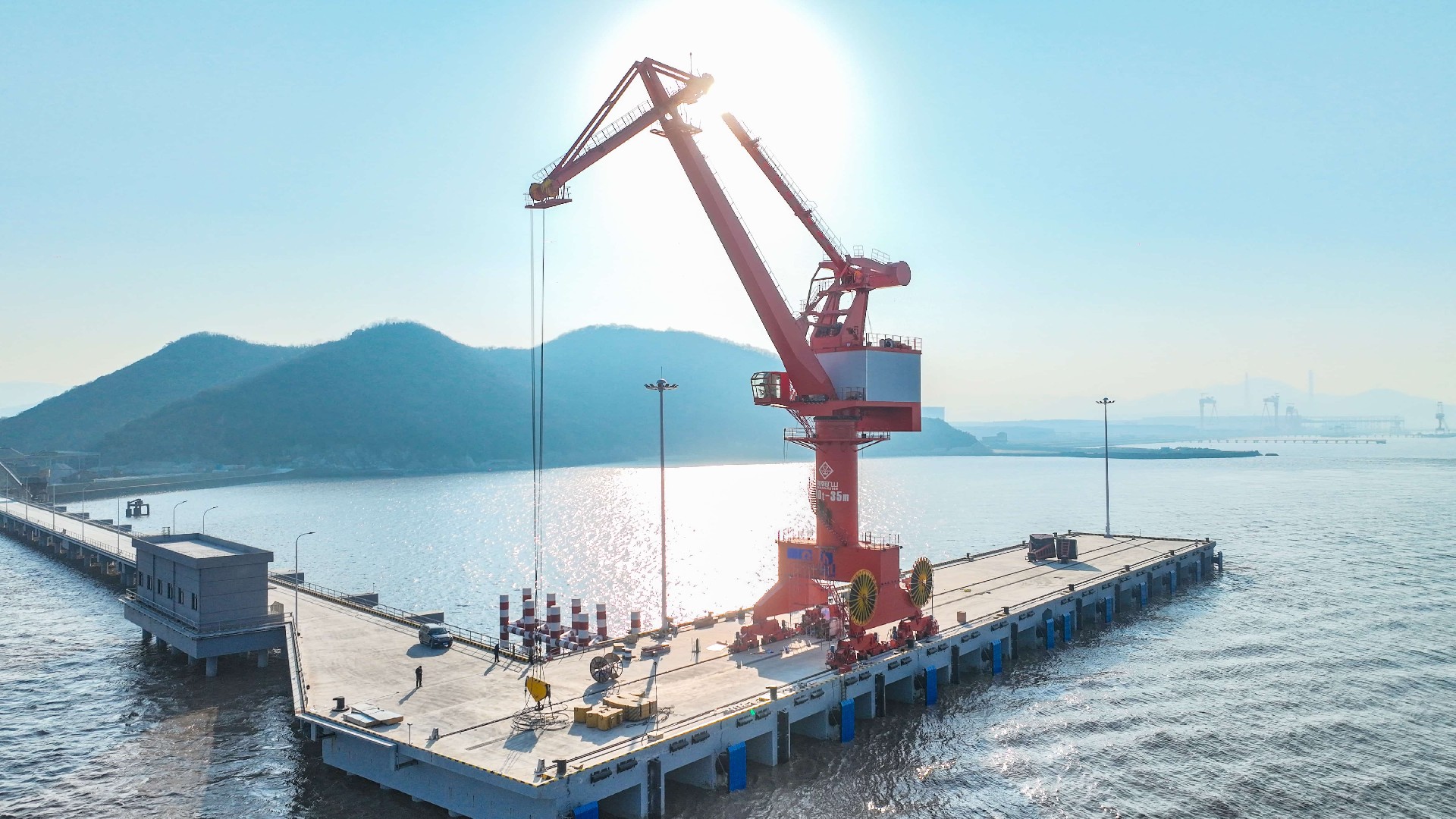
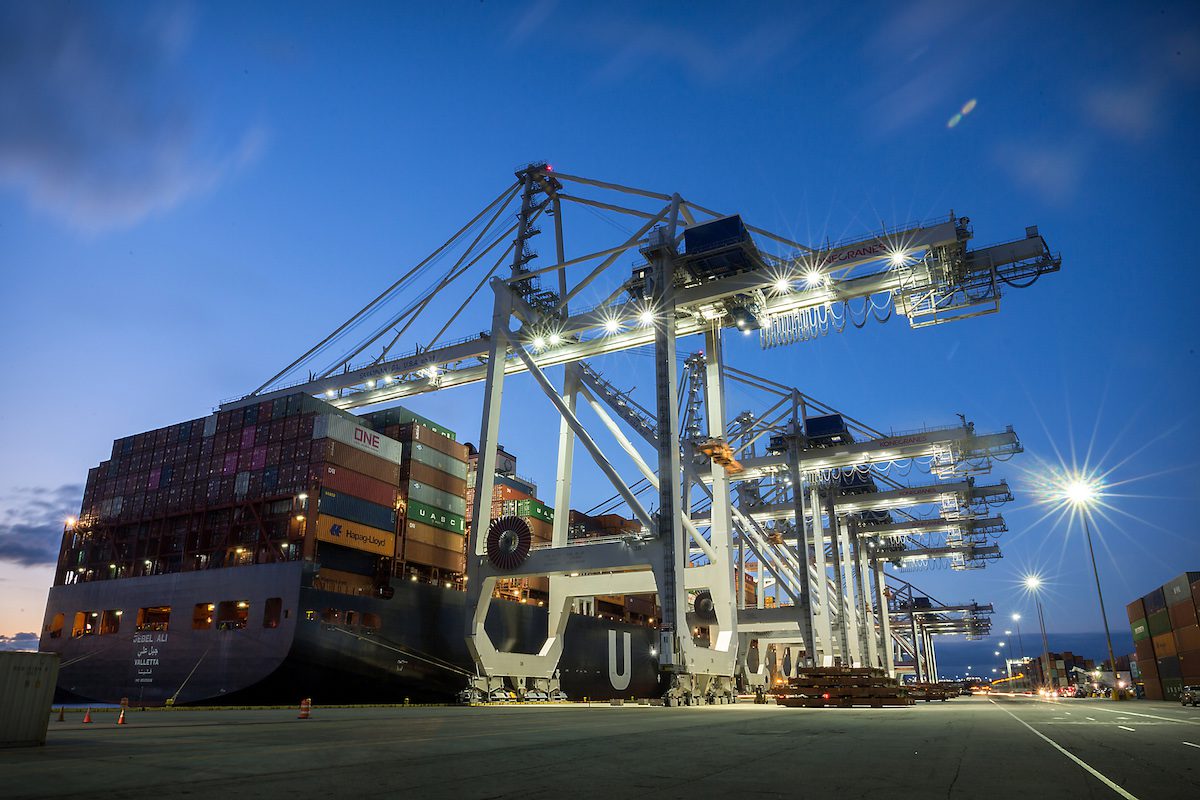
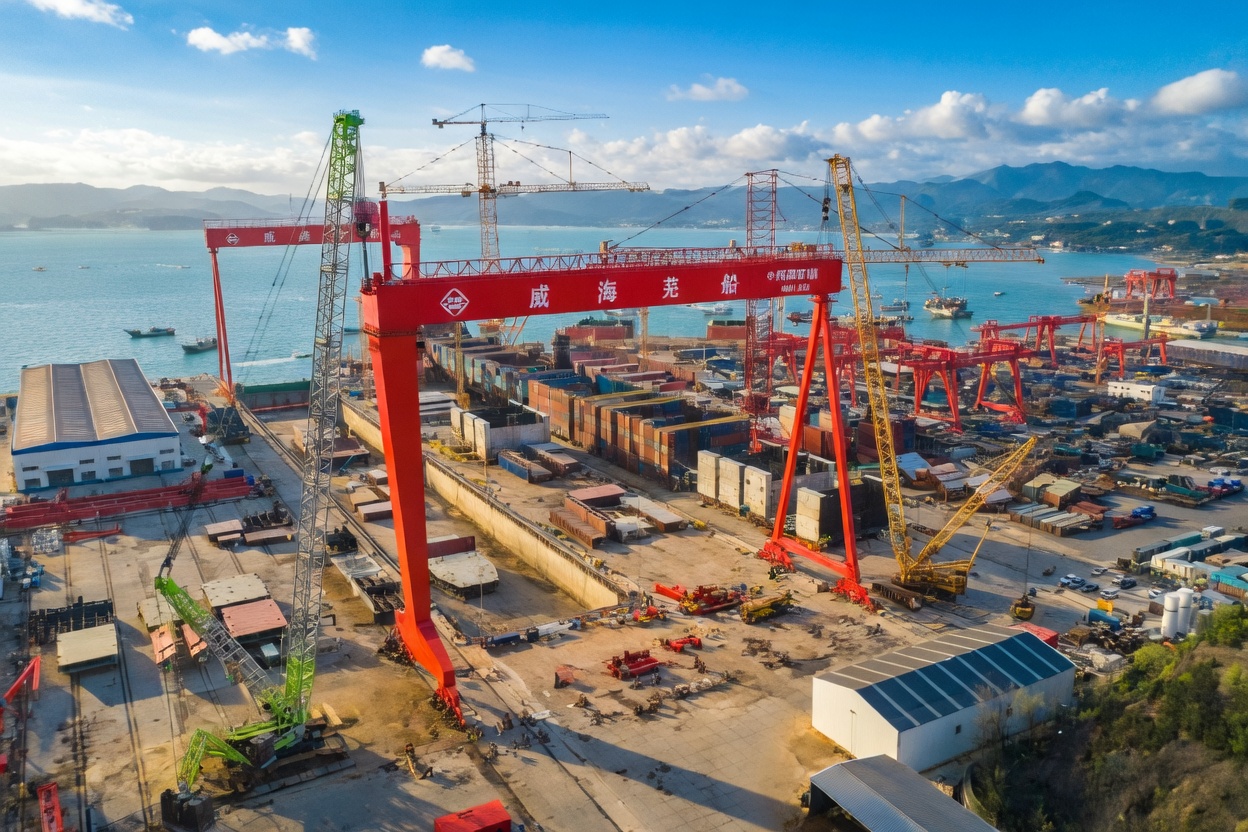
The vast majority of shipyards use gantry cranes (also often called giant gantry cranes) to carry out hull assembly operations. The specific equipment configuration will be flexibly adjusted according to the size of the shipyard and site layout.
- Rail gantry crane (RMG) and tire gantry crane (RTG): Among them, rail gantry crane is the standard equipment of fixed dry dock assembly station; tire gantry crane is suitable for shipyards that need to adjust the lifting path according to different projects.
- Single beam gantry crane and double beam gantry crane: light operation in assembly workshop, including lifting of small components, tooling equipment and small modular prefabricated parts. Single beam gantry crane with smaller load specification can be selected; double beam gantry crane has stronger structural bearing capacity, which can meet the super-tonnage lifting requirements of heavy hull sections and adapt to high-intensity assembly operations.
- Top-mounted gantry crane and down-mounted gantry crane: the lifting trolley of the top-mounted gantry crane is mounted on the top rail of the main beam, with larger bearing tonnage and wider operation span, which is the mainstream model of hull assembly operation; the down-mounted gantry crane has limited bearing capacity and is more suitable for workshop light lifting operations, rarely used for large hull assembly process.
| Configuration Factor | Typical Final Assembly Choice | Why |
| Crane type | Double-girder gantry (Goliath) | Handles hundred-ton+ hull sections |
| Rail system | Rail-mounted (RMG) | Fixed dry-dock/slipway geometry |
| Trolley arrangement | Dual upper/lower trolleys or multi-hook | Enables synchronized, balanced lifts |
| Capacity range | 100–600+ tons (up to 2,000t for mega-yards) | Matches block and equipment weight |
| Control system | PLC + VFD synchronized control | Millimeter-level alignment accuracy |
Key Configuration Parameters to Specify
Before purchasing inquiry crane equipment, the assembly workshop needs to clarify the five core selection parameters. The specific requirements are as follows:
- Safe Working Load (SWL): It shall be determined according to the maximum single-stage lifting weight or multi-lifting point combination lifting weight in the shipyard planning operation, and shall not only be based on the average load of current routine operation.
- Operation span: crane track center spacing shall completely cover the full width range of dry dock or berth, and be compatible with the temporary stacking and operation staging areas on both sides of the hull to ensure that there is no space for lifting operations.
- Lifting height: The effective lifting height shall be higher than the total height of the highest superstructure module and sling, and safety margin shall be reserved at the same time to meet the operation requirements of sling displacement and accessory disassembly during hull section turnover and attitude adjustment.
- Work level: assembly cranes need to work continuously in multiple shifts and carry large loads for a long time. Therefore, heavy operation conditions are generally adopted. The common industry standard is A7-A8, which can adapt to high-frequency and heavy-duty assembly lifting work.
- Trolley and lifting point configuration: single lifting point configuration is suitable for the routine operation scenario of small and medium-sized shipyards; for large special-shaped hull sections, due to the need for multi-point decentralized lifting, double trolley or multi-lifting point collaborative lifting system is the industry standard configuration, which can effectively distribute the load and ensure stable lifting and uniform force of components.
The selection of these five core parameters is very important, among which the safe working load and working span are the most critical. If the parameter selection is wrong, it will either result in insufficient crane load and span to undertake future large-scale ship construction projects; or it will result in excessive redundancy of equipment parameters and greatly increase unnecessary costs for equipment procurement, operation and maintenance.
Multi-Hook & Multi-Trolley Synchronization
Among all the parameters, lifting point and trolley configuration are the most easy to appear inadequate specification selection, and they are also the core parameters that directly affect the hull assembly quality.
This is also the core reason why high-quality shipbuilding gantry cranes must be equipped with synchronous control systems, which can achieve stable and accurate coordinated operation of multiple lifting points, effectively ensuring the structural integrity and construction assembly accuracy of hull components.
In actual equipment selection, the following configuration requirements shall be specified:
- Equipped with PLC global synchronous control system, it can realize coordinated control of all trolleys and all lifting points, get rid of the limitation of traditional two-point pairing, fully adapt to the complex working conditions of multi-point synchronous lifting of large hull sections, and ensure the consistent height of each lifting point;
- The lifting and traveling mechanism is fully equipped with variable frequency drive system (VFD), which can realize stepless speed regulation and accurate speed matching under the condition of load dynamic fluctuation, effectively avoid the running speed deviation of different mechanisms, and continuously guarantee the stability and synchronization accuracy of the lifting process;
- Set exclusive micro-speed alignment function, which can realize centimeter-level low-speed accurate alignment fine adjustment before hull section welding, eliminate docking deviation, and greatly improve assembly accuracy and assembly quality of hull assembly;
- Integrated anti-sway and deflection automatic correction system, can effectively inhibit the lifting load swing and component deviation during long-span walking, offset the adverse effects caused by outdoor wind disturbance, and significantly improve the safety and stability of large lifting operations.
For shipyards adopting double-crane technology, synchronous control requirements are no longer limited to the control system of single equipment, but also need to realize cross-crane communication linkage between two cranes. This function shall be confirmed with the supplier in advance at the equipment configuration stage, and it is strictly prohibited to reserve it for later supplement and transformation at the field commissioning stage.
Structural & Site Considerations
Crane configuration doesn't happen in isolation from the workshop itself. Three site factors shape what's structurally possible:
Wheel loads and runway design
A larger model crane gives a proportionately larger point load into the rail runway. The workshop foundations and rail structure should be designed or checked to resist the addition of the maximum wheel loads (under full load) of the intended crane, and not just the weight of the crane itself.
Workshop layout and clearance
Span and height to under hook should encompass the entire footprint of block staging, not merely its ultimate assembly zone. Dry-dock cranes that design to span too little often lack the capacity to stage the next project‘s largest blocks as the current build progresses.
Future capacity headroom
Since the beneficial working life of the shipyard gantry cranes is measured in decades to the end of their service life, a typical and very expensive error would be to define a configuration precisely suited to the largest project in the present day with no allowance for growth.
Environmental & Safety Protection
Most shipyards are built adjacent to sea areas, and lifting equipment is always in severe marine conditions of strong wind, rainfall, high humidity and high salt fog. The gantry crane for hull assembly has large span, open-air operation and exposed structure, so it must be equipped with protective facilities suitable for marine environment. The specific requirements are as follows:
- Marine grade anticorrosive material and special anticorrosive coating are adopted, matched with sealed electrical cabinet and stainless steel fasteners, which can resist long-term salt spray corrosion and ensure long-term stable service of equipment for decades;
- Equipped with a complete wind protection system, including rail clamp, storm brake and wind speed linkage alarm device. Long-span gantry crane is affected by wind load significantly, and the system can effectively avoid potential safety hazards caused by strong wind weather.
- Equipped with parking and fastening device of the whole machine, the crane can be firmly locked and fixed when the equipment is idle and encountered strong convective gale weather, so as to prevent the risk of equipment displacement and overturning;
- Match the operating temperature range for extreme climates. For shipyards with large temperature difference between cold and summer, cranes should meet the stable operation requirements of temperature fluctuation in all seasons, and should not only adapt to the normal moderate temperature range.
Omitting environmental protection configuration in order to reduce initial purchase cost is the most common hidden loss mistake in shipyard crane purchase. Under coastal conditions, equipment with imperfect protection configuration is easy to corrode and age, and the subsequent high maintenance cost and shutdown delay loss will far exceed the purchase cost saved in the early stage in just a few years.
Automation & Control Systems
In addition to the core synchronous control performance, modern hull assembly cranes are increasingly focused on optimizing operational efficiency and safety control capabilities, with a number of intelligent and safe configurations as standard, as follows:
- Equipped with cab operation console or remote control terminal and equipped with HD camera monitoring system, it can eliminate visual blind area in large-scale sectional hoisting process, enable operators to master the working conditions of hoisting operation area in real time and all-round way, and ensure that there is no dead angle in hoisting vision.
- Equipped with load monitoring and overload protection system, it can identify abnormal lifting conditions in real time, warn unsafe operation conditions in advance, and avoid safety accidents such as equipment structure damage and component falling caused by excessive load from the source.
- Integrated fault diagnosis and equipment status monitoring function, for multi-shift, heavy-duty continuous operation of crane equipment, can monitor the loss and operation status of each component in real time, provide accurate data support for maintenance team, realize preventive maintenance, and prolong the service life of equipment.
- Push key operation data such as wind speed and load status to operators in real time, and set up direct communication channel with hull assembly construction personnel below, so as to realize up and down linkage and information exchange and avoid cooperative operation risks.
For shipyards with multiple assembly stations, the operating data of all cranes can be consolidated into a central monitoring system. The system can display the on-duty status, operation status and maintenance status of each equipment in real time, which is convenient for management personnel to reasonably coordinate scheduling, optimize construction scheduling, and greatly improve the overall construction operation efficiency.
How to Configure a Crane for Your Workshop: A Step-by-Step Framework
When the shipyard customizes and purchases the final assembly crane, it is necessary to confirm the parameters and working conditions item by item according to the standardized process to ensure that the equipment fully meets the construction requirements. The specific implementation points are as follows:
- Check existing and future maximum lifting loads: calculate the weight of maximum hull sections, main equipment and superstructure modules, and include the weight of lifting tools and rigging to verify the required safe working load (SWL) of equipment.
- Geometric size of survey workshop site: actual measurement of effective width of dry dock and berth, determination of required operation span of crane; measurement of stacking height of highest component on site, verification of effective lifting height of hook in combination with assembly requirements.
- Clarify the working condition grade of equipment: count the lifting frequency of single shift, the average proportion of conventional operation load to rated load, and accurately determine the required working grade of crane according to the actual operation intensity.
- Determine the configuration scheme of trolley and lifting point: match the configuration of single lifting point, double trolley or multiple lifting points according to the shape size and structural weight of conventional hull sections of shipyard; at the same time, complete the selection by adopting double-crane combined lifting technology according to whether it is normalized.
- Clarify the synchronization control accuracy index: set the alignment accuracy standard required for hull section closure (the mainstream standard for ship assembly is millimeter accuracy), verify that the crane control system can stably meet the standard and meet the requirements of high-precision assembly.
- Matching marine environmental protection parameters: according to the coastal salt fog, strong wind, temperature and humidity and other climatic conditions of the plant, the anti-corrosion coating grade, windproof configuration and equipment temperature resistance interval are determined according to the plant, and the severe sea conditions are adapted.
- Verification of site structure bearing conditions: confirm the bearing capacity of crane track beam and civil foundation, which can fully match the wheel pressure load under full load state to ensure the safe operation of equipment.
- Submit to the manufacturer for professional verification: before the quotation is finalized, qualified equipment manufacturers are required to conduct special verification and confirmation on wheel pressure parameters, drive configuration and main structure strength in combination with berth layout and local wind zone grade.
Choosing a Supplier or Partner
Not all crane manufacturers have the R & D and manufacturing capabilities of large-scale synchronous lifting equipment in shipyards. Compared with ordinary industrial cranes, such equipment is more professional and has higher technical threshold. When shipyards select cooperative suppliers, they shall focus on verifying the following core conditions:
- Practical operation experience of the same tonnage project: the supplier is required to provide the past landing cases with the same tonnage or higher than the demand of the factory, and the manufacturers with large-span and heavy-duty shipbuilding crane manufacturing experience are preferred.
- Autonomous core synchronous control technology: PLC frequency conversion synchronous control system is the core key of hull assembly crane, not a universal add-on accessory, requiring manufacturers to have independent R & D, debugging and optimization of the core technical capabilities.
- Complete machine pre-installation and factory test capability: regular manufacturers will complete machine pre-installation, component debugging and performance testing before the equipment leaves the factory, which can greatly reduce the failure risk and construction period pressure of on-site installation and debugging.
- Customized site engineering supporting services: wheel pressure, drive system and main structure parameters can be customized according to the actual working conditions of dry dock and berth of shipyard, instead of applying general standard specifications.
- Perfect after-sales and spare parts guarantee: shipbuilding gantry crane design service cycle for decades, suppliers need to have long-term stable after-sales operation and maintenance, spare parts supply and equipment upgrade service capabilities.
Conclusion
Accurate selection and configuration of shipyard cranes is the key to ensure long-term safe production and efficient operation and maintenance. Scientific selection can take into account the current construction needs and future expansion and maintenance projects, and avoid later transformation and shutdown losses by checking equipment structure, accuracy and site conditions.
Compared with general models, shipyard customized lifting equipment is more adaptable. Customized design and full-process service from professional manufacturers can optimize equipment performance, reduce life-cycle costs and enhance long-term use value.
Henan Mine Crane focuses on the R & D and manufacturing of heavy lifting equipment. It can provide customized lifting equipment and intelligent lifting system for ships, marine engineering and other scenarios, supporting site survey, structure verification, customized design and other complete technical services to create safe and efficient lifting solutions.