
5t Portable Steel Gantry Cranes: Rapid Assembly Mobile Solutions for Workshop Maintenance
When replacing motors, pump sets or large fixtures in the maintenance workshop, the difficulty is not only to lift the parts, but also to find a suitable lifting point in the limited headroom and accurately move the load to the maintenance location.The 5t Portable Steel Gantry Cranes provide partial lifting capacity with a self-supporting steel frame, without the need to install a permanent track beam first.Rapid assembly and movement depend on the specific design and site conditions, and do not mean that the equipment can be carried by bare hands, walk on any ground, or move with a suspension load.
What Is a 5t Portable Steel Gantry Crane?
Main Components and Structural Design
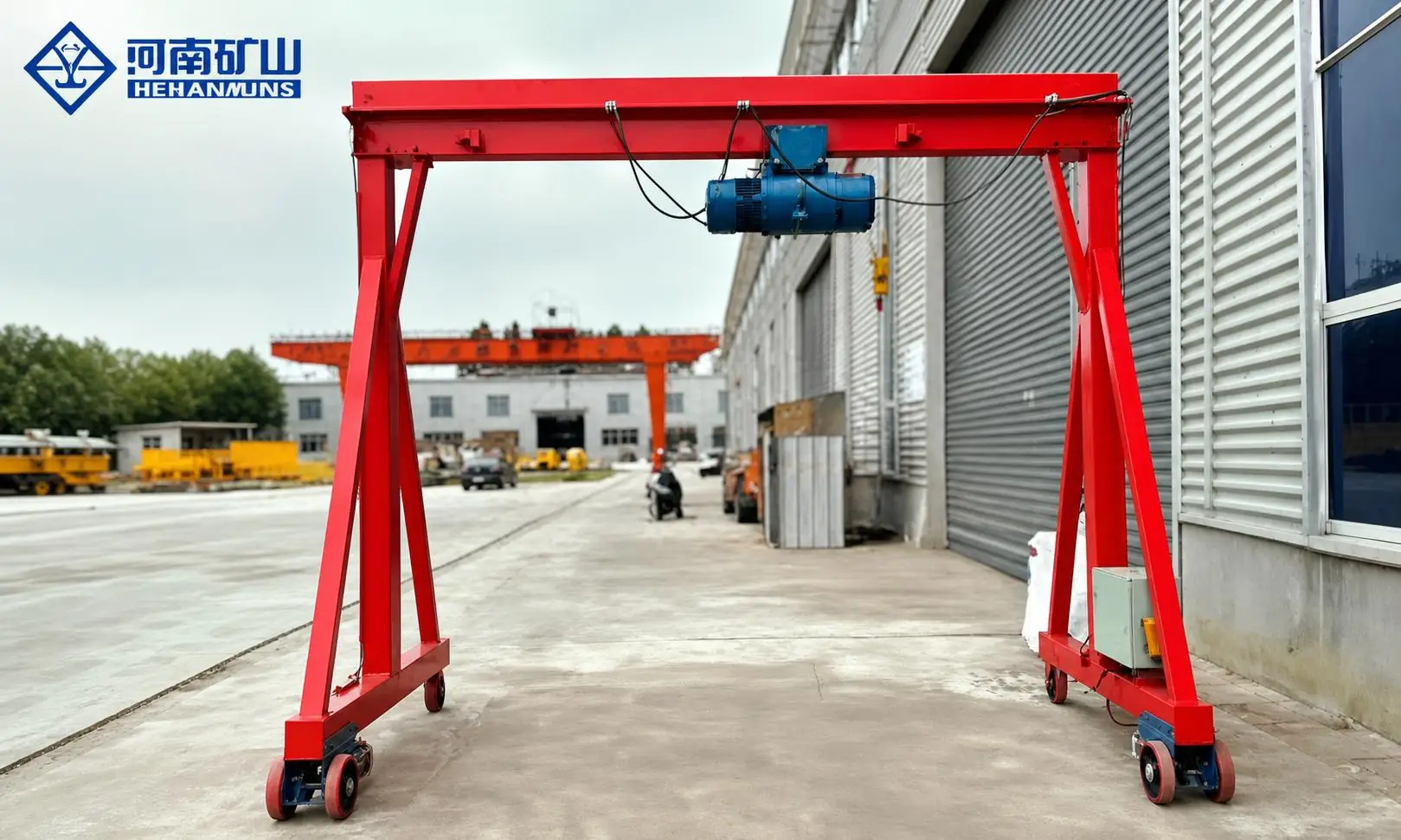
5t Portable Steel Gantry Cranes are usually composed of main beams, outriggers on both sides, struts, connectors, casters, trolleys and hoists.The main beam supports the trolley and load, the outriggers transmit vertical force to the wheel set and the ground, and the horizontal or oblique support helps the frame maintain its design shape.The cross-section, outrigger form and connection details of the beam vary from model to model, and the similar appearance cannot prove that the carrying capacity is the same.
The steel frame may be disassembled into components such as beams, legs, and wheels for easy transportation, but the components of five-ton equipment may still be heavy, and auxiliary lifting equipment is often required for assembly.Flanges, bolts and locking pins must be installed according to the drawings; the height-adjustable model must confirm that the adjustments on both sides are consistent and the locking parts are completely in place.Fixed height and adjustable height, manual and electric hoists, and trolley forms are all specific configurations. The steel beam size, rated load, and trolley must match each other, and cannot be selected based on the product name alone.
How the Portable Gantry System Works
The hoist lifts the load through hooks and suitable spreaders; the trolley runs along the beam to provide horizontal positioning.The casters under the outriggers are responsible for repositioning the whole machine according to regulations, which are two different actions from the movement of the load with the trolley.The task planning should also verify the headroom of the hook, the horizontal stroke, and the route of the equipment into the station.
The common practice is to move the no-load crane to the designated location first, confirm that the wheel set and the ground meet the requirements of the manual, and then lift it and use a trolley to adjust the parts.Whether the whole machine is allowed to roll with load, you must check the manual of the specific model; most ordinary portable frames should be moved after the load is stabilized and released.If individual products are allowed to move with a load, they must also meet their specified ground, speed, load position and personnel coordination conditions.
What Does a 5-Ton Rating Mean?
5t means that the rated lifting weight is 5,000 kg, but this value only applies to the structure, span, height and operating conditions specified by the manufacturer.Adjustable span, cantilever or different outrigger heights may change the allowable load. The nameplate, load gauge and corresponding general drawing must be checked. It cannot be assumed that any configuration can reach 5t.
The actual load evaluation must also consider the spreader and accessories, the lifting point, the center of gravity and the stability.Hoists, trolleys, beams, outriggers, connectors and the ground together form a carrying path, in which the components with lower rated capacity will limit the allowable load of the entire system.The 5t marked on the hoist does not automatically mean that the whole machine can also be hoisted for 5t under any span; each task must be subject to the applicable configuration and complete hoisting combination.
Why Choose a Portable Steel Gantry Crane for Workshop Maintenance?
Rapid Assembly and Deployment
Portable gantry frames suitable for temporary or changing stations usually do not require the installation of track beams on the plant structure, so some permanent construction can be reduced.Segmented beams, bolt flanges and pre-matched wheel sets give the equipment the opportunity to be disassembled and assembled in different maintenance areas, suitable for workplaces that do not want to retrofit buildings.However, eliminating fixed installation does not mean eliminating structural verification, assembly inspection or on-site preparation.
The preparation time depends on the weight of the components, the handling channel, the assembly space, the auxiliary lifting equipment, and the familiarity of the personnel.The beams and outriggers of the steel frame may require mechanical equipment to support the positioning; after the connection is completed, the fastening, alignment, locking parts and wheel sets must be checked according to the manual.If the manufacturer's documents or local requirements stipulate commissioning and inspection, they must be included in the deployment plan, and the rapid assembly promotion cannot be understood as ready-to-use.
Mobile Lifting Without Permanent Infrastructure
One equipment can serve multiple designated maintenance stations, allowing the lifting capacity to move in accordance with the work arrangement, suitable for leased factories, temporary maintenance areas, or locations not covered by fixed cranes.After parking the gantry in a suitable position, the trolley can move the parts to the workbench or installation point within the range of the beam.
The ability to move is affected by the type and ability of casters, brakes, ground bearing capacity and route.Floor joints, gradients, thresholds, and obstacles may all hinder the wheel set, and the force and stability at full load are also different from that at no load.First check the doorway, channel width and turning space, and then move according to the manufacturer's licensed status; the presence of casters does not mean that the load is allowed to be carried out when suspended.
Flexible Handling of Heavy Components
Motors, pumps, gearboxes, molds, and steel components often need to be separated from the base and then moved to the workbench or installation location.When the equipment restrictions are met and the lifting point, weight and center of gravity have been confirmed, the hoist and trolley can provide controlled vertical lifting and horizontal positioning, reducing the situation of relying on multiple people to lift or temporarily splicing the lifting point.
The gantry is suitable for lifting and positioning in the designated area, and does not replace all transportation equipment.Its operating range is limited by span, headroom under the hook, structural configuration and the position of the whole machine; forklifts are more suitable for handling compatible loads such as pallets, while manual handling is only suitable for light and small parts.When choosing, it should depend on how the workpiece is supported, whether the hanging point is appropriate, and whether the drop position is controllable, not just the tonnage.
Potential Cost and Downtime Benefits
If the maintenance is scattered in different stations, the portable rack may reduce the investment in fixed track and building support, and it can also avoid waiting for a shared crane, thereby improving part of the maintenance process.It will not automatically shorten the diagnosis, spare parts, and maintenance time; the actual downtime benefits depend on the work schedule and whether the equipment does cover the target station.
The total cost of ownership also includes transportation, initial assembly, auxiliary equipment, inspection, wheel set and hoist maintenance, spare parts, storage space and training.The fixed bridge system requires the cooperation of the plant, but it may be more suitable for production hoisting with large coverage and high frequency repetition.5t Portable Steel Gantry Cranes can only reflect cost advantages when mobility is actually utilized and operating conditions are matched with capabilities.The frequency of use, deployment cost, and full-cycle maintenance should be compared, not just the initial purchase price.
Typical Applications of 5t Portable Steel Gantry Cranes
Machinery Installation and Repair
When overhauling motors, reducers, and pumps, components usually leave the base and re-align with the axis or interface.The 5t Portable Steel Gantry Cranes can provide upper support at a suitable maintenance station, and the parts are positioned in a position for easy maintenance by means of a trolley.The lifting point, center of gravity and spreader must be confirmed first; irregularly shaped loads still need a suitable lifting plan, and it cannot be assumed that a single hook will naturally maintain balance.
When reinstalling, the crane can temporarily support the components for hole alignment and adjustment, but it cannot be a reason for personnel to enter the work under the suspension load, nor can it replace the prescribed mechanical positioning method.If the headroom is insufficient or the beam does not cover the target position, the lifting arrangement or equipment plan should be changed, and the cable-stayed pull cannot be used to bypass the restriction.
Automotive and Equipment Maintenance
Maintenance of industrial vehicles, engineering equipment, and large machines often requires disassembly and assembly of pumps, gearboxes, or heavy-duty components.The portable frame can establish temporary lifting points in special stations that are not covered by fixed bridge cranes to help control the disassembly and placement of components.Arranging the support, disassembly sequence and spreader position of the components in advance can reduce the risk of the load suddenly detaching, skew or hitting the outrigger.
There are often ditches, tool cabinets and other equipment in vehicle maintenance areas.The movement route of the whole machine must be reserved to confirm that the casters will not pass through unevaluated grooves or uneven ground; if the vehicle is supported by a lift, the working space and support status of the two sets of equipment must also be checked to avoid lifting operations affecting the stability of the vehicle.
Manufacturing Workshops
Molds, fixtures, welding components, and tooling may need to be hoisted at short distances between adjacent stations.Fixed-span gantry frames are suitable for stable local areas, while adjustable models may be adapted to different heights, but any combination must be within the structural range given by the manufacturer.5t Portable Steel Gantry Cranes can also supplement the back of the equipment or temporary installation areas that cannot be covered by fixed cranes.
If the process becomes high-frequency repeated hoisting, the reset of the whole machine, manual operation and wheel set inspection may slow down the beat.The route must also avoid personnel passages, forklift lanes and WIP areas.Fixed bridge systems are usually more suitable for stable, continuous and large-coverage production lines; portable racks are more suitable for scenarios where stations change or the frequency of use is limited.
Maintenance in Restricted or Temporary Work Areas
Temporary maintenance areas, equipment transformation sites, and leased factories may not have fixed crane tracks, and independent outriggers provide another way to deploy.When selecting the type, check the height of the doorway, the clearance under the beam, the stroke of the hook, and the lifting distance required for the workpiece to leave the base.The whole machine passes through the doorway, which does not mean that the space under the hook is enough to accommodate the workpiece and spreader and complete the lifting.
Floor bearing capacity, local wheel pressure, expansion joints, slopes, underground covers and temporary ramps will all affect the contact and stability of the wheel set.The outdoor environment also needs to be evaluated for wind, rain, corrosion and soft ground.Ground or environmental conditions not approved by the manufacturer are deemed applicable if they cannot be rolled by casters; when space is limited, the layout should be adjusted instead of weakening the support.
How to Select the Right 5t Portable Steel Gantry Crane
Rated Capacity and Load Characteristics
The selection should be based on the maximum total hoisting load, not the average part weight.Check the accessories such as workpieces, hanging beams, slings, shackles, etc., and evaluate the center of gravity, the strength of the lifting point, and whether it will rotate or slip after lifting.Multiple hoisting points or auxiliary tooling will change the force, and if necessary, the complete hoisting combination will be confirmed by personnel with corresponding capabilities.
It must also be confirmed that the rated capacity corresponds to the planned span, beam height, outrigger position, wheel set and trolley position.If the load gauge distinguishes the configuration, the data consistent with the site should be used.When approaching the rated capacity, the manufacturer's restrictions, applicable regulations and engineering plans should be followed, rather than setting the safety margin by yourself.
Span, Lifting Height, and Overall Dimensions
The span determines the working width between the legs, and it also affects the beam force and allowable load.In addition to the beam length, it is also necessary to confirm the footprint on the outside of the outrigger, the effective trolley stroke, and the space for the workpiece to enter the frame, so as to avoid the size that seems appropriate but cannot be close to the working point.
The height under the hook should consider the space occupied by the hoist, trolley and spreader, and allow for the travel required for the workpiece to leave the base, cross obstacles, and fall to the target support.The adjustable height can adapt to different stations, but the structural configuration has been changed; the locking position and the corresponding load must be verified, and the maximum span and maximum height cannot be used at the same time by default.
Steel Frame Strength and Structural Stability
The supplier shall be required to provide the general drawing, rated load description and assembly documents consistent with the supply configuration, and confirm the beam, outrigger, oblique support, flange, connecting piece and wheel frame as the complete structural design.Only comparing steel grades or beam cross-sections is not enough to judge stability. Span, height, connection stiffness, and load position may all change the structural response.
Moisture, cleaning agents, dust, or outdoor environments can affect coating, corrosion, and maintenance requirements.Laws and regulations vary by country, industry, and use; for example, the United States OSHA 29 CFR 1910.179 is only used within its scope of application and cannot replace the requirements of other regions.The buyer should explain the target market and let the supplier give a specific design basis.
Caster Wheels and Mobility Requirements
Casters affect steering, steering, braking and ground contact.The wheel set capacity, installation method, wheel surface material, steering locking and braking configuration should be checked, and the overall machine and operating status should be considered.The brake can limit rolling, but it cannot compensate for excessive slope, uneven ground or eccentric load.
Expansion joints, sills, debris, and gutters may hinder small-diameter casters.When planning to move across areas, check the complete route and clarify whether it must be unloaded when moving, whether the casters are locked when lifting, and whether it is allowed to walk with a load.Only when the model document clearly permits and the conditions are met on site can it be operated in accordance with its regulations.
Hoist and Trolley Configuration
Manual chain hoists are suitable for operations with low frequency and low speed requirements; electric hoists can reduce repetitive manual operations, but they must match the power supply, control method, limit and maintenance conditions.Both forms must be adapted to the load, lifting height and frequency of use, and cannot be selected only by price or speed.
The trolley should be adapted to the size and contour of the beam flange and operate within the specified range.The end stop, effective stroke and spacing with the outriggers should be verified to prevent the load from exceeding the design boundary.Electric equipment must also plan cables to avoid touching workpieces or personnel; if the manual chain is blocked by the machine tool, it may also make the program with sufficient rated capacity unable to operate effectively.
Assembly, Disassembly, and Storage
The weight, length and handling method of the components should be checked, especially whether the longest beam section can pass through the doorway and passage, whether the outriggers can be turned on site, and whether mechanical assistance is required for assembly.Detachable does not mean that it can be safely lifted by hand; the manufacturer should specify the hanging point, support method and required tools, and avoid replacing it with unevaluated ropes or forklift fork teeth.
After disassembly, suitable storage space is also required, and fasteners, pins and positioning parts are properly managed to prevent omissions or wrong combinations in the next assembly.When purchasing and delivering, the assembly and maintenance manual, general drawing, inspection requirements and spare parts list should be obtained so that the configuration can be checked after the equipment changes stations.
Portable Steel Gantry Crane vs. Fixed Overhead Crane vs. Forklift
The portable gantry is carried by self-supporting legs, which is suitable for temporary work positions and local hoisting that requires changing positions. It does not require continuous building track beams, but the coverage is limited by the span, the location of the whole machine, and the deployment arrangement.The fixed bridge crane runs along the track of the plant, which is suitable for repeated lifting covering a larger area, and the path is stable; the cost is that the plant structure, track and installation engineering cooperation are required.
Forklifts are suitable for transporting pallets and other compatible loads, and their walking range is usually more flexible.Whether it can perform hoisting depends on the approved accessories and working conditions; hanging the spreader directly on the fork does not automatically constitute a compliance plan.The suspension load will swing, and the ability is also affected by the center distance of the load, the height of the gantry, and the accessories.When it is necessary to accurately place the components into the base or narrow gaps, the design-approved configuration should be selected.
When comparing, it should look at the installation foundation, moving range, positioning accuracy, channel and headroom, operating frequency and long-term maintenance costs.Dispersed stations and occasional maintenance may be suitable for portable racks, high-frequency fixed routes may be suitable for bridge cranes, and forklifts are more suitable when on-site transportation is required.Ultimately it depends on the load path, beat, ground and size, not the individual rated tonnage.
Safety Considerations for Rapid Assembly and Mobile Operation
Pre-Operation Inspection
Before use, check whether the frame, connecting parts, locking pins, wheel sets, brakes, main beams, trolleys, hoists and spreaders are damaged, loose, deformed or worn according to the manufacturer's procedures, and confirm that the rated logo is clear and corresponds to the current configuration.When lifting, braking or operation is abnormal, it should be stopped and checked by qualified personnel. The trial cannot be continued by reducing the load.
The inspection cycle and records must comply with equipment documents and local regulations.After replacing the wheel set, repairing the bearing structure or changing the configuration, it should be confirmed whether additional inspection, commissioning or inspection is required.Only look at the risk that the casters cannot cover the entire hoisting system.
Safe Assembly and Commissioning
Support and connect the components in the specified order in areas with suitable bearing conditions and flat and clean areas.Using the specified specifications and quantities of fasteners, the locking pin and safety device must be completely in place; the temporary support must not be removed prematurely before the locking is completed.Auxiliary hoisting equipment should be able to stabilize the control beam and outriggers to avoid swing and clamp damage.
The commissioning requirements after the first commissioning or maintenance should be determined in accordance with the manufacturer's documents and applicable rules, and the test load or method should not be designed by yourself.After confirming that the structure is correct, the connection is reliable, the wheel set is normal, and the hoist is compatible with the trolley, complete the prescribed inspection before putting it into use.The appearance of different series is similar, and it does not mean that the parts can be interchanged.
Load Handling and Crane Movement
The hook should be located as far as possible above the center of gravity, and the lifting rope should be kept vertical, and it should not be dragged laterally or loaded by impact.Tighten the sling slightly first and observe the load balance to help detect slippage or tilt.It shall not exceed the current configuration capacity, nor shall the personnel be placed under the suspension load; it is necessary to confirm the stability of the receiving surface before dropping.
The movement of the casters of the whole machine cannot be confused with the movement of the trolley along the beam.Most equipment requires that the load be stabilized and lifted before moving the gantry; without the approval of this model, no load, forklift or vehicle may be used to push the crane.Even if the equipment is allowed to move on board, it must meet the specified route, ground, speed, load control and personnel collaboration conditions, and the license for individual models cannot be extended to other equipment.
Workshop Floor and Environmental Conditions
The wheel set transmits the load to the floor, and the local wheel pressure may be higher than the simple average.The bearing capacity of the floor, underground grooves, covers, cracks, slopes, and foreign objects may all affect the contact of the wheel set; a caster is suddenly blocked, which may tilt the frame or swing the load.The ground looks hard and cannot replace the load-bearing capacity.
Moisture and cleaning agents may accelerate corrosion, dust will affect braking and trolley operation, and outdoor wind may also cause the suspension load to get out of control.The equipment should be limited to the environmental conditions allowed by the manufacturer; when it exceeds the scope of the document, adjust the operating plan first, and do not use temporary counterweight or support to make up for unverified working conditions.
What Should Buyers Ask a Portable Gantry Crane Manufacturer?
When inquiring, provide the size of the work area, the maximum load, the shape of the workpiece, the lifting frequency, the ground conditions and the hoist requirements, and ask the manufacturer to confirm the corresponding configuration in writing.Key issues include:
- Is the-5t capability applicable to the required span, height, wheel set and trolley configuration, and can the corresponding load data be provided?
- What are the minimum and maximum hook heights, effective trolley travel, and the size of the whole machine?
- What is the weight and dimensions of each component, and does it require auxiliary hoisting equipment and special tools for assembly?
- Is the caster capacity, braking and steering locking form suitable for on-site ground and complete movement routes?
- What are the types, speeds, power supply methods and beam adaptation conditions of the optional hoists and trolleys?
- Is it allowed to move while suspending the load; if so, what are the load, speed, ground and operating restrictions?
- Do you provide general drawings, assembly and maintenance manuals, inspection requirements, spare parts lists and after-sales support?
The written reply should specify which options will change the rated load, which dimensions belong to the external dimensions, and which are the actual lifting headroom.With only common promotional parameters and no corresponding drawings and operating conditions, it is still difficult for the buyer to judge whether the equipment can reach the station, lift the target parts and move along the expected route.
Conclusion
5t Portable Steel Gantry Cranes are suitable for temporary maintenance and material hoisting in flexible stations.When selecting the type, it is necessary to verify the load, span, height, hoist compatibility and ground conditions, and confirm the assembly inspection and movement requirements.Provide the weight of the workpiece, the working size and the headroom under the hook in advance to help formulate a suitable configuration plan.Henan Mine Crane can provide customized gantry crane solutions according to actual working conditions.