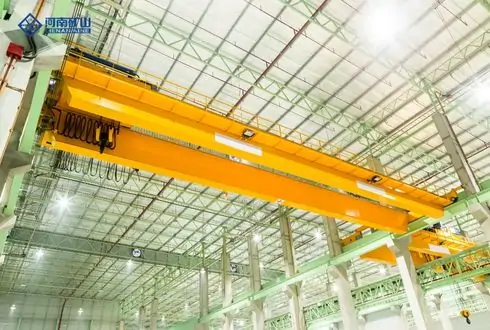

What Happens When an Overhead Crane Cannot Reach Every Workstation?
In machinery manufacturing, steel structure, and equipment assembly workshops, bridge cranes are the core equipment for heavy material handling, which directly affects production efficiency, operational safety, and operating costs.Many companies only value the rated lifting weight in the selection of models, ignoring the coverage of the operation, resulting in a single crane that cannot cover all stations.
Although this type of hoisting blind spot does not cause equipment failure, it brings a series of chain problems such as cumbersome material transfer, disjointed processes, increased manual operations, increased safety risks, and higher costs.For lean production workshops, the global coverage of cranes is a necessary condition to ensure stable and efficient production.
This article will analyze the definition, causes, and effects of insufficient coverage of bridge cranes, and provide a complete set of landing countermeasures such as equipment transformation, installation of auxiliary machines, and process optimization to solve the problem of blind spots in station hoisting.
When One Crane Cannot Serve the Entire Workshop
Many factories have misunderstandings: if the lifting weight is up to standard, it means that the crane is adapted to the working conditions of the workshop.In fact, a large rated load does not mean a wide job coverage.The coverage of the crane is limited, that is, its effective operating range cannot cover all hoisting stations, forming a fixed blind spot.
The effective working area of the crane is determined by multiple factors such as the span of the crane, the total length of the track, the walking stroke of the trolley, the lifting stroke of the hook, and the safe net distance of the site. Various physical obstacles in the workshop will further compress the effective working space. The common restricted reasons are mainly divided into the following categories:
- The basic parameters of the equipment are limited: the span and track length of the crane do not match the overall size of the workshop, and the walking stroke of the hook is insufficient to cover the edge stations of the workshop.;
- Building structure blocking: fixed building components such as workshop columns, walls, mezzanines, roof load-bearing structures, etc., block the normal walking of crane carts and trolleys, and cut the working area;
- Obstacles to production equipment: fixed production lines, conveying equipment, and large-scale tooling equipment in the workshop occupy space for a long time, forming a permanent blind spot for hoisting;
- Restricted access to work: The stations are densely arranged and the passages are narrow. Even if the hooks are theoretically reachable, the hoisting operation cannot be completed safely.;
- Safety limit constraints: crane end limit, buffer device, safety protection net distance, to further compress the actual usable operating range.
In short, if a 100-ton crane with a large bearing capacity has an unreasonable track layout and more on-site blocking, there will still be a large number of blind spots in the operation, which cannot meet the production needs of the whole workshop.The coverage capacity is a matter of spatial layout, not simply a matter of equipment carrying capacity.
What Happens When an Overhead Crane Cannot Reach a Workstation?
Decreased transit efficiency
When the station exceeds the scope of crane operation, heavy objects need to be transported twice by forklifts, pallets, etc., the transportation route becomes longer, the waiting time for the process increases, and the continuity of production is interrupted.
Rising labor costs
For materials in blind areas, forklifts, small lifting equipment and operators need to be added.The amount of work assisted by the transportation of heavy-duty special-shaped materials has become larger, and non-professional equipment operations are also likely to cause damage to workpieces and injuries to personnel, increasing the management burden.
Production bottleneck highlights
The lag in material supply causes the station to be waiting for materials, and the upstream and downstream processes are out of sync.Semi-finished products are piled up in the transit area, disrupting the rhythm of production, reducing production capacity, and prolonging the order delivery cycle.
Increased security risk
Blind spots will increase the cross-operation of people and vehicles and increase the risk of collision.Some operators violate the law by hoisting out of range or using simple spreaders, which are prone to falling and collision accidents; heavy-duty operations of auxiliary equipment also amplify safety risks.
Increased operating costs
Blind spots bring a lot of hidden costs: auxiliary equipment purchase and leasing, labor, equipment maintenance, additional energy consumption; downtime losses, workpiece bumps, rework and scrap, etc., continue to compress corporate profits.
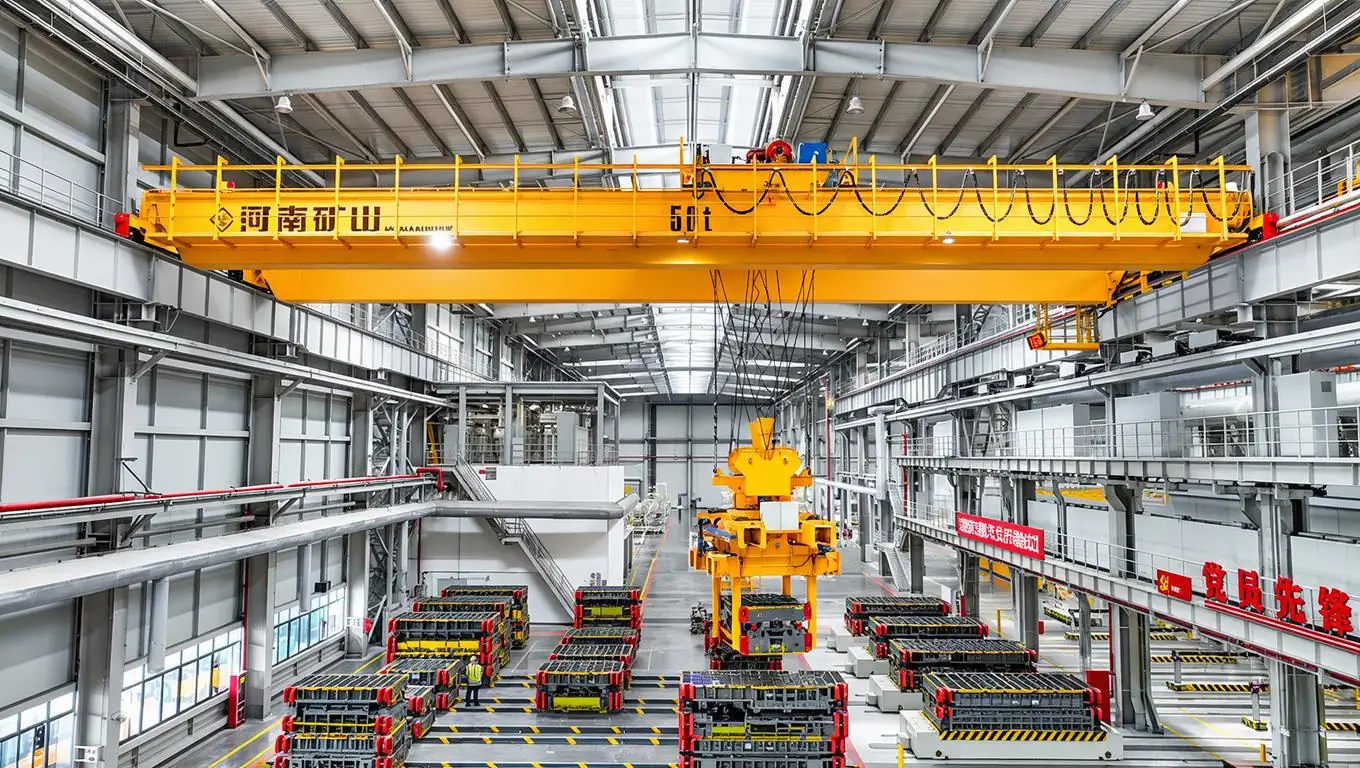
Why Does an Overhead Crane Fail to Cover the Entire Production Area?
The vast majority of crane operation blind spot problems are not caused by equipment quality failure, but by the mismatch between pre-planning, post-transformation and production iteration. The core reasons can be summarized as six points:
- The initial layout planning is unreasonable: in the workshop infrastructure and crane installation stage, the layout of the station and the flow of materials are not fully mapped, the equipment is only installed according to conventional parameters, and the coverage plan is not customized in accordance with the actual production needs.;
- Late expansion and transformation of the production line: After the crane installation is completed, the company will add new production lines and expand processing stations, and the new operating area will exceed the original crane operating scope.;
- Dynamic adjustment of station layout: product iteration, process optimization, and lean production transformation have led to changes in station location and operating area, and the coverage of the original crane is disconnected from the new layout.;
- Hard restrictions on building structure: the column spacing, roof height, and load-bearing structure of the workshop are fixed, and cannot be adapted to the layout of the fully covered crane, forming a congenital blind spot.;
- Single equipment selection criteria: equipment procurement only focuses on the maximum lifting weight, ignoring the relevant parameters such as operating span, track length, hook stroke, etc., and the selection does not match the working conditions.;
- Differences in production requirements in multiple regions: There are multiple independent production areas in the workshop, and there are large differences in material specifications, hoisting frequency, and transfer paths in each region. A single crane cannot be adapted to the differentiated operating needs of multiple regions.
How to Solve the Problem of Limited Crane Coverage
Extend the original track
If the load-bearing and foundation conditions of the workshop building permit, extending the crane's operating track is the most cost-effective transformation plan.By lengthening the track of the cart and adjusting the end limit, the walking range of the crane is directly expanded to cover the original blind spot station.
Before the transformation, professional institutions are required to conduct load-bearing tests on the workshop columns, roofing, and foundations to confirm that the structural bearing capacity is up to standard.The scheme can retain the original equipment, the operators do not need to be re-adapted, and the system is unified after the transformation; the disadvantage is that short-term downtime is required during the transformation, and a small number of blind spots will still remain in the complex structure workshop.
Added bridge crane
For large-scale workshops with large spans, multi-stations, and multi-partitions, the transformation of a single crane cannot meet the full coverage requirements, and the addition of a bridge crane is the best choice.The workshop can be divided into independent hoisting areas, and the two cranes operate separately and perform their respective duties.
With a professional anti-collision control system and zoning operation specifications, it can realize the safe and coordinated operation of multiple cranes, completely solve the blind spots of large-area operations, and adapt to high-frequency and large-workload production scenarios.
Supporting auxiliary spreader
For blind spots such as corner stations and small local areas that cannot be covered by the transformation of the main crane, small auxiliary hoisting equipment can be used to accurately fill the gaps without large-scale transformation of the main equipment.:
- Cantilever crane: installed on columns and walls, suitable for high-frequency small hoisting operations of a single fixed station;
- Monorail hoisting: customized fixed material transfer path, suitable for repetitive material hoisting on assembly lines;
- Wall-mounted cranes: suitable for restricted areas where the space is narrow and the bridge crane cannot be installed.
The main crane is responsible for large-scale and long-distance transportation, and the auxiliary equipment is responsible for local and high-frequency hoisting, forming a three-dimensional hoisting system with primary and secondary collocation, taking into account efficiency and cost.
Selection of gantry lifting equipment
For open-air areas of workshops, semi-open stations, or areas without load-bearing structures and where fixed bridge cranes cannot be installed, gantry cranes and portable lifting equipment can be selected.
There is no need for fixed track installation, the layout is flexible, movable, and adjustable, which is suitable for temporary hoisting operations, outdoor material transfer, and flexible production needs, and perfectly solves the problem of covering blind spots without building structure support.
Optimize material flow
Some blind spot problems do not need to be retrofitted with equipment, and can be completely solved through process optimization.By re-planning the location of the station, the material transfer area, and the storage area, the high-frequency hoisting station and the core transfer point are adjusted to the effective operating range of the crane.;
Optimize the production process and material transfer path, reduce invalid transfer and long-distance handling, so that the material flow direction is accurately matched with the crane's operating range, and avoid the efficiency loss caused by covering blind spots from the source.
How to Choose the Right Solution
The working conditions, budgets, and production requirements of different workshops vary greatly, and a single solution cannot be adapted to all scenarios. Enterprises can compare and select models based on the following core dimensions to accurately match the optimal solution.:
- Operating parameters: combined with the actual lifting load on site, material dimensions, station lifting frequency and material transfer operation itinerary and other key indicators, multi-dimensional comparison and screening of lifting equipment that highly matches the working conditions of the workshop to ensure that the equipment specifications can meet the needs of various lifting tasks;
- On-site conditions: fully investigate and evaluate the main structure of the workshop building, the load-bearing capacity of the roof and columns, the available clearance space of the passage, and the layout of the original production tooling equipment, and investigate the various transformation restrictions brought about by the building structure.;
- Production requirements: clearly distinguish between temporary hoisting tasks and normalized continuous hoisting operations, and on the basis of fully meeting the current workshop capacity requirements, reserve sufficient margin to adapt to future production line upgrades, station adjustments and other expansion plans.;
- Cost control: Comprehensively account for the whole life cycle costs of equipment procurement, on-site installation and construction, downtime losses during transformation, long-term operation and maintenance, and replacement of spare parts, not only focusing on one-time investment;
- Safety standards: The complete set of lifting solutions must comply with industry and workshop safety management norms, establish and improve operation control mechanisms, and effectively avoid various safety hazards caused by cross-operation of people and vehicles and illegal hoisting beyond the range.
In most scenarios, the combination of main equipment transformation + auxiliary equipment matching is the most cost-effective, which can take into account the four core needs of full coverage, high efficiency, low cost and low risk.
How to Design an Overhead Crane System for Full Workshop Coverage
When building a new workshop or transforming the workshop as a whole, the crane coverage system needs to be planned in advance to avoid rework in the later transformation. The core design process is as follows:
- Comprehensively survey all production stations, material transfer points, storage areas and loading and unloading operation points in the workshop, systematically sort out all hoisting scenarios, and completely figure out the requirements of various hoisting operations in the workshop.
- Count the maximum hoisting load of the workshop, the material dimensions and specifications, and the hoisting frequency of each station, organize the on-site working condition data, and determine the core operating parameters of the lifting system.
- Combining the overall size of the workshop with the constraints of the building structure, calculate and select the most suitable span of the crane, the total length of the track, and the effective stroke of the hook.
- Plan the crane layout in accordance with the production process flow, follow the design ideas of the equipment to adapt to the flow of materials, and avoid the production process being forced to accommodate the limitations of lifting equipment.
- Reserve flexible space for equipment expansion and station adjustment during the design phase of the plan to meet the development needs of subsequent production capacity improvement and workshop layout transformation.
- Rationally divide the hoisting operation area and pedestrian passages, standardize the safety spacing between the equipment, and reduce the risk of equipment collisions and operation blind spots from the design level.
- According to the actual working conditions, supporting systems such as automatic control, anti-swing, and precise positioning are selected to further improve the work efficiency and safety level of lifting operations.
Conclusion
Insufficient coverage of bridge cranes will slow down material turnover, increase labor costs and operational risks.Blind spots are often caused by selection errors, track restrictions or production line adjustments.Enterprises can solve it by extending the track, adding lifting equipment, installing auxiliary spreaders, or optimizing the material flow, without blindly replacing large-scale equipment.
The planning and transformation of the lifting system needs to take into account the station coverage, load, plant structure, material flow direction and long-term expansion.Henan Mine Crane can provide bridge crane planning, customization and transformation services based on plant layout, hoisting requirements and existing equipment to eliminate blind spots in hoisting and improve material handling efficiency and equipment utilization.