
35t Rail-Mounted Gantry Cranes: Automated Yard Stacking for Rail Terminal Logistics
At the moment of the rapid development of railway multimodal transport, container throughput has risen year after year, and railway hub depots generally face core problems such as insufficient stacking density, lagging transit efficiency, severe congestion during peak periods, and large manual operation errors.Traditional gantry cranes rely on manual control, disordered stacking, and chaotic movement lines, which not only waste the limited space of the yard, but also lead to slow car turnover, truck retention, and soaring logistics costs, which seriously restrict the throughput and carrying capacity of railway terminals.As a special intelligent loading, unloading and stacking equipment for railway depots, 35t Rail-mounted Gantry Cranes has become the core equipment for modern railway terminals to achieve efficient storage, intelligent transportation, cost reduction and efficiency enhancement with the core advantages of precise automated operations, high-density multi-layer stacking, and collaborative adaptation of public railway intermodal transportation.
How Do Rail Terminals Manage High-Density Container Stacking?
The high-density stacking management of railway terminal containers is the core index to measure the logistics operation capacity of the hub.Unlike open port depots, railway depots are limited by track layout, transshipment routes, and site area. They need to complete the orderly storage and rapid retrieval of large quantities of containers in a limited space and connect with public railway transshipment. The traditional manual operation mode has long been unable to adapt to the needs of high-throughput operations, and the core operational difficulties are concentrated in four scenarios.
Container transfer between rail and yard
Container transshipment between the railway and the yard is the core link of terminal logistics, and it is also the link that is most prone to efficiency bottlenecks.In conventional railway terminal operations, containers need to complete the whole process of unloading train carriages, yard transfer, fixed-point storage, and on-demand loading. Traditional hoisting equipment has low positioning accuracy and slow operation pace, which cannot achieve seamless connection between the track and the yard.In the manual operation mode, the alignment of a single transfer takes a long time, and it is prone to problems such as container offset and misplaced placement, which not only lengthens the operation cycle of a single box, but also leads to long-term occupation of track loading and unloading spaces, and the turnover efficiency of train carriages is greatly reduced.At the same time, manual transshipment lacks a standardized process, and empty boxes, heavy boxes, and special boxes are mixed and mixed, which further disturbs the order of yard transshipment and restricts the overall logistics efficiency.
Multi-row stacking requirements
In order to improve the land utilization rate of modern railway hubs, a multi-row intensive stacking mode is generally implemented, which puts forward extremely high requirements for the operating span, stacking accuracy, and spatial adaptability of hoisting equipment.Traditional mobile hoisting equipment has a limited operating range, and can only realize single-row and low-level stacking modes, and the space utilization rate of the yard is less than 50%.High-density multi-row stacking operations require equipment to cover multiple rows of container passages, complete multi-layer misplaced stacking, and strictly comply with the storage rules of the conventional operating guidelines of heavy boxes on the lower, light boxes on the upper, and priority turnover boxes on the front.It is difficult for manual control equipment to accurately control the spacing and height of multiple rows of stacking, and it is prone to problems such as box extrusion, stacking skew, and insufficient channel reservation. There are both safety risks and standardization. Large-scale intensive storage cannot be achieved.
Yard congestion during peak periods
Holidays and peak freight seasons are the high incidence of railway terminal congestion, and they are also the biggest pain points for yard operation and maintenance.During peak periods, large quantities of containers are concentrated in the port and transshipment, and the efficiency of manual operations lags behind, which will directly cause chain problems such as yard storage saturation, blockage of transshipment channels, and retention of public railway vehicles.On the one hand, disordered stacking leads to a waste of effective storage space in the yard. Obviously, the site is not saturated, but there is no available storage space.On the other hand, the response to manual dispatching is slow, the sequence of container retrieval and transshipment is chaotic, and the moving lines of trucks and trains cross and conflict, causing the overall throughput of the terminal to be paralyzed.Long-term congestion will not only increase the cost of cargo retention and labor operation and maintenance, but also reduce the freight carrying capacity and customer service experience of railway hubs.
What Role Does a 35t RMG Crane Play in Intermodal Logistics?
In view of the pain points of high-density stacking at railway terminals and public railway intermodal transport, Henan Mine Crane manufactured 35t automated RMG crane, relying on the hard-core advantages of rated 35-ton lifting load, precise track walking, and intelligent control system, is perfectly adapted to the standard 20-foot, 40-foot, and 45-foot container loading, unloading and storage requirements, and has become the core hub equipment in the multimodal transport logistics system.Its precise, automated, and collaborative operation mode completely solves the problems of low efficiency, chaotic storage, and frequent congestion in traditional depots, and comprehensively upgrades the railway terminal logistics operation system.
Rail-to-yard container transfer
The 35t RMG crane is equipped with a dedicated track walking system, which can run smoothly along the fixed track of the railway loading and unloading line, accurately covering the track loading and unloading area and the yard storage area, and realizing zero-distance seamless transfer between the railway carriage and the yard.Compared with traditional hoisting equipment, its track walking has no offset, no deviation, and the alignment accuracy is greatly improved, which can quickly complete the unloading and warehousing of train containers and the loading and unloading of yard containers.The equipment is automatically linked throughout the process, without the need for manual repeated alignment and calibration, and the transit time of a single box is shortened by more than 40%. It completely solves the problem of track loading and unloading space and slow car turnover, greatly improves the efficiency of freight transportation on railway trunk lines, and adapts to large-volume container centralized transit operation scenarios.
Precise container stacking
Precise stacking is the core advantage of the Henan Mine Crane manufactured 35t RMG crane, and it is also the key to achieving high-density storage in the yard.Relying on intelligent positioning system and spreader calibration technology, the equipment can accurately control the placement, spacing and height of the container, and strictly avoid problems such as box collision, skew, and misalignment.It supports multi-row and multi-layer standardized stacking, which can realize high-level stacking of 6 layers and above, and densely arranged in multiple rows, which can increase the space utilization rate of the yard to more than 80%.At the same time, the system can automatically distinguish between empty boxes, heavy boxes, and special boxes, classify and store according to logistics turnover needs, organize the layout of the yard, maximize the storage potential of limited sites, and perfectly adapt to the core needs of high-density storage in railway terminals.
Coordinated truck and rail handling
The core of railway multimodal transport is the co-transfer of public railways. The 35t RMG crane can be perfectly adapted to the two-way operation needs of trains and freight trucks, so as to realize the efficient linkage of public railway logistics.The operating scope of the equipment can cover both the railway loading and unloading track and the truck transfer area at the same time. There is no need to replace the equipment and adjust the operating line, so the two-way two-way cargo transfer operation between the train, the yard, and the truck can be completed.The automation system can intelligently schedule operating processes, effectively avoid cross-conflicts between public railway operations, connect trunk railway transportation and short-distance road distribution in an orderly manner, and completely solve the problems of disjointed public railway operations, chaotic scheduling, and vehicle retention in traditional depots, and comprehensively open up multimodal transport logistics links.
How Does Automated Stacking Change RMG Crane Operations?
Traditional RMG cranes rely on manual control, manual scheduling, and manual inspection. They have low operating efficiency, large errors, high safety risks, and are extremely dependent on operator experience.The landing of automated stacking technology has completely reconstructed the operating mode of the 35t RMG crane, realized unmanned operation, intelligent scheduling, and digital control, fundamentally improved the operating accuracy, efficiency and stability of the equipment, and adapted to the operation and maintenance standards of modern smart railway terminals.
Automatic container positioning
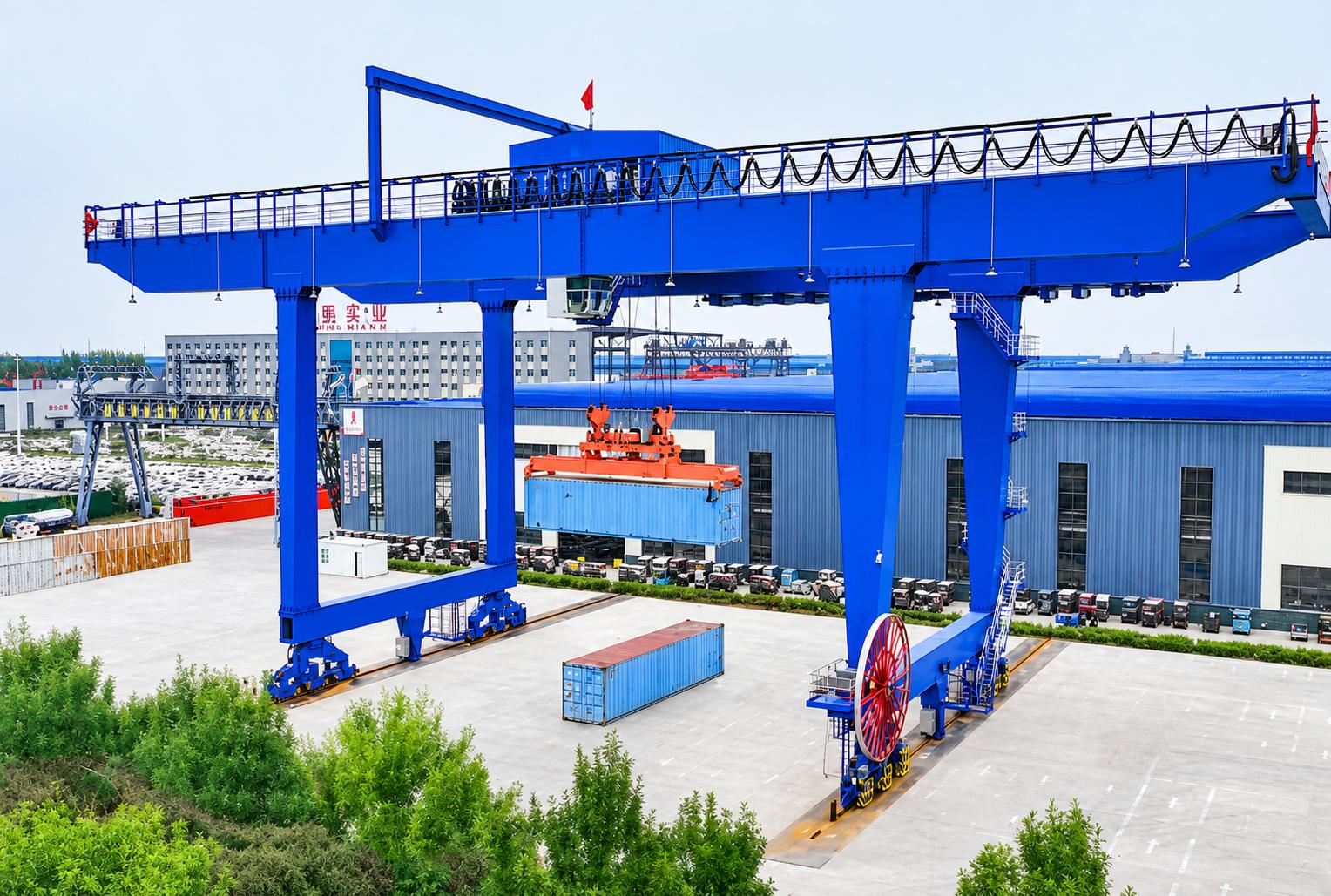
The automated positioning system is the core support of intelligent stacking. The 35t automated RMG crane is equipped with high-precision laser positioning, visual recognition and GPS dual-mode positioning technology, which can scan the location, size and status of the container in real time, and automatically calibrate the attitude of the spreader and the walking trajectory of the equipment.There is no need for manual intervention during the operation process, and the whole process of container grabbing, alignment, and placement can be completed independently, and the positioning error is controlled at the millimeter level.Compared with manual operation, problems such as alignment deviation and placement skew are completely eliminated, which not only guarantees the regularity of stacking and operation safety, but also greatly improves the accuracy and efficiency of a single operation, and is suitable for high-frequency and large-volume standardized operation scenarios.
Stacking sequence management
Relying on the terminal intelligent logistics management system, the Henan Mine Crane manufactured 35t automated RMG crane can realize the intelligent overall management of the stacking sequence.The system can synchronize core data such as cargo arrival time, cargo type, turnover priority, and transportation destination in real time, and automatically plan the optimal storage location and retrieval sequence, following the operating principle of “first in, first out, heavy down and light up, nearby storage, and rapid retrieval”.Automatically avoid the problems of wrong stacking, random stacking, and mixed stacking, while reducing the invalid operations of container turning and moving containers in the later stage, greatly reducing the energy consumption and time costs of operation and maintenance, and making the whole process of yard storage and transshipment orderly and controllable.
Remote operator control
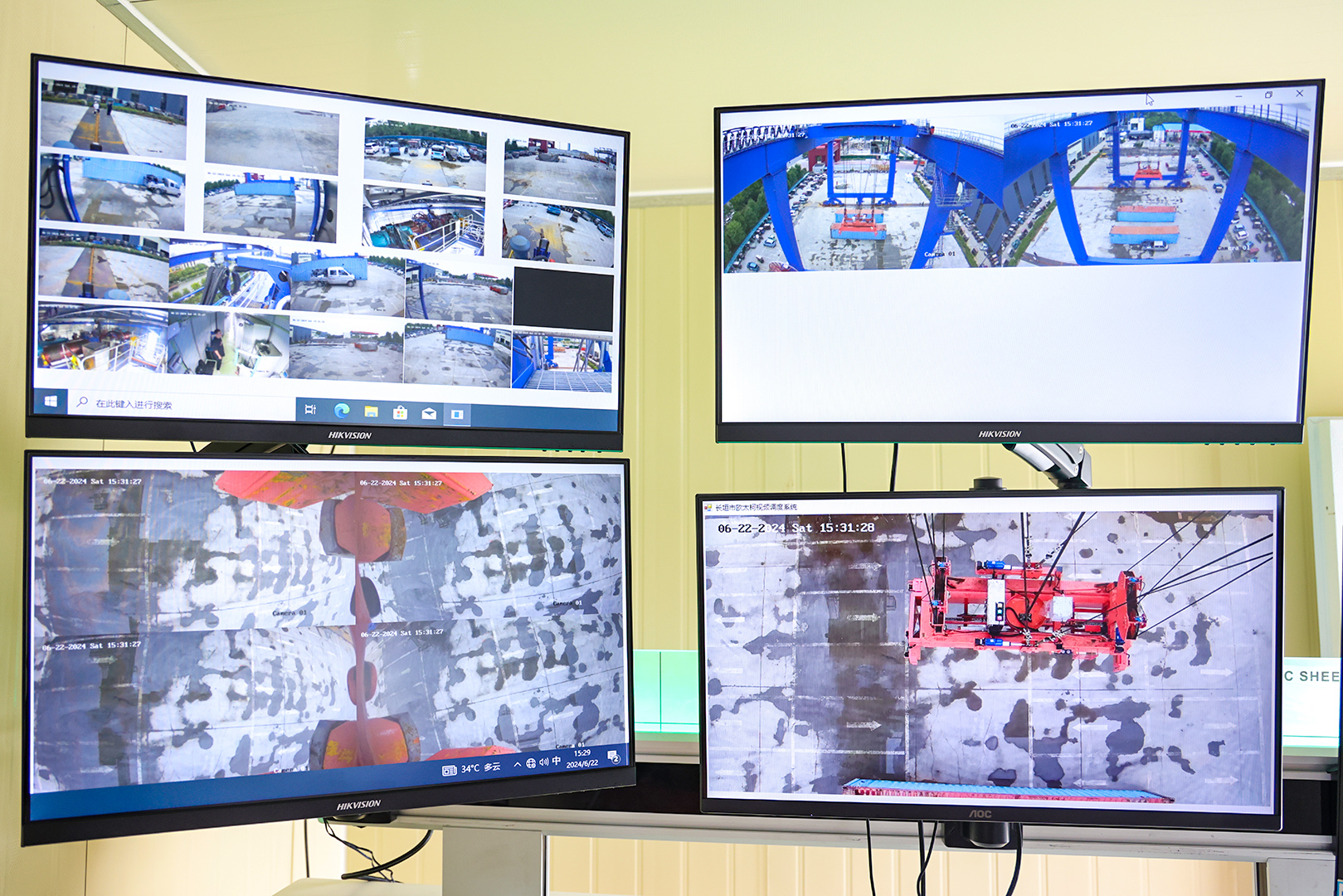
The new remote control mode completely subverts the traditional on-site operation mode. The operator does not need to board the plane to operate, and can control multiple 35t RMG cranes in real time through a remote terminal in the central control room.The system is equipped with high-definition real-time image transmission, remote attitude control, emergency braking and other functions, supporting single-person and multi-machine collaborative operation, greatly reducing labor costs.At the same time, remote operations avoid the safety risks of high-altitude operations and heavy-duty hoisting sites, and improve the operating environment.In night operations, bad weather operations, and high-intensity operation scenarios during peak periods, the remote control mode can maintain a stable operating state and ensure the uninterrupted operation of the terminal for 24 hours.
Real-time equipment monitoring
The 35t automated RMG crane is equipped with a full set of Internet of Things monitoring modules, which can realize real-time digital monitoring of the operating status of the equipment.The system collects core data such as equipment walking speed, lifting height, load status, motor temperature, braking system, and track status throughout the process, and uploads it to the smart terminal platform in real time.In the event of overload, offset, equipment failure, abnormal track and other problems, the system will automatically give early warning, real-time alarm and trigger safety interlock protection to avoid safety accidents in time.At the same time, operation and maintenance personnel can predict equipment loss through background data, carry out maintenance and overhaul in advance, reduce equipment failure and downtime, and greatly improve equipment operation stability and attendance.
How Should RMG Crane Layouts Be Planned for Terminal Capacity?
The site layout planning of RMG cranes directly determines the storage capacity, operating efficiency and throughput capacity of railway terminals.Unreasonable layout will lead to limited operating range of equipment, conflict of moving lines, and waste of space. Even if the equipment has excellent performance, it will not be able to maximize its operating value.Scientific layout planning needs to be designed in all directions in combination with railway track parameters, stacking requirements, transportation lines, and site expansion requirements.
Rail gauge and stacking lanes
The track gauge and the number of stacking channels are the basic core of layout planning.It is necessary to strictly match the railway standard gauge parameters to ensure that the RMG crane walking track is adapted in parallel with the railway freight track to avoid the transfer obstacles caused by the misalignment of the track.At the same time, according to the average daily throughput of the terminal and the container storage stock, the number of stacking channels and channel spacing are reasonably planned. Conventional scenarios can be adapted to 6+1 and 7+1 multi-channel layout, taking into account the needs of multi-row storage and vehicle traffic.The layout of the channel needs to be clearly zoned and independent of moving lines, and distinguish between heavy box areas, empty box areas, special box areas, and turnover box areas, so as to avoid the problem of chaotic stacking in the layout and improve the level of standardized operation of the site.
Crane span and stacking height
The crane span and stacking height directly determine the space utilization rate of the yard.The 35t RMG crane supports customization with a long span of 18-35 meters, and can cover multiple rows of container storage channels at once, reducing the number of equipment inputs and reducing equipment collaborative operation conflicts.The stacking height can be flexibly planned according to site load-bearing, security standards, and operating requirements, and supports 5-6 layers of high-rise stacking, greatly increasing the storage capacity per unit area.The combination of large-span + high-stacking mode can directly increase the storage capacity of the terminal by more than 30% without expanding the site, which is perfectly adapted to the needs of high-density storage.
Truck access and transfer zones
The core of public railway intermodal transport is the coordination of moving lines. In the layout plan, standardized truck passage areas and transit connection areas need to be reserved separately, and truck entry and exit channels, stopping points, and loading and unloading areas need to be clarified.Ensure that the operating scope of Henan Mine Crane manufactured RMG crane can fully cover the railway track area, the yard storage area, and the truck transit area, so as to achieve seamless connection between the three areas.At the same time, the width of vehicle traffic and the distance between stops are rationally planned to avoid congestion of trucks and intersections of moving lines during peak periods, ensure efficient and orderly transit of public railways, and improve the overall turnover efficiency.
Yard expansion considerations
The logistics throughput of railway terminals continues to grow, and the layout planning needs to take into account the current practicality and future expansion.Sufficient expansion space needs to be reserved for track laying, equipment foundation, and channel planning to support the later addition of stacking channels, the addition of RMG equipment, and the expansion of transit areas.Priority is given to the use of modular layout design, without the need for large-scale transformation of the site foundation, equipment upgrading and site expansion can be completed, the cost of late transformation can be reduced, and the terminal logistics capacity can be continuously upgraded and iterated with freight demand.
What Affects the Performance of a 35t Automated RMG Crane?
The operating performance, stability and service life of the 35t automated RMG crane directly affect the overall operating efficiency of the railway terminal.Equipment performance is affected by multiple core parameters. Only by accurately controlling the key influencing factors and doing a good job in equipment selection, commissioning, and operation and maintenance can the value of equipment operations be maximized and the efficient and stable operation of the terminal be guaranteed.
Spreader compatibility
The adaptability of the spreader is the core factor that determines the versatility of the equipment operation.The high-quality 35t RMG crane needs to be equipped with adjustable universal spreaders, which are fully adapted to 20-foot, 40-foot, and 45-foot standard containers, and are compatible with some special container loading and unloading needs.The spreader needs to be equipped with automatic calibration, anti-swing, and precise box locking functions, and the span and locking point can be automatically adjusted according to the size of the box, so as to eliminate problems such as unstable gripping, box shaking, and loading and unloading failures caused by improper adaptation of the spreader.The more adaptable spreader system can greatly broaden the operation scene of the equipment and improve the stability and versatility of the operation.
Travel and hoisting cycles
The efficiency of the walking and lifting cycle directly determines the throughput of the equipment's single-day operation.The walking speed, lifting speed, start-stop response speed, and smoothness of the equipment jointly affect the operation cycle of a single box.Henan Mine Crane supply high-quality 35t RMG crane adopts a frequency conversion speed control system, which starts and stops smoothly and without impact, and the walking and lifting movements are smoothly connected, which can greatly shorten the invalid operation time.The stable cycle operation ability can ensure that the equipment does not get stuck or fail for long-term and high-frequency operations, and continuously outputs efficient operation capabilities, which are suitable for the terminal's 24-hour continuous operation requirements.
Positioning accuracy
Positioning accuracy is the core guarantee of automated stacking, and it is also the key to distinguish between ordinary RMG and intelligent RMG.High-precision positioning can ensure that the container stacking is regular, the spacing is uniform, and the layer height is in compliance, and the stacking skew, box extrusion, and channel blockage caused by alignment deviation can be avoided.The millimeter-level precise positioning ability can not only improve the space utilization rate of the yard, but also reduce secondary operations such as turning and moving boxes, reduce equipment energy consumption and cargo loss, and greatly improve operational safety and eliminate hoisting collisions. Accidents.
Safety interlocking systems
The safety interlock system is the core barrier between the stable operation of equipment and the safe production of the site.The 35t automated RMG crane is equipped with a full set of intelligent safety interlock systems, including overload protection, limit protection, anti-collision protection, emergency braking, track failure interlock, personnel intrusion early warning and other multiple protection functions.The various systems are linked and coordinated to monitor operational risks in real time. Once safety hazards are triggered, they will automatically stop, alarm, and lock operating procedures immediately, so as to avoid equipment damage, cargo damage, and personnel safety accidents from the root cause, and ensure the safe and compliant operation of the terminal around the clock.
How Can a 35t RMG Crane Be Customized for Different Rail Terminals?
There are significant differences in site size, track layout, freight type, and operating requirements of different railway terminals, and standardized equipment cannot be fully adapted to personalized operation scenarios.Henan Mine Crane manufactured35t RMG crane supports a full range of customized transformation, and can tailor exclusive intelligent stacking solutions according to the actual working conditions of the terminal, accurately adapting to the operating needs of various railway hubs, logistics parks, and multimodal transport bases.
Span and stacking height
According to the space and storage needs of different sites, the equipment span and stacking height can be customized.Small terminals and compact depots can choose small and medium-span models, which are suitable for narrow-channel and low-row stacking scenarios.Large-scale hubs and high-throughput depots can be customized with long-span equipment of 18-35 meters, covering multiple rows of stacking channels.The stacking height can be flexibly adjusted according to the site's load-bearing standards, security requirements, and storage capacity requirements to achieve multi-layer high-density storage, accurately match the space utilization needs of different sites, and maximize the value of the site.
Rail layout and cantilever design
Combining the existing track layout, site boundaries, and transfer lines of the terminal, the exclusive track laying plan and cantilever structure design can be customized.For single-sided track operation scenarios, a single cantilever structure can be configured.For the scene of double-sided public railway intermodal transport, a double-cantilever design can be used to expand the coverage of the operation.At the same time, the layout of the equipment walking track can be optimized according to the terrain, track spacing, and boundary restrictions of the site, and it can be adapted to different scenarios such as the renovation of old sites and the planning of new hubs. There is no need to significantly change the existing site facilities to achieve efficient equipment adaptation.
Automation and control integration
According to the progress of the intelligent upgrade of the terminal, the automation and control system can be customized in stages.The traditional retrofit terminal can be configured with a semi-automatic system, with remote control and semi-automatic positioning functions, to complete the intelligent upgrade at low cost.The intelligent new terminal can be equipped with a fully automated unmanned operating system and connected to the terminal's intelligent logistics platform to realize the whole process of unmanned operations such as automatic scheduling, automatic stacking, automatic inspection, and data synchronization.At the same time, it can integrate functions such as data monitoring, video surveillance, intelligent early warning, and remote operation and maintenance on demand to adapt to the needs of intelligent operations at different levels, and help railway terminals gradually complete the intelligent logistics upgrade.
Henan Mine Crane Factory Custom
The 35t automated RMG rail gantry crane is the core equipment to solve the high-density storage, efficient transportation, public railway collaboration, and intelligent operation and maintenance of modern railway terminals.It has completely cracked the industry pain points of frequent congestion in traditional depots, low space utilization, lagging operating efficiency, and high labor costs. Through precise automated stacking, intelligent sequence management, remote digital control, and scientific site layout adaptation, the operational efficiency and storage capacity of railway multimodal transport can be improved in all directions.
At the same time, relying on the flexible customization capabilities of Henan Mine Crane Factory, the 35t RMG crane can be adapted to various types of railway terminals, large, medium and small, and different working conditions of old and new sites, taking into account practicality, economy and foresight. It has become the optimal solution for the intelligent upgrading, throughput expansion, cost reduction and efficiency of railway logistics parks, and it is also the core just-needed equipment for the large-scale development of smart railway hubs in the future.