
Electric Slewing Heavy Jib Cranes: Continuous 360° Motorized Rotation for Steel Yards
The steel plates, billets, and coils in the steel yard need to be frequently rotated between storage, cutting, welding, and assembly stations; bridge cranes are easy to wait in line, and manual jib hoisting and pushing arms are laborious and inefficient.
The electric rotary heavy-duty jib crane is centered on a fixed column and continuously rotates 360°, taking into account the large tonnage carrying capacity and no dead angle coverage, making it the best choice for fixed-point and high-frequency handling in the yard.This article gives a complete guide from equipment principle, selection parameters, equipment comparison, application scenarios to safety operation and maintenance.
What Is an Electric Slewing Heavy Jib Crane?
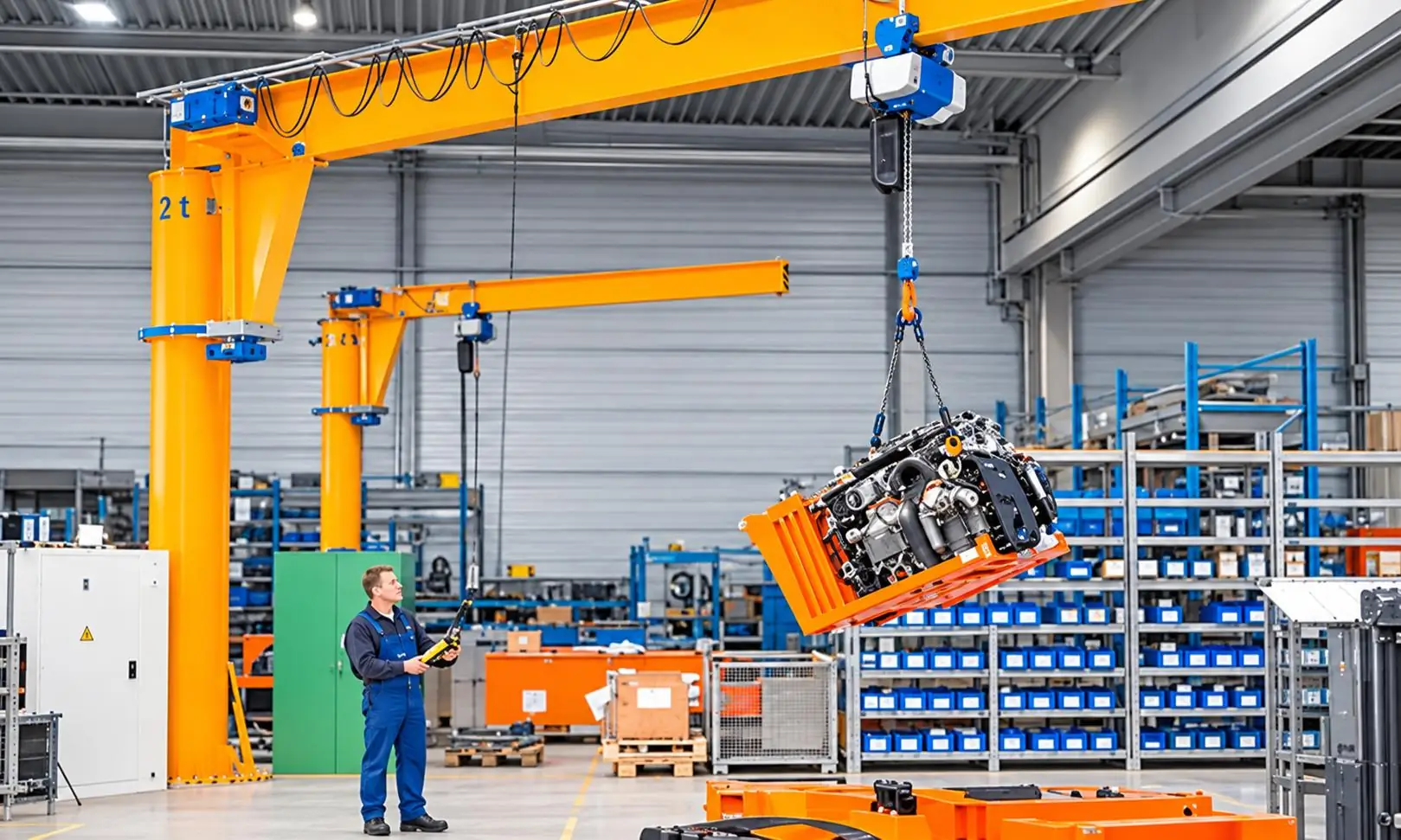
Electric rotary heavy-duty jib crane is a floor-standing fixed equipment supported by a column: a horizontal cantilever is mounted on the upper part of the column, driven by a motor to rotate around the axis of the column, and the distribution electric hoist and the operating trolley complete the three-dimensional lifting of heavy objects.
Its core working logic is clear: the electric hoist is responsible for the lifting of heavy objects, the trolley moves radially along the cantilever, and the electric rotary mechanism drives the cantilever to rotate. The three cooperate to complete the lifting, shifting, and blanking of steel materials within the circular operating range. Positioning.The whole process of rotation is driven by a motor, even if several tons of steel are hoisted, the operator does not need to manually push and pull the cantilever.
The complete set of equipment mainly contains six core components:
- Support column and foundation: The rigid steel structure column is anchored to the concrete foundation or load-bearing base by anchor bolts, which can withstand all vertical loads and overturning moments, and is the stable foundation of the whole machine.
- Horizontal cantilever and structural frame: More I-beam or box beam structures are used. Under long-radius working conditions, an upper tie rod or a lower support structure will be added to increase the stiffness of the cantilever and reduce deformation under heavy loads.
- Electric slewing drive and slewing mechanism: it consists of a motor, a reducer, a pinion, and a slewing bearing to provide controllable slewing power to achieve smooth start-stop and speed-regulating rotation.
- Electric hoist and trolley walking system: wire rope hoist or chain hoist, supporting electric trolley, to achieve vertical lifting of heavy objects and radial movement along the direction of the cantilever.
- Electrical control system and operating components: wired handle, wireless remote control or column control cabinet, unified control of the three major actions of lifting, trolley walking, and rotation, and can be operated in linkage.
- Safety devices and limit switches: overload limiter, lifting upper and lower limits, optional rotation limits, emergency stop buttons, and braking systems constitute a complete set of safety protection systems.
The difference between electric and manual rotary jib cranes is obvious: manual manual push arm, slow rotation under heavy loads, poor positioning, easy to fatigue; electric motor outputs stable torque, controllable acceleration and deceleration, reliable braking, suitable for high-frequency heavy-duty transportation.
How Does Continuous 360° Motorized Rotation Work?
Continuous 360° unlimited rotation, relying on electric slewing drive device, slewing bearing, and collector ring (slip ring assembly) to work together.
- The geared motor with its own braking function drives the reducer to operate, and the output terminal of the reducer is connected to the pinion, and the pinion meshes with the inner or outer ring gear of the large-diameter slewing bearing.;
- The slewing bearing can withstand the radial force, axial force and overturning torque caused by the cantilever and heavy objects at the same time, and ensure that the boom can rotate smoothly.To achieve uninterrupted 360° rotation, a slip ring power collector device must be configured, and the power cord and control line are transmitted through the slip ring to avoid the cable from twisting and twisting as the boom continues to rotate.
- The operator controls the direction and speed of rotation through the handle or wireless remote control. The industry generally supports frequency conversion drives to achieve soft start, stepless speed regulation, smooth shutdown, and reduce impact.The lifting, trolley walking, and rotation actions can be controlled independently, or they can be combined with linkage to allow the steel workpieces to be accurately aligned in the circular working area.
- The rotary structure is divided into two mainstream solutions: limited angle rotation (common 270°~300°), mechanical stops and limit switches are set, and the cable layout is simple, which is suitable for stations that do not require full-week coverage.;
- 360° continuous rotation, with slip rings and no hard limit, can be reached from any position around the column, which is the first choice for steel multi-station centralized arrangement of the yard.Both schemes come standard with a motor mechanism, which automatically locks the boom after power failure to prevent free rotation, and has built-in overload and overspeed protection to ensure the safety of the rotary system.
Evaluate the rotary system during the selection, focusing on these technical indicators:
- Rotation speed and acceleration: normal 0.5~1.5rpm for heavy-duty working conditions, the acceleration should not be too fast to prevent the steel load from shaking and impacting the structure.;
- Rotation smoothness and positioning accuracy: frequency conversion control + high-precision gear pair, reduce start-stop jitter, and facilitate precise placement of steel coils and steel plates. Tooling;
- Torque reserve of motor and reducer: calculated according to the maximum overturning torque (load × operating radius), sufficient margin is reserved;
- Braking performance and overload protection;
- Work level: It matches the heavy working conditions of frequent start and stop and repeated lifting of steel depots.
Why Are Electric Slewing Heavy Jib Cranes Suitable for Steel Yards?
The steel yard has heavy materials, high dust in working conditions, and intensive process flow. The cutting, welding, machining, warehousing, and assembly stations are centrally arranged, and the characteristics of the electric rotary heavy-duty jib crane just match the pain points on the site.
Efficient handling of heavy steel
The weight of steel plates, billets, steel coils and prefabricated components ranges from a few hundred kilograms to several tons. The lifting can be completed with steel plate clamps, vacuum suction cups, C-shaped reel hooks and other spreaders; lifting, walking, and rotating are all electric, and the loading and unloading beat is stable, which can reduce the second reverse of the forklift.
Full circumference coverage
The length of the spiral arm is the working radius, and the material rack, cutting table, welding tooling and inspection table can all be arranged within this circular working range; one equipment can serve multiple surrounding stations, and there is no need to wait in line for the bridge crane to dispatch, and there is no need to move the whole machine frequently.
Reduce manual operation load
The labor intensity of manually pushing and turning heavy-duty cantilevers is extremely high, and long-term operations are prone to operating errors and strain problems.Electric rotation cancels the manual push arm action, the operator only needs to focus on controlling the alignment of the spreader, the consistency of the operation is higher, and more hoisting cycles can be completed in a single day.
Straighten out the production process
Cutting, welding, machining, warehousing, and assembly stations are concentrated in the rotary coverage area. Steel workpieces can be transferred directly from the previous process to the next process, no longer competing for shared bridge crane resources, process waiting time is shortened, on-site material placement is more orderly, and site utilization is improved.
Adapt to dust and open-air working conditions
There is a lot of dust and vibration in the workshop, and there are occasional bumps and shocks of workpieces; the main beam of the whole machine adopts a thickened steel structure, the protection level of the electrical box reaches IP54 and above, the motor and the slewing bearing are dust-proof and sealed, and the outdoor or semi-open-air version can also be equipped with rainproof and anticorrosive coatings.
Key Technical Specifications to Evaluate Before Purchasing
| Parameter | What buyers should evaluate |
| Rated capacity | Total weight of the steel plus lifters, vacuum pads, clamps and other attachments; never the workpiece weight alone |
| Working radius | Horizontal distance from slewing center to hook; allowable capacity drops as radius increases |
| Lifting height | Vertical clearance under the jib, enough to lift, clear fixtures and stack loads |
| Slewing angle | 360° continuous slewing, or limited to 270°/300° |
| Slewing speed | Steady rotation at full load; VFD control preferred to keep the load from swinging |
| Hoisting speed | Matched to production takt, balancing efficiency with load stability |
| Duty class | Selected by handling frequency and load spectrum; FEM 2m / ISO M5 or above for high-frequency heavy steel handling |
| Power supply | Voltage, frequency and phases matching the plant supply |
| Mounting type | Floor-mounted fixed base, or mounted on a supporting structure |
| Safety devices | Overload limiter, upper/lower limit switches, slewing limit, emergency stop, brakes, buffers |
The rated lifting weight, working radius, and working level must be evaluated together, and the lifting weight cannot be used as the selection criteria alone.The allowable load of the jib crane decreases as the working radius increases;
The steel yard continues to start and stop at high frequencies and is often hoisted at full load. If low-level models are selected, the wear of gears, bearings, and hoists will be accelerated, the equipment will fail in advance, and there will even be safety risks.
Electric Slewing Jib Cranes vs. Other Lifting Equipment
Electric rotary jib crane vs manual jib crane
Manual jib hoisting relies on manpower to push the boom. The larger the load and the longer the arm length, the higher the difficulty of pushing. The positioning accuracy is poor and the efficiency is low under heavy loads. It is only suitable for occasional light-load hoisting; electric rotary jib hoisting has no burden on the push arm, and the rotation speed is controllable. It is suitable for high-frequency and large-tonnage continuous operation of steel yards.
Electric rotary jib crane vs bridge crane
The bridge crane covers the rectangular span of the plant and has a strong long-distance transfer capacity, but it needs to lay driving tracks and carry the main structure of the plant, the procurement cost is high, and multiple stations are shared, making it easy to wait in line; the electric jib crane is fixed on a single-point basis and independently serves a circular area. It does not occupy the resources of the bridge crane, which is suitable for short-distance material transfer at fixed points in the station, and the two complement each other.
Electric rotary jib crane vs gantry crane
Gantry cranes are suitable for large-area outdoor depots and long-distance material transfer. They cover a large area and have a high amount of track foundation engineering. The jib crane only occupies a small area of the column foundation and focuses on the hoisting of local stations. Steel depots generally use gantry cranes for large-scale long-distance transportation, and jib cranes are responsible for cutting and welding stations. Loading and unloading nearby.
Typical Applications of Heavy Electric Slewing Jib Cranes in Steel Yards
- Steel plate loading, unloading and transportation: transfer steel plates between the storage rack and the plasma cutting, flame cutting table, and bending machine, supporting steel plate clamps or vacuum suction cups, 360° rotation can serve multiple cutting equipment at the same time, and one crane can take into account multiple cutting stations.
- Steel coil handling: steel coil storage, uncoiling, loading and transportation, with a C-shaped coil hook adapted to the inner diameter and rated load of the steel coil, the load is stable during the rotation process, and the steel coil is avoided from slipping and bumping. It is a common configuration in coil processing workshops.
- Transfer of billet and profile: Heavy-duty profiles such as billet, H-shaped steel, I-beam, channel steel, etc. flow between processing stations. When the bridge crane channel is blocked by the workpiece, the jib crane can flexibly reach the restricted area to solve the problem of hoisting in a small station.
- Welding and steel structure prefabrication workshop: Large-scale welded components are rotated between welding, assembly, and flaw detection and inspection stations, and fixed stations are hoisted repeatedly. Electric jib hoisting can continue to operate stably and improve the efficiency of steel structure prefabrication assembly lines.
- Steel processing and equipment maintenance area: heavy-duty spare parts such as rolling mills, shearing equipment, and conveying rollers are hoisted to facilitate equipment disassembly and replacement of parts and improve the maintenance efficiency of yard equipment.
Safety Considerations for Heavy-Duty Motorized Slewing Jib Cranes
- It is strictly forbidden to overload, partial load and cable-stayed oblique hoisting, and it must be hoisted strictly according to the rated load corresponding to the current operating radius.;
- The foundation and anchor bolts of the column must be calculated and designed according to the overturning torque, and the foundation settlement and bolt fastening conditions shall be reviewed regularly.;
- Rely on the braking system to prevent the boom from spinning out of control, cooperate with frequency conversion control to achieve slow rise and slow fall, and suppress the load swing;
- Regularly check the wear condition of slewing bearings, gears, motors and brakes, and focus on investigating the gap between slewing drives.;
- Check the wire ropes, hooks, clamps, suction cups, coiling hooks and other spreaders one by one, and if cracks, deformation or wear exceed the standard, they should be discontinued immediately.;
- Ensure that the emergency stop circuit and limit switch are always sensitive and reliable, and test various safety protection devices before each operation;
- Establish regular inspections and preventive maintenance accounts, maintain on time, and strictly prohibit the operation of equipment with diseases.
How to Choose the Right Electric Slewing Heavy Jib Crane Manufacturer
- Preference is given to manufacturers with experience in the design of heavy-duty industrial lifting equipment: such manufacturers are familiar with the calculation of overturning torque, the design of main beam stiffness and the selection of slewing bearings under heavy-duty conditions, and can leave a structural margin according to the actual tonnage of steel; manufacturers who only do light-duty small cranes mostly use light-load structures, which are difficult to withstand the continuous hoisting of several tons of steel.
- Investigate the processing technology, welding quality and flaw detection capabilities of steel structures: check the welding process procedures and weld forming of the main beams and columns, confirm whether the flaw detection and testing are performed according to the drawings and a report can be issued to avoid cracking of the welds and deformation of the cantilever under heavy loads.
- Verify the complete set of solutions for the slewing system: focus on the configuration quality and supply source of the slewing bearing, reducer, motor and frequency conversion control system, and confirm that each component leaves sufficient torque and carrying margin according to the maximum overturning torque, rather than piecing together with low-cost parts.
- Confirm the customization ability: whether the lifting weight, arm length, lifting height, rotation angle and protection level can be adjusted according to the layout of the on-site station, and whether the spreader interfaces such as clamps, suction cups, and coiling hooks can be reserved to avoid re-manufacturing after the equipment arrives.
- Ask for a full set of qualification documents such as product certificate of conformity, type test report, load test certificate, etc., and check that the model and tonnage on the certificate are consistent with the actual order, as the basis for arrival acceptance and future annual inspections.
- Evaluate the ability of installation guidance, spare parts supply and after-sales technical support: whether there is a clear response time and inventory of commonly used spare parts, whether it can provide basic construction and commissioning acceptance guidance; long-term stable after-sales, more than one-time purchase price affects the equipment utilization rate.
Conclusion
The electric rotary heavy-duty jib crane is suitable for high-frequency fixed-point handling of steel yards. It can cover the circular working area through 360° electric rotation, reduce manual push arm operation, and connect cutting, welding, warehousing and assembly processes.
When selecting the type, the rated load, operating radius, working level and basic conditions should be considered comprehensively, and installation inspections and regular maintenance should be done.If you need to formulate a suitable equipment plan according to the layout of the yard and the production cycle, please contact us.