
4 Main Types of Container Cranes Used in Modern Ports and Terminals
Container cranes are the core special equipment for container loading, unloading, stacking and transshipment in ports. They directly affect the efficiency and turnover capacity of terminal operations, and are the key to the efficient operation of modern international trade logistics hubs.
Compared with ordinary lifting equipment, container cranes are equipped with special locking spreaders, which have the advantages of three-dimensional accurate operation, heavy-duty and efficient, and automated operation.This article analyzes the principles, advantages and disadvantages and applicable scenarios of the four mainstream models of STS, RTG, RMG, and transporter in a concise manner, and provides a reference for port equipment selection, operation and maintenance upgrades.
What Is a Container Crane?
Container cranes are large-scale gantry lifting equipment deployed in container terminals and freight yards, specially used for standardized container loading, unloading, stacking, and transshipment. Their core role is to complete the cargo transfer between container ships and terminals, depots and transportation vehicles. It is the core equipment of port logistics.
Unlike traditional lifting equipment, modern container cranes have four common core characteristics:
- The exclusive telescopic spreader is equipped with a four-corner rotary locking mechanism, which can accurately lock the corners of the container, fundamentally eliminating the hidden dangers of hoisting and falling off, and the operation safety is higher.;
- Adopt a three-dimensional linkage motion control system, support vertical, horizontal, and vertical multi-dimensional precise motion, smooth operation and controllable positioning;
- Strong heavy-duty capacity, rated load covering 40-120 tons, compatible with single-box and double-box joint lifting conditions, suitable for all kinds of heavy-duty operations in the port;
- The degree of intelligence is high, and the new machines are generally equipped with anti-swing, automatic alignment and remote control systems as standard, which greatly improves operation stability and turnover efficiency.
Ship-to-Shore (STS) Crane
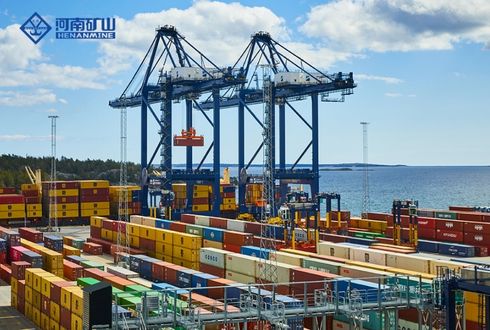
STS shore container crane (referred to as shore bridge, also known as terminal shore crane, ship shore crane) is the core heavy equipment at the forefront of the port terminal. It is exclusively used for container loading and unloading operations between the ship and the terminal shoreline. It is the first core process equipment for containers entering and leaving the port, which directly determines the efficiency of ship berthing turnover.
Core structure and operating characteristics
The shore bridge as a whole is a large rigid gantry structure, which is permanently installed on the leading track of the pier, and can move parallel to the direction of the ship along the coastline.The equipment is equipped with an ultra-long pitchable cantilever, which can span the deck of the ship and operate deep into the interior of the cabin.The operation cab is suspended on the cantilever operation trolley to provide the operator with an unobstructed operation field of view and ensure accurate operation.
Compared with ordinary cranes, the shore bridge abandons traditional hooks and comes standard with special telescopic spreaders. The four corners of the container are firmly locked by a rotary locking mechanism, which supports single-box, double-box and even multi-box joint hoisting.The weight of the equipment can reach 800-2000 tons, the mainstream rated load is 40-65 tons, and the load under double crane conditions can reach 80-120 tons, which is suitable for the operation needs of ultra-large container ships.
Job operation principle
The STS shore bridge is coordinated and linked through three sets of mechanisms to form a standardized and efficient closed loop of ship loading and unloading operations.:
- Longitudinal walking of the gantry: translation along the shoreline track of the terminal as a whole, accurately aligning the ship's space and the deck container stackage;
- Horizontal position of the trolley: The cantilever trolley slides laterally along the main beam to accurately calibrate the horizontal drop point of the container;
- Vertical lifting operation: complete the whole process of container picking, lifting, and dropping through the lifting mechanism.
The complete operating system is equipped with intelligent anti-sway and high-precision positioning modules to effectively suppress hoisting shaking, greatly improve operating stability and turnover efficiency, and adapt to high-frequency ship berthing, loading and unloading conditions.
Model size classification
According to the operating extension distance, lifting height and adaptation ship type specifications, the industry divides the STS shore bridge into three mainstream levels to accurately match the positioning of shipping ships and ports of different tonnages:
- Panama-type shore bridge: the operating extension distance is 40–45m, which is suitable for small and medium-sized container ships and feeder transport ships that meet the navigation scale of the original Panama Canal, and is widely used in small and medium-sized feeder ports.
- Ultra-thin shore bridge: The operating extension distance is 50–60m, which can be adapted to mainstream large ocean-going container ships, with balanced performance and strong applicability. It is the main configuration model of modern medium-sized large-scale ports.
- Super ultra-large (giant) shore bridge: The maximum operating extension distance can reach 65–75m, and it can cover 26 rows of containers on the deck. It is specially adapted to ultra-large container ships (ULCV). It is the core equipment for large international hub ports to improve the loading and unloading efficiency of ocean-going ships.
Development history and modernization functions
The world's first modern STS shore bridge was put into use at the California terminal in 1959, which completely promoted the commercialization and popularization of container shipping and reshaped the global logistics pattern.
The modern new type of shore bridge is equipped with a high-speed lifting system, multi-box joint lifting technology, a fully automatic operating system, and an energy-saving regenerative power system. The stability rate of equipment operation can reach more than 99%, which is the core guarantee for the efficient operation of large ports.
Rubber-Tired Gantry (RTG) Crane
RTG tire-type gantry crane, referred to as tire crane, is a special mobile lifting equipment for port container depots. It is mainly used for stacking, sorting, and transshipment of containers in the back yard of the terminal, connecting the loading and unloading of shore bridges and the transshipment of land freight.Unlike rail-type equipment, tire cranes use rubber tires to walk, without laying fixed tracks, and have extremely high operating flexibility.
Core structure and operating characteristics
The equipment adopts a long-span steel gantry structure, which can operate across 5-8 rows of containers and freight lanes, covering a wide range.The walking mechanism is equipped with 8-16 sets of rubber tires, which can be freely turned and translated, and can be flexibly switched between different operating blocks of the yard without the need to transform the site infrastructure.
The standard telescopic rotary lock spreader is equipped with a rated operating load of 35-65 tons, and the mainstream stacking capacity is “1 stack of 5, 1 stack of 6”, which can make full use of the vertical space of the yard.
The power mode is flexible. The traditional models are powered by diesel generator sets, and the new models are fully upgraded to hybrid, pure electric, and battery-powered modes, which effectively reduce energy consumption and carbon emissions, and adapt to the needs of green port construction.
Core advantage
- Low investment in infrastructure: the trackless walking structure of rubber tires is adopted, and there is no need to lay special tracks and supporting foundation projects, which greatly reduces the cost of civil construction in the early stage of the terminal, and the threshold for equipment landing and deployment is low, which is suitable for all kinds of existing hardened yards.
- High operational flexibility: it supports in-situ steering, global translation, and cross-block operations, and can flexibly adjust the scope of operations according to the cargo volume of the yard and the operation movement line, which is perfectly adapted to the terminal operation model of continuous expansion and dynamic layout optimization.
- Strong integrated operation ability: integrated container stacking, interval transshipment, truck loading and unloading and other functions in one, without the need to match a large number of auxiliary equipment, the operation system is simple and stable, and the comprehensive adaptability is extremely strong.
Applicable scenarios
- Small and medium-sized conventional container depots: suitable for small and medium-sized depots with medium and low throughput and stable operation scale, which can efficiently complete routine operations such as daily container storage, on-site transshipment, and vehicle loading and unloading to meet basic operating needs.
- Renovation and expansion of iterative terminals: it is adapted to upgraded terminals with continuous expansion and dynamic layout adjustment. It is not limited by fixed tracks and can be flexibly adapted to the operating area following the expansion of the site and the adjustment of functional partitions.
- Flexible large-scale yard: suitable for medium-sized large-scale yard stations with fixed operating lines and strong random cargo flow, relying on high maneuverability characteristics to adapt to changeable production operation plans.
- Cost-effective general operating scenarios: balance equipment procurement costs, infrastructure investment and operating performance, both economical and practical, and are the mainstream standard equipment for small and medium-sized ports and general depots around the world.
Equipment limitations
Compared with rail-type equipment, the positioning accuracy of the tire crane is slightly lower, and the adaptability of high-density stacking and fully automated operations is weak; the long-term heavy-duty operation of the tire has a large amount of wear and tear, and the operation and maintenance cost is high; the energy consumption and noise pollution of traditional diesel engines are relatively higher.
Rail-Mounted Gantry (RMG) Crane
RMG rail gantry crane, referred to as rail crane, is a high-end yard operation equipment adapted to large-scale automated ports. The operation function is the same as that of RTG tire crane. It mainly completes container stacking, access, and transshipment operations. The core difference lies in the use of fixed steel rail walking, focusing on high-precision, high-density, and fully automated operations.
Core structure and operating characteristics
The track crane runs along the preset fixed steel rails of the yard, the walking path is accurate and controllable, there is no offset error, and the positioning accuracy far exceeds that of the tire crane.The rigid gantry has a span of up to 20-70 meters, can cover multiple rows of containers and transshipment lanes, has a stacking capacity of up to “1 stack of 6 to 1 stack of 8”, and has a very high vertical space utilization rate. It is the preferred equipment for high-density depots.
The equipment is driven by electricity throughout the process, equipped with a busbar and cable reel power supply system, which has quiet operation, low emissions, low energy consumption, and lower long-term operation and maintenance costs.Equipped with a terminal operating system (TOS), intelligent anti-swing, and automatic alignment system, it can realize fully automatic unattended operation, which is the core standard equipment of the smart port.The rated load is 35-65 tons, supports single-box and double-box joint hoisting, and has strong stability for heavy-duty operations.
Core advantage
- Strong operating stability: relying on the rigid guidance of fixed steel rails, the equipment's walking trajectory error is very small, the controllability is extremely high, there is no offset shaking in heavy-duty operations, and the container stacking regularity is excellent, which can meet the requirements of high-standard refined yard operations.
- High storage density: support 6-8-layer ultra-high stacking operations, fully tap the vertical space potential of the yard, effectively solve the problem of shortage of land resources in the port area, greatly increase the storage capacity per unit area, and adapt to the high-density intensive operation model.
- High degree of intelligence: it can be seamlessly connected to the terminal TOS operation and maintenance management system, realize fully automatic alignment, stacking, and transshipment closed-loop operations, support all-weather unattended operation, significantly reduce labor costs, and the overall operating efficiency far exceeds that of traditional RTG equipment.
- Low long-term operation and maintenance costs: the use of all-electric drive mode, silent operation and low noise, energy consumption savings, zero exhaust emissions; no tire wear and loss, low mechanical failure rate, long service life, large-scale long-term operation and outstanding economic benefits.
Adapt to the scene
- Large-scale automated hub port: suitable for high-throughput, standardized, and large-scale ocean-going core port areas, it can support high-frequency and large-volume container turnover operations, and is the standard core equipment of smart hub ports.
- High-density smart container yard: suitable for modern yards with scarce land resources and high storage pressure, relying on ultra-high stacking accuracy and automation capabilities, to maximize the use of site space and unmanned intelligent control.
- Specialized stations for public railway intermodal transport: it can accurately connect railway freight tracks and container trains, efficiently complete batch container loading, unloading, storage and transit operations, and adapt to the integrated logistics hub of multimodal transport.
- High-capacity normalized operation terminal: suitable for large-scale specialized terminals with stable cargo flow, high operating intensity, and strict requirements for standardization and timeliness to ensure efficient, stable and normalized operation of the port area.
- Large-scale and high-capacity terminals: suitable for large-scale specialized terminals with long-term stable operation, large cargo flow, and extremely high requirements for operational efficiency and standardization.
Equipment limitations
The initial infrastructure investment is high, special tracks and foundations need to be laid, and site transformation is difficult; the scope of operation is limited by the track, and the operation blocks cannot be freely switched, and the site layout flexibility is poor, which is not suitable for small, dynamically adjusted depots.
Straddle Carrier
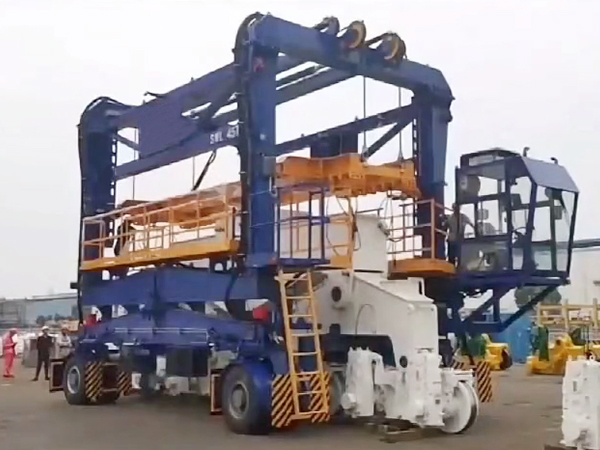
The transporter is a composite port equipment that integrates hoisting, transshipment, and stacking. It is different from the fixed operation block mode of gantry cranes. The transporter can independently complete the entire container transfer operation without the need to match the transshipment equipment. It is the most flexible container operation machinery.
Core structure and operating characteristics
The equipment adopts an open high-frame structure, which stands straddle above the container during operation, locks the container through the top spreader, and suspends the box body under the frame to achieve load-bearing driving.Relying on rubber tires to walk, the driving speed can reach 20-30km/h, the steering is flexible, there are no site restrictions, and it can freely shuttle between the leading edge of the terminal, the yard, and the freight lanes.
The mainstream models have a rated load of 40-65 tons and are suitable for all kinds of standard containers. The stacking capacity is “1 stack 2, 1 stack 3”. The power modes cover diesel, hybrid, and pure electric, which are suitable for different operating scenarios and environmental protection requirements.The cab is arranged sideways, the operator has a wide field of view, and the operation safety is high.
Core advantage
- Extremely high degree of functional integration: it integrates the functions of container hoisting, on-site transshipment, yard stacking, and vehicle loading and unloading. The whole process can be completed with a single equipment, without relying on auxiliary equipment such as trailers and forklifts, and the operation system is extremely simple and efficient.
- Ultra-low infrastructure cost: there is no need to lay special tracks and load-bearing foundations, and it can be put into use by relying only on conventional hardened pavement, which greatly reduces the investment in civil construction on the site, and the equipment landing and deployment cycle is short and the threshold is low.
- Extremely maneuverable operation: it adopts all-rubber tires to walk, supports free steering, global shuttle, and fast driving speed. It can be flexibly adapted to different operating areas such as terminal frontiers, depots, and freight lanes, and can be adapted to changeable operating lines.
- Wide adaptability to working conditions: it covers diesel, hybrid, and pure electric multi-power modes, can be adapted to different port area power supply conditions and green environmental protection operation requirements, and is compatible with all kinds of standard container heavy-duty operations.
Adapt to the scene
- Small and medium-sized feeder ports: it is suitable for feeder terminals with medium and small throughput and moderate operation scale, and can meet the operation needs of the whole process of container loading, unloading, transshipment, and storage in one stop.
- Characteristic docks with irregular layout: For stations with irregular site shape, irregular functional partitions, and difficult to lay track equipment, they rely on high mobility to adapt to complex site conditions.
- Large-scale stations with sufficient land resources: ports and inland container transit stations that do not require extreme compression of storage space, and give priority to operational flexibility and low-cost operation.
- Lightweight and simple operation port area: suitable for simple terminals and temporary work stations that pursue streamlined equipment, convenient operation and maintenance, and do not require high-intensity automated operations.
Equipment limitations
The stacking height is limited, and the space utilization rate of the yard is lower than that of RTG and RMG; the energy consumption of on-load driving is high, the tire wear is large, and the long-term operation and maintenance costs are high; the adaptability of automation is general, and it is difficult to meet the high-density and unmanned operation needs of ultra-large ports.
Comparison of the Four Main Container Crane Types
In order to visually present the differentiated characteristics and adaptation positioning of the four major container cranes, the following systematic comparison and combing are carried out from the dimensions of core functions, operating scope, mobility, stacking capacity, load specifications, infrastructure investment, automation level and operation and maintenance costs to provide a clear basis for equipment selection.:
Core job functions
- STS shore crane: It exclusively serves the ship-to-shore docking process at the forefront of the terminal. It is the core equipment just needed for ship berthing and loading and unloading, and builds a key transit channel for maritime ships and land logistics in the port area.
- RTG tire gantry crane: focus on yard operations in the back yard of the port area, mainly responsible for container storage regularization, intelligent dispatching and short-distance transshipment in the yard, and adapt to the normalization and standardization of conventional yard operations.
- RMG rail gantry crane: Mainly focuses on the intensive operation of smart yard, relying on the advantages of high-precision positioning, it realizes ultra-high-density stacking of containers, fully automatic access and efficient batch transfer, and is suitable for high-end smart port areas.
- Transporter: it integrates multiple functions of container hoisting, global transshipment, yard stacking, and vehicle loading and unloading. It does not require supporting auxiliary equipment, and can independently complete the closed loop of the whole process of container operation in the port area.
Scope of work area
- STS shore crane: The operating area is fixed to the leading shoreline of the terminal, and it is only for ship berthing, loading and unloading conditions. The service scenario is specific and the operating boundary is fixed.
- RTG tire gantry crane: it covers the container yard in the back yard of the port area in a global area, can flexibly shift operations across blocks, has strong site adaptability, and can be adapted to dynamically adjusted yard layout.
- RMG rail gantry crane: The operating range is strictly limited, and it can only operate in the yard block where the preset track is laid. It cannot expand the operating area across the track, and the scene is highly fixed.
- Transporter: There is no fixed operating boundary, and it can freely shuttle between the front edge of the terminal, the container yard, and the freight lane. The operation covers no dead ends, and the site has a high degree of freedom of adaptation.
Mobile flexible performance
- STS shore crane: the maneuverability is poor, it can only translate vertically along the dock shoreline track, and the operating position adjustment space is limited, which is suitable for fixed shoreline operation mode.
- RTG tire gantry crane: excellent maneuverability, relying on the rubber tire walking structure, it can freely turn, translate laterally, and change lanes across regions, and the equipment can be adjusted efficiently and conveniently.
- RMG rail gantry crane: The maneuverability is extremely poor, the walking trajectory is completely subject to fixed steel rails, there is no autonomous displacement, cross-zone operation ability, and the operating mode is cured.
- Transporter: The mobility flexibility is top-notch in the industry, it can travel unconstrained in the whole area of the port area, quickly align and adjust positions, and is perfectly adapted to complex and changeable operating lines.
Stacking height ability
- STS shore crane: there is no yard storage function, and the core function focuses on ship-shore container loading and unloading, which is specially designed for ship entry and exit port transfer operations.
- RTG tire gantry crane: The standard stacking level can reach 5-6 floors, which can meet the needs of medium-density storage in the port area, and the site space utilization rate is balanced and moderate, which is suitable for conventional yard operations.
- RMG rail gantry crane: Supports ultra–high stacking operations of 6-8 floors and above, fully taps the potential of the vertical space of the yard, and adapts to the high-density and intensive smart yard operation model.
- Cross-transporter: The stacking capacity is limited. It generally only supports 2-3 layers of stacking, and the space utilization rate is low. It is more suitable for low-density and flexibility-first operation scenarios.
Rated operating load
- STS shore crane: the rated load range is 40-120 tons, supports single-box, double-box and multi-box joint hoisting, and has strong heavy-duty adaptability, which can meet the heavy-duty loading and unloading needs of ultra-large ocean-going ships.
- RTG tire gantry crane: the conventional operating load is 35-65 tons, which fully covers all kinds of standard container operating conditions, and is fully adapted to the daily heavy-duty operation needs of the port area.
- RMG rail gantry crane: the rated load can reach 35-65 tons and above, relying on the rigid support structure of the track, the stability and safety of heavy-duty operations are more prominent.
- Transporter: the load covers 40-65 tons and above, which can be adapted to conventional standard containers and can also meet the operating needs of some overweight non-standard containers.
Infrastructure input cost
- STS shore crane: Infrastructure investment costs are high, and it needs to be equipped with heavy-duty dedicated shoreline tracks, high-strength load-bearing dock foundations and exclusive supporting facilities. The initial civil construction and landing costs are extremely high.
- RTG tire gantry crane: The infrastructure investment cost is low, no special track is required, and the deployment can be completed by relying on conventional hardened pavement. The construction cycle is short and the landing cost is low.
- RMG rail gantry crane: Infrastructure investment costs are high, and special steel rails, load-bearing foundations and a full set of ancillary supporting projects need to be accurately laid, and the amount of civil construction investment in the early stage is large.
- Transporter: The infrastructure input cost is extremely low, there are no special civil construction requirements, and it is suitable for all kinds of hardened work sites. The threshold for equipment landing and deployment is the lowest of the four types of equipment.
Automation adaptation ability
- STS shore crane: The level of automation is medium and high. The new equipment is generally equipped with semi-automatic, fully automatic alignment and remote control systems. The intelligent operation technology is mature and the operation is stable.
- RTG tire gantry crane: The level of automation is medium, mainly based on a mature semi-automatic operation mode, which can meet the basic operation needs of conventional intelligent port areas.
- RMG rail gantry crane: The automation level is top in the industry, and fully automated unattended operation is the standard function. It is the core equipment for unmanned operation of smart ports.
- Transporter: The level of automation is medium, and it only supports semi-automatic operation and remote control, making it difficult to adapt to all-weather and unmanned normalized operation scenarios.
Long-term operation and maintenance costs
- STS shore crane: The operation and maintenance cost of the whole life cycle is moderate, the overall structure of the equipment is stable, the mechanical failure rate is low, the daily maintenance process is simple, and the long-term operation stability is excellent.
- RTG tire gantry crane: long-term operation and maintenance costs are high, long-term heavy-duty tire wear and loss are large, energy consumption is high, and there are expenses for the replacement of normalized consumables and equipment maintenance.
- RMG rail gantry crane: long-term operation and maintenance costs are extremely low, pure electric energy-saving drive, no tires and vulnerable accessories, low mechanical failure rate, and significant economic benefits from large-scale long-term operation.
- Transporter: the operation and maintenance cost is high, the energy consumption and consumption of on-load driving are large, the tire wear rate is fast, the transmission machinery structure is complex, the maintenance frequency is high, and the comprehensive maintenance cost is higher.
Core adaptation scenario
- STS shore crane: It is a just-needed equipment for all navigable container ports. It is extremely versatile and can be adapted to the berthing and loading operations of large, medium and small ships.
- RTG tire gantry crane: suitable for medium-sized and large-scale ports, especially suitable for container depots with continuous expansion, dynamic iteration of layout, and flexible adjustment of operating areas.
- RMG rail gantry crane: suitable for large-scale smart hub ports and port areas with scarce land resources, focusing on high-end yard scenarios with high-density storage and unmanned intelligent operations.
- Transporter: suitable for small and medium-sized feeder ports, inland transit stations and irregular port areas, focusing on lightweight, low-cost and highly flexible operating modes.
How to Choose the Right Container Crane
The four types of cranes have no absolute advantages or disadvantages, each has its own adaptation scenarios, and professional ports adopt a multi-model combination and collaborative operation mode.The selection needs to combine the five core factors of terminal throughput, site conditions, budget, automation planning, and ship specifications. The specific selection criteria are as follows:
According to core job requirements
- Ship berthing and loading and unloading operations: STS shore container cranes are the core equipment just needed for terminal navigation operations. All ports that undertake container ships must be equipped as standard. Panama, super Panama and giant shore bridge models can be flexibly selected according to the scale of the largest navigable ship type in the port area.
- High-density, unmanned intelligent yard operations: priority is given to the configuration of RMG orbital gantry cranes, relying on the advantages of ultra-high stacking capabilities and fully automatic operations, the ultimate use of limited site resources, significantly reduce labor and operating costs, and adapt to the intensive operation needs of smart ports.
- Highly flexible and low-cost iterative operation: RTG tire-type gantry cranes are preferred, without fixed track infrastructure, and the site is highly adaptable. They can be adapted to medium-sized large-scale ports, continuous expansion, and dynamic layout adjustment yard scenarios, taking into account economy and operational flexibility.
- Minimalist full-process transshipment operations: cross-transporter vehicles are selected, relying on the advantages of the integration of hoisting, transshipment, and stacking, and there is no need to match various auxiliary operating equipment to simplify the operation process in the port area and adapt to the needs of lightweight and high-efficiency closed-loop operations.
By terminal size and throughput
- Large-scale automated hub port (high throughput): The mainstream configuration of STS+RMG equipment combination, relying on the efficient loading and unloading capacity of the shore bridge and the advantages of high-density unmanned operation of rail cranes, realizes the rapid turnover of ships and intelligent warehousing in the yard, and is perfectly adapted to the operation scenarios of large-volume and high-frequency hub port areas.
- Medium-sized and large-scale conventional ports: the general standard STS+RTG combination takes into account the efficiency of ship loading and unloading, yard operation flexibility and project infrastructure investment in a balanced manner. It is cost-effective and cost-effective. It is the most widely used and adaptable equipment matching solution for medium-sized ports in the world.
- Small feeder ports and inland transit stations: use a combination of STS+transporter or configure RTG and transporter separately to streamline equipment configuration, reduce early infrastructure and procurement costs, and accurately match the operational needs of small and medium-sized throughput and lightweight operations.
According to venue and budget conditions
- Land resources are scarce and site costs are high in the port area: RMG rail cranes are preferred. Relying on the advantages of ultra-high stacking capacity and precise stacking, the storage capacity of the unit site is maximized to solve the problem of limited land resources in the port area.
- Adequate site, flexible layout, and limited budget stations: RTG tire cranes or transports are preferred, without high rail infrastructure investment, flexible equipment deployment, low landing threshold, and adaptable to a low-cost and iterable operating model.
- Long-term normalized operation and strict control of operation and maintenance costs Port: priority is given to the selection of electric RMG and RTG equipment, relying on the pure electric energy-saving operation mode to reduce long-term energy consumption and mechanical operation and maintenance costs, and improve the economic benefits of the whole life cycle.
- Irregular site, multi-format mixed operation port area: priority is given to cross-transport vehicles with strong mobility, which are not limited by fixed operation areas, and can be flexibly adapted to complex site forms and changeable mixed operation scenarios.
Conclusion
STS shore bridge, RTG tire crane, RMG rail crane and transporter are the four core container operation equipment of modern ports. Each performs its own duties and complements each other: STS undertakes the core tasks of ship-shore loading and unloading, RTG and RMG are responsible for yard storage and transshipment, and transshipment is flexible and transshipment in the whole region, which together constitute a complete port operation system.
The equipment selection priorities of ports of different sizes are different: small ports give priority to flexible and low-cost, medium-sized ports take into account balanced and practical, and large hub ports focus on high-density, automated and efficient operations.Combining the needs of terminal operations, site conditions and long-term planning to scientifically match equipment can fully release the efficiency of equipment and comprehensively improve the efficiency and core competitiveness of port operations.