
The Complete Guide to Bridge Crane Anti-Wind Design
Bridge crane is widely used in outdoor infrastructure, ports, mines and other conditions, is the core equipment for heavy material lifting. Outdoor equipment has been exposed to natural environment for a long time, and wind is the main hidden danger affecting equipment safety, service life and production schedule. Many enterprises only pay attention to basic parameters such as load and span, ignore wind-resistant design, often cause equipment slip, deformation and shutdown problems, and cause overturning accidents in serious cases, resulting in considerable economic losses.
The reliable wind-resistant design of overhead cranes is the basic guarantee for safety compliance of outdoor lifting operations, which can effectively reduce equipment failure and operation and maintenance costs. Combined with the actual working conditions, this paper explains in detail the crane wind load principle, wind resistance design points, common windproof devices, industry calculation standards and selection skills, providing practical reference for construction enterprises, procurement personnel and operation and maintenance personnel, and assisting the safe and stable operation of outdoor cranes.
Challenges Faced by Outdoor Bridge Cranes
The outdoor complex and changeable wind environment brings multiple irreversible safety and production hidden dangers to the operation of the Henan Mine Crane Factory supply bridge crane. It is also the core pain point that must be solved in the wind resistance design, focusing on three dimensions:
Strong wind affects the overall stability of the crane: outdoor open field, coastal, mountainous, industrial park and other scenes, instantaneous gust, sustained wind will form lateral thrust and overturning moment on the crane girder, end beam, trolley and lifting load. Crane belongs to high-altitude large-span flexible structure, its own center of gravity is high, wind area is large, wind force will directly break the balance of equipment force, resulting in body tilt, shaking violently, greatly increase the risk of swinging and falling of lifting objects, completely unable to meet the safety requirements of heavy-load operation.
Risk of crane sliding along the track: When the wind exceeds the friction resistance between the wheel and the track, it will push the bridge crane to slide along the track without control, which is commonly known as "running track" in the industry. This kind of uncontrolled movement is not controlled by operation, which may lead to wheel gnawing, track wear and walking mechanism damage, or cause collision between crane and track terminal, workshop column and other equipment, resulting in equipment damage accident. Especially in the no-load standby state of the crane, the weight is insufficient, and the risk of slip will be greatly doubled.
Structural damage and production interruption hidden dangers: long-term wind impact, instantaneous strong wind load will continue to wear crane steel structure, resulting in bending of the main beam, weld cracking, loose joints, structural deformation and other structural damage, greatly shortening the service life of the equipment. At the same time, the crane must be shut down urgently to avoid danger in windy weather. The sudden abnormal wind will disrupt the production plan, cause delay of construction period and decrease of production capacity. Frequent equipment maintenance and fault shutdown will continuously increase the operation and maintenance cost of the enterprise and affect the continuous operation of the production line.
Understanding Wind Loads on Bridge Cranes
How wind forces affect bridge crane operation
The effect of wind on the bridge crane is not a single thrust, but an omni-directional, multi-component composite load, mainly in the form of horizontal wind pressure on the core structure of the equipment, omni-directional interference equipment operating state:
Acting on the crane bridge structure: The overall bridge composed of the main beam and end beam of the Henan Mine Crane Factory supply bridge crane is the main wind-bearing carrier. The large-span bridge has a large windward area. The horizontal wind pressure will generate lateral thrust on the bridge, causing the fuselage to sway and shift., long-term stress will cause fatigue deformation of the steel structure and destroy structural stability.
Action on trolley and lifting equipment: lifting trolley, winch mechanism, wire rope, hook and other moving parts have compact structure and flexible center of gravity. Under the action of wind force, lateral deviation and swing are easy to occur, resulting in trolley operation jamming and positioning deviation. In serious cases, trolley derailment and mechanism jamming will be caused, affecting the normal operation of equipment.
Acting on lifting load: lifting materials, equipment without fixed constraints, wind area is irregular, wind will cause a large swing, rotation, not only can not accurately fall, but also produce additional tension and torque, reverse pull crane body, aggravate the shaking of the whole machine, easy to cause lifting objects fall, equipment overturn major safety accidents.
On the whole, the wind load will completely break the force balance of the crane, reduce the stability of equipment operation, aggravate the track wear and running mechanism failure, and destroy the track flatness and wheel-rail coordination accuracy for a long time, forming a vicious circle and continuously affecting the safe operation of the equipment.
Key factors influencing crane wind loads
The wind load borne by the bridge crane is not a fixed value, and is affected by multiple factors such as environment, equipment parameters and operating conditions. The core influencing factors are divided into five categories:
Wind speed and local climate conditions: Wind speed is the core index that determines the wind load intensity. The greater the wind speed, the exponential increase of wind pressure, and the stronger the impact on equipment. At the same time, climate differences such as coastal typhoon, mountain gust, seasonal monsoon and rainstorm accompanied by strong wind will lead to different wind frequency, duration and peak intensity in different regions, which directly determines the wind resistance level required by equipment.
Crane span and height: the larger the crane span, the larger the windward area of the main beam, the higher the overall wind load; the higher the installation height of the equipment, the greater the wind speed at high altitude, the air flow is unobstructed, and the wind load effect is more obvious. The wind pressure resistance of the crane at high altitude and high position is much higher than that of the low equipment.
Structural surface area: The greater the total windward area of the exposed structure of the crane steel structure, electrical room, cab, winch mechanism, etc., the more the wind capacity, the greater the wind load. Cranes with redundant structure design, excessive external parts and square shape have significantly higher wind resistance.
Lifting load characteristics: the volume, shape and windward area of the lifting material directly affect the additional wind load. Large area plates, frame equipment, bulk materials and other lifting loads are subject to large wind areas, which is easy to generate large wind disturbance loads and greatly increase the mechanical load of the whole machine. At the same time, under no-load and full-load conditions, the center of gravity of equipment is different, and the wind-resistant stability is also obviously different.
Installation environment: open industrial area, port dock, coastal beach, mountain tuyere and other unobstructed environment, wind no attenuation, wind load is the strongest; and there are factory buildings sheltered, surrounded by buildings, wind will be weakened, wind load is relatively small, is an important reference basis for wind resistance design selection.
Static Wind Load vs. Operational Wind Load
The wind resistance design of bridge crane needs to distinguish between two core wind load conditions. The wind standards, protection requirements and stress states of different working conditions are completely different, and the protection scheme must be matched accordingly:
Normal operating conditions: refers to the normal wind load of crane during normal start and stop and lifting operation, corresponding to daily breeze and small wind environment. Under this condition, the wind speed is relatively stable, and the wind mainly affects the operation accuracy and stability. The design core is to ensure the normal and safe operation of the equipment, avoid the swing of the lifting load and the deviation of the fuselage, and meet the daily production requirements. In the general industry standards, the allowable wind speed of conventional outdoor cranes generally does not exceed Grade 6 wind.
Non-operation storm conditions: refers to the static wind load of typhoon, strong gust, storm and other extreme weather encountered by crane in standby and unmanned operation. At this time, the equipment has no operation control and is completely fixed by its own structure and windproof device. The stress risk is extremely high, and it is a high-incidence working condition of equipment overturning and sliding. This working condition requires extremely high wind resistance strength, and it is necessary to resist the annual maximum extreme wind speed in the region to ensure the absolute safety of the equipment under shutdown.
The difference of the two working conditions determines that the crane can not adopt a single windproof design. Only adapt to the working wind load, can not resist extreme storm; excessive strengthening of static windproof structure, and will increase the equipment weight and operation and maintenance costs. Therefore, professional wind-resistant design will configure layered protection system for two working conditions, taking into account operation efficiency and extreme safety.
Key Elements of Bridge Crane Anti-Wind Design
Structural design for wind resistance
Structural optimization is the foundation of bridge crane wind-resistant design. It improves wind-resistant bearing capacity from equipment body and reduces wind load influence from root. The core optimization dimension includes four points:
Optimize the structural design of the main beam: abandon the traditional heavy and square main beam shape, adopt streamlined and box-shaped optimized section design, reduce the windward area of the main beam and reduce the wind impact on the premise of ensuring the load-bearing capacity. For large-span cranes, transverse stiffeners and auxiliary support structures are added to improve the bending and deformation resistance of the main beam and avoid structural deformation caused by wind impact.
Improve the overall structural rigidity: by optimizing the steel structure ratio of the whole machine, strengthening the connection nodes between the end beam and the main beam, strengthening the base of the traveling mechanism, etc., improve the overall rigidity of the crane and reduce the shaking and resonance of the fuselage under the action of wind. Effectively avoid weld cracking, bolt loosening and structural fatigue damage caused by long-term wind vibration, and improve the overall stability of the equipment.
Reduce redundant wind-receiving area: simplify external redundant structure of equipment, optimize installation layout of cab, electrical cabinet and winch mechanism, adopt embedded and flat design, and reduce protruding parts. For the equipment that must be externally installed, add a diversion structure to reduce wind resistance and wind capacity, and reduce wind load from the physical level.
Selection of suitable materials and safety factors: Henan Mine Crane Factory supply outdoor crane main steel structure selection of high strength weather resistant steel, both lightweight and high strength, to resist wind impact and outdoor corrosion environment. The wind resistance design shall reserve safety margin strictly according to international and national standards. For high wind areas and coastal typhoon areas, the structural safety coefficient shall be appropriately improved to adapt to extreme wind conditions.
Rail and travel system wind protection
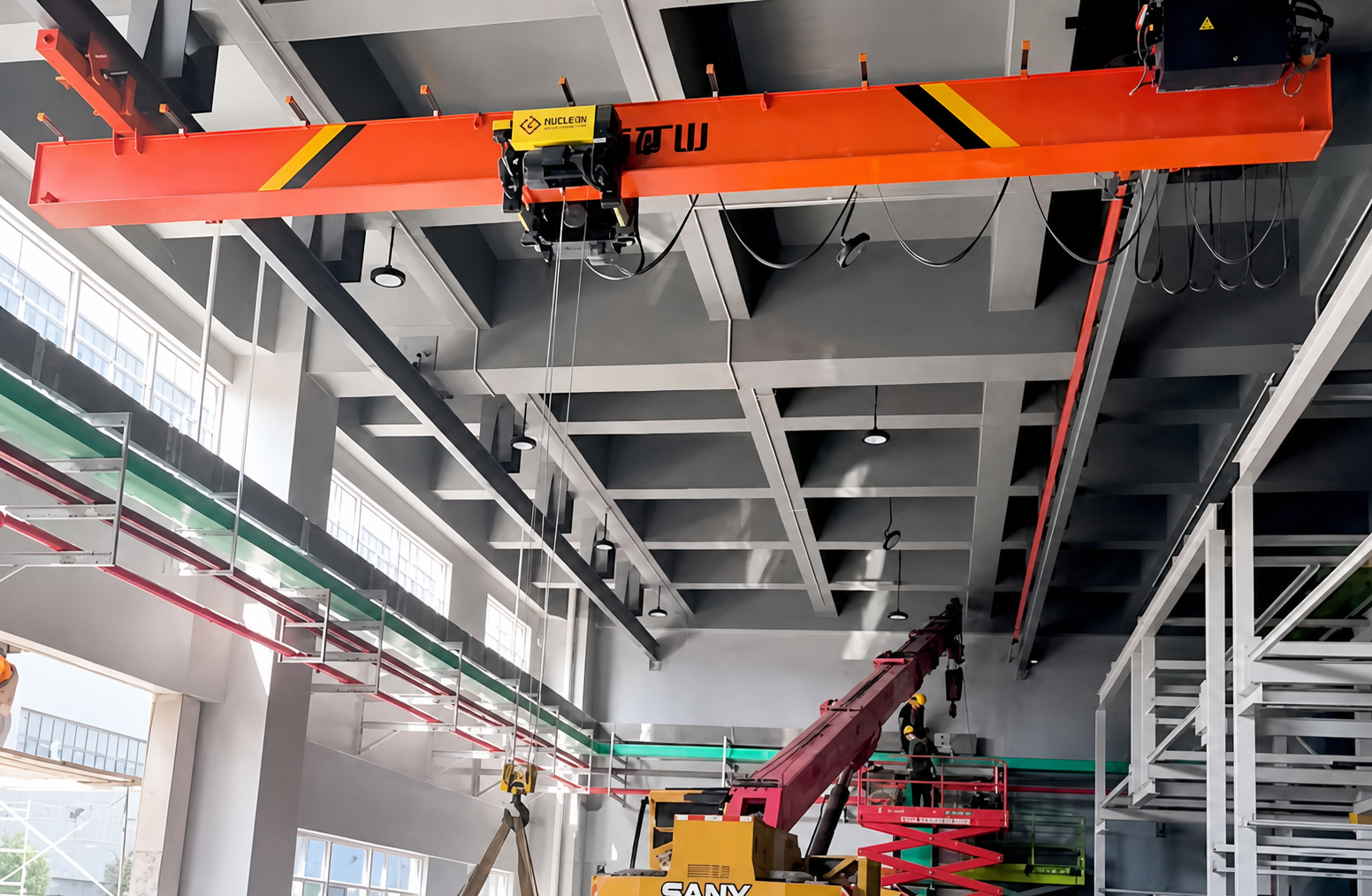
The track and traveling system are the core of the support and operation of the crane, and are also the key link for wind prevention and anti-skid. The vast majority of outdoor crane wind-caused accidents are related to insufficient protection of the track system. After the wind breaks through the wheel-rail friction force, it will directly push the equipment to run track and derail, so the windproof design of track system is very important.
Track flatness and alignment accuracy: track installation must strictly follow industry standards to ensure full horizontal alignment, no offset, no settlement, no deformation. The uneven and offset track will greatly reduce the contact friction force between wheel and rail, and it is easy to cause slip under the action of wind force; at the same time, the accurate track layout can ensure uniform stress of equipment and avoid structural damage caused by local stress concentration.
Optimize wheel-rail contact state: adopt double-rim wear-resistant wheel design to improve the fit and wrapping between wheel and rail, increase contact friction area and improve natural anti-skid resistance. Regularly calibrate wheel/rail clearance to avoid excessive clearance, partial wear and other problems, and ensure the basic anti-slip ability of equipment under static state.
Optimize the design of walking mechanism: the walking drive mechanism is equipped with a special windproof brake base to optimize the rigidity of the transmission structure and avoid the idling and failure of the mechanism caused by wind reverse thrust. For large-span and large-tonnage outdoor cranes, multi-wheel balanced force design is adopted to disperse wind load and improve the stability of the whole machine in orbit.
Crane anchoring and fixing systems
Anchor fixing system is the ultimate protection means of bridge crane against extreme wind, mainly used for rigid fixation under equipment shutdown and extreme storm weather, making up for wheel brake and structural wind resistance performance short board, eliminating the risk of whole machine sliding and overturning, and is the indispensable core windproof configuration of outdoor crane.
The core function of the anchoring device: under the scenarios of wind speed exceeding the allowable range of equipment work, storm attack, long-term shutdown of equipment, etc., the crane is firmly locked with the ground and track through mechanical rigid fixation, so as to offset the super wind thrust, eliminate track running and overturning accidents from the root cause, and ensure the safety of equipment in extreme weather.
Mainstream anchoring solutions: Rail clamp is the most commonly used rail anchoring equipment, through mechanical or hydraulic power clamping rail, lock wheel displacement, adapt to daily wind protection; storm brake can cooperate with the walking mechanism to achieve double braking, improve dynamic windproof capacity; mechanical locking device through bolts, snaps to achieve rigid locking of the fuselage and rail, stability is very strong; The ground anchoring system fixes the crane legs, end beams and ground foundation through embedded anchor pits and anchor pins, and is specially designed to cope with extreme conditions such as typhoons and strong winds above Grade 10.
Common Anti-Wind Devices Used in Bridge Cranes
Rail clamps and wind brakes
Rail clamp and windproof brake are the most widely used active windproof equipment for Henan Mine Crane Factory supply outdoor bridge cranes. They are suitable for most conventional outdoor operation scenarios. They are divided into two types: mechanical and hydraulic. They have high degree of automation and stable protection effect.
Automatic rail clamp system working principle: automatic rail clamp equipped with intelligent induction and power drive mechanism, equipment shutdown, power failure or wind speed exceeds the standard, the system automatically triggers clamping action, jaws closely attached to both sides of the track, relying on mechanical clamping force to produce strong anti-skid resistance, locking crane travel mechanism, to prevent slippage. When the equipment starts operation, it will automatically release the reset, which will not affect the normal operation. During installation, it is necessary to ensure that the contact area between the jaw and the rail is ≥80%, and the gap is controlled at 3-5mm in the loosened state to avoid abnormal noise and wear during operation.
Core advantages of outdoor application: high degree of automation of equipment, no need for manual high-altitude operation, high safety and fast response speed; can adapt to bridge cranes of different tonnage and span, with strong versatility; can be linked with wind speed monitoring system to realize intelligent protection without manual intervention, greatly reducing operation and maintenance costs.
Difference between hydraulic and mechanical schemes: hydraulic rail clamp has sufficient power, stable clamping force, no noise, suitable for large-tonnage, large-span heavy bridge cranes, and can cope with high-intensity wind loads; mechanical rail clamp has simple structure, low failure rate, convenient maintenance, high cost performance, and is suitable for small and medium-sized conventional outdoor cranes to meet normal wind protection requirements.
Crane wheel braking systems
The wheel brake system is the foundation windproof protection device of crane, which relies on the traveling mechanism brake to realize windproof and anti-skid, and is the first protective barrier of the windproof system of the whole machine. Its core principle is to lock the wheel rotation through the walking brake, prevent the wheel from rolling and sliding, and use the static friction force of the wheel and rail to resist the wind thrust.
Windproof function of the walking brake: after the equipment stops, the brake automatically locks the wheels, limits the rotation of the wheels, and avoids the problem of track running caused by wind-driven wheel rolling. Under normal light wind and small wind conditions, it can independently realize anti-skid protection, ensure the stability and quiescence of equipment, and is suitable for daily routine weather protection.
Limitations of single wheel braking: wheel braking can only limit wheel rolling, but cannot prevent the overall lateral slip of the fuselage. When the wind force is too large and exceeds the maximum static friction force of wheel and rail, even if the wheel is locked, the whole machine will still slide along the track, and the protection ability is limited. At the same time, relying solely on wheel braking for a long time will aggravate the wear of brake pads and wheels and shorten the service life of the mechanism. Therefore, wheel braking can only be used as basic protection, and multiple protection systems must be formed with rail clamps and anchoring devices.
Wind anchoring systems
Windproof anchoring system is the ultimate protection configuration for extreme weather, belonging to passive rigid protection device, specially for typhoon, strong storm, sustained wind and other conditions beyond the conventional protection capacity, is a necessary configuration of cranes in high-risk wind environment.
Extreme weather fixed protection principle: through the factory embedded anchor base, anchor pin, connecting rod and other parts, the crane machine and the ground foundation rigid connection, completely lock the fuselage displacement, completely offset the thrust and overturning moment of super wind, eliminate equipment slip, overturning risk, even if encountered more than ten strong winds, but also can ensure that the equipment intact.
Scenes requiring strengthened anchoring protection: coastal typhoon-prone areas, which are hit by strong typhoons and storms all the year round, with high wind intensity and strong suddenness; plateau, open Gobi, mountain tuyere and other high-wind areas, with frequent strong winds and gusts all the year round, with strong wind persistence; large-scale open-air industrial storage yards, ports, logistics parks and other open operation scenarios without shelter, with no attenuation of wind force and significant wind load effect. All the above scenarios must be equipped with special wind-proof anchoring system.
Automatic wind monitoring systems
Intelligent wind monitoring system is the core intelligent equipment of modern bridge crane wind protection, which realizes the upgrade from "passive protection" to "active early warning and intelligent protection", effectively avoiding the safety risks caused by human operation omissions.
Wind speed sensor: the equipment is equipped with high-precision wind speed sensor, real-time collection of wind speed and wind data of the operating environment, accurate capture of instantaneous gust and sustained wind data, real-time transmission of data to the operation console and background system, high monitoring accuracy and fast response speed.
Intelligent alarm system: the system preset safe wind speed threshold, when the real-time wind speed is close to the warning value, automatically trigger the sound and light alarm, remind the operator to stop work, prepare for protection, and avoid wind risk in advance.
Automatic shutdown and protection function: When the wind speed exceeds the safe operation threshold of the equipment, the system can link the whole machine control system to automatically cut off the operating power, trigger the braking and rail clamping devices, complete the equipment locking, realize intelligent protection without human intervention, and completely eliminate Safety accidents caused by forced operation in strong winds.
Wind Load Calculation and Design Standards for Bridge Cranes
Basic principles of crane wind load calculation
Accurate calculation of wind load is the core basis of Henan Mine Crane Factory supply bridge crane wind resistance design, which directly determines the structural design standard, wind protection equipment selection and safety margin setting. All wind resistance design needs to be based on accurate wind load calculation. The core calculation logic revolves around three core elements.
Corresponding relationship between wind speed and wind pressure: wind speed is the basic parameter, wind pressure increases exponentially with wind speed, and it is the core pressure source of wind acting on equipment. Wind speed of different grades corresponds to fixed wind pressure standard, which is the basic value of load calculation. It is necessary to strictly follow the local meteorological extreme wind speed value to eliminate insufficient protection caused by parameter underestimation.
Crane wind area: including the main beam, end beam, trolley, electrical equipment, hanging load and other exposed structures of the total windward area, the larger the wind area, the greater the wind load under the same wind speed, is the core variable of load calculation, calculation needs to fully cover all wind-affected parts, no omission calculation.
Importance of environmental data: wind load calculation must rely on real meteorological data of project location, including annual average wind speed, extreme maximum wind speed, typhoon frequency, wind duration and other parameters. Accurate environmental data can ensure that the calculation results conform to the actual working conditions, avoid insufficient or excessive design redundancy, and balance safety and economy.
Factors engineers consider during design
In the process of wind resistance design and load calculation of bridge crane, engineers need to integrate four core parameters to achieve accurate adaptation of design scheme to scene requirements:
Local maximum wind speed: collect the meteorological extreme wind speed data of the project location in recent 10-20 years, distinguish between normal working wind speed and extreme storm wind speed, calculate the working wind load and static wind load respectively, and match the double-layer protection standard.
Crane working conditions: distinguish between no-load, half-load, full load, standby four core conditions, different conditions of equipment gravity, wind state, stability, wind load force difference is very large, need to be calculated one by one, to ensure the safety of all working conditions.
Maximum lifting load: calculate the additional wind load under the maximum lifting load state in combination with the rated load of the crane, avoid the risk of equipment overturning and lifting out of control caused by heavy load wind, and ensure the wind safety of heavy load operation.
Equipment installation position: according to different installation positions such as coastal, inland, open factory area, mountain area and tuyere, correct wind load coefficient, adjust structural rigidity and windproof equipment configuration accordingly, and adapt to the wind environment exclusive to the scene.
Compliance with international crane design requirements
The wind-resistant design of bridge crane belongs to mandatory compliance design, which must strictly comply with the domestic and foreign general crane design standards. The core includes GB/T 3811-2024, GB/T 47722-2026, ISO, FEM and other international specifications to ensure the compliance and universality of equipment.
All kinds of standards clearly stipulate the core parameters of crane wind load calculation method, wind resistance structure design requirements, wind protection device configuration standard, extreme working condition safety margin, etc., which are the hard basis of engineering design. Following standardized design, safety hazards, unqualified acceptance, and equipment failure caused by non-standard design can be completely avoided.
At the same time, according to different operation environments, the standard requires to reserve differentiated safety margin. The safety factor shall be improved in high wind, coastal and typhoon areas. The redundancy design can be reasonably optimized in inland conventional areas, so as to ensure equipment safety, avoid resource waste and realize the optimal balance between safety and cost.
Conclusion
The safe and stable operation of outdoor bridge cranes relies on a scientific, perfect and adaptable wind-resistant design system, and a single wind-proof equipment cannot cope with complex and changeable wind conditions. A reliable wind-resistant solution for overhead cranes is an organic combination of multiple technologies. The optimized windproof steel structure improves the anti-load capacity of the equipment from the body, the reliable brake anti-skid system realizes accurate protection under daily working conditions, the professional anchoring device resists extreme storm risk, and the intelligent wind monitoring system realizes active early warning and intelligent risk avoidance.
For all kinds of outdoor industrial production scenarios, Henan Mine Crane Factory's customized wind resistance design scheme can perfectly adapt to different wind environments, different equipment specifications and different operation requirements, avoid equipment failures, safety accidents and production interruption problems caused by wind from the root, greatly improve the safety, stability and long-term performance of outdoor operation of overhead cranes, and provide solid equipment guarantee for safe production, efficient operation and maintenance, cost reduction and efficiency increase of enterprises.