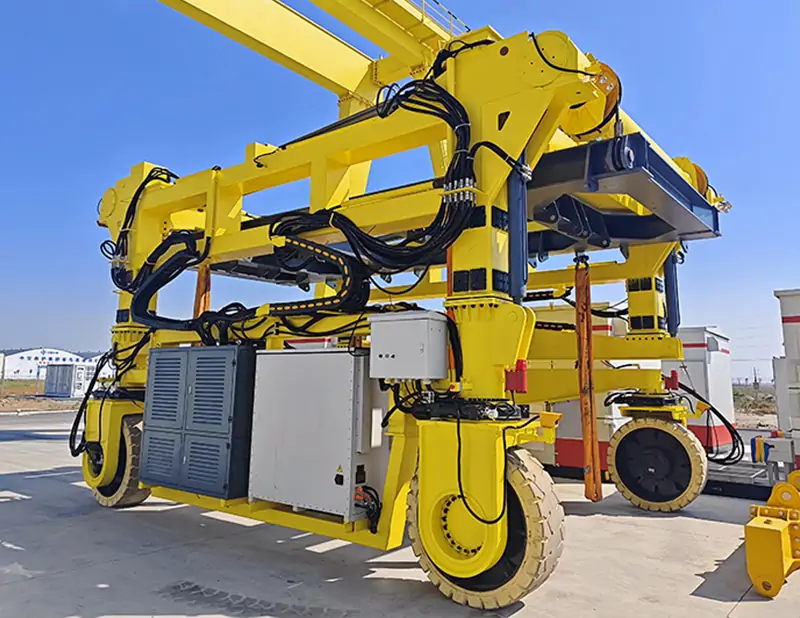

16t Double Girder Overhead Cranes: Compact Hoist Trolley Layout for Low-Clearance Workshops
The 16-ton double-girder bridge crane is mostly used in the heavy industry. There are generally space constraints in old factories. The lifting height of traditional models is insufficient and the adaptability is poor, and the cost of plant transformation is high.
The low-clearance double-girder crane has been optimized in structure, with a compact fuselage and a larger lifting height. There is no need to transform the plant, and the space utilization rate and operating stability are better.This article comprehensively introduces the performance parameters, adaptation scenarios and operation and maintenance selection points of the equipment, and provides a basis for equipment procurement.
What Is a 16t Double Girder Overhead Crane
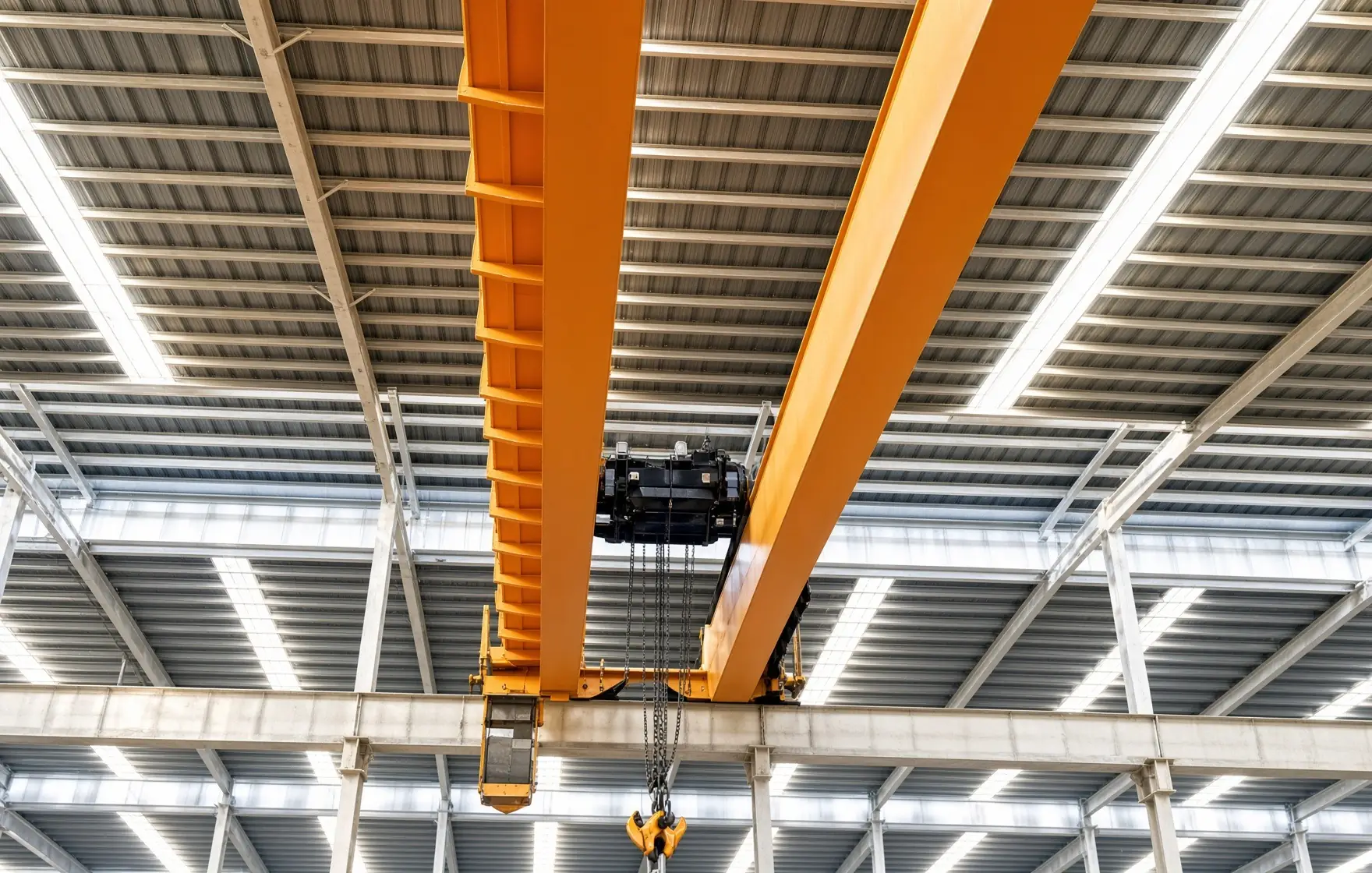
The 16-ton double-girder bridge crane is a cross-frame material handling equipment. The core relies on two parallel main beams to span the tracks on both sides of the workshop, and cooperates with multi-system linkage to achieve three-dimensional space lifting operations.The whole machine has a precise structure and a clear division of labor, and the four core subsystems constitute a complete operating system.:
- Double main beams (2 pieces): The core load-bearing body of the equipment, which spans the span of the workshop, undertakes all vertical loads and dynamic operating loads to ensure the structural stiffness, smooth operation and positioning accuracy of the whole machine.;
- End beam: symmetrically connect the ends of the two main beams, integrate the walking wheels of the cart, and be responsible for the longitudinal walking of the whole machine. At the same time, the equipment and lifting load are evenly distributed to optimize the overall force.;
- Cart operating mechanism: it is composed of a motor, a reducer, and a walking wheel, which provides stable power for the longitudinal movement of the whole machine along the track of the plant.;
- Hoist and trolley mechanism: equipped with a hook pulley block, it can walk laterally along the main beam track, and cooperate with the vertical lifting action of the hoist to complete the precise lifting, alignment and handling of materials.
How it works
The crane as a whole is erected on the operating tracks on both sides of the plant through the end beam wheels, and the trolley operating mechanism drives the whole machine to move vertically and long distances along the track; at the same time, the hoist trolley relies on the dedicated track on the top of the main beam to realize horizontal walking.
Combined with the vertical lifting function of the hoist, the three motion dimensions cooperate with each other, which can cover the entire workshop operation area under the track, realize no dead ends, material handling, positioning, assembly and other operations, and adapt to various medium and heavy industrial hoisting scenarios.
Why Choose Double Girder for 16t Capacity
16 tons is a medium- and heavy-duty lifting load. Single-girder cranes are limited by structural stiffness and load distribution, and cannot be adapted to long-term, high-frequency, and long-span operation needs. The structural advantages of double-girder cranes are fully highlighted under this tonnage. It is also the mainstream selection scheme for industrial scenarios.
Higher structural stiffness
The parallel force structure of the double main beam greatly improves the overall bending stiffness of the crane bridge, and the span deflection under full load can strictly comply with FEM, ISO, GB/T and other industry standards, effectively suppressing the shaking and vibration during equipment operation, start and stop.
For a rated load of 16 tons, the high-stiffness structure can ensure accurate hoisting and positioning, avoid safety risks caused by load offset and equipment jitter, and adapt to precision assembly and heavy material displacement scenarios.
More reasonable load distribution
Compared with only 2 load-bearing wheels at both ends of the single-girder crane, the 16-ton double-girder crane is equipped with a total of 8 load-bearing wheels at both ends, which can evenly distribute the load and hoisting load of the whole machine to the operating track and the plant column.
The single-wheel load is greatly reduced, which not only reduces the force and pressure of the track beam, but also reduces the carrying load of the foundation and column of the plant, adapts to long-term heavy-duty operations, and extends the service life of equipment and plant infrastructure.
Long-span and high-load adaptability
The upper limit of the economic span of conventional single-girder cranes is 20-22 meters, and after the tonnage exceeds 12 tons, the weight surges and the cost performance drops significantly.The 16-ton double-girder crane can be adapted to a workshop span of 18-28 meters. While ensuring structural stability, there is no need to increase the weight of the fuselage excessively, and it is perfectly adapted to the high-frequency and continuous heavy-duty operations of large and medium-sized production workshops.
Lifting height advantage
This is the core advantage of double-girder cranes for low-clearance workshops.The single-girder crane hoist is suspended under the main beam, taking up a lot of vertical space; the double-girder crane can arrange the hoist trolley between the two main beams or on top of the main beam. Through the compact structure design, the vertical space occupied by the whole machine is greatly reduced, and the limited headroom of the plant is maximized. , Improve the effective lifting height.
Typical Applications of 16t Double Girder Overhead Crane
With a moderate load capacity of 16 tons, stable operating performance and flexible space adaptability, the equipment is widely used in various heavy industry production, processing, and maintenance scenarios.:
Machinery manufacturing workshop
It is suitable for loading and unloading, cross-station transfer and precision assembly alignment of large-scale castings, welded components and machine equipment. It can be stably adapted to the normalization and high-frequency hoisting of medium and heavy workpieces, and perfectly matches the modern production conditions of large-scale and high-precision.
Steel structure processing plant
It can efficiently undertake the transportation and hoisting of shaped steel, thick steel plates, and large-scale welded welded parts, covering all processes from cutting, welding, finishing to finished product outbound, and is perfectly adapted to the continuous, high-load, and large-scale mass production rhythm of steel structure factories.
Automobile production workshop
It is highly adapted to the precision and high-beat production needs of intelligent automotive manufacturing, and can stably complete the hoisting and transportation of stamping molds, body assemblies, power assemblies, and large-scale tooling fixtures, rapid mold replacement, and precise alignment assembly, fully in line with the strict operating standards of high precision, high frequency, and continuity in the automotive industry.
Foundry and heavy industry workshop
It is perfectly adapted to the harsh operating environment of high temperature, dust, and high load in the foundry workshop, and can stably complete the efficient transfer and alignment of molds, castings, and heavy-duty accessories. After being equipped with special protection and supporting devices, it can safely undertake the special hoisting process of high-temperature special materials such as steel ladles, and the adaptability of working conditions and operating safety are extremely strong.
Equipment repair and assembly workshop
It is suitable for the maintenance and assembly scenarios of heavy equipment such as large motors, gearboxes, industrial units, etc., and can accurately complete the disassembly, displacement, alignment and assembly of heavy components, effectively improve the operation accuracy and maintenance efficiency of large-scale equipment maintenance, and ensure the efficient landing of equipment operation and maintenance processes.
Key Design Parameters for a 16t Low-Clearance Overhead Crane
Accurate parameter selection is the key to adapting the equipment to the working conditions of the workshop. The following are the standardized design parameters and selection basis of the 16-ton low-clearance double-girder crane, which can be directly used as a reference for procurement and customization.:
- Rated load: The standard rated lifting weight is 16 tons, including the weight of the hook and spreader; safety load redundancy can be customized according to heavy-duty, eccentric, and high-frequency impact conditions, which complies with FEM, ISO and national standard safety specifications to ensure the stability and safety of heavy-duty operations.;
- Span: It can be precisely customized according to the spacing of the workshop columns and track parameters, and is suitable for the mainstream span of 18-28 meters.Through the optimization of the main beam structure, the deflection is effectively controlled to ensure smooth operation and accurate positioning over a long span.;
- Lifting height: combine the net height of the plant, the elevation of the track and the obstacles on the top to customize the maximum lifting stroke, fully tap the vertical space, and match the actual production hoisting needs without retrofitting the plant.;
- Work level: conventional processing and assembly workshops are adapted to A5–A6 levels; casting, heavy industry and other high-load continuous working conditions can be upgraded to A7 levels to strengthen the fatigue resistance and wear resistance of the whole machine, and adapt to long-term high-frequency operations.;
- Hoist type: standard low-clearance compact wire rope hoist, with integrated structure and high-strength rope configuration, stable start and stop, wear-resistant and fatigue-resistant, designed for low-rise workshop space-restricted working conditions;
- Trolley layout: The compact layout embedded on the inside of the double beam is adopted, and the core components of the hoist are integrated in the gap of the main beam, eliminating the traditional external stacking structure, greatly reducing the size of the vertical envelope, and effectively increasing the effective lifting height.;
- Operating speed: equipped with a frequency conversion speed control system, the cart is 20–80m/min, the trolley is 10–40m/min, and the lifting is 1–8m/min to achieve stepless and smooth start and stop, reduce load shaking, and take into account the transfer efficiency and alignment accuracy.;
- Power supply method: adapt to industry standard voltage, support two power supply modes of sliding contact line and cable pulley, and can be flexibly selected according to workshop layout and operation frequency, stable operation and convenient maintenance;
- Control mode: Support three modes of handle, wireless remote control, and cab control. It can be used alone or in combination to adapt to close-range precision positioning, flexible remote control, and heavy-duty operation scenarios in large workshops.;
- Safety configuration: A full set of safety interlocking systems such as overload protection, two-way limit, emergency stop, travel limit, anti-collision device and failure protection brake are standard. Multiple protections effectively avoid risks such as overload, offside, collision, and falling objects, and ensure the safe operation of equipment and human-machine.
16t Double Girder vs. Single Girder for Low-Clearance Workshops
Under the conditions of 16-ton tonnage and low headroom, the overall performance of double-girder cranes far exceeds that of single-girder cranes, and the structure, space utilization, and cost performance of the two are significantly different.
Core structure differences
The single-girder crane is a single main beam load-bearing, and the hoist is suspended at the bottom of the main beam. The load is concentrated and the structural deflection is large; the double-girder crane relies on the symmetrical load-bearing of the double main beam, and the trolley walks above or inside the main beam.
The load is evenly dispersed and the structural stiffness is stronger.At the same time, the size of the main beam of the single-girder crane is greatly thickened under the working conditions of 16 tons, and its own weight is bloated, while the size of the double-girder structure is more reasonable and the operation is more stable.
Comparison of headroom adaptation capabilities
The “single beam is more space-saving” generally recognized by the industry is only applicable to light-load conditions below 10 tons.Under 16-ton working conditions, the thickness of the main beam of the single-girder crane is extremely large, and the hoist sagging takes up a lot of vertical space, and the effective lifting height is extremely low.;
The optimized compact double-girder crane can lift the hook to a higher position. Under the same workshop headroom, the effective lifting height of the double-girder model is far better than that of the single-girder.Therefore, the selection of low headroom needs to be based on the overall operating envelope size of the equipment, rather than simply distinguishing single and double beams.
Cost and performance trade-off
In terms of initial procurement costs, the price of single-girder cranes is lower, but under 16-ton working conditions, the adaptability is poor, the failure rate is high, and the cost of plant transformation is high; the initial investment of compact double-girder cranes is slightly higher.
However, there is no need to retrofit the plant, adapt to high-frequency heavy-duty operations, low operation and maintenance costs, and longer service life.In the long run, the comprehensive price ratio, stability and adaptability of 16-ton double-girder cranes under low headroom conditions are comprehensively ahead of single-girder models.
How to Design the Crane Around Existing Workshop Dimensions
Low-clearance cranes cannot be applied to standard models, and need to be customized in combination with the actual size of the workshop. The standardized five-step process can be accurately adapted to on-site working conditions.:
- Accurately survey the headroom size of the workshop and accurately measure the minimum obstacle height of the roof, the raised size of the beams and columns, the bottom elevation of the pipeline and the top elevation of the existing track. The minimum headroom boundary of the site is used as the design benchmark to avoid equipment installation interference and space conflicts from the source.;
- The effective lifting height required for approved production is combined with the maximum lifting height of the workpiece, the safe reserved gap above the material, and the closed size of the hook pulley block to accurately calculate the minimum effective lifting stroke to meet the production process to ensure that the lifting operation is in compliance with the available;
- Calculate the available installation envelope space of the equipment through the difference between the height of the track elevation and the height of the limit hook, calculate the maximum vertical installation size allowed by the crane and trolley, lock the upper limit of the equipment structure design, and adapt to the restricted headroom on the site;
- The configuration of the low-headroom compact trolley is preferred to standardize the core parameters of the standard trolley and the low-headroom trolley, and the customized trolley layout with small hook size, small vertical footprint and sufficient maintenance space is preferred to balance the space utilization rate and equipment maintainability.;
- Verify the structure and electrical conditions of the site, comprehensively verify the carrying capacity of the existing track, the load margin of the plant column and foundation, the power supply parameters of the workshop and the supporting electrical conditions, to ensure that the structure is stable, the electrical matching, and the operation is safe and stable after the installation of the equipment.
Safety Considerations for 16t Overhead CraneCranes
The low-headroom workshop has compact working space and small equipment operating margin, which is prone to safety hazards such as insufficient limits and structural collisions, which puts forward higher requirements for the safety and protection performance of lifting equipment.Therefore, the 16-ton low-clearance double-girder crane must be equipped with a full set of customized safety protection system to avoid the risks of narrow space operations in all directions and ensure the safety of man-machine and the stable operation of equipment.:
Overload protection device
The equipment is equipped with a high-precision overload protection system. When the load reaches 110% of the rated 16 tons, the sound and light alarm is automatically triggered and the lifting power is cut off to prevent overload operations, effectively protect the crane's main beam, walking track and plant infrastructure structure, and avoid structural deformation and equipment damage caused by overload.;
Two-way multiple limit system
It is equipped with multiple protective devices for the upper and lower lifting limits of the hooks, the vertical and horizontal walking limits of the carts and trolleys, and the operating boundaries of the equipment are accurately restricted.It can effectively eliminate high-risk problems such as hook rushing to the top, touching the structure of the trolley, and equipment offside collision and stroke overrun under low headroom conditions.;
Global emergency stop system
Configure the emergency stop button in multiple positions of the operation handle, wireless remote control, and cab, covering all operation scenarios.In case of emergency situations such as sudden failure, space interference, and personnel intrusion, the power of the whole machine can be cut off with one key, and the machine can be stopped instantly to avoid danger, and dangerous operations can be terminated quickly.;
Intelligent anti-collision protection device
For multi-machine operation on the same track and narrow workshop conditions, it is equipped with an infrared intelligent anti-collision system to monitor the spacing of equipment in real time.When the distance between the two cranes is less than the safety threshold, it will automatically slow down, give early warning, and stop, completely avoiding equipment collision accidents.;
Failed self-locking brake system
All series are equipped with power-off self-locking safety brakes, which have automatic locking functions for failure, power failure, and voltage loss.In the event of a sudden power failure or system failure, the lifting and walking mechanisms can be locked instantly to prevent major safety hazards such as heavy objects falling and equipment slipping.;
Strict factory load testing
The equipment strictly implements the national standard load test before leaving the factory, completes the 125% rated static load test pressure and 110% rated dynamic load test operation, and comprehensively verifies the structural strength, braking performance and stability of the whole machine to ensure safety and reliability under full load and fluctuating operating conditions.;
Visual safety operation mechanism
The wireless remote control is equipped with a professional living person protection function, which strictly limits the visual range of operations, eliminates blind spot hoisting and long-distance illegal operations, avoids safety risks such as material collisions and accidental injuries to personnel from the operating level, and adapts to a complex operating environment with low headroom.
Dedicated debugging precautions
The upper travel margin of the hook of the low-clearance crane is very small and the structural gap is compact. The upper limit position parameters must be accurately calibrated during the installation and commissioning of the equipment, and the limit lifting position of the hook must be strictly controlled to prevent hard collisions between the hook, pulley block, trolley and main beam, and ensure the long-term safe operation of the equipment.
Conclusion
With its high structural stiffness, reasonable load distribution and high space utilization rate, the 16-ton double-girder bridge crane is suitable for medium and heavy lifting in low-clearance workshops.Through compact trolleys, optimized lifting size and customized structural design, the effective lifting height can be increased while reducing the renovation of the plant.
When selecting the type, the headroom, operating envelope, lifting height, structural safety and maintenance requirements of the plant should be considered comprehensively, rather than just looking at the tonnage.Henan Mine Crane can provide customized solutions for low-clearance double-girder bridge cranes according to workshop structure and hoisting conditions to help customers achieve safe and efficient space optimization hoisting.