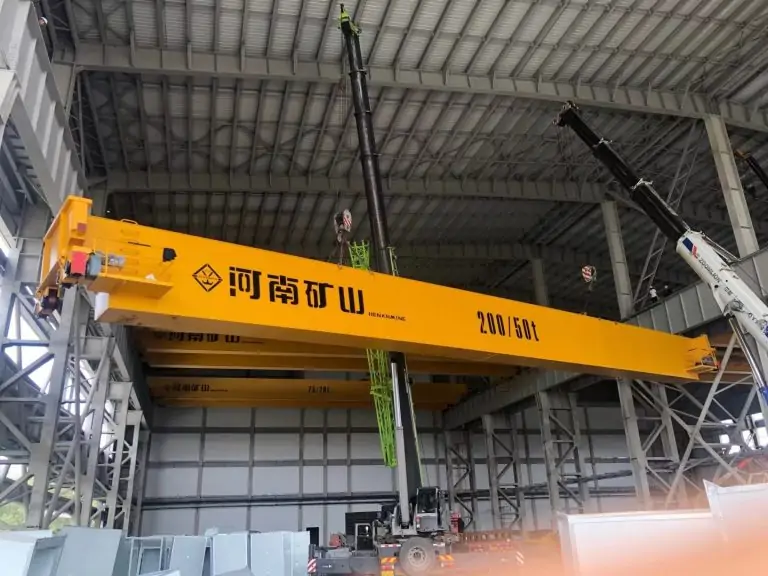

How to Plan Gantry Crane Loading Zones for Faster Truck Turnaround
For steel depots, prefabricated component factories, logistics transit bases and heavy-duty processing plants, the speed of truck turnover directly determines the throughput capacity of the site and customer satisfaction.Many companies have purchased high-performance gantry cranes, but because of the unreasonable layout of the loading and unloading area, there are long queues of trucks, frequent interruptions in hoisting, and traffic interference with each other, the equipment production capacity cannot be released.Scientific planning of the gantry hoisting and unloading area is not just about drawing lines to divide the area, but combining site conditions, traffic direction, lifting equipment parameters, and operating procedures to make a complete set of landing plans, compressing the length of time the truck stays in the factory from the source, reducing waiting costs, and improving the efficiency of order delivery.
Why Loading Zone Planning Matters for Truck Turnaround
Reduce truck waiting time
The most common pain point of unplanned loading and unloading sites is that trucks wait in place for a long time, and drivers get together and line up at the hoisting point. After one truck is loaded and unloaded, the next one can only be in place, and a lot of time is spent waiting.After the loading and unloading area is reasonably laid out, the vehicle can be docked in an orderly manner according to the preset position, and Henan Mine Crane manufactured gantry crane does not need to move frequently and extensively to pick up the material and align, and the hoisting cycle is significantly shortened.A stable operating rhythm can compress truck waiting from tens of minutes to several minutes, reduce driver retention and fuel consumption at idle speed, while avoiding complaints from freight forwarders due to long queues, stabilize long-term cooperative freight channels, and improve the overall carrying capacity of the station to receive orders.
Improve material flow
Smooth material flow is the underlying logic to improve turnover. The planning of the loading and unloading area needs to open up the movement line between the temporary storage of raw materials, the hoisting point, and the truck berth to avoid repeated material transfer and secondary stacking.During the layout, the high-frequency hoisting goods are arranged nearby within the coverage of the gantry crane, the unpopular materials are placed in the peripheral area, and the spreaders and auxiliary materials are stored at fixed points, so the operators do not need to look for accessories from a long distance.Orderly material movement lines can reduce invalid handling, allowing goods to leave the warehouse, load, and leave the site to form a coherent closed loop. There will be no situation where the goods are still being transferred from a long distance after the truck is in place, and the daily cargo handling capacity of the station will continue to be enlarged.
Prevent traffic congestion
Most of the congestion in the yard comes from mixed traffic, sharing of imports and exports, cross-conflicts between loading and unloading trucks and passing vehicles, and it is easy to block, reverse, and interrupt operations during peak periods.The planned loading and unloading area will distinguish three moving lines of entry, loading and unloading, and departure, forming a one-way circular traffic flow to prevent vehicles from crossing and grabbing the road.At the same time, a buffer waiting area is reserved so that the trucks to be loaded will not be directly blocked in front of the hoisting station. Even if there is a backlog of operations in a short period of time, the traffic can wait in an orderly manner in the buffer area, and it will not spread to the main passage of the station, ensuring the normal passage of other material transportation vehicles in the site, and maintaining the stability of the whole site.
Assess Site Conditions Before Planning
Measure yard dimensions
Before formally designing the loading and unloading area, the first step is to accurately measure the full size of the yard, including the available operating length, width, ground bearing capacity, and the location of boundary obstacles. The layout cannot be estimated alone.It is necessary to mark the location of fences, columns, drainage ditches, distribution boxes, and existing buildings to confirm whether the ground needs to be hardened and reinforced to meet the walking loads of heavy trucks and gantry cranes.At the same time, record the location of the entrance and exit of the site, the width of the gate, and the turning space to determine whether the large trailer can enter and exit smoothly and turn around.Complete and accurate site data is the basis for subsequent selection of berths, lanes, and gantry crane spans, so as to avoid the rework problems of insufficient space and vehicles that cannot be docked after completion.
Check crane capacity
It is necessary to check the rated lifting weight of the Henan Mine Crane manufactured gantry crane, the lifting height, the operating speed of the cart, and the moving range of the trolley to match the weight and dimensions of the daily loading and unloading of goods.If you often hoist ultra-long and ultra-wide heavy-duty components, it depends not only on the rated load, but also on the operating restrictions caused by partial load and wind load, and reserve a safety margin.If the coverage of the original gantry crane is limited, the loading and unloading berths cannot be forcibly increased, otherwise there will be safety hazards such as insufficient lifting and cable-stayed crooked lifting.Only by including the lifting performance parameters in the evaluation in advance can we determine the type of cargo suitable for each loading and unloading position, and determine whether it is necessary to add gantry cranes or replace larger equipment to match the traffic requirements.
Map truck routes
On-site surveying and mapping of all truck traffic routes, combing the complete path of the trailer entering, stopping, loading, and leaving the field, and marking the vehicle's reversing point, turning area, and meeting place.Priority is given to the design of one-way traffic loops to reduce time-consuming and high-risk actions such as reversing and turning around in place.For factory areas where the site is restricted and cannot be used as a loop, the reversing guide area is planned separately, and signs, reflective strips and guide marks are installed.Route planning should take into account the different traffic needs of ordinary trucks, semi-trailer long trailers, and large transport vehicles, so as to ensure that all types of vehicles can pass smoothly along a fixed route, and reduce the time-consuming for drivers to find berths and adjust the body.
Identify traffic bottlenecks
Carefully investigate the natural blocking points in the site, such as narrow gates, corners, passages under gantry cranes, intersections, and common passages for incoming and outgoing materials. These places are areas with high delays.Record the congestion frequency of the bottleneck during the morning peak and afternoon centralized loading periods, and determine whether it is caused by insufficient space or chaotic movement.Corresponding plans are given for different blocking points. Some need to widen the channel, some need to adjust the operating hours to divert vehicles, and some directly isolate the flow of people and traffic.Identify bottlenecks in advance and optimize them at the program stage, rather than retrofitting after production, and eliminate card points that continue to affect truck turnover at a lower cost.
Design an Efficient Gantry Crane Loading Zone
Set loading bay dimensions
The size of the loading and unloading berth should match the main transport vehicle model, taking into account the total length of the trailer, the width of the body, the reversing margin, and the side safety clearance, and reserve sufficient parking space.The width of the berth cannot be just stuck to the body. It is necessary to leave room for personnel to get on and off the car and hang the sling. The length of the berth meets the parking of the whole vehicle to avoid the rear of the car invading the main lane.At the same time, marking lines and limit stops are made on the ground of the berth to guide the driver to stop at one time, and repeated adjustments to the body will slow down the loading rhythm a lot.The number of berths should refer to the peak daily arrivals of trucks, and the buffer waiting area should be used to avoid the backlog of queuing outside the venue caused by insufficient berths.
Optimize crane coverage
The effective coverage of the gantry crane is the core of the efficiency of the loading and unloading area. Try to arrange all the loading and unloading berths within the effective operating range of the crane trolley and the main beam to reduce the long-distance movement of the cart back and forth.Priority is given to placing the high-frequency loading berths in the middle of the gantry crane span, where the lifting alignment is the fastest, and the positions at both ends are reserved for low-frequency operations.When multiple Henan Mine Crane manufactured gantry cranes work together, reserve a safe avoidance distance between the two equipment and set limit protection to prevent mutual interference.Reasonable coverage layout can shorten the length of a single hoisting cycle. The same gantry crane can handle more trips per hour, which directly improves the efficiency of truck turnover.
Separate truck lanes
The lanes must be divided into functions, separating the approach lanes, the departure lanes, the loading and unloading lanes, and the transfer lanes in the field, so that the traffic does not cross each other.It is recommended that the one-way traffic mode, the incoming vehicles follow the designated lane directly to the berth, and after the loading is completed, take an independent exit to leave the venue, without intersecting with the incoming traffic.The width of the lane is designed according to the turning radius of the largest model, the lanes for large-scale transportation are widened, and the ground is clearly marked with lines and arrows to distinguish the functions.After lane isolation, the probability of vehicles rushing, scratching, and parking in the way is greatly reduced, and drivers travel more smoothly, reducing the time loss caused by avoiding and waiting for other vehicles.
Plan staging areas
The stocking staging area is a key support for rapid loading and unloading. It is set within the coverage of the gantry crane and close to the loading and unloading berth. It is used to gather the goods to be shipped, supporting spreaders, and tooling in advance.According to the order and carrier classification and stacking, the goods of the same truck are collected in the same temporary storage point in advance. After the truck is in place, it can be hoisted and loaded directly without having to transfer the goods everywhere.The temporary storage area and the driving lane remain isolated, do not occupy traffic space, and reserve a forklift transfer channel at the same time.Adequate stocking areas can pre-position the preparation work, simplify the operation content of the loading site, realize the ready-to-install of the car, and greatly compress the length of stay of the bicycle.
Coordinate Truck Arrivals and Loading Operations
Schedule truck arrivals
Using the appointment arrival mechanism, trucks are arranged to enter the port in time according to the operating capacity of the gantry crane, so as to avoid a large number of vehicles concentrated in the same time period to get together and flood in.Open an appointment channel to the freight company, and agree on the arrival window, and the station will stock the goods in advance according to the order of appointment.When encountering temporary expedited orders, intersperse arrangements so as not to disrupt the overall schedule.At the same time, overtime waiting rules are set up to delay the queuing of late vehicles to ensure that priority operations for vehicles are booked on time.Orderly arrival dispatching can smooth the operating load, avoid peak overload and idle equipment in low troughs, allow the gantry crane to continuously and stably output loading and unloading capacity, and shorten the average turnover time stably for a long time.
Prepare loads in advance
The pre-processing of the goods is all completed before the arrival of the truck, including inventory of the goods, binding and reinforcement, selection of spreaders, inspection of hanging points, classification and collection, rather than waiting for the truck to stop before starting to organize.Large-scale and special-shaped components are marked with lifting points in advance, steel coils and profiles are equipped with special lifting pliers, and multiple pieces of assembled goods are pre-packaged into standard hoisting units.When the truck is parked in place, the operator can directly hook up and lift it, eliminating the time to organize, find accessories, and check the bill of goods on site.Pre-stocking is a means of improving efficiency with low investment and fast results. After the optimization of many stations, the loading time of bicycles is directly shortened by more than one-third.
Standardize loading procedures
Formulate a unified and written loading operation process, clarify the operation specifications for each step of vehicle alignment, hook lifting, blanking alignment, decoupling, and document handover, and all hoisting teams will implement it uniformly.The specification labels the hoisting sequence, placement, and fixation requirements of different types of goods, reducing the pauses and repeated adjustments caused by the operator's random operation based on experience.With a simple inspection list, the loading is completed quickly, so as to avoid the need to readjust if the loading is unqualified.Standardized processes reduce the difficulty of newcomers getting started, reduce operating errors, make the rhythm of each loading controllable, and the turnover time fluctuation becomes smaller, which is convenient for follow-up statistics and optimization.
Reduce idle crane time
Henan Mine Crane manufactured gantry crane is empty and idle. It is a great waste of production capacity. It is necessary to match the scheduling so that when one vehicle is finished, the next vehicle and the goods are ready.The dispatcher synchronizes the status of the berth, the progress of cargo preparation, and the location of the vehicle in real time, guides the next vehicle to be in place and stands by in advance, and seamlessly connects the operations under the premise of safety.Regularly count the reasons for the standby of the gantry crane, distinguish whether the vehicle is late, the goods are not ready, the documents are waiting, or the equipment is faulty, and solve them in a targeted manner.Continuously compress the empty window time, increase the effective operation ratio of gantry cranes, and carry more truck loading and unloading tasks without adding cranes.
Improve Safety Without Slowing Operations
Separate pedestrian routes
The flow of people, traffic, and hoisting operation areas must be physically isolated, and independent pedestrian passages, safety guardrails, and warning signs must be set up to prohibit workers from crossing truck lanes and Longmen hoisting operations at will.Hoisting command and division personnel only operate at designated operating points, and other office and quality inspection personnel take independent passages and do not enter dangerous areas under vehicles and hoisting objects.The mixing of people and vehicles is not only extremely easy to cause safety accidents, but once there is a dangerous situation, the whole operation will be stopped urgently, causing large-scale delays.Isolating pedestrian routes can not only protect the safety of on-site personnel, but also avoid interrupting the rhythm of loading and unloading due to safety incidents, and ensure stable turnover.
Maintain safe clearances
Reserve various safety gaps in strict accordance with the lifting specifications, including the distance between the crane and the truck cab, the clearance between the main beam of the gantry crane and the ground cargo, the avoidance distance between the equipment, the cargo stacking and the safe spacing of the lane.The minimum safe distance for different goods and spreaders should be written into the on-site specifications, and the ground should be drawn to delineate the no-entry zone, and the gap should not be reduced at will in order to save space.Insufficient safety margin will bring the risk of collision and scratches. Once the collision occurs, it is necessary to stop work to inspect the equipment and goods, which will slow down the overall progress.Adequate and consistent safety clearance allows the operator to hoist at normal speed stably and confidently, without having to slow down carefully at all times.
Control vehicle movement
The driving speed of vehicles in the field is strictly controlled, low-speed traffic in the hoisting operation area, and the speed limit of the main channel is limited, and it is clear that reversing must be commanded by a special person.All trucks are only allowed to turn off and wait in designated berths, and they are not allowed to stop or stop at will in the passage for a long time. The departing vehicles will leave immediately after the handover is completed.Dispatching and on-site security cooperate to guide traffic, and vehicles that occupy roads and wander at low speeds are found to be dredged in time.Orderly control of vehicle movements, reduce emergencies, avoid multiple vehicles grabbing positions at the same time, reversing in disorderly manner, maintain the order of operation in the loading and unloading area, safety and efficiency can be taken into account simultaneously, and the speed of truck turnover will not be sacrificed for safety.
Improve operator visibility
Focus on eliminating the visual blind spots of gantry crane drivers, installing surveillance cameras and supplementary lighting in berths, temporary storage areas, and corner locations to ensure sufficient brightness for night operations.Plan the orientation of the berth rationally, and don't let trucks or cargo block the driver's sight.It can be equipped with a gantry crane with remote monitoring and video assistance system to help drivers see clearly the lifting point, truck compartment, and surrounding personnel.When the field of vision is insufficient, the operator will slow down the hoisting speed, repeatedly confirm the position, and lengthen the loading cycle.Good visual conditions, smooth transmission of command signals, faster alignment, coherent hoisting actions, and continuous compression of time-consuming single operations while ensuring safety.
Choose the Right Gantry Crane for Your Loading Zone
Match capacity to loads
When selecting the type, the rated lifting weight of the gantry crane should match the mainstream cargo of the station, and at the same time reserve safety redundancy. It cannot be purchased with the maximum load just stuck, and the failure rate of long-term full-load operations is higher.If you load and unload multiple weights of goods at the same time, you can consider the configuration of the main and auxiliary hooks. The auxiliary hooks are used for fast operation of small and light goods, and the main hooks are used for heavy and large goods, taking into account efficiency and carrying capacity.If there are plans to expand production and undertake heavier goods in the future, reserve room for upgrading in advance to avoid the need to replace the whole machine in just a few years.The load matching is in place, the crane runs stably, there are fewer failures and shutdowns, and the continuity of loading and unloading operations is stronger. The truck does not have to wait because of equipment overload and failure.
Select the right span
The span directly determines how many loading and unloading berths and temporary storage areas the gantry crane can cover. The span is too small to cover fewer berths, and multiple vehicles can only line up.The span is too large, the weight of the equipment, the cost, and the energy consumption of the cart operation increase, and the alignment speed slows down.Combined with the width of the yard and the arrangement of berths measured in the previous stage, a reasonable span is determined, and the track arrangement is aligned with the center line of the loading and unloading area.Rail-type gantry cranes are suitable for long-term and large-scale operations in fixed loading and unloading areas, and tire-type gantry cranes are suitable for scenarios where berths are flexibly changed and cross-regional transitions are required.The right span allows the equipment coverage to be perfectly adapted to your loading and unloading layout to maximize the value of the site.
Compare single and double girders
The single-main beam gantry crane has lower cost and light weight. It is suitable for loading and unloading of small and medium-sized tonnage, conventional profiles, and prefabricated parts. The installation cycle is short, and the site foundation requirements are lower. It is suitable for stations with limited budgets and medium operating frequencies.The double-main beam gantry crane has stronger rigidity and better stability, supports the hoisting of large-tonnage and large-size special-shaped components, and has a higher lifting height. It is suitable for heavy-duty steel, large-scale prefabricated components, and complete sets of equipment. It can also be equipped with more automation accessories.You have to combine the cargo type, hoisting accuracy requirements, and budget comparison to select the type, and choose the wrong main beam type. Either the stability is insufficient and you dare not speed up, or the excess equipment performance increases costs and drags down long-term operating benefits.
Consider automation options
The automated gantry crane includes frequency conversion speed regulation, anti-shake system, automatic positioning, remote control, and unmanned hoisting modules, which are suitable for large transit depots with high flow and 24-hour continuous operation.Automatic anti-shake can reduce the shaking of the spreader, eliminating the need for manual hook stabilization time, automatic positioning can accurately fall to the designated position of the carriage, greatly shortening the alignment cycle.For small and medium-sized stations, low-cost automation accessories such as frequency conversion and remote control can be selected first, so there is no need to have a one-step solution.The early investment in automation solutions is higher, but human delays are continuously reduced for a long time. In the scenario where truck traffic continues to rise, the cost recovery speed is fast, which is an important choice to increase the turnover limit.
Measure and Improve Truck Turnaround Performance
Track turnaround time
Establish a data ledger to continuously record the length of the whole process of each truck from entry registration, docking, loading, verification of documents to departure, and divide out the waiting time, hoisting operation time, and document handover time.Distinguish between working days, morning and evening peak, off-season and peak season data, calculate the average turnover time, and set benchmark goals.Through long-term data records, we can intuitively see whether the optimization plan has any effect after it is implemented, and judge whether the overall process is slow or individual berths and shifts continue to time out.Optimizations without data tracking are based on sensory adjustments, and the turnover time can be continuously counted in order to find the real efficiency shortcoming and continuously iterate the loading and unloading plan.
Monitor crane utilization
Continuously count the effective operating time, standby time, and downtime of the gantry crane, calculate the equipment utilization rate, and analyze the root cause of inactivity.If the utilization rate is low but the truck queuing is serious, most of it is due to scheduling and stocking process problems.If the utilization rate is close to saturation for a long time and the backlog of vehicles continues, it means that the existing lifting equipment capacity is insufficient, and it is necessary to increase the number of seats or add new cranes.Regularly compare the utilization rate data with the truck turnover data, distinguish whether the bottleneck is in the equipment hardware or the management process, avoid blindly purchasing new equipment, use data to support upgrade decisions, and maximize the investment value of lifting equipment.
Identify recurring delays
Summarize long-term records and screen for recurring delay factors, such as long-term replacement of spreaders, slow document flow, insufficient lighting at night, difficult reversing of trailers, and inconsistent cargo lifting points. High-frequency issues.Formulate special improvement plans for each type of repeated delays, standardize the storage location of spreaders, synchronize document information online, optimize reversing guidance marks, and unify the design of cargo lifting points.Periodic re-order delay lists, eliminating card points one by one, as repetitive problems continue to decrease, the average turnaround time of the station will steadily decrease, and the experience of customers and carriers will continue to improve, forming an efficient and stable loading and unloading operation system.
Henan Mine Crane Factory Custom
The planning of the gantry hoisting and unloading area is not only to choose the appropriate lifting weight, but also to comprehensively consider the truck entry and exit route, the size of the loading and unloading space, the cargo temporary storage area, the crane coverage area, and the traffic flow line in the site.These factors will directly affect the truck waiting time, the efficiency of a single loading and unloading, and the overall throughput of the station.Reasonable planning of the layout of the loading and unloading area, and determining the configuration of the gantry crane according to the actual operating needs, will help reduce unnecessary lifting actions, alleviate the problem of vehicle queuing, and avoid additional transformation costs due to the mismatch between the equipment and the site in the later stage.
Henan Mine Crane Factory focuses on the design and customization of gantry cranes, and can provide corresponding gantry crane solutions according to the site conditions, cargo weight, operating frequency and loading and unloading needs of different projects.Whether it is a steel yard, a prefabricated component factory, a logistics park and a heavy-duty processing plant, we can combine the site layout to help match the lifting weight, span, lifting height and equipment configuration.Provide corresponding services for the project from pre-plan design, manufacturing to installation, commissioning and after-sales support.