
High-Speed Pneumatic Manipulator Jib Cranes: Fast Pick-and-Place for Assembly Lines
In discrete assembly production lines such as automobiles, electronics, sheet metal, and home appliances, high-frequency and short-distance workpiece picking and discharging have always been pain points that restrict the beat, cause personnel strain, and increase poor bumps.Fully automated robots have high investment and long commissioning cycles; ordinary cantilever cranes are laborious to operate, and the cycle speed cannot keep up with the fast-paced production line.
As a man-machine collaborative assisted handling equipment, the high-speed pneumatic manipulator jib crane combines the advantages of wide-range rotation of the jib crane with the zero-gravity follow-up characteristics of the pneumatic balance system to achieve fast and controllable picking, transportation and positioning in the assembly station. It is a material handling solution that takes into account efficiency, cost and flexibility.
What Is a High-Speed Pneumatic Manipulator Jib Crane?
The high-speed pneumatic manipulator jib crane is an industrial lifting and positioning system assisted by the operator. The main structure of the jib crane is equipped with a balance and actuator driven by compressed air.
Enterprises use this kind of pneumatic manipulator, the purpose is to reduce manual load, optimize the ergonomics of the station, avoid workpiece collision damage, and stabilize the production rhythm; it carries the weight of the workpiece, the operator only needs to guide the movement, in the high-speed assembly scenario, to achieve high-frequency picking and discharging cycle, without having to bear the complex development cost of a full set of automation equipment.
Structure and core components
The structure of the complete set of equipment is clear, and the components work together to complete the rotation, lifting, grasping, and safety protection.:
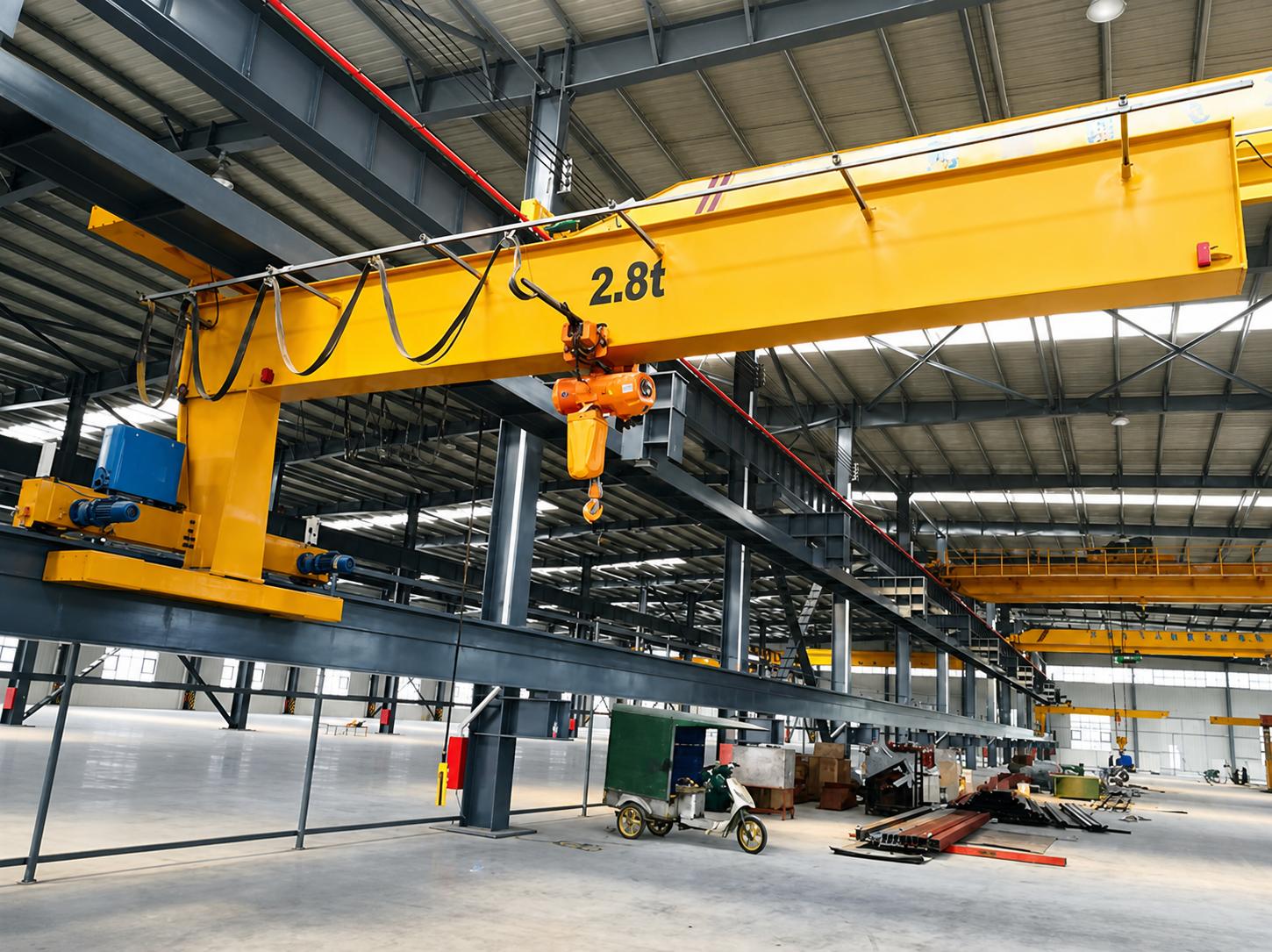
- Spiral arm body, column/wall-mounted support seat, rotary mechanism: suitable for fixed assembly stations, repeated lifting and positioning of workpieces within a fixed radius, without occupying the ground passage; support floor-to-ceiling column or wall-mounted installation, multi-rotation angle is optional, covering the range of material flow in the station.
- Pneumatic lifting and balancing system: driven by compressed air and using zero gravity balancing technology, hundreds of kilograms of workpieces can be lifted and translated with only 2–5kg guiding force; the system automatically adjusts the pressure and suspends the load, and controls it with movement.
- Manipulator execution end, jaw or vacuum suction device: The end of the spiral arm crane can be equipped with pneumatic jaws, vacuum suction cups, and customized fixtures to adapt to different forms of workpieces such as plates, housings, castings, and modules.
- Operating handle, pneumatic valve set and safety mechanism: the cylinder controls the vertical movement of the load, and the operator controls the lifting, clamping and release through the handle, while integrating safety components such as air failure protection, emergency stop, and load fall prevention.
The working principle of pneumatic manipulator spiral arm crane
Compressed air is the power core of the entire set of equipment.The pneumatic balancer relies on a clean air source and realizes stepless variable speed action after pressing the control handle.The equipment follows the natural control logic of the human body, and the operator can control the movement speed according to the speed of assembly requirements.
The typical operation process is simple: for example, laser cutting machine loading and unloading, manual control of manipulator reclaiming, rotating, and positioning of discharge, the transfer range is limited by the installation method of the spiral arm.Key distinction: It is a human-controlled booster device, not a fully automatic robot; in the face of complex working conditions such as special-shaped workpieces and flip fine-tuning, it relies on manual on-site guidance instead of automatic program operation.
Key Benefits of High-Speed Pneumatic Manipulator Jib Cranes on Assembly Lines
Efficient picking and discharging beat
The jib crane can significantly compress the length of material handling time.Measured data in the manufacturing industry show that compared with pure manual or forklift transportation, the material handling time can be shortened by up to 30%, and the production line can flow more smoothly and wait for less downtime.
The equipment is directly deployed in the assembly station, eliminating manual lifting links, speeding up the flow of materials between stations, and stabilizing the beat of the entire assembly line.Relying on reasonable spiral arm coverage and station layout, invalid positions are reduced; upgrading bottleneck stations does not require drastic transformation of the entire production line to increase output.
Reduce operator fatigue
It replaces manual weight-bearing handling and reduces the risk of work-related injuries such as sprains and strains from the source.A single person can quickly complete the handling and positioning, and the tooling and fixtures can also be updated and adapted with the products of the production line.The value of ergonomics is not only weight loss.
The physical exertion of workers has decreased significantly, and even in the second half of the shift, the beat of the production line can still be maintained stably; in high-frequency moving positions, fatigue accumulation often causes a decline in production capacity in the later stage. This set of booster equipment solves this problem well.
Accurate workpiece positioning
With a precision balancing unit and special positioning tooling, the operator can accurately place the workpiece millimeter-level into the fixture, assembly tooling, and processing equipment to reduce alignment guesswork and brute force adjustment.
Automobile engine assembly stations use a lot of such equipment, and each station corresponds to a dedicated handling jib crane to ensure the stability of the assembly sequence.Suitable end tooling and load balancing are the basis for high-precision handling. The operator can stabilize the grip and fine-tune the attitude to avoid workpiece collisions and positioning deviations, and reduce defective products.
Flexible station deployment
The wall-mounted spiral arm crane is suitable for workshops where the wall and column are arranged and the ground space is tight; the self-supporting floor-standing model is suitable for independent stations that do not have reliable walls and require greater loads and 360° full rotation.
Pneumatic manipulator jib crane is compatible with various workpieces such as boxes, coils, plates, castings, battery modules, molds, precision finished parts, etc. When facing product changes and production line layout adjustments, the difficulty of transformation is much lower than that of automated robot units.
Reduce the overall cost of material handling
Booster cranes can efficiently carry heavier parts, reduce handling hours, and shift workers from simple material lifting to high-value assembly operations.Its initial investment is usually 30%-50% lower than that of bridge cranes, with less infrastructure transformation and a faster return cycle.
At the same time, it reduces the damage to the workpiece caused by repeated manual movement and the downtime caused by handling; when evaluating the benefits, it is necessary to comprehensively compare the cost of equipment procurement, installation, maintenance, and the continuous use of compressed air.
Common Applications in High-Speed Assembly Lines
Auto parts assembly
Engine assembly is one of the processes with the highest accuracy requirements in automobile workshops. Workpieces such as cylinder blocks, gearbox housings, and brake assemblies are heavy in weight and have strict tolerances.With a pneumatic spiral arm manipulator that locates the tooling, the workpiece can be accurately lowered to the tooling table.
A typical case: the gearbox housing (320kg) adopts wall-mounted spiral arm + pneumatic balancer for handling and positioning, the operator is reduced from 2 people to 1 person, and the production capacity is increased by 38%.The welding station is also applicable: the manipulator stably lifts the workpiece, rotates and flips as needed to meet the needs of multi-angle welding, without the need for workers to flip the workpiece with their bare hands.
Electrical and electronic equipment manufacturing
The electronic housing and power module are precision parts, and they cannot be bumped and scratched during handling.Pneumatic vacuum suction cups can achieve non-destructive grasping.When selecting models for clean workshops and semiconductor supporting production lines, pneumatic valves and cylinders with independent exhaust structures should be selected to avoid air source pollution; before selecting models, confirm that the air source cleanliness level meets the workshop specifications.
Sheet metal processing and mechanical equipment assembly
After the laser cutting machine cuts the material, the sheet cutting speed is very fast, but manual loading and unloading often becomes a bottleneck.Pneumatic manipulator jib crane solves the problem of loading and unloading heavy-duty machined workpieces.
In the bending airport scene, the manipulator follows the bending stroke and feeds the material synchronously; in the case of loading and unloading of blank parts in CNC machining centers, the column-type pneumatic-assisted spiral arm crane compresses the single loading and unloading cycle from 8 minutes to 3.5 minutes, increasing the efficiency by 56%.
Home appliance and general manufacturing industry
In batch assembly stations for home appliance housings, panels, motors, and sub-assembly parts, it is easy for manual or ordinary chain hoists to form bottlenecks.The pneumatic manipulator jib crane supports single-person continuous handling, is suitable for small and medium-sized batch and multi-variety mixed-line production, and improves the flow of materials in the station.
End process of packaging line
In the packaging offline station, it is used to transfer finished products, bins, and sub-assemblies to the packaging tooling and packing station to undertake high-frequency repetitive loading and unloading tasks.In short-distance and high-frequency handling scenarios, pneumatic manipulator jib cranes are more flexible and less expensive to deploy than conveyors and robot units.
How to Select the Right Pneumatic Manipulator Jib Crane for Fast Pick-and-Place
Rated load and load characteristics
First determine the maximum weight of the workpiece, and count the jaw and tooling weight together.The mainstream load range of the assembly station is 50–500kg, depending on the crane model.
In addition to weight, the shape of the workpiece, surface material, center of gravity position, clamping point position, and whether it needs to be flipped and tilted are all the key points of selection.Be sure to check the rated load of the nameplate, the allowable torque, and the operating limit marked by the manufacturer, and do not use it overloaded.
Working radius and rotation range of spiral arm
Measure the distance from the reclaiming point to the discharge point, and select the matching working radius and rotation angle.The joint-type spiral arm can bypass the obstacles of uprights and machine tools, and extend into the interior of the equipment and operate in narrow passages. There is no need to move the crane base for multi-point pick-and-place.Before the plan is finalized, check whether there will be interference with machine tools, tooling, adjacent stations, and personnel within the rotation range.
Pneumatic performance matches beat requirements
First clarify the target beat: the number of picks per minute, or the time-consuming handling of a single move, and then select the lifting equipment.The balancer suitable for fast beats supports stepless speed regulation. The stronger the handle is pressed, the faster the movement speed.
Confirm that the pressure and flow of the air source in the workshop are stable, and the standard pneumatic booster system generally requires a clean and dry 0.6MPa air source.You can't just look at the no-load speed index, you must use real workpieces to test the cycle performance on site; at the same time, evaluate the pressure drop problem of multiple pneumatic equipment in the workshop when using air at the same time.
Jaws and end effectors
The end tooling directly determines the speed of the cycle:
- Mechanical jaws: suitable for workpieces with reliable clamping surfaces, stainless steel roller parts, non-ferrous metal parts commonly used custom jaws;
- Vacuum suction cup tooling: suitable for flat and non-porous plates, which can grab, rotate, and accurately place sheet metal parts;
- Customized tooling + quick-change fixtures: special-shaped workpieces, multi-variety mixed-line production, quick-change structure is selected, and clamping tooling is quickly switched.
Determine the installation form
Floor-to-ceiling column type: independent station, large load, no wall support; wall-mounted/column attachment type: the ground space is tight, relying on the original column and wall installation of the plant, but the bearing capacity of the building structure must be verified in advance.Comprehensively evaluate the foundation strength, plant structure, installation gap, and coverage, and determine the plan.
Safety and maintenance requirements
Check whether the continuous working frequency of the equipment matches the production schedule; focus on the self-locking, load holding, and emergency stop protection functions of air failure; at the same time, understand the regular maintenance cycle, pneumatic seals, valve maintenance plans, and spare parts delivery cycle.The moving parts of the jib crane are less than that of large-scale lifting equipment, which has strong durability and can be stably used for more than 20 years after maintenance.
Pneumatic Manipulator Jib Cranes vs. Other Material Handling Solutions
The selection should be based on the working conditions, and there is no universal optimal solution. The following table visually compares the differences.:
| Comparison Item | Pneumatic Manipulator Jib Crane | Conventional Manual Jib Crane | CraneIndustrial Robot |
| Pick & Place Speed | High speed for repetitive short-distance handling | Highly dependent on operator’s physical strength and proficiency | High speed for programmed fixed paths |
| Flexibility | High flexibility with operator guidance | Acceptable flexibility for simple lifting | Subject to program and fixture change efficiency |
| Automation Level | Operator-assisted power lifting | Fully manual | Mainly fully automatic |
| Initial Investment | Varies by working condition | Generally lower | Usually high for integration and commissioning |
| Best Application Scenarios | High-frequency human-machine collaborative handling | Low-frequency, occasional lifting | Unmanned programmed handling with fixed paths |
When is the priority for pneumatic manipulator jib crane?
- The operation requires manual real-time guidance and attitude fine-tuning. The working conditions such as workpiece assembly alignment, angle reversal, and attitude correction are flexible and changeable. It cannot be completed entirely by preset procedures. Operators are required to observe and manually fine-tune the attitude of the workpiece on site to ensure the assembly accuracy.
- The reclaiming and discharging distances in the high-frequency and short-distance circulating transfer stations of the entire shift are short, the handling actions are highly repetitive, and the operation continues uninterrupted throughout the day, with high requirements for handling beat and worker fatigue control.
- Focusing on improving handling efficiency and ergonomics, there is no need for unmanned projects. The core appeal is to reduce the burden, speed up, and reduce work-related injuries. It does not pursue unattended automation of the whole process, and retains human flexibility to better meet production needs.
- The investment in robot solutions is high and the cost performance is insufficient. If industrial robots are used, the cost of supporting tooling, programming and debugging, and system integration is high, the cycle is long, and the output or working conditions are not enough to offset the high investment, and the comprehensive income is not ideal.
- The location is stable, the production line layout is fixed for a long time, the pick-and-place position changes little, and the workshop production line layout will not be significantly changed in the short term. After the pneumatic jib crane is deployed, it can be used stably for a long time, the return cycle is short, and the system is simple and easy to maintain.
If the handling point is fixed and the layout of the production line remains unchanged for a long time, the pneumatic jib crane tends to return to the cost faster and the system complexity is lower.
How to Maximize Pick-and-Place Speed Without Compromising Safety
High beat is not equal to blind speed-up, efficiency improvement is based on safety specifications:
- Optimize the overall layout of the station, reasonably plan the reclaiming and discharging points, reduce unnecessary rotation actions and excess movement travel of the equipment, and compress the invalid movement time of a single handling.
- According to the shape, weight and clamping position of the workpiece, the adapted tooling jaws are selected to optimize the gripping structure, reduce the time-consuming waiting during gripping, locking, and loosening, and improve the fluency of picking and placing.
- Implement standardized management of material placement in the reclaiming area, fix the direction and position of material placement, avoid repeated adjustments and alignment during each operation, and stabilize the operation beat.
- Establish a sound preventive maintenance plan, regularly inspect key components such as pneumatic valves, air supply trachea, seals, and rotary joints, and promptly investigate hidden dangers of air leakage, caton, and wear to ensure the continuous and stable operation of the equipment.
- Control the acceleration of the operation of the equipment, do not blindly adjust the start and stop speed, avoid the risks of large load swing, workpiece shedding, and positioning offset, and take into account the efficiency and safety of the operation.
- The whole process of operation strictly complies with the relevant safety regulations of lifting machinery, and at the same time conducts operations in accordance with the operating guidelines provided by the original equipment factory to standardize the operating behavior of personnel.
Conclusion
The high-speed pneumatic manipulator jib crane takes into account fast response, flexible control and man-machine collaboration, and is suitable for high-frequency handling scenarios such as mold replacement, auto parts assembly, and sheet metal transfer.
Reasonable matching of load, arm length, aerodynamic performance and fixture, and verification by the actual production line, can effectively improve handling efficiency and operating safety, while reducing the intensity of repetitive operations and automation integration costs.Henan Mine Crane can provide customized pneumatic-assisted jib crane solutions based on workpiece weight, operation beat and station layout.