
How to Coordinate Multiple Overhead Cranes in One Workshop
In manufacturing, steel structure and assembly storage workshops, a single bridge crane cannot meet the lifting of heavy-duty long pieces. Multiple vehicles are often configured to improve operating capabilities, but they are prone to collisions, operational conflicts and communication errors.
Multi-machine collaboration relies on layout planning, zoning control, intelligent systems, operation specifications and maintenance to achieve safe operation.This article introduces the difficulties of coordination, planning, anti-collision, lifting specifications and pit avoidance points, and helps the workshop establish a multi-machine lifting standard system.
What Does Coordinating Multiple Overhead Cranes Mean?
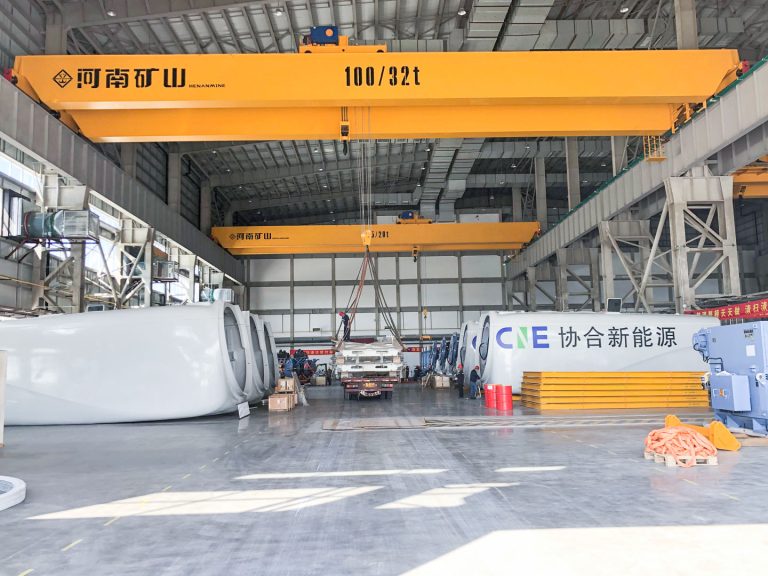
The collaborative operation of multiple bridge cranes refers to the joint operation of two or more bridge cranes (including gantry cranes) in the same workshop and in the same operating area through systematic planning, synchronous control, and safety control. The lifting management mode of the industry.
This mode is not a simple simultaneous operation of multiple machines, but a combination of workshop layout, material flow direction, equipment parameters, and personnel cooperation to avoid operational conflicts and safety risks, and realize the efficient convergence of processes such as material transfer, equipment assembly, and finished product outbound, while ensuring the all-round safety of personnel, equipment, and materials.
Modern multi-machine collaborative operation will integrate technologies such as sensors, PLC intelligent control, anti-collision monitoring, and partition control, but smart devices are only used as auxiliary tools and cannot replace standardized operating procedures and professional control by licensed operators. This is the core principle of safe and efficient operation.
Independent work and collaborative work
Many workshop safety accidents and efficiency shortcomings are essentially confusing the control standards of independent crane operation and collaborative operation, and the two are significantly different.:
- Independent operation: each crane has its own dedicated area and independent track, and the scope of operation does not overlap with each other. The operator only needs to complete its own lifting tasks without linkage with other equipment, and only complies with basic operating specifications; low risk, simple management, suitable for small workshops with simple processes and clear partitions.
- Collaborative operation: The crane has working conditions such as track sharing, overlapping operations, and joint lifting, and the equipment trajectory and tasks are interrelated.It is necessary to unify safety spacing, operation priority, anti-collision mechanism, communication plan and emergency plan. The control is complex, which can improve the workshop's operating capabilities and require higher processes, equipment and operators.
Common layout forms of multiple cranes in the workshop
The layout of multiple bridge cranes in industrial workshops directly determines the collaborative operation plan and the focus of safety control. The mainstream layout is divided into four categories:
- Independent track layout: multiple cranes are installed on parallel or independent dedicated tracks, with almost no overlap in the operating area and a very low risk of collision.It is suitable for workshops with clear process partitions and fixed production lines. The disadvantage is that the space utilization rate is low and there are blind spots for material transfer and convergence.
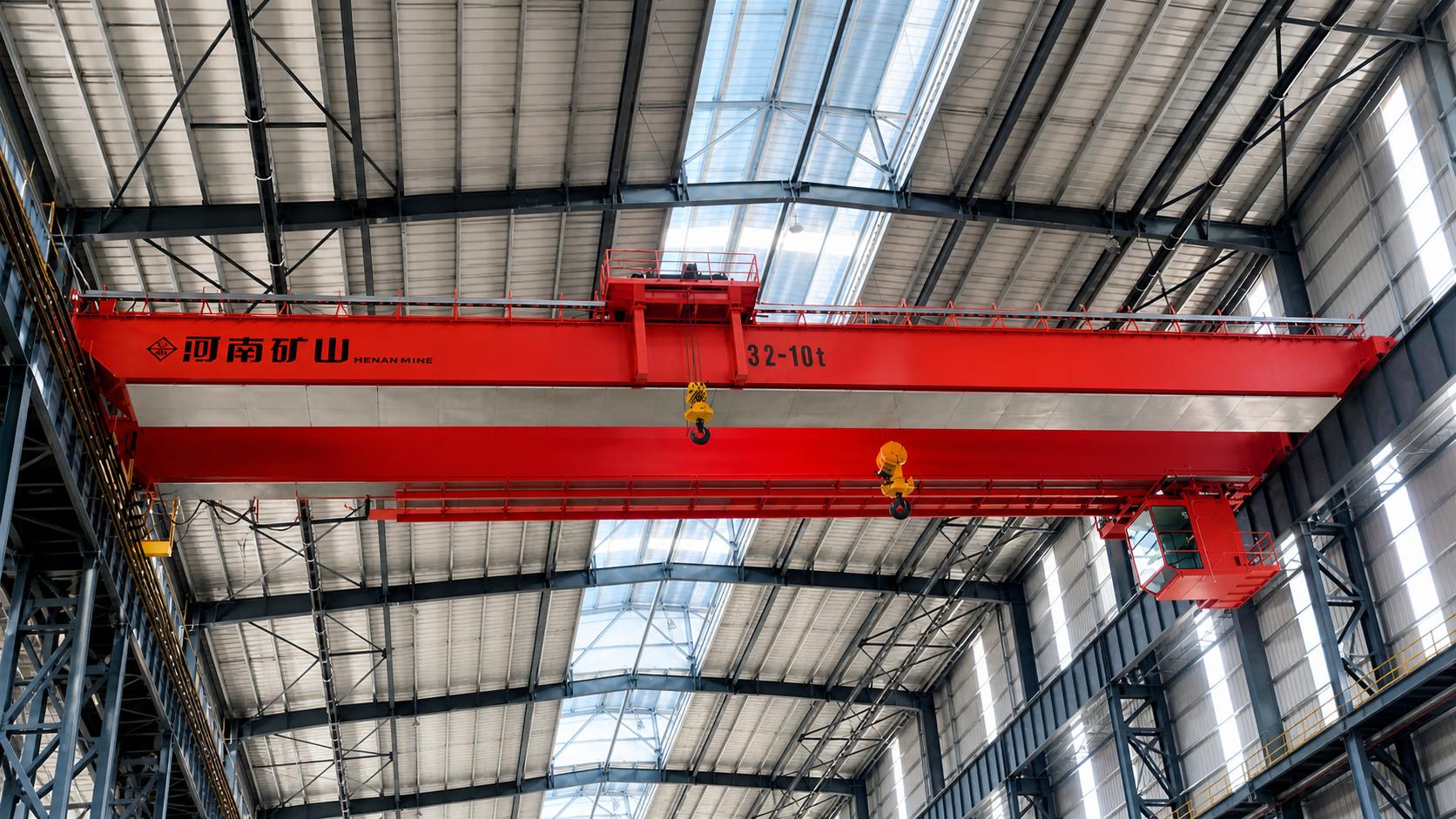
- Shared single-track layout: Two or more cranes share the same set of operating tracks, which is the mainstream layout of large assembly workshops and maintenance workshops.The space utilization rate is extremely high, but the controllability of equipment spacing is poor, and machine-machine collisions are prone to occur. Anti-collision systems, electrical interlocking and strict zoning rules must be matched.
- Overlapping layout of work areas: The crane tracks are independent of each other, but there is overlap in the core lifting area, material transfer area, and equipment assembly area.Commonly used in comprehensive manufacturing workshops, the main risks are conflicts in lifting paths and material swing collisions. Risks need to be avoided through regional authority control and priority scheduling.
- Dual-machine lifting layout: designed for ultra-long, overweight, and eccentric loads, two or more cranes simultaneously undertake the same load, which is a special high-risk collaborative operation mode, and a special lifting plan and synchronous control system need to be customized.
Key Challenges When Operating Multiple Overhead Cranes
The risk of multi-machine collaborative operation is much higher than that of stand-alone operation. The risk points are concentrated in the four dimensions of equipment interference, regional conflicts, parameter differences, and personnel communication. It is also the core pain point of workshop safety control.
Equipment collision risk
Collision is the most important type of accident in multi-crane operations, covering multi-dimensional equipment interference:
- Collision of the main body of the crane: the common rail crane is traveling in opposite directions, the spacing between the two is insufficient, or the operating trajectories in overlapping areas intersect, causing the main beam and end beam of the crane to collide directly.
- Interference between the trolley and the spreader: The spacing between the main body of the crane is up to standard, but the lifting trolley, hoist, wire rope, and hook swing, causing collisions between the spreader and the spreader and the adjacent crane structure.
- Risk of gap between the end beam and the track: insufficient buffer space at the end of the track, track deformation, and equipment operation offset, causing the end beam to touch the track limit structure, and the risk will increase exponentially when multiple machines are operating at the same time.
Shared work area conflict
The core transit areas, assembly areas, and storage areas of most comprehensive workshops are multi-machine shared areas, which are prone to operational congestion and conflicts: multiple operators seize the same lifting area at the same time, material transfer paths intersect and overlap, and the working space around the production equipment is narrow, which can easily cause loads to collide with equipment, personnel are not avoided in time, and the operation is congested and stagnant, which seriously affects production efficiency and at the same time lays safety risks.
Differences in parameter working conditions
Multiple cranes configured in the workshop are usually not of uniform specifications, and differences in parameters can lead to imbalances in collaborative operation: the rated lifting weight, lifting speed, operating speed, working level, and load frequency of different equipment are different.
Light-duty high-speed cranes have high operating efficiency and fast moving speed. Heavy-duty cranes start and stop slowly, and have high operating inertia. If the operating tasks are not matched according to the parameters, they are prone to sudden shrinkage of spacing, uneven load distribution, chaotic operation rhythm, etc., and even cause overload, tilt and other hoisting risks.
Communication and coordination defects
Multi-machine operations involve multiple operators, ground command personnel, and division personnel. Personnel communication loopholes are the main causes of man-made accidents: the operation information between operators is not synchronized, the ground command instructions are vague, and the noise in the workshop causes radio communication to fail, gesture signals are not uniform, and temporary operation instructions are not clear, which can cause misoperation, misoperation, and cause operation delays and even safety accidents.
How to Plan Multiple Overhead Cranes for One Workshop
Scientific pre-planning is the basis for realizing safe and efficient collaboration of multiple machines. It can avoid more than 80% of operational conflicts and safety hazards from the root cause. The core revolves around the four dimensions of material flow, regional division, equipment matching, and structure adaptation.
Sort out the flow of materials
Taking the overall production process of the workshop as the core, draw the whole process route of raw material warehousing, processing and production, material transfer, finished product assembly, and warehousing out of the warehouse, and mark the high-frequency lifting path, peak operating hours, and key operating areas.
Optimize the lifting trajectory through data analysis, reduce invalid operations such as crane idling, foldback, and cross-detour, streamline the operation process, reduce the probability of multi-machine operation conflicts from the source, and improve the overall transfer efficiency.
Divide the work area
Combining material flow direction and equipment layout, delineate exclusive operating areas, overlapping operating areas and prohibited operating areas for each crane: equipment in the exclusive area operates independently and has priority access; overlapping areas clarify operating authority, access priority and time-sharing operating rules;
No-work areas are set up in the precision equipment area, the densely populated area, and the end of the track, and they are controlled by three methods: ground identification, on-site warning, and system background locking to prevent illegal operations.
Matching equipment parameters
Eliminate the unreasonable configuration of “large machines for small use, small machines for large use”, and match equipment parameters according to the operation needs of each region: allocate equipment according to load weight, lifting height, operation span, operating frequency, and work level, and match high-speed light cranes for light and high-frequency transfer tasks.
Heavy-duty precision assembly tasks match low-speed heavy-duty cranes to ensure that equipment performance is highly adapted to operating requirements, avoid overload, rhythm imbalance and other problems, and reduce equipment energy consumption and wear.
Verify the bearing capacity of the structure
Multi-machine collaborative operation will greatly increase the load-bearing pressure of the track and the plant. Structural verification must be completed in the early stage: confirm the track arrangement, the spacing of the plant columns, and the load-bearing limit of the steel structure, and calculate the wheel pressure load of multiple machines operating at the same time to avoid track deformation and structural overload.;
At the same time, verify the carrying capacity of the power supply system and the equipment maintenance channel to ensure the continuous and stable operation of multiple machines, and reserve space for later equipment upgrades and capacity expansion.
Crane Control Systems for Coordinated Operation
The intelligent control system is the core auxiliary tool for multi-machine collaborative operation. It can effectively make up for the shortcomings of manual control, reduce human error and avoid operation conflicts. At the same time, it relies on manual operation authority throughout the process, and will not replace safe operation specifications. It is perfectly adapted to workshop safety control and efficient production needs.
- Wireless remote control system: get rid of the restrictions of the fixed operation room, the operator can flexibly control according to the operating perspective, and the supporting master-slave control mode is perfectly adapted to the dual-machine lifting and other linkage industry scenarios to improve operational flexibility and accuracy.
- PLC programmable control system: realize programmable control and control of equipment operation logic, support regional interlocking, track limit, and job timing scheduling, automatically avoid multi-machine track conflicts, and standardize equipment operation processes.
- Intelligent anti-collision system: equipped with laser, infrared, radar, and UWB ultra-wideband sensors, it monitors the relative position and trajectory of the crane in real time, triggers three-level protection for early warning, deceleration, and emergency shutdown, and eliminates the risk of aircraft collision.
- Precise positioning monitoring system: real-time collection of equipment location data through encoders and laser positioning equipment, dynamic monitoring of equipment spacing and operating status, and accurate data support for collaborative scheduling.
- Regional authority control system: lock the operation area of each device through the software background, automatically restrict unauthorized equipment from entering the exclusive area, and standardize the priority of operations in overlapping areas.
- Limit and electrical interlocking device: equipped with stroke limit, over-range protection, and emergency interlocking functions to prevent equipment from running out of range, and linkage shutdown is automatically triggered when multiple machine operations are abnormal.
- Centralized monitoring automation system: integrate the workshop MES production system to display the operating status, work area, and task progress of all cranes in real time, dynamically optimize the lifting route, and realize the integrated scheduling of production and lifting operations.
How to Prevent Crane-to-Crane Collisions
Collision is the number one safety hazard in multi-machine operations. A multi-level protection system of “manual specification + intelligent protection + physical protection” needs to be adopted to avoid risks in all directions.
- Adhere to safety spacing standards: according to the operating speed, braking distance, and inertial parameters of the equipment, a standardized minimum safety spacing is formulated, and the bottom line of spacing is strictly adhered to during operation to prevent close parallel and opposite driving.
- Normalization verification of anti-collision equipment: regularly calibrate anti-collision sensors, early warning devices, and shutdown systems to ensure that the equipment is sensitive and effective, and prevent safety accidents caused by the failure of protective equipment.
- Set up electronic limits and geographic fences: Set up electronic limits and virtual fences at the ends of the track, overlapping areas, and hazardous areas, and the equipment will automatically slow down and stop when it approaches the boundary.
- Strictly control shared area operations: control shared areas through time-sharing operations, permission locking, and priority rules, and prohibit multiple machines from seizing high-risk overlapping areas at the same time.
- Clarify the operation priority rules: uniformly stipulate the priority of heavy-duty equipment, the priority of key production processes, and the priority of straight-line operations, so as to avoid cross-track conflicts in an orderly manner.
- Equipped with physical buffer protection device: install a buffer and anti-collision baffle at the end of the equipment as the last physical protection to avoid collision accidents caused by the failure of smart devices.
- Establish a regular inspection ledger: daily pre-shift inspection, weekly special inspection, monthly comprehensive verification, keep inspection records, and replace failed accessories in time.
Coordinating Two or More Cranes for Tandem Lifting
For ultra-long, overweight, large-span, and eccentric loads, when a single crane cannot meet the lifting needs, dual-machine or multi-machine synchronous lifting operations are required. This operation is a high-risk special working condition and must strictly follow the standardized process.
It is mainly suitable for hoisting scenarios such as heavy machinery and equipment, ultra-long steel structure beams, large tanks, eccentric special-shaped components, etc., which can effectively solve the problems of insufficient stand-alone load, poor hoisting stability, and easy deformation of components.
Core operation control points
- Precise load distribution: accurately calculate the load-bearing ratio of each crane according to the center of gravity of the components and the position of the lifting point, and strictly implement the load derating standard (the load of a single equipment for dual-machine lifting usually does not exceed the fixed value by 75%) to avoid the risk of overload, and can be used with a balance beam to optimize the load distribution.
- Precise control of movement synchronization: priority is given to the selection of cranes of the same specifications and parameters. Through the master-slave synchronous control system, the whole process of lifting, operation, and trolley movement is synchronized to ensure the vertical force of the sling and eliminate offset and tilt.
- Unified personnel command system: set up a dedicated hoisting commander-in-chief, unify radio channels and gesture signals, and all operators and division personnel obey the instructions of the commander-in-chief throughout the process, eliminating multiple commands.
- Implement special hoisting plans: multi-machine hoisting must prepare a written special construction plan, clarify the load parameters, equipment configuration, operation trajectory, warning area, and emergency response measures, and complete the technical submission and test hoisting exercises before the operation.
Establish Clear Operating Procedures
A sound system is the guarantee of long-term safe and efficient operation. It is necessary to clarify rights and responsibilities, unify standards, and standardize processes to prevent people from operating at will.
- Clarify job responsibilities and authority: divide the job responsibilities of operators, ground commanders, maintenance personnel, and on-site management personnel, and set up dedicated on-site responsible persons for multi-machine operations to unify scheduling and management.
- Unified regional operation priority: clarify the traffic priority of shared work areas and cross-lifting trajectories, compile formal written operation specifications, organize all staff to learn and strictly implement them on the ground, and reduce job competition and path conflicts in multi-machine intersection scenarios.
- Establish a standardized communication system: unify radio call techniques, command gestures and emergency instructions, complete the functional testing of communication equipment before each shift starts, and eliminate communication risks such as unclear signals and deviations in command understanding.
- Formulate abnormal emergency plans: formulate standardized disposal procedures for various sudden working conditions such as communication interruption, anti-collision sensor failure, large load swing, and unexpected crane shutdown to facilitate on-site personnel to respond quickly and resolve safety risks in a timely manner.
- Collaborative scheduling of hoisting and production: combine the overall production plan of the workshop to co-ordinate the arrangement of hoisting tasks, and arrange high-frequency hoisting operations at peak times to avoid multiple cranes working together at the same time and reduce regional congestion.
- Normalized training and assessment: regularly carry out special training on multi-machine coordination, dual-machine lifting, and emergency response, and support skill assessments to continuously consolidate the professional capabilities of operators and ensure that personnel qualifications meet the requirements of multi-machine collaborative operation.
Common Mistakes to Avoid
The safety hazards and inefficiency of most workshops are due to the irregular operation of daily operations. The nine common misunderstandings need to be avoided.:
- Failure to analyze the flow of materials and plan the operation area, blindly adding cranes, causing chaos in the lifting order of the workshop and frequent congestion in the operation.
- There is a lack of control over overlapping work areas, no traffic priority and time-sharing work mechanism are set, and multi-machine work conflicts have become the norm.
- Excessive reliance on the experience and judgment of operators, only the naked eye can identify the spacing and operating trajectory of the equipment, and the lack of intelligent safety protection as the bottom guarantee.
- Ignoring the parameter differences between cranes, forcibly synchronizing equipment with inconsistent lifting speed and rated load, resulting in unbalanced operating conditions.
- The maintenance of the anti-collision system is not in place, the sensor is not calibrated or detected for a long time, and the safety protection function fails, laying hidden dangers of collision.
- The implementation of dual-machine hoisting without the preparation of a special hoisting plan, relying solely on experience operation, is extremely prone to load overload and component overturning accidents.
- The management of human-computer communication is not standardized, the command signals are not uniform, and the operation instructions are vague, which can easily cause misoperation and cause safety accidents.
- The carrying capacity of the plant track and steel structure has not been verified in advance. When multiple cranes are operating at the same time, structural risks such as structural overload and track deformation are prone to occur.
- Operator training is superficial, and there is a lack of regular retraining and ability assessment, making it difficult for the professional level of personnel to meet the requirements of multi-machine collaborative operation.
Maintenance and Periodic Safety Checks
The stable operation of equipment is the basis for collaborative operation. Normalized maintenance and inspection can effectively reduce equipment failures and safety hazards and extend the service life of equipment.
- Inspection of core components: Regularly inspect key components such as brakes, lifting mechanisms, end beam wheels, wire ropes, hooks, etc., and promptly investigate defects such as wear, loosening, and deformation.
- Safety equipment verification: periodic testing of stroke limits, anti-collision systems, electrical interlocking and emergency shutdown devices to ensure that various safety protection functions are sensitive, stable and reliable.
- Track structure inspection: Verify the flatness and wear of the track, confirm the fastening status of the connection parts of each structure, and investigate potential risks such as deformation of the steel structure and foundation settlement of the plant.
- Electrical system maintenance: overhaul and maintain components such as power supply lines, control cabinets, wireless remote controls, sliding contact lines, etc. to prevent electrical failures such as leakage and signal interruption.
- Improve the maintenance ledger: complete retention of inspection records, maintenance logs and parts replacement files to achieve traceable management of the crane's whole life cycle status.
- Timely disposal of abnormalities: Once abnormal equipment noise, abnormal vibration, operation offset, motion caton and other phenomena are found, it must be stopped for maintenance, and it is strictly prohibited for the equipment to be put into operation with faults.
Conclusion
The focus of the collaborative operation of multiple bridge cranes is not to add equipment, but to rely on reasonable layout, zoning control, anti-collision protection, collaborative control and standardized processes to build a lifting system adapted to the workshop, reduce equipment interference, improve equipment utilization, and meet the needs of multi-station complex material handling.
Intelligent anti-collision, scheduling and automation systems can improve the safety and efficiency of multi-machine operations, but they still require professional operators, inspection and maintenance, and safety system support.Henan Mine Crane can provide overall planning, customized design and manufacturing services for multiple bridge cranes based on workshop layout, load, operating scope and production process to create a safe and efficient multi-machine collaborative lifting system.