
How to Choose a Carbon Block Stacking Crane for Chemical Plants?
The wrong crane is selected for carbon block warehouse, which not only affects production capacity, but also hides safety risks.Dust, combustible gas and corrosive medium coexist in chemical and carbon products workshops. Heavy carbon blocks need to be handled frequently and accurately during operation. Ordinary cranes are easy to induce fire accidents.
Carbon block special stacking crane is specially designed for this harsh working condition, suitable for carbon processing, aluminum electrolysis, chemical scene, can safely complete carbon block grab, transfer and stacking.The core of the selection is not tonnage, but matching the fixture, automation system and explosion-proof and anti-corrosion protection configuration according to the field conditions.
This article will disassemble the core selection standards in detail, assist enterprises to select safe, stable and adaptable carbon block stacking cranes, and ensure efficient, compliant and controllable operation in the factory area.
What Is a Carbon Block Stacking Crane?
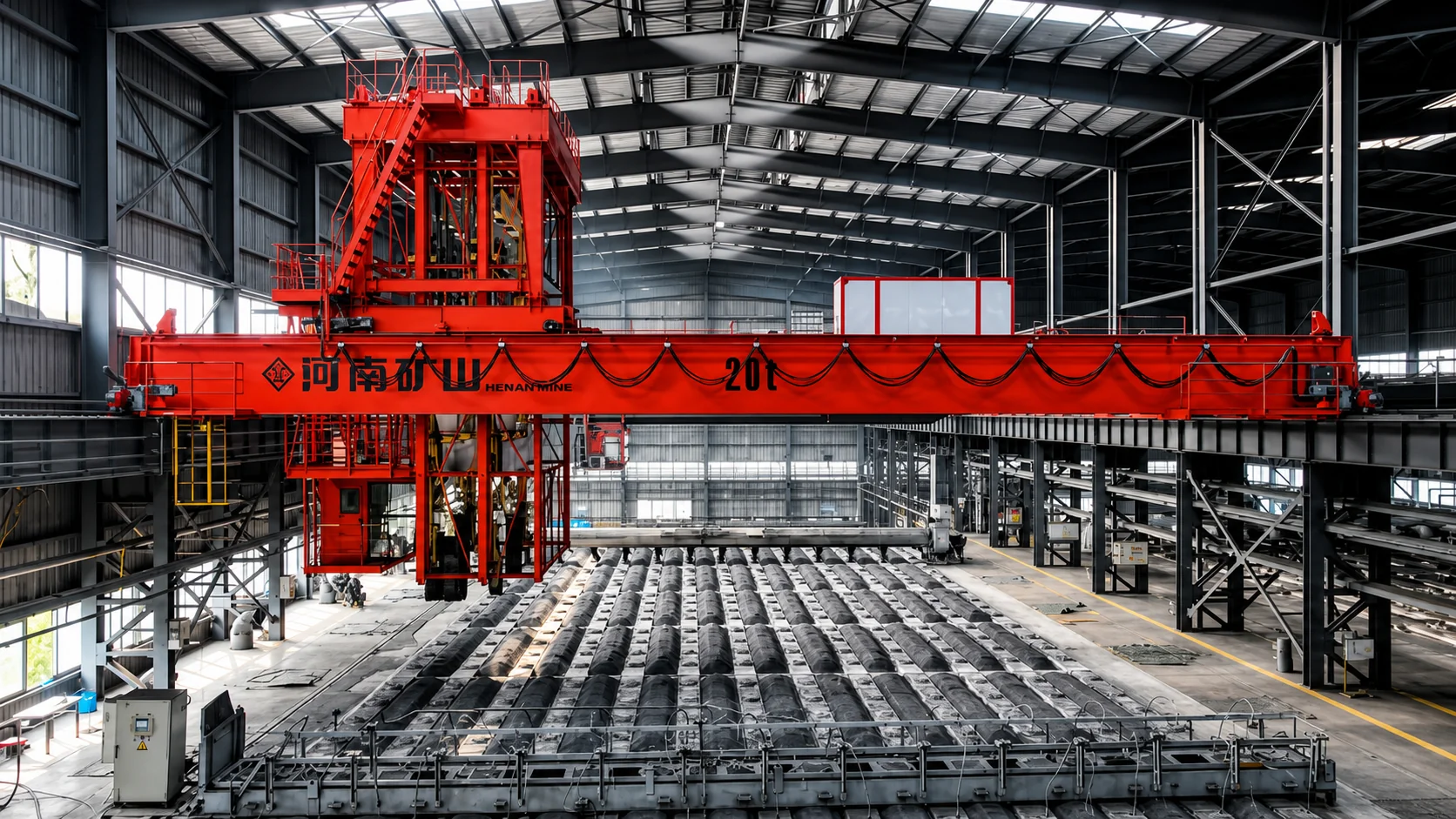
Carbon block stacking crane is a special bridge crane, cancel the traditional hook and ordinary grab, equipped with exclusive clamping tooling.The equipment can vertically clamp the whole row of carbon blocks (conventional 19 blocks, 21 blocks) at one time, and complete the whole process of carbon block production, baking, cooling and storage as a unit. The operation efficiency is much higher than that of ordinary lifting equipment for single block lifting.
The core components of the equipment are as follows:
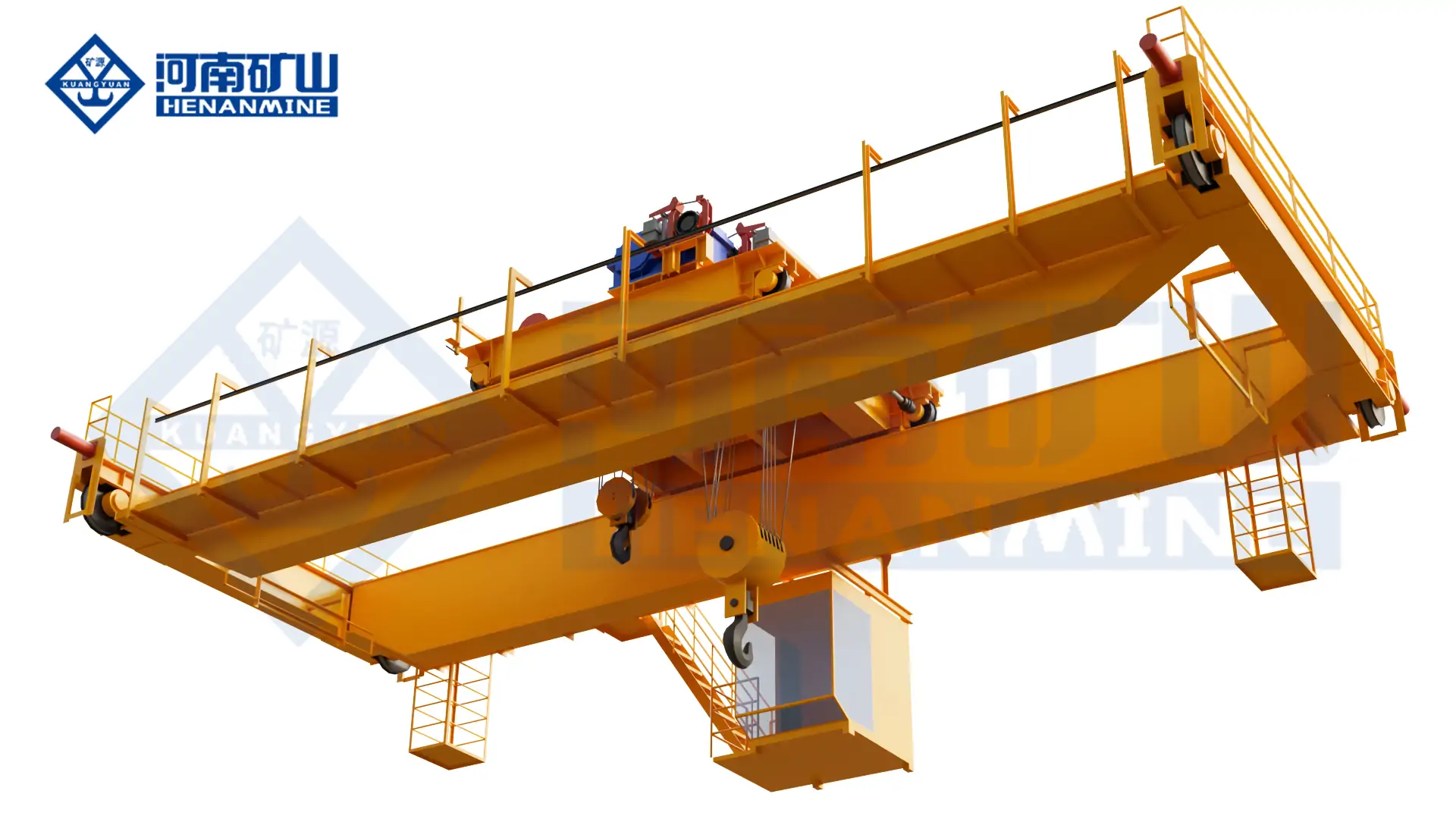
- Bridge structure: the overall welded box beam structure, strong rigidity, anti-fatigue, anti-deformation, long-term adaptation to high-frequency, heavy-duty continuous reciprocating operation, stable operation without shaking, equipment longer service life.
- Trolley travel mechanism: integrated high-precision drive and buffer structure, support the longitudinal movement of the whole machine track, lateral movement of the trolley bridge, stable start-stop without impact, accurate positioning, can cover the operation area in all directions, and ensure that the carbon block is transported without deviation and dislocation.
- Lifting mechanism: equipped with heavy-duty lifting and braking system, can accurately adjust the lifting speed, to achieve stable lifting of carbon blocks, slow drop, effectively avoid collision damage.At the same time, it has overload protection and power-off braking functions, which is safe and reliable, suitable for full-process material taking and stacking operations.
- Clamping device: customized tooling for the core of the equipment, optimized design according to the size and arrangement characteristics of the whole row of carbon blocks, uniform clamping force and firm attachment, which can effectively prevent the carbon blocks from loosening, deviation and sliding during the transfer process and ensure the materials are intact.
- Guidance system: equipped with high-precision positioning and guidance components, the load operation attitude is corrected in the whole process, the displacement error caused by equipment vibration and track deviation is offset, and the carbon block is transported vertically and stably, and the alignment is accurate, so as to meet the requirements of high-precision stacking conditions.
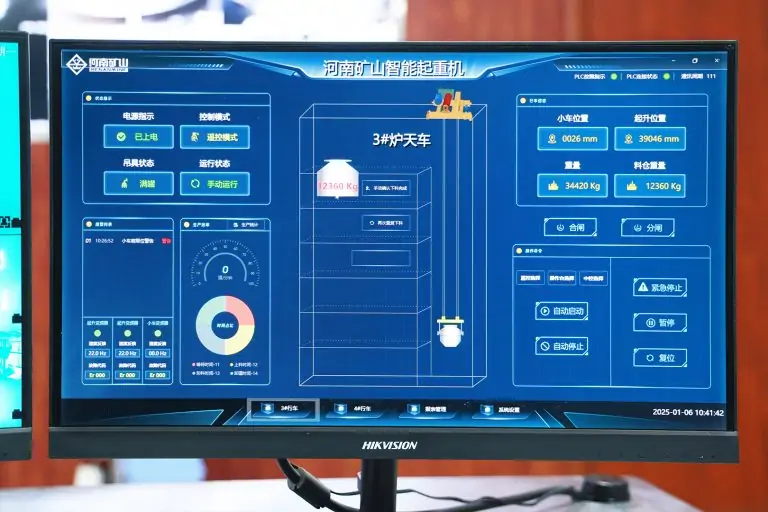
- Control system: PLC+VFD frequency conversion drive +HMI touch intelligent control system, which can realize intelligent operation such as accurate positioning, weight verification, automatic stacking, etc., support accurate control of the whole process of equipment, with safety functions such as fault self-test and overload protection, easy to operate and strong stability.
Different from the general overhead crane, all structural parts of the equipment are customized and developed according to the weight, shape and precision handling requirements of carbon blocks, and are specifically adapted to special working conditions such as carbon products, aluminum electrolysis and chemical industry. Standard general cranes cannot meet the requirements of such special operations.
Where These Cranes Are Used
Carbon block stacking crane is widely used in the whole process of carbon products and aluminum production, covering multiple core operation sections, which can complete accurate and repetitive material handling operations under high-risk conditions. The main application scenarios are as follows:
- Raw anode workshop:responsible for transferring the unbaked carbon blocks to the roasting furnace to ensure smooth connection of procedures;
- Anode baking work area: complete raw carbon block loading into ring furnace and tunnel furnace, and accurately remove and transport the finished carbon block after high temperature baking;
- Cooling and storage area: orderly stacking of roasted high temperature carbon blocks, support multi-layer three-dimensional storage stacking, and ensure the stability of materials without damage when the carbon blocks are cooled to the operating temperature;
- Carbon block warehouse: coordinate the orderly stacking and inventory management of finished carbon blocks, and provide stable material supply for subsequent anode assembly processes;
- Chemical and petrochemical plants: It is suitable for standardized and repetitive handling operations of various carbon-based materials, electrodes and bulk solid materials, and can perfectly adapt to the flammable, explosive and corrosive high-risk operating environment of the plant.
If the plant involves multiple production sections at the same time, it is necessary to focus on verifying the adaptability of equipment: due to the differences in risk levels and working conditions of each section, it is necessary to evaluate whether the crane with uniform specifications can be compatible with multi-area operations, or configure customized equipment for different sections, so as to ensure operation safety and equipment operation stability.
Key Selection Criteria: Load and Stacking Capacity
Capacity planning for a carbon block stacking crane isn't just about tonnage, it's about matching the crane to your block dimensions, batch size, and stacking pattern.
Block group size
The most popular cranes are configured to pick up a batch of 19 or 21 blocks per cycle, stacked lengthways in the gripper. Check your block dimensions, batch size before specifying as the gripper beam length and pitch spacing is based on this number.
Rated capacity
On a crane, a typical 15–30 ton capacity is found for most sizes of block, with a larger installation having a higher rating. However, making the capacity too small because of previous capital, car, wiring and structure savings is one of the most common and costly selection errors, as it constrains batch size and throughput permanently.
Stacking height
Specify the number of layers necessary with your storage scheme (multi-layer stacking which is usually up to 6-9 layers). The control system needs more accurate positioning as multi-layer stacking (which would exceed 6-9 layers) is more vulnerable to dislocation.
Span and duty class
Span should be the same width of your warehouse or workshop bay and duty class (typically A7 or 8) should be set for the amount the crane will continually run. If you set the duty for intermittent duty a crane would last only a very short time under 24/7 stacking.
Gripper and Clamping System Design
The clamping fixture is the single most application-specific part of a carbon block stacking crane, and it deserves more scrutiny than most buyers give it.
- Mechanical v. hydraulic clamps.Mechanical grippers use a four-link gravity self-locking arrangement, allowing them to open and close without power and retain force with power lost mid-cycle. Hydraulic clamps employ proportional valve control, to provide a variable clamp force to match block size and fragility, but require a hydraulic system to still retain force
- Variable pitch.Seek grippers with a variable spacing (typically around +/-50 mm) so the same crane can lift blocks that vary marginally in size without a change of fixture.
- Overload and leak protection.Weighing modules monitors clamped weight before lift and use automatic detection of fixture leakage and slip. No dropped loads! A potential disaster,when blocks of hundreds of kilos are stacked several meters high.
- Wear life and serviceability. Find out from suppliers about the rated cycle life of gripper liners, and if individual grippers are removable and replaceable rather than if the entire fixture beam has to come down every time a gripper wears out.
- High-temperature operation.Should the crane be expected to pull blocks from a baking furnace it will require heat resistant materials, and some form of insulation, as a generic Clamp would be doomed to failure.
Explosion-Proof and Hazardous Zone Requirements
The vast majority of carbon block equipment product data will ignore a core selection criteria, and for the chemical process area, rather than pure storage area of the crane, this point is crucial, that is, explosion-proof grade matching.
Combustible gas, solvent vapor and carbon dust exist in carbon processing and chemical workshops. Electric parts of ordinary cranes are easy to produce sparks and have hidden dangers of explosion.Therefore, high-risk areas should be zoned according to ATEX and IECEx standards, and the crane electrical system must match the corresponding explosion-proof level to ensure safe operation.
Practical steps for this section of your selection process:
- Classify the zone first: It is necessary to cooperate with the plant safety engineer to accurately determine the risk type of the crane operation area, and identify whether it belongs to gas hazard, dust hazard or solvent vapor hazard scenario.The explosion-proof design scheme corresponding to different dangerous working conditions is completely different and cannot be applied universally.
- Match the Ex-rating to the gas or dust group: Ex d IIB T4, Ex d IIC T4 and other explosion protection classes correspond to specific gas groups and ignitiontemperature Blindly high explosion-proof specifications will cause budget waste, while insufficient explosion-proof grades will leave major safety hazards, and accurate adaptation of working conditions and grades must be achieved.
- Seal every electrical interface: In high-risk gas explosion-proof areas, all electrical enclosures and cable access ports of the crane must be completely sealed to prevent flammable gases from penetrating into the equipment and contacting electrical components, so as to avoid explosion risks from the source.
- Don't assume higher explosion-proof class is always better: The core of explosion-proof selection is to fit the officially approved regional grade of the factory, and the higher the grade, the better.Excessive high allocation will not only increase the equipment procurement cost for no reason, but also increase the difficulty of equipment overhaul and maintenance, and cannot bring actual safety gain.
- Confirm compliance documentation: The explosion-proof performance of equipment shall not be based only on the oral instructions of the manufacturer, but must be certified by a third-party authority.Especially imported equipment, it is necessary to ensure that its explosion-proof qualification meets the local safety specifications for high-risk areas, and ensure that the equipment is put into use legally and in compliance with regulations.
Corrosion and High-Temperature Resistance
In addition to the risk of fire ignition in the chemical plant environment, various chemical media erosion will also cause significant equipment loss.The joint action of acid and alkali steam, high humidity air and carbon powder dust in the workshop will make the corrosion rate of ordinary steel and electrical shell much higher than that of conventional industrial plants.
The following core protection schemes shall be clearly implemented for equipment selection:
- The steel structure and exposed mechanical parts of the factory building shall be sprayed with anti-corrosive coatings or made of corrosion-resistant materials to withstand the erosion of acid and alkali steam, humid air and carbon powder to prevent corrosion of components and attenuation of structural strength.
- Electrical equipment shall be sealed shell, in addition to meeting the standard explosion-proof grade, but also need to adapt to the special conditions of dust, high humidity and strong corrosion on site, so as to prevent medium intrusion and avoid various electrical faults.
- Lifting accessories suitable for baking process shall be made of high-quality materials with high temperature resistance and thermal aging resistance, so as to effectively avoid deformation, loosening and failure of accessories under high temperature environment and ensure safe and stable lifting operation.
- Equipment wearing parts selection needs to take into account mechanical wear and chemical corrosion double loss, chemical corrosion conditions will greatly reduce the service life of conventional parts, need to choose wear-resistant, corrosion-resistant composite special materials.
When purchasing carbon block stacking cranes, confirm whether the equipment is optimized for chemical corrosion conditions.If there is no difference in material, structure, and protection between the ordinary model and the chemical version, it means that the equipment is not suitable and there are safety hazards, and should not be selected.
Automation and Control Systems
Modern carbon block stacking cranes range from fully manual cabin-operated units to fully automated systems that run entire stacking sequences without an operator in the loop.
Control architecture. Look out for a PLC+VFD+HMI configuration. The combination gives repeatable precise positioning and real-time viewing of the operation through a point-n-click touchscreen. This configuration also facilitates remote recording of cycle counts and fault diagnostics.
Operating modes. The majority of installations will ease operation by having at least one of: cabin operation, remote radio control or dual-mode switching. (Dual-mode switching necessary for remote station operation or comfort of operation during maintenance/commissioning.)
Positioning and weight verification. Most commercial systems employ a vertical position sensor and a weighing module: the crane is lowered to an programmable position, the clamp is applied after a “loose rope” condition is detected, and then weight is confirmed before the lift is terminated. This safeguards against misalignments and overloads.
Level of automation. Determine as early as possible if a fully automated system (grip, place, destack, and load the truck without operator intervention) is best, or a semi-automated system where the operator loads or destacks from the semi and trucks, but the system does the handling. Fully automated systems minimize labor and reduce operators’ time in the hazard zone but rely on tighter tolerances in your dimensions and storage layout to operate reliably.
Structural and Mechanical Reliability
Carbon block stacking crane core structure and transmission system, the core requirement is to adapt to long-term continuous heavy duty cycle operation, rather than only meet short-term peak load, the key configuration standards are as follows:
- Bridge structure: box beam integral structure, compared with traditional open truss structure, bending resistance, torsion resistance, deformation resistance is stronger, can perfectly adapt to the workshop high-frequency, uninterrupted heavy-duty reciprocating operation, long-term operation is not easy to deform, higher stability, adapt to high-intensity continuous production conditions.
- Walking drive mechanism: long-span models are equipped with double-drive walking structure, which effectively solves the problems of unstable single-drive operation, large vehicle deviation, track deviation, etc., greatly improves the stability and positioning accuracy of the whole machine operation, and ensures accurate and error-free carbon block transfer and stacking operations.
- Hoisting brake system: the main hoisting mechanism is equipped with double brake redundancy protection, which subverts the single brake structure of ordinary cranes.It can completely avoid the safety risks such as falling and damage caused by single brake failure and suspended load, and ensure the safety of heavy lifting operation from the hardware level.
- Equipment working level:equipment working level shall match the actual operation frequency on site, and A7/A8 high working level shall be selected for general use.It is strictly prohibited to refer to the rated tonnage parameters only in the selection, and it is necessary to match the working condition grade in combination with the continuous operation intensity of the workshop, so as to avoid overload fatigue operation of the equipment, ensure the long-term stable service of the equipment, and prolong the service life of the whole machine.
Safety Standards and Certifications
Carbon block stacking crane high-risk operating conditions, in addition to basic explosion-proof certification, but also to meet a full set of safety compliance standards, core requirements are classified as follows:
- Industry specifications and qualification documents: The equipment must strictly comply with the safety standards for overhead cranes in the project territory, and be equipped with complete official qualification materials such as equipment working level certificates and rated load test reports to ensure that the equipment parameters and performance meet the production compliance requirements of the factory.
- Hardware safety protection configuration: The lifting system is equipped with multiple limit protection devices, including upper and lower travel limit, over-travel forced protection and other functions, which can effectively eliminate safety accidents such as equipment collision and carbon block falling caused by over-winding and over-release, and build up hardware safety defense lines.
- Acceptance criteria for commissioning: Before the equipment is officially put into operation, it must pass comprehensive inspection, commissioning and acceptance by an authoritative third-party organization, issue a compliance acceptance report, and prevent the equipment from being put into use with hidden dangers and non-compliance.
- Procurement compliance principle: all safety, explosion-proof and detection-related qualification documents shall be verified and confirmed in advance at the procurement signing stage.It is strictly prohibited to supplement the compliance data after equipment installation, which can effectively avoid the high cost and shutdown risk caused by later rectification and transformation.
Cost Factors and Total Cost of Ownership
Carbon block stacking crane selection can not only pay attention to the purchase unit price, but also comprehensively consider the full life cycle use cost. The cost factors are classified as follows:
- Cost difference of equipment working condition level: low-cost and low-level equipment cannot adapt to long-term full-load continuous production, long-term high-intensity operation is easy to rapidly age, frequent failures, frequent overhaul or even replacement of the whole machine, short-term purchase advantages will be offset by high operation and maintenance and replacement costs in the later period, and the comprehensive cost performance is extremely low.
- Wear parts and maintenance costs: preferred to support more than 50,000 cycles of fixture wear bushing, with quick-change tooling structure, can greatly shorten the equipment maintenance, replacement of parts downtime, effectively reduce the equipment full-cycle operation and maintenance costs, ensure production continuity.
- Explosion-proof and anti-corrosion configuration hidden value: Although explosion-proof and anti-corrosion special accessories will increase the initial purchase investment of equipment, they can adapt to high-risk corrosion, flammable and explosive conditions, effectively avoid high hidden losses such as equipment failure, safety accidents, shutdown rectification and compliance penalties, and are safer and more economical for long-term use.
- Automation investment and labor cost: High automation configuration can greatly reduce the labor cost of single stacking and transfer, improve operation efficiency, but it will increase the initial cost of equipment, and it needs regular maintenance of supporting professional sensors and control systems, which is suitable for large-scale and high-frequency production scenarios.
- Spare parts supply chain downtime cost: focus on checking the supplier's core wearing parts stock reserve and delivery cycle.Carbon block stacking crane is the core equipment of storage. Once the equipment is shut down due to shortage of accessories, the whole carbon block warehouse will be shut down directly, resulting in huge capacity loss.
Choosing a Supplier
Carbon block stacking crane is a special lifting equipment. The comprehensive strength of the manufacturer directly determines the equipment adaptability, operation stability and post-service guarantee. The core dimensions of the selection are classified as follows:
- Industry special project experience: give priority to verifying similar landing cases of suppliers in carbon products, anode processing and chemical high-risk explosion-proof scenarios, focus on benchmarking project experience under the same working conditions and equipment specifications, abandon manufacturers with only general crane installation experience, and ensure that manufacturers are familiar with special working conditions and operation pain points of carbon block production.
- Non-standard customization adaptability: there are different requirements for carbon block size, marshalling quantity, yard layout and explosion-proof zoning conditions on site, and standard models cannot be fully adapted.The supplier is required to have exclusive customization capability, which can optimize fixture structure, equipment parameters, explosion-proof configuration and control system according to actual working conditions on site, and meet the personalized production requirements of the plant.
- Localization after-sales maintenance capability: equipment integration explosion-proof structure and intelligent automation system, maintenance professional requirements are extremely high.It is necessary to confirm that the supplier has a localized technical team and a rapid response mechanism, which can provide a full set of services such as on-site maintenance, fault handling, parts replacement, system commissioning, etc. to avoid long-term downtime caused by equipment failure.
- Transparency of compliance certification: regular manufacturers shall actively and completely provide a full set of official materials such as explosion-proof certificates, safety inspection reports, equipment qualification documents, etc., eliminate problems such as lack of qualification and supplementary qualification, and ensure that equipment is put into operation in compliance with regulations and smoothly passes factory and safety supervision inspections.
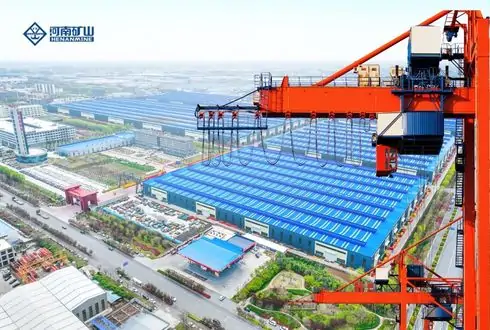
Henan mine crane as China lifting equipment leading high-tech enterprises, has a professional R & D platform and a number of patented technologies, with strong non-standard customization and complex working conditions adaptation capacity.
The company has a complete intelligent manufacturing industry chain, leading the production and sales scale of gantry cranes in the industry, and the products are exported to many countries around the world. They are mature and suitable for high-risk and complex conditions such as carbon products, aluminum electrolysis, chemical explosion prevention, etc.
Conclusion
The selection of carbon block stacking crane needs to accurately match four core conditions: carbon block handling parameters, factory explosion and corrosion risk level, automation requirements and professional industry suppliers.Blind reduction and simplification of explosion-proof and anti-corrosion configuration can reduce initial investment, but it will significantly increase safety hazards and shutdown losses.
Key parameters such as explosion-proof grade and carbon block specifications of the factory shall be specified in advance before procurement, so as to facilitate the manufacturer to provide accurate and compliant equipment solutions.When selecting partners, priority shall be given to checking similar project cases of carbon products and chemical high-risk working conditions, and professional suppliers with special customization and practical operation capability shall be accurately selected.