
How to Avoid Crane Interference in a Multi-Crane Workshop
In workshops where multiple bridge cranes share the same span of plant and track, the working space of the main beam, trolley, hook and hoisting cargo often overlaps.The light ones restrict each other and production stagnates, while the heavy ones damage the structure of the equipment and fall from the crane, causing injuries to personnel.
This article will explain to you what crane interference is, the root causes of interference, how to prevent and control it through workshop layout design and modern technical means, and share the safety management plan for operators and workshop managers to coordinate multi-machine operations.
What Is Crane Interference in a Multi-Crane Workshop?
Crane interference refers to the unexpected interaction between two or more cranes in the same workshop (or between the crane and a fixed building or other equipment).It includes both physical contact and collision, as well as operation conflicts: the action of one crane forces another crane to slow down, stop, or change the operation route.
Physical collision refers to the direct impact of the main beam, end beam, trolley, hook or hoisting cargo of the crane; and operation interference refers to the overlap of the hoisting area. Even if there is no contact, the operating range of one crane will limit the normal operation of another crane and reduce operating efficiency.Common interference points include:
Crane main beams that are close to each other on the same track, lifting trolleys running on adjacent main beams, swinging hoisting, vertical safety clearance conflicts between cranes of different heights, and multiple shared operating channels.
Common types of crane interference
- Interference between the main beam and the main beam: Two bridge cranes approach each other on the same operating track.The main beams generally cannot travel through each other, and when the spacing is insufficient, there is a high risk of hard limit shutdown and even collision.
- Trolley and trolley interference: the distance between the lifting trolley adjacent to or layered on the main beam is too close. When the crane exceeds the range of the centerline of the main beam, the risk of this interference will be further increased.
- Interference between the hook and the crane: The suspended cargo swings, or the extra-long spreader or workpiece extends into the operating envelope of another crane.
- Vertical interference: There is a gap conflict between cranes with different installation elevations. When the upper crane drops the hook or cargo, it will invade the working space of the lower crane.
- Shared track interference: Multiple cranes compete for limited access space on the same set of tracks, and there are frequent shutdowns and job scheduling conflicts.
Why crane interference is a major safety hazard
Interference will damage the main beam, end beam, track and core lifting parts of the crane; greatly increase the risk of falling crane objects and injuries to on-site personnel; sudden downtime disrupts production plans and causes long-term shutdowns.
Frequent dangerous situations or collisions will also drive up equipment maintenance costs and reduce the overall efficiency of equipment use.In multi-crane operation scenarios, such problems will also have a knock-on effect: the stagnation of one crane will affect the normal operation of other cranes on the same track and in the same operating area.
What Causes Crane Interference in Industrial Workshops?
Unreasonable layout of the workshop
Insufficient safety clearance of adjacent cranes, overlapping lifting areas and no clear boundaries are the most important incentives for interference.In the design stage of some plans, the dimensions of the crane, the stroke of the trolley, the limit position of the hook, the swing range of the crane, and the complete operating envelope of the special-shaped long-piece cargo were not fully considered, laying long-term safety risks.
Multiple machines share the same track
When two or more cranes share the track, the cranes cannot intersperse with each other.Insufficient braking safety distance, high-speed operation of multiple machines at the same time, and differences in lifting status will all amplify the risk of interference.When designing and managing, it is necessary to comprehensively consider braking performance, approaching speed, and the dangers caused by the superimposed movement of two cranes facing each other.
Crane operation process is not uniform
Synchronous lifting and cart operation in restricted areas; poor communication between drivers; lack of clear traffic priority and scheduling rules will lead to unavoidable conflicts.In the absence of a standardized collaborative system, it is easy for both drivers to acquiesce to their priority right of way.
The driver’s field of vision is limited
Plant columns, production equipment, stacking materials, and the crane's own steel structure will all form visual blind spots; when oversized and overweight workpieces are hoisted, they will further block the driver's line of sight; poor lighting in the workshop and loud environmental noise will also hinder signal transmission and communication.
How to Prevent Crane Interference Through Workshop Design
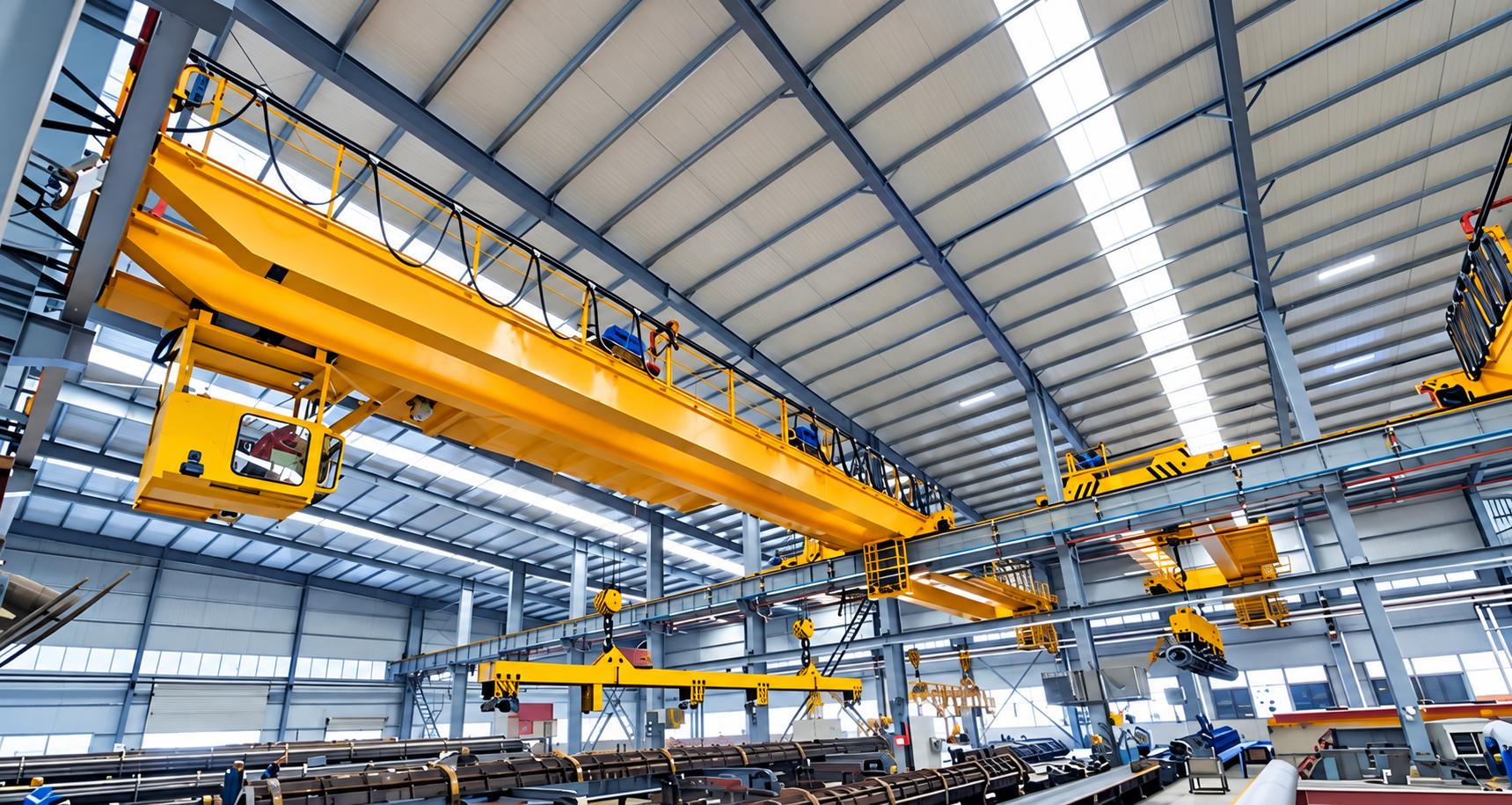
- Planning crane tracks and independent operating areas: early in the project, it is necessary to calculate the track layout spacing and the safety clearance of the main beam; under the premise of meeting the production process, divide the independent operating areas as much as possible.Give priority to using three-dimensional modeling and simulation tools to assess the risk of overlap in the lifting area, and do not wait for the crane to be installed before remedying it.
- Reasonable setting of layered elevations: when the height of the plant floor and the bearing capacity of the structure allow, a hierarchical arrangement of high and low levels is adopted to enable the upper and lower floors to operate independently and reduce horizontal interference; at the same time, check the distance, lifting height and structural clearance of the hook limit to ensure that the upper lifting will not break into the lower operating range.
- Choose the appropriate crane model configuration: according to the rated lifting weight, span, and net height restrictions of the plant, choose a single main beam or double main beam bridge crane.For scenes with tight vertical space, low-clearance cranes are preferred.The form, lifting height, and operating speed of the lifting trolley must all match the law of material flow and the frequency of simultaneous multi-machine operations.
- Set up exclusive material lifting channels: separate the lifting, loading, and unloading areas from each other to minimize the intersection of material flow routes; delineate exclusive control areas for oversized and heavy-duty lifting to avoid conventional lifting operations from entering high-risk envelope areas.
Essential Technologies for Preventing Crane Collisions
Crane anti-collision system
Mainstream anti-collision systems rely on laser ranging sensors, infrared, photoelectric or radar sensors to measure the distance between cranes, cranes and fixed obstacles in real time.
When the spacing reaches a preset threshold value, the system performs a hierarchical response of early warning, deceleration, and forced shutdown in turn, leaving reaction time for the driver and the drive system.This system is of great application value in shared track and multi-layer crane scenarios.
Stroke limit switch and limit device
The first-level and second-level stroke limit switches are used to limit the movement range of carts and trolleys at the end of the track or in the delineated area to prevent the crane from breaking into the no-go area and exceeding the safety boundary of the mechanical stop.Software partition control can be used as a supplement to mechanical limits and set electronic no-fly zones.
Variable frequency drive system (VFD)
Frequency conversion drive can achieve smooth start-stop, acceleration and deceleration control.When the crane is close to another equipment or the boundary of the area, it slows down smoothly, reduces the impact load, improves the positioning accuracy, and shortens the safe braking distance.
Collaborative control system
The programmable logic controller relies on priority logic, partition control, and action interlocking to achieve multi-machine collaboration.The system integrates sensor signals, frequency conversion drive status, and driver operation instructions. When multiple machines share the same area, they will automatically give way according to preset logic.
Wireless communication and remote monitoring system
Wireless control and centralized monitoring system help drivers grasp the location and operating status of other cranes in real time; real-time alarms and status signs facilitate managers to coordinate multi-machine operations and quickly deal with interference risks when they arise.
How to Coordinate Multiple Crane Operations Safely
- Formulate priority rules for crane operations: clarify the priority of passage based on production needs, and prohibit multiple cranes from moving at the same time in restricted and shared areas.Formulate right-of-way rules, and support dispatch and wireless dispatch mechanisms when necessary.
- Delineate safe operating areas: mark the driving boundary and lifting range of carts through ground signs and visual signs; prohibit unrelated equipment and personnel from entering the crane's exclusive operating area; use warning lights, buzzers, and luminous signs to indicate that the crane is working.
- Strengthen communication between crane drivers: unify wireless speech techniques and standard gesture signals to ensure audio-visual communication between drivers and on-site dispatchers.For dual-machine hoisting and multi-machine collaborative hoisting operations, the only hoisting commander must be designated.
- Preparation of standardized operating procedures (SOP): The document specifies the multi-machine synchronous operating procedures, large-piece lifting specifications, and emergency response plans, including collision avoidance operations, emergency shutdowns, and inspection procedures after dangerous situations, and regularly organizes driver training exercises.
Inspection and Maintenance Practices for Crane Interference Prevention
Regular inspection of anti-collision devices
Check the installation location, detection distance and response accuracy of the sensor, and verify the three-level functions of early warning, deceleration, and shutdown through simulation of actual working conditions; if the sensor or line is found to be abnormal, it should be replaced in time to avoid the protection function being useless.
Maintenance brake and walking mechanism
Check the brakes, motors, wheels, and transmission mechanisms; verify the braking distance under no-load and full-load conditions respectively; after adjusting the speed and lifting conditions, re-check the frequency conversion parameters and braking performance.
Normalized safety inspection
Check the track, end stop, structural connection parts, and electrical system; sort out maintenance records to locate recurring interference risk points; after maintenance and control procedures are changed, carry out functional tests of the whole machine to ensure the reliability of the anti-collision function.
How to Choose the Right Overhead Crane System for a Multi-Crane Workshop
Workshop size and lifting requirements
First figure out the length, width and available net height of the plant, and clarify the key parameters such as rated lifting weight, span, and lifting height; then combine the workpiece size, weight and lifting frequency to make the selection results fit the real production rhythm.
Compatibility and synergy
Confirm that when multiple machines share tracks or are arranged in layers, the wheel pressure load of the plant structure meets the requirements; the control system supports access to anti-collision equipment and PLC collaborative control, and it must also be confirmed when there is a lifting synchronization function.Different processes can be equipped with differentiated operating speeds and lifting mechanism configurations.
Security configuration and customization scheme
Configure the anti-collision system, stroke limit, frequency conversion drive, and wireless remote control according to the layout; give priority to customizing the partition plan, rather than directly applying general products; equipment selection needs to meet the corresponding lifting safety specifications and standards.
Henan Mine Crane provides corresponding equipment configuration and technical solutions according to customers' project needs, on-site conditions and actual operating requirements.
Conclusion
The interference problem of multi-crane workshops can be avoided through scientific layout, adaptation technology, standardized operating procedures, and strict maintenance system.The anti-collision system, zoning control, and hierarchical arrangement are adopted when conditions permit, and a complete collaborative management mechanism is used to jointly create a safer and more efficient operating environment.
When purchasing and upgrading bridge crane systems, interference prevention and control should be regarded as the core design requirement, rather than additional remedial measures in the later stage.After implementation, risks can be reduced, maintenance expenses can be reduced, equipment utilization rates can be improved, and the operation safety of all personnel in the workshop can be guarded.