
Electric Wire Rope Hoist Selection Guide: Low Headroom vs. Standard Types
Wire rope electric hoists are the core equipment of industrial hoisting scenarios, and are widely adapted to various heavy-duty operation scenarios such as factory production, material transfer, equipment maintenance, and port loading and unloading.In the selection of equipment procurement, most users only pay attention to the rated load of the hoist, but ignore the key core factor of the structure.
The mainstream wire rope electric hoists on the market are divided into two types: low-clearance wire rope electric hoists and standard wire rope electric hoists.The adaptation scenarios, structural advantages, and cost systems of the two are significantly different.
This article will compare the characteristics, applicable scenarios and selection points of the two equipment in an all-round way, and help factory managers, procurement engineers, and equipment operation and maintenance personnel to accurately select suitable hoisting equipment based on plant conditions, hoisting requirements, and budget standards.
What Is an Electric Wire Rope Hoist?
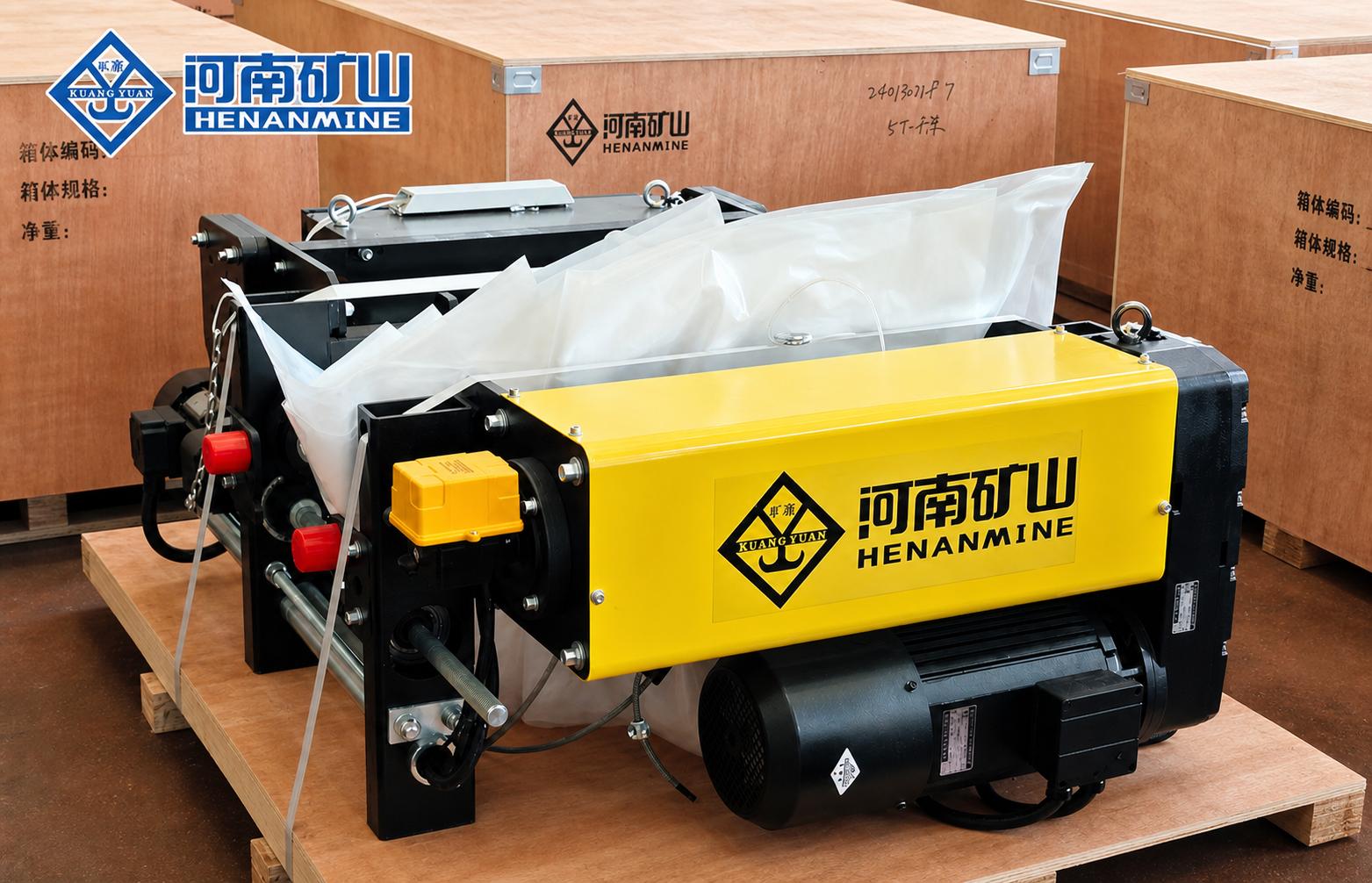
The wire rope electric hoist relies on electric drive to realize heavy-duty lifting and translation operations. The core operating logic is simple and mature: the motor transmits torque through the gearbox, drives the reel to rotate at a uniform speed, and drives the wire rope to wrap or loosen, so as to realize the lifting action of the hook and load.
At the same time, the braking system can lock the load at the moment the equipment stops, eliminating the risk of heavy objects slipping; the upper and lower limit switches accurately limit the operating stroke of the hook to avoid damage to the equipment by over-range collisions; the operating trolley cooperates with the control system to achieve accurate horizontal movement of the load, and the whole system is stable in linkage and easy to control to meet the needs of industrial high-frequency hoisting.
Core components
The wire rope electric hoist is composed of multiple core components in collaboration, and each component performs its own duties to ensure the safe and stable operation of the equipment.:
-Drive motor: The core power unit of the equipment can match the power and speed requirements of different working conditions, and the output power is stable and long-lasting, ensuring the long-term stable start-stop and continuous operation of the hoist.
- Wire rope reel: equipped with precision special rope grooves, it can guide the wire rope to be wound in an orderly and neat manner, effectively eliminate problems such as messy rope, off-groove, abnormal wear, etc., and extend the service life of the wire rope.
- Variable speed gearbox: responsible for power transmission and torque adjustment, accurately control the lifting and operating speed, adapt to various heavy-duty hoisting conditions, and improve the power transmission efficiency and operating stability of the whole machine.
- Wire rope and hook components: The core load-bearing components are made of high-strength and wear-resistant wire rope with safety self-locking hooks, with strong carrying capacity and high safety factor, which guarantees the safety of heavy-duty hoisting operations in all directions.
- Braking system: The core safety protection structure can achieve smooth deceleration, precise shutdown and load locking, adapt to conventional operation braking and instantaneous braking in emergency working conditions, and eliminate the risk of heavy objects slipping.
- Limit switch: Intelligent travel protection device, which accurately defines the upper and lower operating limits of the hook, effectively avoids over-range collisions, equipment damage and safety accidents, and realizes standardized limit protection.
- Running trolley: The whole machine walks smoothly and horizontally along the main beam of the crane, with smooth movement and accurate positioning, which can realize flexible transfer and precise alignment of workpieces, and is suitable for multi-point hoisting operations.
- Electrical control system: integrated handle control, wireless remote control, frequency conversion speed control and other multi-function modules, accurate and convenient control, equipped with multiple electrical protection mechanisms to ensure the intelligent and safe operation of the equipment.
- Overload protection device: real-time dynamic monitoring of the hoisting load, once the rated load is exceeded, automatic shutdown will be triggered immediately, avoiding the risk of overload operations from the source, and protecting the safety of equipment and personnel.
Mainstream application scenarios
Wire rope electric hoists have the advantages of strong carrying capacity, large lifting stroke, stable operation, and low failure rate. They can be adapted to normal hoisting operations under all working conditions such as light load, medium load, heavy load, and overweight, and are suitable for almost all industrial lifting scenarios.According to the application field, it can be divided into the following three categories:
- General processing and maintenance scenarios: widely used in machining workshops, equipment maintenance bases, steel structure processing plants and other scenarios, used for workpiece assembly, equipment displacement, mold replacement, daily maintenance and hoisting, suitable for high-frequency, lightweight to medium-heavy-duty conventional operations.
- Heavy industry and energy scenarios: it is suitable for harsh working conditions such as steel mills, power plants, and heavy industry manufacturing workshops. It can stably complete the hoisting and alignment of steel billets, components, and large-scale unit equipment. It is resistant to high temperature and continuous load, and is suitable for high-intensity continuous operation needs.
- Logistics and infrastructure scenarios: it covers outdoor and storage conditions such as warehousing and logistics centers, construction sites, ports and terminals, and is responsible for material handling, cargo stacking, and building materials transshipment. It adapts to the needs of hoisting with changeable sites and large operating spans.
What Is a Standard Electric Wire Rope Hoist?
The standard type (conventional headroom type) wire rope electric hoist is a classic configuration in the industry. It adopts the traditional modular structure layout. The motor, gearbox, reel, and operating trolley are arranged in a conventional manner. The overall structure is regular and no special optimization design is required. It is the most versatile hoisting equipment.This type of hoist is installed under the main beam of the crane, and the overall structure occupies a large vertical clearance space, which has basic requirements for the height of the plant floor.
Core advantage
- Mature structure and stable operation: relying on decades of industrialization and application accumulation, the standard modular structure has been verified by long-term working conditions, with stable and reliable performance and low failure rate, which can meet the long-term and uninterrupted continuous hoisting operations of enterprises, and the equipment has higher fault tolerance.
- Simple operation and maintenance, universal accessories: The whole machine adopts an open layout design, the structure is transparent, the disassembly and assembly are convenient, and the daily maintenance, maintenance and parts replacement process is simple.The core accessories are highly versatile and the market is well stocked, which can effectively shorten the downtime and maintenance time and reduce the cost of equipment operation and maintenance.
- Full coverage of tonnage and wide adaptability: the load specification system is perfect, fully covering light, medium, heavy and even heavy-duty conditions of more than 50 tons, while supporting non-standard tonnage customization, which can be adapted to the conventional and special hoisting needs of most industries.
- Outstanding cost performance and controllable landing cost: the structural design is simple and mature, no complex precision machining technology is required, the equipment procurement threshold is low, the installation and commissioning are simple, the late operation and maintenance investment is small, and the comprehensive economic benefits of the whole life cycle are excellent. It is suitable for standardized projects with controllable budgets.
- Excellent compatibility, suitable for many types of models: it is extremely versatile and adaptable, and can seamlessly match mainstream cranes such as single-beam, double-beam, gantry, and cantilever cranes. It is suitable for all kinds of standardized hoisting conditions such as conventional workshops, open-air sites, warehousing and logistics, and the threshold for equipment adaptation is lower.
Applicable scenarios
With the core advantages of mature structure, simple operation and maintenance, high cost performance, and wide adaptability, the standard wire rope electric hoist focuses on standardized hoisting conditions without vertical space restrictions.Combined with the actual use requirements, the applicable scenarios can be clearly classified from the two dimensions of the attributes of the adapted working conditions and the typical application site:
Adapt to working condition attributes
- Sufficient plant space: the vertical clearance height of the workshop and site is sufficient, and there is no need to compress the lifting height of the equipment structure, and there is no floor height restriction problem.
- Conventional hoisting requirements: mainly for medium and light conventional material hoisting, equipment assembly, and daily maintenance, without the need for extreme high-level hoisting operations.
- Normalized and stable working conditions: the operating frequency is stable and the load is uniform, mainly continuous conventional operations and low-frequency heavy-duty operations, and there is no need for high-intensity extreme working conditions.
- Refined budget control: the project prioritizes the comprehensive price ratio of equipment procurement, operation and maintenance, and pursues low-cost, high-stability landing solutions.
- Simple operation and maintenance requirements: on-site maintenance equipment is easy to overhaul, accessories are universal, and maintenance time is short, which reduces equipment downtime and loss.
Typical application site
- Newly built standardized factories: mechanical processing workshops with regular layout and sufficient floor height, equipment manufacturing production lines, and hardware processing workshops.
- Warehousing and logistics sites: storage centers with high-level standards and open spaces, material transfer bases, and finished product stacking workshops.
- Outdoor construction sites: open-air construction sites, depots, and outdoor equipment hoisting sites, without floor height constraints.
- Conventional maintenance stations: factory equipment maintenance area, auxiliary hoisting stations, used for daily equipment disassembly, displacement, and maintenance operations.
Overall, in the standardized working conditions without vertical space constraints, the standard wire rope electric hoist can give full play to the core advantages of stability and durability, wide adaptability, and low cost of operation and maintenance. It is the preferred equipment for industrial general hoisting scenarios.
What Is a Low-Headroom Electric Wire Rope Hoist?
The low-clearance wire rope electric hoist is a special equipment optimized for scenarios where the floor height of the plant is insufficient and the vertical clearance is limited.By reconstructing the equipment structure, optimizing the combined layout of the reel, motor, and trolley, and adopting a compact C-shaped structure design, the vertical spacing between the hoist body and the main beam of the crane is greatly reduced, and the headroom height occupied by the equipment itself is minimized.
Core design principles
Compared with the standard hoist, the low-headroom model re-optimizes the structure ratio of the whole machine, adjusts the installation position of the core components, and greatly shortens the vertical distance from the bottom of the main beam to the highest point of the hook (the hook is close).Under the premise that the total height of the plant is fixed, the effective lifting height of 200-500mm can be effectively increased, which perfectly solves the pain points of the traditional gourd industry of “enough space and insufficient lifting height”.
Core advantage
- The ultimate release of vertical space, greater lifting height: By optimizing the compact structure layout, the headroom occupied by the equipment itself is greatly reduced. Under the premise that the floor height of the plant is fixed, compared with the standard hoist, the effective lifting height can be increased by 200-500mm, and the potential of vertical working space can be fully tapped.
- Strong space adaptability and double utilization rate: completely improve the pain points of traditional hoist fuselage squeezing vertical working space, perfectly adapt to the layout of modern workshops with dense equipment and compact workstations, and improve the overall space utilization rate of the plant in all directions.
- Adapt to old-fashioned transformation, low transformation cost: there is no need to dismantle the factory building, raise the roof, and transform the main structure. It can be directly adapted to the upgrading and replacement of old cranes and equipment renovation projects. The construction cycle is short, the transformation investment is small, and the landing efficiency is high.
- Optimize infrastructure design and save construction costs: For new plant projects, the design standards for plant floor height can be reduced, steel structure, enclosure, hvac and other infrastructure investments can be effectively reduced, and the total cost of project construction can be compressed from the source.
Typical application site
- Old and low-rise factories: old-fashioned processing workshops, assembly workshops, and hardware manufacturing buildings with long construction years, high and low floors, and insufficient clearance.
- Equipment-intensive workshop: A modern intelligent manufacturing workshop with intensive automated production lines, compact layout of large machine tools, and tight vertical space.
- Renovation and renovation project sites: various industrial workshops for the replacement of old cranes, the upgrading of hoisting systems, and the process transformation of the factory area.
- Special restricted sites: production and storage areas where the top is covered with pipelines, bridges, and hvac equipment, and the effective operating floor height is further compressed.
- Low-cost new factories: new standardized factories that adopt low-rise and high-infrastructure design, pursue high space utilization, and strictly control civil construction costs.
Overall, the low-clearance wire rope electric hoist is specially tailored for space-constrained working conditions. Without changing the main structure of the plant, it maximizes the excavation of vertical working space and improves the hoisting height and site utilization. It is the optimal solution for industrial hoisting in restricted space.
Low-Headroom vs. Standard Electric Wire Rope Hoists
In order to facilitate users to visually distinguish the differences between the two devices, combining the core dimensions of structure, performance, cost, and adaptation scenarios, the precise comparison table is as follows:
| Contrast dimension | Low headroom wire rope electric hoist | Standard wire rope electric hoist |
| Required plant clearance | Extremely low, suitable for small vertical spaces | Higher, sufficient layer height support is required |
| Effective lifting height | The same layer is higher and higher, lifting 200-500mm | Limited by the structure of the equipment, the lifting height is limited |
| Structural design | Compact, integrated, optimized design, precise structure | Traditional modular conventional structure, mature design |
| Installation space requirements | Adapt to small spaces, flexible installation | Sufficient vertical installation clearance needs to be reserved |
| Initial procurement cost | High, the precision structure and process cost are higher | Affordable and more cost-effective |
| Maintenance difficulty | The layout of the components is compact and requires professional maintenance and operation | Open structure, simple and convenient daily maintenance |
| Space utilization | Excellent, maximize the value of plant space | Good, completely enough when there is no space limit |
| Best application scenario | Low-rise factory buildings, old-fashioned renovation, space-restricted working conditions | Standard factory building, adequate floor height, budget-sensitive working conditions |
Core summary: There is no absolute difference between the two gourds, only the adaptation scenarios are different.The core basis for selection is: plant space size, actual hoisting height requirements, crane configuration and project budget.The space is limited, choose the low headroom type, and the general working conditions give priority to the standard type.
7 Key Factors When Selecting an Electric Wire Rope Hoist
Rated lifting load
The rated load is the basis for selection, and the maximum lifting load of the equipment needs to be accurately calculated, including the total weight of the workpiece, tooling, spreader, etc.When selecting the type, it is strictly forbidden to select the type only according to the maximum load of the load, and it needs to be combined with the average daily hoisting load and the frequency of operation to make a comprehensive judgment.
High-frequency heavy-duty operations need to match higher-specification loads and operating condition levels to avoid small cars pulling large vehicles, resulting in accelerated wear and tear of equipment and shortened life; low-frequency light-load operations do not need to be over-selected to avoid budget waste.
Actual required lifting height
It is necessary to accurately measure the maximum stroke of the hook required for the operation, and calculate the whole process from the lowest reclaiming point to the highest unloading point, while avoiding the influence of obstacles such as workshop equipment, operation platforms, storage shelves, and pipelines.
In the scenario of restricted floor height, the standard hoist will take up a lot of vertical space due to its own structure, which can effectively raise the height, and the structural advantages of the low headroom hoist can perfectly compensate for this defect and ensure that the operating height is up to standard.
Available headroom height of the plant
Headroom height refers to the vertical distance from the bottom of the main beam of the crane to the obstacles (roof, pipes, lamps) on the top of the plant, which is the core hard index of selection.Among them, the proximity of the hook is the key parameter, that is, the distance from the bottom of the main beam to the highest point of the hook. The smaller the value, the greater the effective lifting height.The standard hoist hook has a large distance at close range, which can easily waste vertical space; the low headroom hoist greatly reduces this value and maximizes the release of working space.
Job level and work system
The operating frequency, load ratio, and running time of different operating conditions vary greatly, and the selection of FEM and ISO operating condition classification standards must be strictly followed.The core considerations include: the number of starts per hour, the average daily operating time, the average load to the rated load ratio, and the service life of the equipment design.
For light-duty maintenance conditions and low-frequency operations, a low-condition hoist can be selected; for high-frequency and continuous heavy-duty operations of the production line, it must be matched with high-condition equipment such as M5-M7.Insufficient selection of working conditions will lead to frequent equipment failures and frequent downtime and maintenance, which will seriously affect production efficiency; excessive selection will cause waste of equipment resources.
Crane type and trolley configuration
The electric hoist must be perfectly adapted to the supporting crane, otherwise there will be problems such as inconsistent installation, stuck operation, and safety hazards.Mainstream adaptation models include: single-girder bridge crane, double-girder bridge crane, gantry crane, monorail crane system, etc.At the same time, it is necessary to distinguish between the top-mounted and bottom-mounted trolley structures, and combine the crane's main beam specifications, wheel track, and track gauge selection to ensure that the hoist is compatible and matched with the structure of the whole machine.
Lifting and operating speed
The speed of the equipment directly determines the operating efficiency and hoisting accuracy.The single-speed hoist has a simple structure and low cost, and is suitable for ordinary material transfer; the two-speed hoist can realize fast and slow switching, taking into account operational efficiency and precise positioning;
The frequency conversion speed control hoist supports stepless speed regulation, stable start and stop, accurate positioning, and is suitable for precision equipment assembly and high-precision hoisting scenarios.Users can flexibly choose according to the production rhythm and operation accuracy requirements.
Operating environment conditions
The operating environment directly determines the protection level and special configuration requirements of the hoist.Standard protection models can be selected for indoor conventional environments; outdoor, dust, humidity, high temperature, and corrosive working conditions need to be equipped with sealed motors, high IP protection levels, and anticorrosive coatings; explosion-proof wire rope electric hoists must be selected for flammable and explosive scenes, and the whole machine adopts an explosion-proof structure to eliminate safety hazards and adapt to special industries such as chemical industry, mining, oil and gas.
When Should You Choose a Low-Headroom Hoist?
Low-headroom wire rope electric hoist is the exclusive preferred equipment for vertical space-restricted working conditions. It can specifically solve the pain points of insufficient lifting height of traditional hoist, low space utilization rate, and high cost of plant transformation. It is suitable for the following types of restricted operating conditions:
- Insufficient floor height and limited headroom of the workshop: The original vertical headroom height of the workshop is low, and the standard electric hoist cannot meet the effective lifting height required for production due to the large space occupied by the fuselage structure, making it difficult to install and put into operation normally.
- Upgrading and transformation of old factories: refurbishment of old workshop equipment and replacement of old cranes. The main steel structure and roof of the plant cannot be removed and raised. It does not meet the conditions for civil construction transformation. It is necessary to rely on the optimization of the equipment structure to improve the operating performance.
- Requirements for high-level hoisting operations: The production process has extremely high requirements for the lifting stroke of the hook, and it is necessary to maximize the vertical working space to meet the high-precision and high-stroke hoisting requirements such as high-level equipment assembly, high-level material stacking, and alignment of large workpieces.
- The layout of workshop equipment is dense: the automation equipment and large machine tools in the factory area are tightly arranged, and there are many top pipes, bridges, and hvac facilities. The vertical working space is greatly compressed, and the lifting operation gap is narrow.
- Strictly control the cost of infrastructure construction: The new plant project needs to optimize the architectural design, reduce the height of the plant floor, reduce the investment in steel structure, civil construction, and enclosure, and compress the overall infrastructure cost of the project from the source.
When Is a Standard Electric Wire Rope Hoist the Better Choice?
Under conventional hoisting conditions without vertical space constraints, the standard wire rope electric hoist has the core advantages of stable operation, easy operation and maintenance, and excellent cost performance, and has better adaptability. The following scenarios can be preferred for selection and use:
- Sufficient floor height of the plant: The vertical clearance space of the workshop is fully filled, which can fully meet the installation conditions and operating clearance requirements of the standard hoist. There is no floor height restriction, and the equipment can be directly and stably put into operation.
- Conventional hoisting requirements: Daily production hoisting operations have moderate requirements for vertical lifting stroke, and the rated lifting parameters of the standard hoist are fully adapted, without the need for ultra-high stroke and extreme high-level hoisting performance blessing.
- Controllable project budget: the equipment procurement and landing budget are limited, focusing on the comprehensive price ratio, and the initial investment in the procurement, installation and commissioning of standard gourds is lower, which can accurately control the project construction cost.
- Standardized new factory area: it is adapted to the new standardized factory building with a regular layout and a high floor height target, which can be perfectly matched with conventional crane equipment and fits the general hoisting and installation conditions.
- Lightweight operation and maintenance requirements: Relying on the characteristics of universal standard hoist accessories, open structure, and convenient disassembly and assembly, the daily maintenance process can be greatly simplified, and the equipment downtime loss and long-term operation and maintenance costs can be effectively reduced.
- Conventional operating conditions: the operating environment has no space constraints, high-precision alignment, extreme lifting and other special process requirements, focusing on stable, high-frequency, and normalized general material hoisting and equipment maintenance operations.
Common Mistakes When Choosing an Electric Wire Rope Hoist
Only select the type based on the rated load
The rated load is only the basic threshold for the selection of electric hoists. The working condition level, effective lifting height, space adaptation accuracy, and operation speed regulation performance are also the core indicators that determine the landing effect and service life of the equipment.
If you rely solely on tonnage selection, there will often be various problems such as equipment load reaching the standard, but insufficient adaptability to working conditions, inconsistent installation space, and substandard operating efficiency, which will eventually cause frequent equipment failures, downtime for repair and even long-term idleness, seriously affecting the normal operation of the production line.
Ignore the close-range parameters of the hook
The close distance of the hook is the core selection parameter that can easily be ignored, which directly determines the effective lifting height of the equipment and is related to the actual available stroke of the hoisting operation.If the selection and matching of this parameter is not correct, it will directly cause the loss of hundreds of millimeters of vertical working space, resulting in the actual lifting height of the equipment can not meet the standards, does not meet the production process requirements, and ultimately leads to a series of problems such as equipment return and rework, project construction period lag, etc., increasing additional landing costs.
Inaccurate measurement of plant headroom
The measurement of the headroom of the plant is a key part of the selection. If the occupied height of the top obstacles such as pipes, lamps, brackets, etc. is ignored, or the highest point of the hook is not used as a unified measurement reference, it is easy to produce data deviations and cause selection errors.After the equipment procurement is completed, there is a high probability that there will be insufficient installation space and the effective lifting height is not up to standard, resulting in additional high costs and construction period losses for equipment transformation and replacement of the whole machine.
Blindly pursuing low-cost equipment
The initial investment in low-cost equipment is low, but there are generally problems of rough craftsmanship, poor-quality accessories, insufficient working condition level, and high failure rate.Long-term use will produce high maintenance costs, downtime losses, and replacement costs, and the overall cost of use is much higher than that of compliance with high-quality equipment.The selection of models needs to consider the whole life cycle cost comprehensively, rather than simply looking at the purchase price.
Ignore the operating condition level
Inconsistent selection of working condition levels is the core cause of early aging of equipment and soaring failure rates.If you choose a low-condition electric hoist in a high-intensity operation scenario with high-frequency and heavy-duty loads, it will exacerbate the wear and aging of core components such as brakes, wire ropes, gearboxes, etc., resulting in frequent equipment failures and shutdowns, which will not only seriously delay production progress and cause loss of production capacity, but also breed major hoisting safety risks.
Ignore crane equipment compatibility
There are obvious differences in the wheel track, track gauge, body size and weight of the trolley of different types of electric hoists, and they must be accurately adapted to the parameters of the main beam of the crane.If the equipment compatibility is not up to standard, it is very prone to problems such as operation caton, force imbalance, and structural deformation, which will not only cause safety hazards, but also directly invalidate the original equipment warranty rights and interests.
How to Calculate the Right Hoist Configuration
Following the following standardized accounting process, the adapted electric hoist model and full set of configurations can be accurately matched, and various problems such as selection deviation, equipment mismatch, and working conditions can be avoided from the source, and the equipment can be accurately landed.:
- Approved maximum hoisting load: accurately count the overall total weight of workpieces, spreaders, and tooling aids, and combine the daily average load and peak load to determine the rated load specifications required by the equipment to eliminate the problems of high configuration for small loads and low configuration for large loads.
- Accounting for effective lifting height: on-site measurement of the maximum operating stroke of the hook throughout the operation, covering the whole process of low-level reclaiming to high-level unloading, while avoiding interference from obstacles such as on-site equipment, shelves, pipelines, etc., to ensure that the actual operating height is sufficient.
- Accurately measure the headroom of the plant: Based on the bottom of the main beam of the crane, the vertical distance to the top obstacles such as the roof, pipes, lamps, etc. of the plant is accurately calculated, and the real and available vertical headroom parameters of the plant are obtained.
- Check the close-range parameters of the hook: Compare the manufacturer's official equipment parameter table to verify the close-range value of the hoist hook, and combine the measured headroom size of the plant to verify whether the actual available lifting space of the equipment meets the production needs.
- Determine the operating conditions of the equipment: according to the core indicators such as the average daily operating time of the equipment, the frequency of start and stop per hour, and the load ratio, match the corresponding FEM and ISO operating conditions, and adapt to the intensity of various types of light, medium and heavy-duty operations.
- Matching and adapting operating speed: combining the operating efficiency of the production line with the requirements of workpiece hoisting accuracy, flexible selection of single-speed, two-speed or frequency conversion speed control configurations, taking into account the efficiency of hoisting operations and the stability of precise alignment.
- Check the on-site power supply conditions: check the on-site power supply voltage, frequency, power supply standard and other electrical parameters to ensure that the electrical configuration of the equipment is perfectly adapted to the on-site power supply system to avoid electrical adaptation failures.
- Verify the compatibility performance of the whole machine: check the wheel track, track gauge, fuselage size and other parameters of the electric hoist to accurately match the specifications of the crane's main beam and operating track to ensure that the equipment is installed and runs smoothly.
- Evaluate the on-site operating environment: according to the on-site temperature and humidity, dust concentration, moisture corrosion, flammable and explosive working conditions, select the corresponding protection level, anti-corrosion, explosion-proof and other special configurations.
- Verification of compliance with industry standards: Ensure that the selected equipment fully complies with international industry safety design standards such as ISO and FEM, meets industrial hoisting safety specifications, and ensures the compliance and stable operation of the equipment.
Core selection criteria: If the required clearance height of the standard wire rope electric hoist is greater than the actual vertical clearance available in the plant, it needs to be directly replaced with a low clearance hoist to make up for the lack of space and ensure that the lifting height of the equipment meets the standards and is put into operation normally.
Conclusion
The low-clearance type and the standard wire rope electric hoist have their own strengths, and the core of the selection is to match the plant space and hoisting conditions.The standard type is stable, easy to operate and maintain, and cost-effective, and is suitable for general hoisting of conventional factories; the low-clearance type has a compact structure and is suitable for restricted working conditions with insufficient floor height, renovation of old workshops and high lifting requirements.
Enterprises should not only look at the price in the selection of models. They need to integrate the headroom height, lifting parameters, load, working level and operating environment, and rely on accurate parameter accounting to match the model, avoid adaptation errors and transformation costs, and effectively improve the efficiency of the whole cycle of equipment use.
Henan Mine Crane, a professional lifting equipment manufacturer, can provide overall solutions for standard and low-clearance wire rope electric hoists and supporting lifting equipment. It can customize the adaptation configuration and engineering solutions according to the actual parameters of the project, and provide safe, efficient and adaptable equipment support for various industrial hoisting scenarios.