
A Plant Manager’s Guide to Selecting Smart Crane Automation Features
In the context of digital intelligent manufacturing, traditional manual cranes have low operating efficiency, poor safety, and lagging operation and maintenance, which can no longer meet the production needs of modern factories.Relying on automation, the Internet of Things, and AI technology, intelligent cranes can effectively improve quality and efficiency, avoid risks, and reduce operation and maintenance costs. They are the key to upgrading the factory's material handling system.
There is no need for factory selection to blindly pursue high-end functions, and it needs to be adapted on demand in accordance with its own working conditions.This article comprehensively explains the selection method, core functions, automation level, landing points and pit avoidance techniques of intelligent cranes, and provides the factory with a reference for the selection of types that can be landed.
What Is Smart Crane Automation
Intelligent crane automation integrates sensors, PLC, Internet of Things, machine vision and AI technology to assist or replace manual lifting, positioning, operation and maintenance operations.The core value is standardization and precision operation to solve the pain points of poor accuracy, unstable efficiency and high risk of traditional equipment. It can independently monitor the status of equipment, predict failures, and link up the factory production system to achieve intelligent material handling.
Comparison of three types of crane operating modes
Traditional cranes: purely manual control, the quality of the operation depends on the experience of the operator, the positioning error is large, the load swing is obvious, and the safety risk is high. It is only suitable for low-frequency, non-standard simple hoisting scenarios.
Semi-automatic crane: manual supervision, automatic equipment to complete repetitive and accurate operations, positioning accuracy of ±1-3cm, taking into account flexibility and stability, is the mainstream upgrade choice of most factories.
Fully automatic crane: it can be connected to warehousing and production systems, and no one can independently complete the picking and discharging operations throughout the process. It has millimeter-level positioning accuracy and is suitable for high-frequency, standardized, and unmanned large-scale production scenarios.
Core Support Technology
The intelligent and automated operation of intelligent cranes, relying on the collaborative support of the seven core technology systems, can be clearly divided into five categories according to functional attributes, covering the whole link of control, perception, driving, communication, and intelligent applications.:
Control technology
PLC industrial control system: As the “brain” of intelligent cranes, it coordinates all lifting operation logic, action scheduling, safety interlocking and data operations to ensure accurate, stable and repeatable equipment operation. It is the basic carrier of all automation functions.
Perception acquisition technology
Sensors and encoders: they belong to the sensing terminal of the equipment, and accurately collect core data such as crane position, lifting height, walking distance, load weight, and operating spacing in real time to provide accurate data support for automatic control, safety protection, and data monitoring.
Machine vision positioning: relying on visual recognition and laser detection technology, it realizes millimeter-level accurate alignment, obstacle recognition, and material recognition, and adapts to the needs of high-precision operations and obstacle avoidance in complex working conditions.
Power drive technology
VFD frequency conversion drive system: realize flexible speed regulation, intelligent soft start-stop and automatic acceleration and deceleration of the crane, eliminate mechanical impact and load shaking, reduce equipment wear, and realize energy-saving operation, taking into account operating efficiency and equipment life.
Communication interconnection technology
Industrial communication protocol: Equipped with standardized industrial protocols, it breaks through the data barriers of PLC, drive, sensor, and host system, realizes multi-device collaborative control, fast data interaction, and guarantees the synchronization and stability of automated operations.
Intelligent application technology
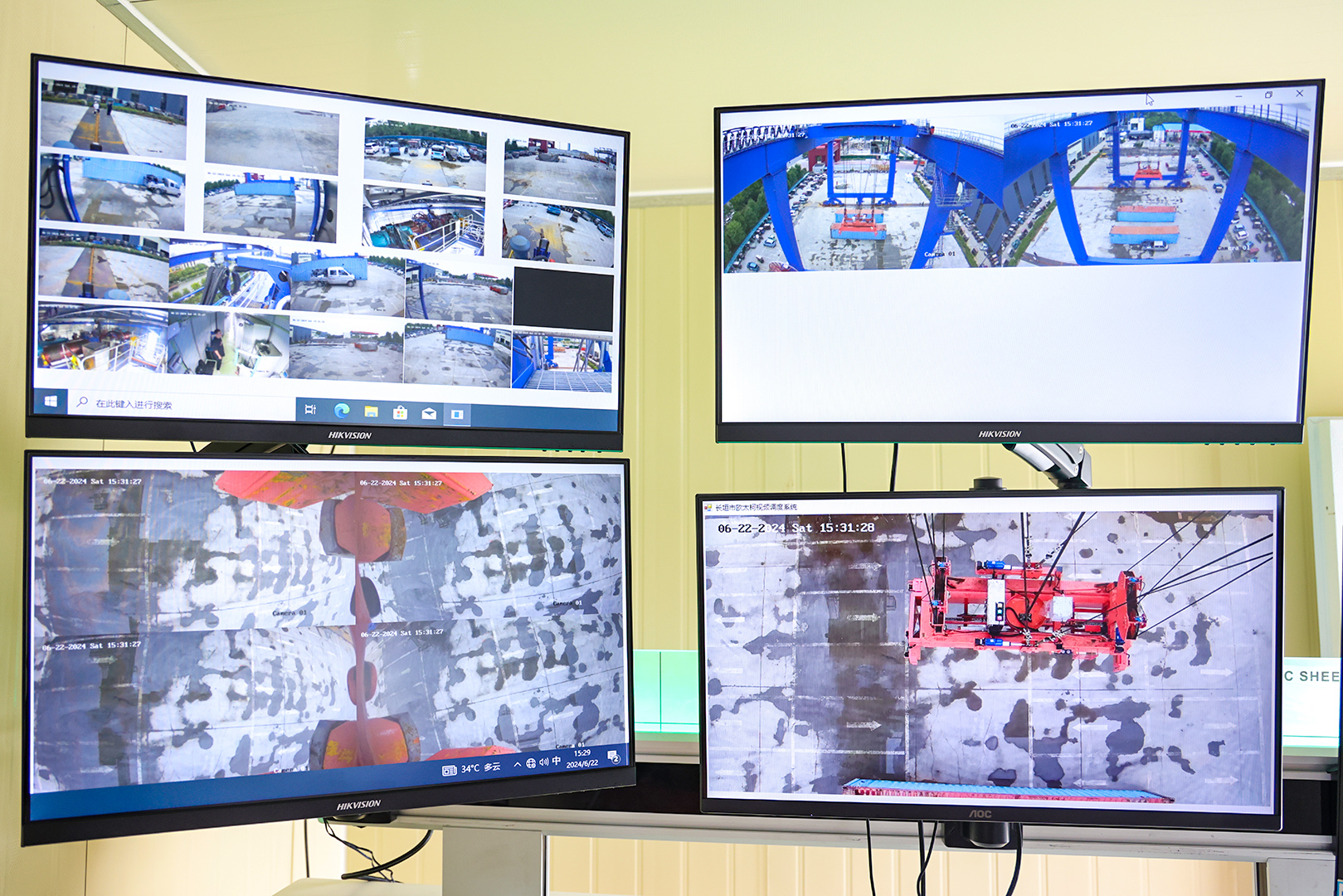
Internet of Things monitoring: realize visual traceability and remote monitoring of equipment operating status, job data, and fault information, and help equipment efficient operation and maintenance and working condition analysis.
AI intelligent analysis: optimize the hoisting trajectory, acceleration and deceleration logic, and anti-swing algorithm based on massive operating data, while predicting the hidden dangers of equipment failure, and realizing continuous optimization of equipment performance and predictive maintenance.
Essential Smart Crane Automation Features to Consider
In view of the immediate needs of intelligent upgrading of factories, the following ten intelligent crane automation functions cover most production scenarios. Each function is clearly positioned and has strong landing properties. It can be selected on demand according to working conditions to accurately solve efficiency, safety and operation and maintenance pain points.:
- Automatic load positioning: relying on high-precision encoders and PLC control systems, the three-dimensional coordinates of the material are automatically and accurately aligned, completely eliminating manual fine-tuning errors.It is suitable for high-frequency fixed-point moving conditions such as mold access, steel coil transfer, storage and stacking, which effectively shortens the operation cycle time and improves the repeatability and stability of handling.
- Intelligent anti-swing control: equipped with a dynamic anti-swing algorithm, it adaptively adjusts the crane start-stop, variable speed and walking parameters in real time to effectively suppress the swing of the hoisting load.It can improve the overall operating efficiency by 20%, avoid the risk of material collision and falling, and is especially suitable for high-demand hoisting scenarios such as high-speed transportation and precision workpieces.
- Automatic walking and lifting control: Based on the flexible speed regulation technology of VFD frequency conversion partition, it realizes intelligent soft start and stop, smooth acceleration and deceleration, and replaces the traditional hard start and stop mode.It greatly reduces mechanical impact and reduces the wear of core components. While ensuring production efficiency, it effectively extends the service life of the crane.
- Intelligent anti-collision and area control: equipped with real-time ranging and position monitoring modules, it can intelligently identify equipment, buildings and obstacles, and automatically warn, slow down and brake.Support for custom virtual no-go areas, work areas and low-speed areas to protect personnel, equipment and plant infrastructure in all directions. It is the core safety function of multi-crane intensive operation plants.
- Load monitoring and overload protection: equipped with high-precision load cells, real-time monitoring of hoisting loads 24 hours a day.Once the rated load is exceeded, the system automatically triggers a sound and light alarm and locks the lifting action to eliminate the risk of overload operation.Retain hoisting data throughout the process to meet the traceability needs of factory safety production compliance.
- Automatic load identification: integrated RFID radio frequency, two-dimensional code, and machine vision multi-dimensional identification technology can automatically identify material model, specification, and batch information.It can seamlessly link the WMS and ERP management systems, automatically match the hoisting parameters and storage points, and eliminate problems such as material misplaced, misplaced, and chaotic ledger from the source.
- Remote intelligent control: It supports multiple operating modes such as wireless remote control and centralized control in the central control room, so operators do not need to enter high-risk operating areas.It is perfectly adapted to harsh working conditions such as high temperature, dust, flammable and explosive, and high altitude. While ensuring the safety of personnel, it realizes uninterrupted and continuous operation of equipment.
- Crane fleet Internet of Things monitoring: Build a centralized visual Internet of Things management platform to uniformly monitor the operating status, operating time, load conditions, equipment utilization rate and fault information of all cranes in the factory.Help managers optimize equipment scheduling, reduce equipment idleness, and realize digital and refined fleet management.
- Predictive maintenance of equipment: collect vibration, temperature, and operating load data of core components such as motors, brakes, gearboxes, and wire ropes in real time, and rely on AI algorithms to analyze abnormal trends in equipment operation.Upgrading the traditional passive emergency repair to state predictive maintenance can reduce unplanned downtime by more than 50% and significantly reduce maintenance costs.
- Automatic fault diagnosis: The system automatically inspects the operating status of the equipment throughout the process, triggers an early warning when an abnormality occurs, and generates accurate fault codes and event logs.Support remote troubleshooting and data analysis, greatly shorten the time for fault location and maintenance, and effectively ensure the continuous and stable operation of the production line.
How to Match Automation Features to Your Plant’s Needs
Combined with various typical production conditions of the factory, the following is a precise one-to-one intelligent function adaptation plan, based on the actual production pain points, precise selection, eliminate invalid function stacking, and maximize the cost-effective automation upgrade:
- High-frequency repeated hoisting conditions: priority is given to automatic load positioning and programmable walking control functions.Effectively avoid manual operation deviations, greatly improve the consistency and standardization of hoisting operations, simplify repetitive operation processes, and significantly improve the overall handling efficiency.
- High-precision alignment operation conditions: suitable for precise positioning of the encoder, laser alignment, and closed-loop automatic control functions.It can achieve precise alignment at the millimeter level, and is perfectly adapted to harsh operating scenarios such as precision parts assembly, precise mold docking, and high-precision material stacking.
- High-speed material transfer conditions: it is recommended to be equipped with intelligent anti-swing, VFD frequency conversion speed regulation, automatic acceleration and deceleration control system.While ensuring the efficiency of high-speed material transfer, it suppresses load shaking and cushions the impact of equipment operation, taking into account operating efficiency, material safety and equipment service life.
- Multi-equipment intensive operation conditions: it is necessary to have intelligent anti-collision and virtual area control functions.It can monitor the operating status of multiple cranes in real time, avoid the risk of cross-operation collisions, divide standardized operating areas and no-go areas, and ensure the safety of equipment, infrastructure and personnel in all directions.
- High-risk and harsh operating conditions: suitable for remote intelligent control, fully automatic unmanned operation, and all-round safety monitoring functions.Completely remove operators from high-risk operating environments such as high temperature, dust, explosion-proof, and high altitude, realize stable and continuous unmanned operation of equipment, and reduce the probability of safety accidents from the root cause.
- Working conditions with low equipment utilization rate and high idle rate: with IOT fleet monitoring and global operation data analysis functions.Visually monitor the running time, operating frequency and load status of each crane, assist management personnel to optimize equipment scheduling, activate idle equipment resources, and improve the comprehensive utilization rate of equipment.
- Frequent equipment failures and large downtime losses working conditions: predictive maintenance and automatic fault diagnosis functions are preferred.Predict potential equipment failures through real-time data monitoring, realize early maintenance and accurate troubleshooting, effectively reduce the number of unplanned downtime, and reduce production downtime losses and equipment maintenance costs.
- Automated warehousing, intelligent assembly line supporting working conditions: suitable for intelligent load identification, high-precision automatic positioning, WMS/ERP system docking functions.Break through the data barriers of material handling, warehouse management, and production scheduling, realize automatic material identification, accurate homing, and data synchronization, and build an intelligent collaborative operation system for the whole process.
Safety Features Should Come Before Productivity Features
Cranes are heavy-duty and high-risk operating equipment. Intelligent upgrading must strictly follow the core guidelines of safety first and efficiency as a supplement. All automation and efficiency-enhancing functions must be based on a complete safety protection system.Emergency stop circuit, overload/overspeed protection, intelligent anti-collision control, stroke limit protection, safety-level sensing and control system are indispensable basic safety configurations for intelligent cranes.
The automation system is only used to assist manual operations, optimize operating processes, and reduce operating loads. It must not replace or exceed standard safety operation specifications and personnel supervision mechanisms.Through the dual background of technical protection and management system, safety hazards such as hoisting collisions, load falls, and equipment overruns are avoided from the source, and the operation of the whole plant is guaranteed to be stable and controllable.
Integration With Existing Plant Systems
The core advantage of the intelligent upgrade of intelligent cranes lies in their strong equipment compatibility and scene adaptation capabilities, which can be seamlessly integrated into the existing digital system of the factory, while supporting the low-cost transformation of old equipment, taking into account the cost-effective landing and long-term extensibility, which can be divided into three core dimensions:
- l System compatibility and data integration: The equipment supports standard industrial protocols, can interface with various mainstream management and control systems of the factory, open up production, warehousing, and handling data, realize real-time data exchange, and build an integrated intelligent production system.
- l Intelligent transformation of old equipment: The modular upgrade scheme is adopted, without the need to replace the whole machine, and the intelligent functions can be realized by installing core intelligent components.Complete equipment iteration at low cost and in a short period of time, and activate the stock of equipment assets in the plant.
- l Scalable architecture selection: give priority to open standardized systems and avoid private closed protocols.Support late-stage functional expansion, equipment linkage and system docking, adapt to the long-term development of the factory, and avoid repeated investment.
Calculate the ROI of Crane Automation
The automation upgrade of intelligent cranes has a clear and quantifiable return on investment value, which can effectively reduce labor and job training expenses, improve the comprehensive utilization rate of equipment, compress the length of hoisting operations, and reduce maintenance costs and unplanned downtime losses.
At the same time, it reduces material damage and equipment bumps, and avoids the risk of safety accident compensation and compliance penalties.The vast majority of standardized production plants can complete the return on investment in 1-3 years, and continue to achieve multiple benefits of cost reduction, quality improvement, efficiency enhancement, and safety in the long term.
Common Mistakes Plant Managers Should Avoid
In the selection of intelligent crane automation upgrades, factories generally have cognitive biases and decision-making misunderstandings, which can easily cause problems such as waste of funds, idle equipment, inability to iterate the system, and the upgrade effect does not meet expectations.The eight major high-frequency misunderstandings are now classified and sorted out by scene to help enterprises scientifically avoid pits and accurately select models.:
- l Functional stacking redundancy: blindly pursuing high-end intelligent configuration, away from the actual hoisting conditions of the factory, a large number of functions are idle for a long time and the utilization rate is extremely low, resulting in invalid investment and waste of resources.
- l Scenario mismatch upgrade: For low-frequency, non-standard, and fragmented simple hoisting scenarios, fully automated transformation is forcibly implemented. The input cost is much higher than the efficiency gain, and the input-output ratio is seriously unbalanced.
- l Ignoring basic conditions: The basic conditions such as the working space of the plant, the carrying capacity of the infrastructure, and the power supply load of the infrastructure were not surveyed before the project was upgraded, and the blind construction landed, resulting in the inability of smart equipment to be put into use normally, and the upgrade project failed.
- l One-sided price comparison and selection: only focus on the initial purchase quotation of equipment, blindly drive down input costs, ignoring hidden costs such as late parts replacement, equipment maintenance, failure and shutdown, and system iteration, and the comprehensive cost of the whole life cycle of equipment is higher.
- l Poor system compatibility: A customized system with a private closed protocol is selected, which is insufficient in openness and versatility, and cannot be connected to the factory's existing digital systems such as MES and WMS. It is easy to form data silos, and it is difficult to expand and iterate in the later stage.
- l Lack of long-term planning: the selection only meets the current production needs, and does not combine the expansion of plant capacity and process upgrade planning to reserve space for equipment linkage and function expansion. The equipment is easy to be quickly eliminated, resulting in secondary investment.
- l Ignoring network security: Ignoring the network protection configuration of smart devices of the Internet of Things, the system has security risks such as data leakage, remote intrusion, and equipment out of control, which threaten the production and data security of the factory.
- l Weakened operation and maintenance training: Excessive attention is paid to the upgrading of equipment hardware and intelligent functions, and the professional skills training of operators and operation and maintenance personnel is ignored, resulting in the equipment unable to perform optimally, the troubleshooting efficiency is low, and the intelligent upgrade effect is greatly discounted.
Conclusion
The key to the automation upgrade of intelligent cranes is not to blindly pursue high configuration, but to choose reasonably based on actual working conditions, based on safety, with efficiency as the goal, and taking into account future expansion.Through scientific automation configuration, enterprises can improve material handling efficiency, reduce labor and operation and maintenance costs, and lay a reliable foundation for intelligent manufacturing upgrades.
As a professional lifting equipment manufacturer, Henan Mine Crane can provide bridge, gantry and intelligent crane solutions according to factory layout, operation requirements and automation level.If you are planning a crane automation upgrade, please contact us for targeted technical solutions and quotations.