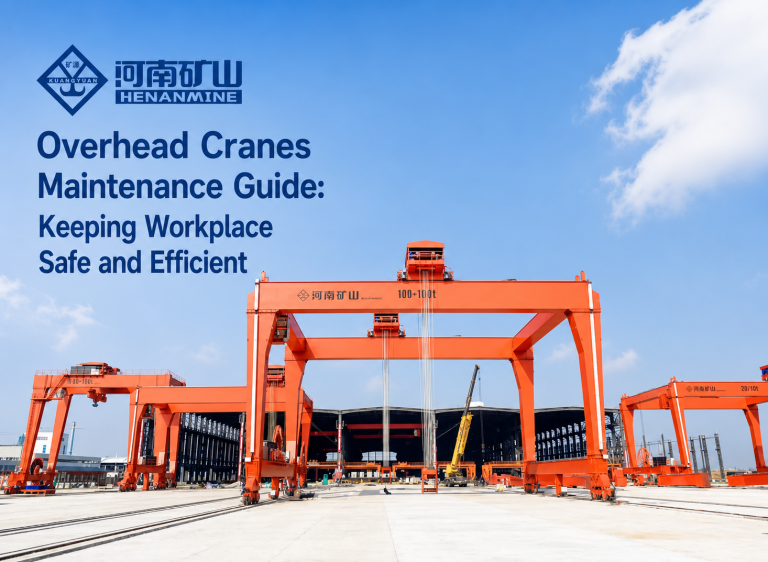

100t Tandem Operating Bridge Cranes for Long Steel Tubes
In the steel pipe manufacturing, pipeline processing and heavy equipment industries, hoisting of ultra-long heavy steel pipes has always been a difficult point for material handling.Single-point lifting can easily cause the steel pipe to bend and deform, and the load to tilt, which will not only cause the product to be scrapped, but also bring major safety risks.
The 100-ton dual-machine linkage bridge crane uses a multi-hook PLC synchronization system to realize multi-point collaborative hoisting of ultra-long steel pipes. It is the core heavy-duty lifting equipment of the steel pipe workshop.This article introduces its working principle, PLC synchronization technology, safety configuration, selection points and application scenarios for reference by pipe companies and equipment buyers.
What Is a 100t Tandem Operating Bridge Crane?
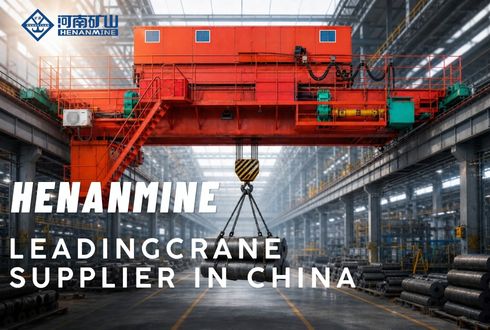
The 100-ton dual-machine linkage bridge crane is suitable for multi-point collaborative lifting of heavy and ultra-long workpieces such as long steel pipes, pipelines, and large steel beams.The equipment consists of one or more double-beam bridge mechanisms, equipped with multiple sets of synchronous lifting mechanisms and hooks, and is uniformly controlled by PLC.100 tons is the total rated load of the system under linkage conditions, which can avoid the risks of pipe bending, load skew and single-point overload caused by single-point hoisting.
This kind of equipment is widely used in industrial plants, and can transfer long steel between production stations, flaw detection and inspection areas, finished product warehouse areas, and delivery areas, reducing manual intervention throughout the process and reducing pipe deformation and damage.
Principle of dual-machine linkage lifting operation
- Definition of dual-machine linkage: Multiple sets of lifting mechanisms work together to lift workpieces under the same control system, and the operator uniformly controls the entire set of equipment, relying on PLC and position sensors for real-time monitoring to ensure that the position and operating speed of each lifting point are kept in sync.
- The difference between a single bridge crane and a two-machine linkage system: a single machine is suitable for short workpieces, and it is easy to bend due to its own weight when hoisting long steel pipes; the linkage system adopts a multi-point support structure, and the electronic control can automatically correct the load attitude deviation, and the hoisting stability is stronger.
- Why long and heavy-duty steel pipes are suitable for dual-machine linkage hoisting: single-point hoisting of long steel pipes is easy to flex and deform, and multi-point hoisting can disperse the force, and the ultra-long steel pipes and steel pipe bundles can be hoisted smoothly and safely.
Core composition of the 100-ton dual-machine linkage crane system
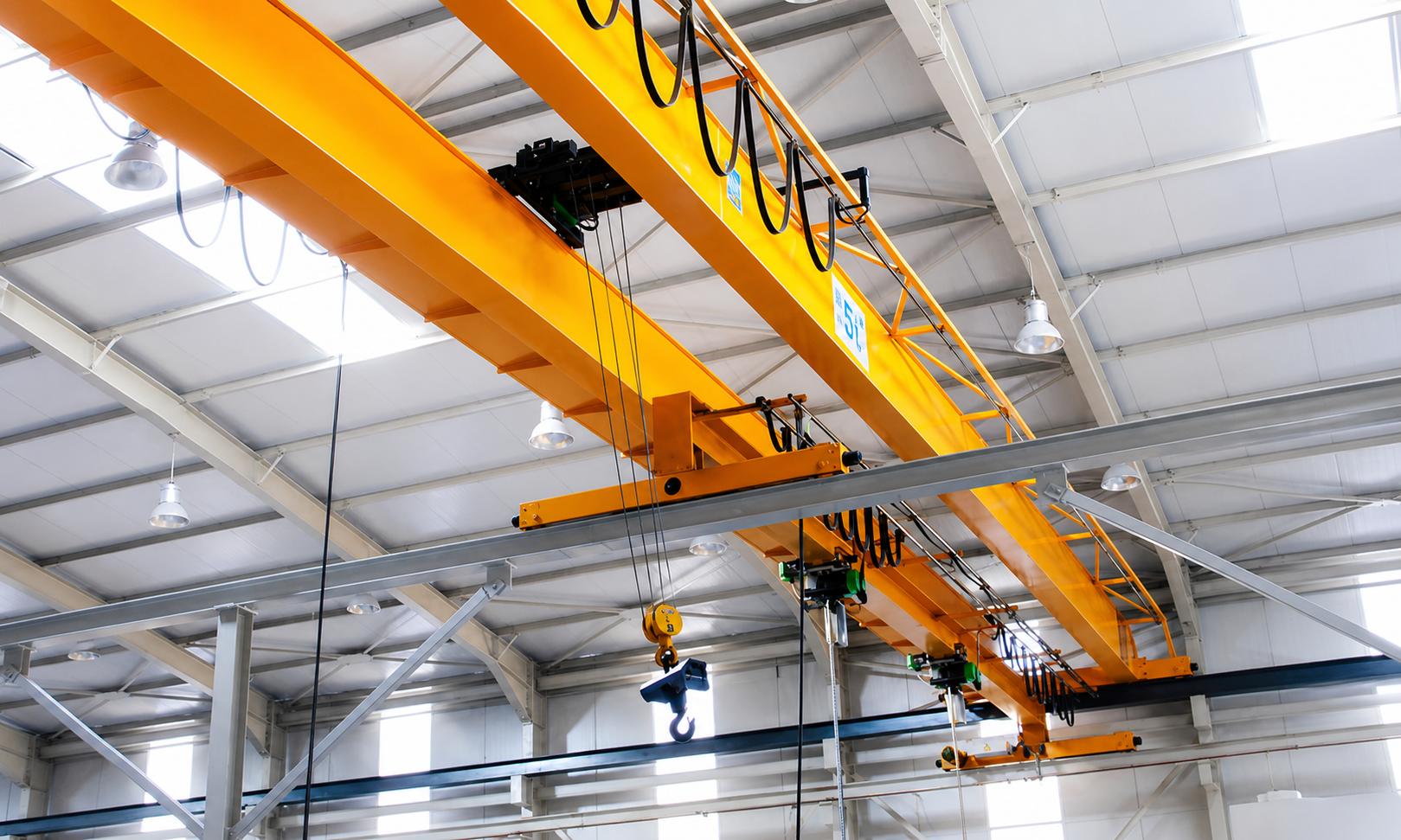
- Bridge structure and end beam: high-rigidity double-beam box-shaped or truss main beam, the deformation of the main beam under heavy load is controlled in a very low range, and it is suitable for decentralized heavy loads.The end beam is equipped with a walking drive wheel set, which runs along the track of the plant, and is generally equipped with an anti-skew mechanism.
- Main and auxiliary lifting mechanism: wire rope hoist mechanism, the main lifting bears the rated load, and the auxiliary lifting is used for fine-tuning attitude and light load auxiliary operations.Multiple sets of independent reel hoists, providing multiple hook lifting points.
- Multi-hook and hanging point components: usually equipped with 2 to 4 hooks, the spacing is drawn in the direction of the long workpiece.It can be equipped with hanging beams, balance beams, special hanging pliers for steel pipes, permanent magnet suction cups and other tooling to achieve multi-point stable clamping.
- Electrical drive, encoder, sensor and PLC control cabinet: frequency conversion drive (VFD) to achieve smooth speed regulation; the motor or reel is equipped with absolute/incremental encoder to feedback the hook position in real time; load cell monitors the load; the central PLC uniformly coordinates all moving axes through the industrial bus (such as Profinet).
- Operation unit and safety monitoring system: wireless remote control or cab operation, supporting human-machine interface HMI, real-time display of hook height, load of each hanging point, synchronization status, fault alarm.With safety PLC and stroke limit switch, the status of the whole machine is monitored in real time throughout the process.
Why Multi-Hook Lifting Matters for Long Steel Tubes
Anti-bending and deformation of steel pipe
Long steel pipes can be equivalent to long beam structures. The number of lifting points is insufficient or the spacing between the lifting points is unreasonable. Thin-walled and large-diameter pipes will flex significantly, and they will be directly and permanently deformed in severe cases.
The spacing of hanging points needs to be calculated based on the length of the steel pipe, stiffness (elastic modulus, wall thickness, pipe diameter), material and load distribution, and the bending moment and deflection are controlled within the design allowable range.When necessary, it is equipped with balanced hanging beams to optimize the force form and make the force of multi-point hoisting more controllable.
Maintain load stability
Multi-point hanging points distribute the weight according to the geometry of the workpiece and the position of the center of gravity, reducing the tilt, rotation, and large swing of the steel pipe.Each hook rises and falls synchronously, maintaining the level of the steel pipe, and suppressing the swing during lifting and cart operation.This solution can be adapted to different pipe diameters, lengths, wall thicknesses, and weight differences between batches, and stably control the attitude of the pipe.
Improve work efficiency
Simultaneous hoisting of multiple hoisting points, loading and unloading, warehousing and shelves, and process transfer can be completed in one action, from molding, flaw detection to finished product delivery, reducing the operation of repeatedly adjusting the spreader and re-hooking, reducing the amount of manual operation for long-piece handling, shortening the operating cycle, and reducing personnel safety risks.
How PLC Synchronization Works in Tandem Bridge Cranes
PLC control system function
The PLC receives the operator's remote control/cab instructions, and uniformly coordinates multiple sets of lifting, trolley, and trolley drive units.Continuously collect operating data such as position, speed, and load through the encoder, and rely on master-slave or multi-axis closed-loop control logic to output motion curves to achieve synchronous action of multiple mechanisms.
Multi-hook synchronous control
The system controls the lifting height and lifting speed of each hook to ensure that the height difference of the hook is maintained within a very small tolerance range (high-end systems can reach within ±3~5mm).
The encoder collects the height deviation in real time, and the PLC adjusts the output speed of the inverter in real time.The acceleration, deceleration and shutdown curves are uniformly matched to avoid sudden load movement, and low-latency industrial communication networks are relied on to ensure real-time data interaction.
Load and deviation monitoring
Load cells and overload protection devices monitor the load of each hook and the total load.Pre-set the synchronization error threshold and load imbalance threshold.Once the limit value is exceeded, the system will issue an alarm, automatically slow down, and trigger a shutdown if necessary.Important note: Position synchronization is not equal to automatic load sharing.The static load distribution is still determined by the mechanical structure, spreader, and the position of the center of gravity of the workpiece.
Hook lag emergency response
The system detects the difference in the position and speed of the hook in real time. Once the deviation exceeds the standard, the driven mechanism is first executed to follow the correction; when the deviation exceeds the safety threshold, all shafts perform a controlled shutdown interlock, and it is forbidden to continue dangerous operations.Before the fault is reset, the synchronization state and load state must be confirmed to be normal before restarting is allowed.
Key Safety Features for 100t Tandem Crane Operations
Overload and partial load protection
Independently monitor the load of each set of lifting mechanism, and summarize the total load at the same time.Overload protection is set for a single hook and lifting mechanism, and hierarchical alarm thresholds can be configured (such as 90% to 100% load alarm, 105% to 110% trigger shutdown), which comply with EN 15011, ASME and other lifting specifications.The linkage mode downloads the load summary logic to protect the bridge structure from being overloaded.
Anti-swing smooth control
Relying on frequency converters to achieve segmented acceleration and deceleration curves, multi-axis linkage and coordinated movement, it can be equipped with open-loop/closed-loop anti-swing algorithms to reduce the swing amplitude of the pipe during the transfer and precise alignment stages.
Emergency stop and fault interlocking
An emergency stop loop that meets the safety level, and all mechanisms stop synchronously and safely in the linkage state.Encoder failure, drive failure, communication interruption, sensor abnormality, and synchronization deviation overrun will all trigger interlock protection.After the fault is cleared, the equipment must be checked and verified in accordance with the standardized process before it can be restarted.
Control method and field of vision guarantee
Wireless remote control is preferred, and the operator can operate on the ground away from the long pipe area; you can also choose the cab to operate.The HMI interface clearly displays the hook height, single hook/total load, synchronization status, and fault information.For long steel pipe operations, standardized communication signals and intercom processes are formulated between teams.
How to Configure a Tandem Bridge Crane for Long Steel Tubes
- Determine the size and load characteristics of the pipe: clarify the maximum length, outer diameter, wall thickness, weight of the steel pipe (considering batch weight fluctuations), material stiffness, allowable deflection, and center of gravity position, and include the weight of the spreader and the working system level.
- Selection of the number of hooks and the spacing between the hanging points: determine the number of hanging points based on the geometry and stiffness analysis of the pipe, and calculate the load of each hanging point and the local stress of the support position.Evaluate whether accessories such as balance beams, special hanging pliers, slings, magnetic tooling, etc. are needed.
- PLC control system matching accuracy requirements: select the encoder and frequency conversion closed-loop scheme as needed, define the synchronization error limit, load imbalance threshold, alarm and fault response logic.The prototype needs to be tested and verified under conditions close to the real load, and the load test is done.
- Assessment of plant layout and environmental conditions: calculate crane span, lifting height, total track length, and plant clearance height; evaluate workshop environment: temperature, dust, humidity, and busy production; at the same time consider power supply, maintenance channels, and docking with existing conveyor lines, finished product shelves, and processing equipment.
Typical Applications in Steel Manufacturing and Processing
- Steel pipe production line: relying on the linkage multi-hanging point system to transport finished steel pipes, it can smoothly transfer pipes between various process stations such as forming, welding, flaw detection, and finishing, and the hoisting positioning is stable and reliable, effectively reducing the surface bumps and scratches of the pipes during the hoisting process, and ensuring product appearance and quality.
- Steel pipe warehousing and logistics: complete the transfer of long pipes between storage shelves, waiting buffer areas, and finished product delivery areas; multi-hook collaborative lifting can stably and safely carry out the stacking and depalletizing of single or bundles of steel pipes, and improve the efficiency of warehouse material turnover.
- Steel processing service center: used for hoisting large bundles of pipes and oversized single steel pipes to meet business needs such as subsequent cutting, secondary deep processing and external distribution. Multi-point synchronous hoisting greatly reduces the frequency of repeated alignment of workpieces and adjustment of spreaders, saving operating time.
- Pipeline prefabrication workshop: accurately transport long steel pipes to cutting, beveling, welding, and machining stations, and sustainably maintain the straightness of the pipes with multi-point support, reduce the deformation caused by hoisting, and reduce the workload of manually correcting the attitude of the pipes on site.
- Energy heavy industry: responsible for the lifting of large-caliber pipelines supporting oil and gas, power stations, and large-scale steel structure engineering projects. Such workpieces have strict standards for lifting positioning accuracy and pipe deformation control, and the linkage multi-lifting point lifting system can meet the needs of high-standard operations.
In all of the above scenarios, simultaneous hoisting of multiple hoisting points can improve positioning consistency, shorten operating cycles, improve safety levels, and reduce manual operation and pipe damage.
Common Problems and Solutions in Tandem Crane Operation
| Operational Problem | Potential Cause | Recommended Measure |
| Uneven hook elevation | Sensor drift or drive parameter mismatch | Calibrate feedback sensors and review synchronization control logic |
| Tube tilting during lifting | Uneven load distribution | Reassess hook spacing and verify load distribution at each lifting point |
| Excessive tube deflection | Unreasonable lifting-point support scheme | Review tube mechanical properties and re-optimize lifting point layout |
| Frequent synchronization alarms | Incorrect parameter settings or mechanical jamming | Inspect drive units, sensors, and mechanical alignment of bridge/trolley |
| Excessive load swinging | Abrupt acceleration and deceleration during start & stop | Optimize motion profiles and standardize operating procedures |
| Repeated positioning adjustments | Insufficient positioning control precision | Upgrade position feedback components and optimize control parameters |
Regular maintenance, sensor calibration, and operator training are the keys to avoiding most failures.
Conclusion
The 100-ton dual-machine linkage bridge crane relies on a dual-machine collaborative structure, multiple lifting points and PLC synchronous control system. It is a special engineering hoisting scheme for long and heavy steel pipes and large-scale components.Reasonable planning of load, lifting point spacing, synchronization accuracy and safety configuration can enhance the stability of hoisting and reduce the deformation of the workpiece and the risk of operation.
When selecting models, focus on the supplier's engineering design, electronic control synchronization, manufacturing strength and after-sales capabilities, and determine the lifting parameters and safety configuration based on working conditions.Henan Mine Crane can customize a 100-ton dual-machine linkage bridge crane for steel pipe processing and heavy industry logistics scenarios to ensure safe, efficient and accurate lifting of long and heavy parts.