
Wall-Traveling Bridge Cranes: Enhancing Workstation Efficiency Under Main Overhead Cranes
The traditional main bridge crane is suitable for large-tonnage, long-distance heavy-duty transshipment in the workshop, but it is difficult to adapt to the high-frequency, light-weight and repetitive hoisting conditions of the station.Workshop operations are overly dependent on the main traffic, which is prone to problems such as equipment congestion, idle resources, and long waiting periods for hoisting, which seriously restricts the overall production flow efficiency.
The wall-mounted bridge crane is suitable for hoisting fine chemical stations in the workshop, relying on the embedded installation of walls and columns, and does not occupy ground space.It can form a double-layer handling system with the main vehicle, undertake light and high-frequency hoisting operations, and make up for the shortcomings of traditional equipment.This article explains the principle, advantages, applicable scenarios, selection standards and operation and maintenance specifications of the equipment in detail, and provides a reference for enterprises to optimize the lifting configuration, improve quality and reduce costs.
What Is a Wall-Traveling Bridge Crane
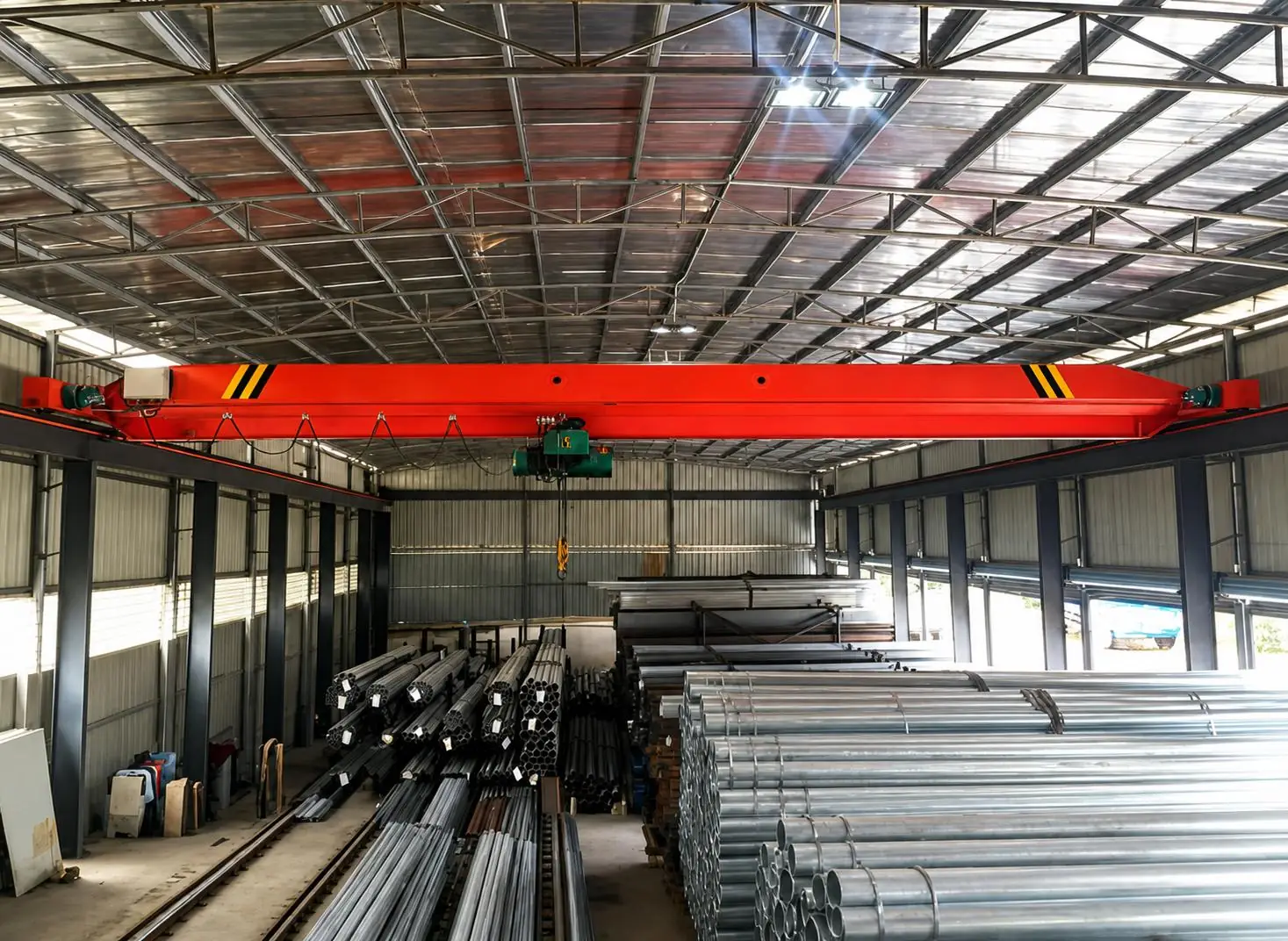
Wall-mounted bridge crane is a special lifting equipment for lightweight stations installed on the walls and columns of the plant. The track is directly fixed to the building structure without ground support. It belongs to the category of standard bridge lifting equipment and is suitable for refined and miniaturized material handling operations in the workshop.
The equipment relies on three-axis linkage to achieve full-dimensional hoisting operations: the end beam walks vertically along the wall track, the lifting trolley moves laterally along the main beam, and the crane lifts vertically. The three-axis coordination can fully cover the lifting area of the station, and the operation is flexible and efficient.
Wall-mounted bridge cranes are composed of seven core components, and each system operates in concert to form a stable and efficient operating system.:
- Main beam bridge: The core load-bearing beam of the equipment, which spans the track spacing area, can walk vertically along the wall track as a whole, carrying all the loads of lifting trolleys, hoists and hoisting materials, and is the core force structure of the equipment.
- Lifting trolley: Equipped with the mobile components of the crane, it can run horizontally and back along the main beam track to achieve precise horizontal positioning of materials and adapt to the multi-point hoisting needs of the station.
- Hoisting hoists: The core components of hoisting execution are divided into two types: wire rope type and chain type. They are responsible for the vertical lifting of materials and match different models according to the load tonnage and operation frequency to ensure the stability and efficiency of hoisting.
- Track beam: Dedicated fixed operating track, which is different from the roof or floor track of traditional cranes. The wall-mounted crane track is anchored to the wall and column structure of the plant throughout the process, and is arranged in parallel and symmetrically to provide stable support for the equipment to walk vertically. Support.
- End beam walking mechanism: it consists of a frame, wheels, bearings, axles and driving devices, which drive the main beam bridge to walk smoothly along the track, and is equipped with cushioning and anti-collision devices, which can effectively reduce the impact loss of the equipment from operation to the end of the stroke.
- Control system: It supports two operating modes: hand-held button box and wireless remote control. The operator can accurately control the walking, lifting, and positioning of the equipment, which is convenient to operate and has high positioning accuracy.
- Power supply system: supporting conductive rail and conductive shoe components, arranged along the track throughout the process, the equipment can take power sustainably and stably during walking, ensure continuous operation, and avoid power failure and caton affecting the production beat.
Design points of rated load and span
Wall–mounted bridge cranes are suitable for light and intermediate frequency hoisting operations at stations, with a conventional load range of 250kg-10 tons, which can meet the needs of most stations such as processing, assembly, maintenance, and welding.There is no general standard for equipment load, span and track stroke, and it needs to be designed according to the bearing capacity of the plant structure, track layout, operating frequency and actual load torque.
It is forbidden to apply common parameters to equipment selection. All core parameters must be verified by professional structural mechanics and matched according to the working conditions of the plant to ensure stable operation, safety and durability of the equipment, and avoid failures, safety hazards and production downtime caused by inconsistent parameters.
How Wall-Traveling Cranes Work Under Main Overhead Cranes
Double-layer material handling operation mode
Modern industrial workshops generally adopt a double-layer material handling structure of "main bridge crane + wall-mounted bridge crane", which realizes hierarchical operation of high and low positions in the same workshop span, completely solves the problem of chaotic and inefficient operation of a single lifting equipment, and forms a standardized and efficient division of labor system.
Main bridge crane (high-level core): Focus on large-tonnage, long-distance, and cross-regional operations, responsible for the transfer of heavy raw materials in the workshop, the hoisting of large-scale finished products, the overall feeding of the production line, and the transportation of large materials across stations. Core, low-frequency, and high-load work, giving full play to its long-span and high-load core advantages.
Wall-mounted bridge crane (low-level auxiliary): focus on station localization, high-frequency, lightweight operations, responsible for parts loading and unloading, workpiece positioning, tooling mold hoisting, semi-finished product transfer, equipment maintenance, disassembly and assembly and other short-distance, repetitive hoisting work.
This hierarchical division of labor model completely eliminates the inefficient scenarios of frequent start and stop of the main crane and taking up working hours to handle small hoisting, allowing high-end heavy-duty equipment to focus on core high-value operations, greatly improving the overall material flow efficiency of the workshop.
Dual-device collaborative operation and safety control
It is necessary to establish a standardized and collaborative control mechanism for the operation of high and low-level dual cranes on the same site to avoid equipment interference, collisions and operation conflicts, and ensure safe and efficient operations. The core control measures are as follows:
- Zoning and isolation operations: Combine the layout of the workshop to clarify the vertical and horizontal operating boundaries of the two cranes, divide independent and exclusive operating areas, strictly prohibit cross-zone operation, and completely avoid the risk of equipment interference from the spatial level.
- Intelligent limit anti-collision protection: The equipment is equipped with standard travel limit, lifting limit and close-range induction anti-collision system, which can automatically identify the operating boundary, realize deceleration, start-stop protection, and effectively eliminate failures such as over-range operation and equipment collisions.
- Standardize the operation and communication mechanism: formulate a dedicated dual-machine operation process, unified communication standards for operators, operation gestures and scheduling specifications, and plan the path in advance for large-scale hoisting operations to prevent blind operations and rush operations.
- A full set of safety protection configuration: Both equipment are equipped with overload protection, emergency stop button, sound and light alarm device, buffer and other safety components. The safety equipment function verification must be completed before operation to ensure that risks can be quickly avoided under sudden working conditions.
Optimize the efficiency of material flow in the station
Compared with traditional station lifting equipment such as cantilever cranes and monorail cranes, wall-mounted bridge cranes have a longer stroke and a wider coverage range. They can cover multiple sets of continuous stations along the wall track to achieve uninterrupted material flow and adapt to most processing, assembly, and maintenance conditions.
The equipment is deployed nearby, used and started at any time, without waiting for the main vehicle to cross-zone operation, greatly shortening the hoisting path and turnover time, effectively speeding up the material flow of the station, and ensuring the continuous and efficient operation of the production line.

Key Efficiency Benefits for Industrial Workstations
Speed up high-frequency hoisting operations
The frequency of hoisting operations such as loading and unloading of parts and components, tooling replacement, etc. at the station is high, and the traditional mode needs to wait for the main traffic to be dispatched, which can easily delay production.The wall-mounted bridge crane is the exclusive equipment of the station, which can instantly respond to hoisting needs, eliminate time-consuming waiting, greatly improve the efficiency of high-frequency operation cycles, and stabilize the beat and production capacity of the production line.
Relieve main traffic congestion
A large number of lightweight and repetitive small hoisting takes up the main traffic resources, which is the main cause of congestion on the main traffic and delays in core heavy-duty operations. At the same time, it will exacerbate unnecessary losses on the main traffic, shorten the service life of equipment, and increase maintenance costs.
Wall-mounted cranes undertake light-duty hoisting tasks at all stations, completely release the production capacity of the main vehicle, give priority to high-value heavy-duty and cross-zone transfer operations, optimize the resource allocation of lifting equipment in the workshop, and improve the overall cost performance of the operation.
Adapt to refined operations
The equipment adopts wall-embedded installation, which does not occupy the ground space of the workshop, does not affect the passage of forklifts, personnel operations and material stacking, and maximizes the use of the vertical space of the workshop.At the same time, it can accurately cover small working spaces such as machine tool stations, assembly areas, and maintenance consoles, and efficiently complete the precise hoisting and positioning of molds, fixtures, small equipment, parts, and semi-finished products, adapt to the needs of various fine chemical station operations, and greatly improve the convenience of station operations.
Increase production flexibility
The wall-mounted bridge crane adopts a modular track and equipment architecture, which is extremely compatible and adjustable.When the production layout of the workshop is optimized, the number of stations is increased or decreased, and the process flow is upgraded, the track layout can be extended and adjusted to meet the new operating requirements without the need for large-scale infrastructure transformation.
Compared with traditional fixed lifting equipment, its flexible adaptation ability is stronger, and it can be perfectly adapted to the modern production model of multi-variety, small batch, and dynamic process adjustment.
Wall-Traveling Bridge Crane Applications
With the advantages of light weight, high precision, high flexibility, space saving, and easy collaboration, wall-mounted bridge cranes are widely adapted to various industrial station refined hoisting scenarios. The core application areas are as follows:
- Whole machine manufacturing and assembly workshop: it is adapted to the multi-station collaborative operation of the assembly line, which can efficiently complete the transfer of parts, precise alignment and docking of semi-finished products, effectively improve the assembly accuracy and ensure the efficient and stable production of the assembly line.
- Machining workshop: suitable for supporting operations of CNC machine tools and machining centers, stable completion of workpiece loading and unloading, tooling replacement and workpiece transfer, and completely solve the efficiency pain points of high-frequency repeated hoisting of machining stations.
- Automobile production workshop: to meet the needs of high-precision hoisting and alignment of auto parts, engine components and fixtures, adapt to the strict assembly standards and production beats of automobile manufacturing, and ensure the accurate landing of the process.
- Steel structure processing workshop: it is suitable for short-distance transportation, precise alignment and welding-assisted hoisting of steel plates, profiles, and small steel components, and is perfectly adapted to the lightweight and refined processing conditions of steel structures.
- Equipment maintenance workshop: it can efficiently complete the disassembly, hoisting and reset installation of industrial equipment such as motors, water pumps, gearboxes, hydraulic equipment, etc., reduce the intensity of manual operations, improve maintenance efficiency, and save labor costs.
- Warehouse and material temporary storage area: suitable for short-distance transfer and stacking of small materials, station consumables and small finished products, to make up for the inefficient handling of large-scale vehicles and small pieces, and to improve the efficiency of warehousing and circulation.
How to Select a Wall-Traveling Bridge Crane
Hoisting load parameters
The primary core of the selection is to clarify the load standard. It is necessary to distinguish between the conventional working load and the limit maximum load. The load calculation must include the weight of the workpiece, the hook, the spreader, the sling, the spreader bar and other ancillary accessories. Weight.
At the same time, the working level of the equipment is determined based on the hoisting frequency of the station and the length of a single load. It is strictly prohibited to select the type only according to the maximum load to avoid redundancy in equipment performance under high-frequency and light-load conditions, or overload loss of equipment under low-frequency and heavy-duty conditions, and ensure that the equipment is adapted to the needs of working conditions.
Station coverage and working space
Sort out the material flow path of the station and the distribution of work points in advance, and accurately approve the three core parameters: the total length of the wall track (the longitudinal stroke of the equipment), the span of the main beam (the width of the horizontal coverage), and the effective lifting height (the vertical operating range).
Combined with the operation area, plan the full coverage of the hook to ensure that the equipment can cover all the lifting points of the station, there are no blind spots in the operation, and at the same time avoid the interference between the equipment and the workshop equipment and structure.
Carrying capacity of buildings and rail structures
The operating safety of wall-mounted cranes depends entirely on the wall and column structure of the plant. Before installation, professional structural engineers must complete the building structure inspection, focusing on the inspection of column spacing, wall bearing capacity, installation site structural integrity, foundation stability, track force limit and other indicators.All installation plans must pass mechanical verification, and empirical installation is strictly prohibited to prevent safety hazards such as structural overload, deformation, and collapse.
Gourd and trolley configuration
Hoisting hoists are the core operating components of the equipment, and they need to be strictly matched to working conditions: wire rope electric hoists are preferred for medium- and heavy-duty and high-frequency operating scenarios, with strong carrying capacity, good stability and long service life.;
Chain electric hoists can be used in light-load, medium- and low-frequency operation scenarios, which are cost-effective and compact in structure.At the same time, the lifting speed and trolley walking speed are matched according to production needs, and the frequency conversion drive system is used to achieve smooth start and stop, precise positioning, and prevent material shaking and offset.
Control method and intelligent configuration
Wired button box control can be used for conventional station operations, which is stable in operation and low in cost; wireless remote control is preferred for large workpieces, complex stations, and scenes with limited field of vision, which is flexible in operation, wide field of vision, and higher safety.
The variable frequency drive system (VFD) is the standard and preferred configuration, which can realize smooth acceleration and deceleration of equipment, reduce mechanical wear and material shaking.The high-end intelligent workshop can be connected to the production control system and AGV equipment to realize semi-automatic and automated material hoisting and transportation, and improve the overall level of intelligence.
Henan Mine Crane can provide corresponding crane configuration and customized solutions according to specific working conditions, control requirements and automation levels to help customers achieve safer and more efficient material handling.
Safety Considerations When Operating Two Crane Systems
Standardized installation planning
Complete a full range of on-site surveys before installation, and accurately detect the status of the plant walls, columns, steel frames, and infrastructure; plan the track installation path in combination with the existing main driving layout, and strictly approve the vertical spacing and horizontal safe distance of high and low equipment to ensure that there are no hidden dangers of interference.;
Verify the power supply capacity of the workshop to ensure the stability of the power when the two equipment are operating at the same time. After the installation is completed, the whole machine must be debugged and load tested, and it can be put into use after passing the acceptance.
Normalized preventive maintenance
Establish a hierarchical maintenance system in accordance with industry standards, and inspect vulnerable components such as hoist chains/wire ropes, brakes, limit switches, walking wheels, and buffers at high frequencies; regularly verify the sensitivity of electrical systems, conductive devices, and control systems; check track flatness, fastener firmness, and structural force status.Through normalized maintenance, the hidden dangers of failures are checked in advance to avoid the operation of the equipment with diseases.
Minimize production downtime
Reasonably plan the maintenance time, use the downtime and shift handover periods to carry out inspections and component replacement to avoid occupying production working hours; establish an inventory of spare parts for wearing parts, and keep a standing inventory of high-frequency wear-resistant parts such as brake pads, limiters, walking wheels, and wire ropes. When a failure occurs, it can be quickly replaced to minimize downtime and ensure the continuous operation of the production line.
FAQ
Q1: Can the wall-mounted crane be installed under the main bridge crane to work together?
A: Yes, this is the core application scenario of the device.Through the hierarchical layout of high and low positions, dedicated operation partitions, anti-collision limit protection, and standardized collaborative processes, the safe and efficient simultaneous operation of the two machines can be achieved, which is one of the best solutions to optimize the lifting operation system of the workshop.
Q2: What is the core difference between wall-mounted cranes and cantilever cranes?
A: The cantilever crane only covers a single fixed station, and the operating range is limited and cannot walk long distances; the wall-mounted bridge crane can move long distances along the wall track, covering multiple consecutive stations, and the hook has a wider operating range and greater flexibility. It is suitable for continuous operation scenarios of assembly lines.
Q3: What types of lifting loads are wall-mounted cranes suitable for?
A: Focus on light and medium-tonnage repetitive hoisting operations, suitable for station parts, tooling molds, small equipment, semi-finished products, steel structure small parts and other loads, not suitable for large-tonnage heavy-duty hoisting, mainly refined, high-frequency station operations.
Q4: Does the wall-mounted crane need a dedicated customized track?
A: Yes.The equipment must be equipped with exclusive customized track beams, and the track must be customized according to the load of the equipment, walking power, and the force of the building structure. It is strictly prohibited to use a general simple track to ensure the stability and safety of the equipment.
Q5: How to completely avoid the interference problem of double crane operation?
A: Avoid risks through four major measures: delineate independent operation zones, install intelligent anti-collision and limit devices, standardize operator communication and operation procedures, implement pre-operation safety verification, and multiple protections to prevent equipment collisions and operation conflicts.
Q6: Does the equipment support personalized customization of station working conditions?
A: Support.Track length, span, lifting height, control mode, and safety configuration can be customized according to workshop layout, load tonnage, operating frequency, and special working conditions (dustproof, anticorrosive, and explosion-proof), and can be adapted to the individual production needs of enterprises in all directions.
Q7: What are the requirements for the structure of the plant for the installation of equipment?
A: It is necessary that the walls and structural columns of the plant have sufficient load-bearing capacity to carry the weight of the equipment, dynamic hoisting load and walking torque.Professional structural mechanics testing and verification must be completed before installation, and the engineer must confirm that the standards are up to standard before construction.