
5 Ton Jib Crane Price Breakdown: Wall-Mounted vs. Column-Mounted
The 5-ton cantilever crane is the mainstream light and medium-sized lifting equipment for fixed-point hoisting in small and medium-sized workshops, and is widely used in material handling, equipment assembly and equipment maintenance.The market is mainly divided into two types of wall-mounted and column-mounted structures. The installation form, operating performance and cost of the two are obviously different, which is the core distinction between procurement selection and budget planning.
Most purchases only compare the bare metal price of equipment, ignoring hidden costs such as civil construction, reinforcement, installation and commissioning, operation and maintenance, which can easily cause budget overruns or insufficient equipment adaptation.This paper systematically disassembles the pricing logic of the 5-ton cantilever crane, compares the cost structure, advantages and disadvantages of the wall-mounted and column-mounted type, and applies scenarios to help buyers accurately control prices, avoid misunderstandings, and optimize cost-effective solutions.
What Is a 5-Ton Jib Crane?
The 5-ton cantilever crane is a light and medium-sized rotary lifting equipment with a rated lifting weight of 5 tons. The whole machine is mainly composed of a cantilever boom, a crane, a rotary transmission mechanism, an electrical control system and a load-bearing support structure.
The equipment can be flexibly rotated around a fixed support point, covering a fixed radius operating area.Compared with traditional bridge cranes, 5-ton cantilever cranes do not need to lay a complex rail foundation, have short installation cycles, low operating thresholds, and high space utilization. They are the core industrial equipment for realizing stationization, refinement, and high-efficiency material hoisting.
Core technical parameters
The carrying performance, operating range and equipment cost of the 5-ton cantilever crane are completely determined by the core technical parameters.The adjustment and upgrade of each parameter will directly change the steel material specifications, structural design standards, manufacturing process difficulty and overall landing cost of the equipment. It is the core basis for the manufacturer's quotation and the adaptation of working conditions. The key parameters are as follows:
- Rated lifting weight: The standard rated carrying capacity is 5 tons, which can stably and safely complete the hoisting, shifting and precise positioning of workpieces, machinery and equipment, and raw materials of 5 tons and below, and is fully adapted to the needs of conventional heavy-duty operations in small and medium-sized stations.
- Cantilever span and operating radius: The length of the cantilever arm directly determines the effective operating coverage of the equipment.The larger the span, the higher the mechanical properties of the steel structure for bending, torsional and compression resistance of the equipment. The thickness of the steel required is increased synchronously with the counterweight of the structure, the processing technology is more stringent, and the overall manufacturing cost has increased significantly.
- Lifting height: The height can be customized according to the workshop floor height, operation process, and material size.The higher the lifting height, the longer the effective travel of the crane, and the higher the standards for motor power performance, braking system stability, and vertical bearing capacity of steel structures are one of the core parameters that affect equipment pricing.
- Rotation angle: The mainstream of the industry includes three rotation specifications of 180°, 270°, and 360°, which can be adapted to wall stations, corner stations, and open stations in the center of the workshop.The larger the rotation angle, the smaller the blind spot of the operation, the more complex the structural transmission design, and the higher the equipment manufacturing cost.
- Hoist type and lifting speed: The core components of lifting are divided into two categories: electric chain hoist and wire rope hoist.The lifting speed, smooth operation, carrying limit, wear-resistant life and adaptability of the two types of hoists are significantly different, and they are the key accessories for dividing the equipment configuration level and price range.
- Working level and operating frequency: According to the daily operating frequency, it is divided into three working conditions: light load, medium load, and heavy load.High-frequency continuous operation scenarios need to be equipped with high-power and high-configuration motors, wear-resistant transmission components and enhanced braking systems, and the equipment is more durable, but the overall cost is much higher than conventional light-load models.
Typical application scenarios
The 5-ton cantilever crane is mainly used for fixed-point, high-frequency, short-distance, and high-precision hoisting operations. It is specially designed for lightweight and heavy-duty working conditions in fixed stations. It is extremely versatile and practical, and is widely used in various industrial scenarios.:
- Loading and unloading of raw materials, transfer of heavy workpieces and handling of finished products in machining workshops and precision machine tool stations
- Automated and semi-automated production line assembly stations for precise hoisting, alignment calibration and integrated installation of large parts
- Designated operating areas in the warehouse area to complete the warehousing and transportation work such as cargo stacking, batch material turnover, and regular warehousing and outbound.
- Equipment maintenance station, suitable for disassembly, displacement, overhaul, commissioning and reset fixed operations of large-scale mechanical and electrical equipment in the factory
- Exclusive loading and unloading points in the factory area to meet the high-frequency handling needs of small and medium-sized materials such as centralized transportation, loading, unloading and stacking, and fixed-point collection.
5-Ton Jib Crane Price: What Determines the Cost?
Most purchasing personnel have cognitive misunderstandings, and the price of cantilever cranes is determined purely by tonnage, ignoring core variables such as structure, parameters, construction, and customization.In fact, the final landing price of a 5-ton cantilever crane is determined by the superposition of multiple factors. From the configuration of the equipment body to the construction of on-site infrastructure, every link will significantly open the quotation gap.The following are the core dimensions that affect pricing:
Equipment structure configuration
The structural form is the most important watershed in the price of 5-ton cantilever cranes, and the mainstream market is divided into two categories: wall-mounted and column-mounted.The wall-mounted installation relies on the original building structure of the plant, without the need for independent foundation pouring, and the infrastructure cost is extremely low.;
The column type is an independent floor-to-ceiling load-bearing structure, which requires a dedicated concrete foundation and anchoring system, and the steel structure and infrastructure cost are higher.At the same time, the standard mass-produced models are more cost-effective, and the customized structural design for special working conditions will greatly increase the overall cost of the equipment.
Cantilever arm length and working radius
The length of the cantilever arm and the working radius directly determine the material specifications and mechanical design standards of the steel structure.The longer the span of the boom, the greater the operating torque load of the equipment, the higher the requirements for steel thickness, structural strength, and anti-distortion ability, and the overall weight and material cost are greatly increased.
At the same time, large-radius operation scenarios need to simultaneously upgrade supporting accessories such as rotary mechanisms and walking trolleys to further increase the overall manufacturing cost of equipment.
Lifting height and hoist selection
The higher the lifting height, the longer the effective travel of the crane chain and wire rope, the more stringent the requirements for motor power, braking stability, and lifting stability, and the equipment manufacturing cost will increase accordingly.As the core lifting component of the hoist, the selection difference has the most intuitive impact on the price.:
The electric chain hoist has a compact structure and outstanding cost performance, and is suitable for conventional hoisting conditions at medium and low frequencies; the wire rope hoist runs more smoothly, has stronger bearing capacity, and has better fatigue resistance. It is suitable for high-frequency continuous heavy-duty operations, and the cost is significantly higher than that of the chain hoist.In addition, customized speed regulation, silent lifting and other functions will also incur additional costs.
Rotation and rotation system
The rotation method of the 5-ton cantilever crane is divided into two types: manual rotation and electric rotation.Manual rotation has a simple structure, low cost and low failure rate, and is suitable for low-frequency, light-load, and small-range operation scenarios.;
The electric rotary is equipped with a special drive motor and transmission system, which saves labor in operation, runs smoothly, and has accurate positioning. It is suitable for high-frequency, large-radius, and heavy-duty continuous operation, and the cost of equipment and electronic control is higher.
At the same time, the design complexity of the mechanical structure with different rotation angles of 180°, 270°, and 360° has been gradually increased, and the adaptability and equipment cost of the 360° full-rotation model are the highest.
Installation and supporting infrastructure costs
Infrastructure and installation are the most easily overlooked invisible costs.The wall-mounted cantilever crane completely relies on the plant wall and steel column for load-bearing. If the bearing capacity of the original building structure is insufficient, structural testing and reinforcement construction will be required, resulting in additional material costs and construction costs.;
Column-type cantilever cranes are independent equipment. Special load-bearing concrete foundations must be excavated and poured, and they must be fixed with anchor bolts. Foundation pouring, maintenance, and ground leveling processes will all produce high infrastructure costs. This is also the core reason for the high overall landing price of column-type models.
Control system and optional functions
The equipment comes standard with wired handle control, which can be upgraded with wireless remote control and frequency conversion speed control system to improve the control experience and operating stability, and correspondingly increase the configuration cost.Safety devices such as stroke limit, overload protection, emergency stop, anti-collision, and intelligent monitoring are standard and just need to be configured.
For special working conditions such as explosion-proof, anti-corrosion, high temperature, dust, etc., exclusive motors, steel structures, and sealed electronic control systems can be customized to meet special safety production requirements, and equipment prices fluctuate with customized configurations.
For special working conditions such as explosion-proof, anti-corrosion, dust-proof, and high temperature, exclusive configurations such as explosion-proof motors, anti-corrosion steel structures, and sealed electronic control systems can also be customized to meet special workshop safety production standards, and the price of corresponding equipment will rise significantly.
Wall-Mounted 5-Ton Jib Crane: Price Breakdown
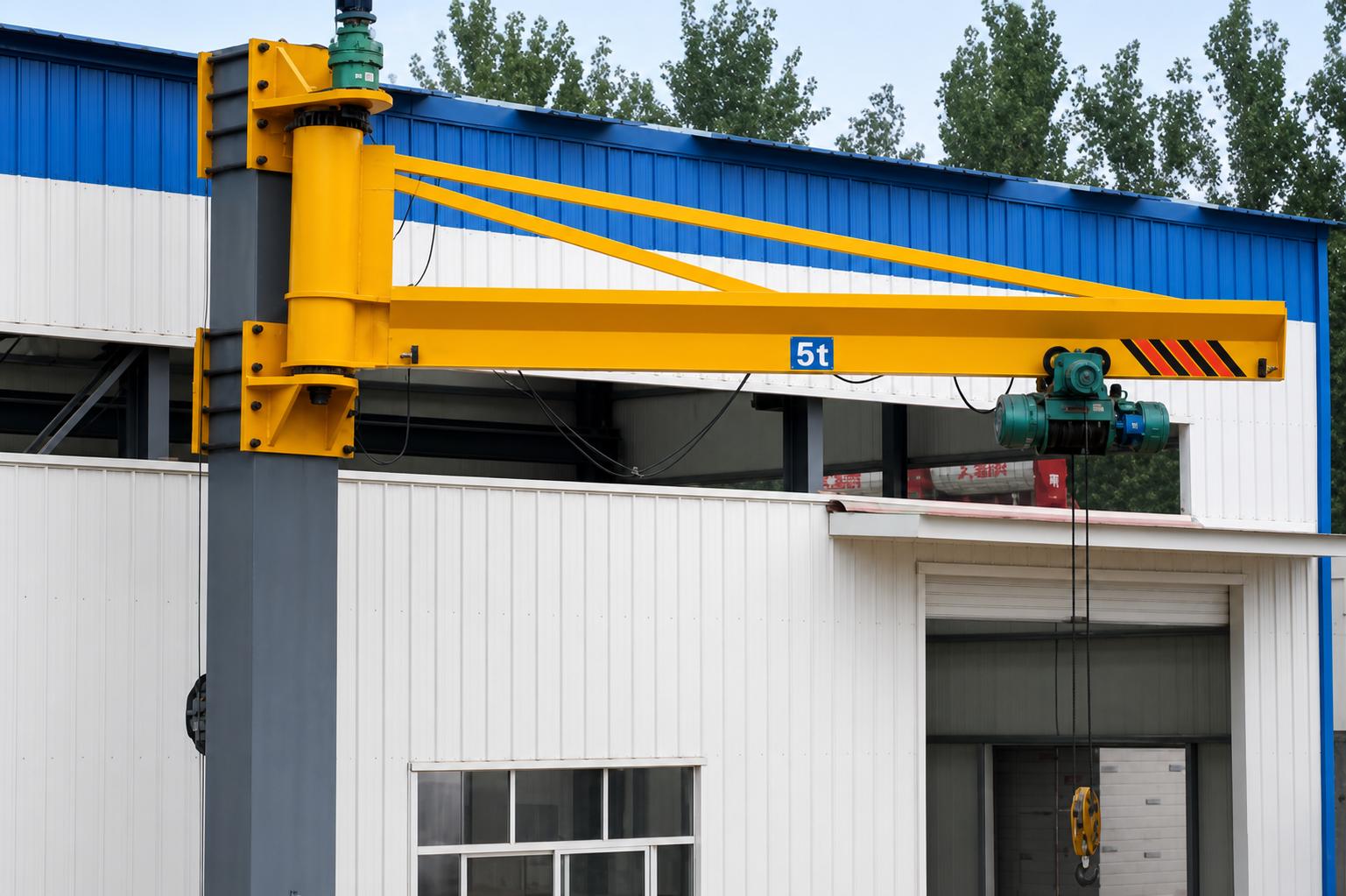
The 5-ton wall-mounted cantilever crane adopts an attached installation structure, and the whole machine is directly anchored to the load-bearing wall, concrete column or steel structure column of the workshop through a special fixing bracket. It does not occupy the ground space of the workshop at all, relying on the original building structure to carry the force.
The cantilever of the equipment can achieve a stable rotation of 180°, and the operating range is concentrated on the wall and the surrounding area of the cylinder. The structure is simple and the installation is fast. It is the preferred lifting equipment for workshops with limited space and fixed stations against the wall.
Core advantages and limitations
advantage:
- There is no need to support an independent concrete foundation, completely eliminating the need for civil excavation, pouring, maintenance and other infrastructure processes, greatly compressing the initial investment of the project, the budget is more controllable, and the lightweight landing is cost-effective.
- The wall and steel structure column attached installation structure is adopted, which does not occupy the effective ground working space of the workshop, does not affect the passage of forklifts, equipment placement and personnel flow, and is highly suitable for small and medium-sized production workshops with dense workstations and restricted sites.
- Relying on the original mature building structure of the plant to complete the fixed installation, the construction process is simple and efficient, the installation cycle is short, the equipment commissioning and commissioning can be completed quickly, and the efficiency of fixed-point hoisting operations in the workshop can be effectively improved.
- Accurately adapt to the operation scenarios of fixed stations against the wall, perfectly match the refined hoisting needs of production line assembly, machine tool loading and unloading, fixed-point material handling, etc., and the working conditions are extremely adaptable, and the heavy-duty handling problems in fixed areas are solved in a targeted manner.
Limitations:
- There are strict structural prerequisites for installation. It is necessary to rely on walls or steel structure columns with standard bearing capacity and torsional resistance. Without qualified load-bearing carriers, they cannot be installed and put into use, and the threshold for site adaptation is high.
- The equipment generally only supports 180° rotation operations. The coverage of the operation is limited by the building pattern of the plant and the installation location of the wall. It is impossible to achieve 360° global operation without dead ends, and the flexibility and coverage area of the operation are relatively limited.
- If the bearing capacity and torque resistance of the original building structure of the plant do not meet the operating standards of the equipment, additional special construction such as structural testing and reinforcement will be required, and the hidden incremental costs will be greatly diluted or even completely offset. The price advantage of the equipment itself.
Column-Mounted 5-Ton Jib Crane: Price Breakdown
The 5-ton column-type cantilever crane is an independent floor-standing lifting equipment. It consists of an exclusive steel load-bearing column, a reinforced base, and a cantilever boom to form a complete closed-loop force system, which does not depend on the original building structure of the plant. Bearing capacity.
The equipment can realize all-round rotation without dead ends from 270° to 360°, with wide operating coverage and high layout freedom. It can be flexibly deployed in any open area of the workshop, adapted to independent workstations and open work sites, and can be used stably in indoor and outdoor working conditions.
Core advantages and limitations
advantage:
- Adopt a completely independent steel structure load-bearing system, without relying on the original building structure such as the plant wall and steel column, and is not limited by the building's bearing capacity. It is suitable for various complex working conditions such as old factories, simple steel structure workshops, and outdoor sites. Site compatibility is extremely strong.
- High degree of deployment freedom, the installation site can be flexibly planned according to the transformation of the production line and the optimization of the workshop layout, and can be shifted and reused in the later stage, which is perfectly adapted to the long-term production upgrade needs of enterprises, and the value of equipment reuse is higher.
- Support 360° global rotary operation, completely eliminate blind spots in hoisting, and cover a wider area of operation, which can meet the needs of open stations and multi-point material handling, and significantly improve the overall hoisting efficiency of the workshop.
- Rich customizable dimensions, can flexibly adjust the cantilever span, lifting height, rotation method and operating level according to actual working conditions, while supporting special customization such as explosion-proof and anti-corrosion, and accurately adapt to various high-frequency heavy-duty and special environmental operating scenarios.
Limitations:
- The equipment needs to occupy the ground space of the dedicated workshop, and fixed installation and working areas need to be reserved. There are certain requirements for the space of the site. It is not suitable for workshops with dense workstations and extremely compact space.
- It comes with independent steel columns and a full set of anchoring infrastructure, with more main materials and consumables, and must be equipped with professional concrete foundation projects. The comprehensive cost of civil construction and equipment is higher, and the initial input cost of the project is significantly higher than that of wall-mounted models.
- The construction process is cumbersome, covering multiple processes such as site excavation, foundation pouring, maintenance anchoring, equipment hoisting and commissioning. The infrastructure cycle is longer, and the pre-construction and labor costs are relatively higher.
Wall-Mounted vs. Column-Mounted 5-Ton Jib Crane: Cost Comparison
In order to help enterprises accurately control their budgets, match working conditions, and avoid additional risks, the following will carry out a refined comparative analysis of the two models from the eight core dimensions of the main structure, infrastructure cost, space occupation, and installation flexibility.
Main structure differences
The wall-mounted 5-ton cantilever crane adopts a lightweight bracket + cantilever structure, without the need for independent load-bearing columns, relying on the plant wall and steel column to undertake the load, with less consumables, simple technology, standardized mass production, and lower equipment body cost and higher cost performance.
The column-type model is an independent steel column + thickened base + cantilever integrated load-bearing structure, which is self-contained and closed-loop by force, and does not need to be attached to the main body of the building.The materials used for its steel structure are solid, the mechanical properties are stronger, and the processing technology is complex. The overall manufacturing cost and equipment unit price are much higher than that of wall-mounted models.
Basic infrastructure cost
The wall-mounted cantilever crane does not require concrete foundation construction, and is only anchored to the wall or steel column by brackets and expansion bolts. There is no infrastructure cost, short construction cycle and low landing cost.
Column-type models must be equipped with a dedicated reinforced concrete foundation, and the equipment is anchored by embedded anchor bolts. Infrastructure processes such as earthmoving excavation, pouring maintenance, and floor restoration are indispensable. Infrastructure cost is an important part of its total cost.
Building reinforcement cost
There is a hidden reinforcement cost for wall-mounted cantilever cranes, and the equipment load and torque all act on the walls and steel columns of the plant.If the carrying capacity of the original building is insufficient, it needs to be modified such as steel structure reinforcement and reinforcement by reinforcement. The cost of reinforcement fluctuates greatly, and the cost of transformation under harsh working conditions even far exceeds the price difference of the model.
The column-type model is an independent load-bearing structure, does not rely on the plant building, and does not require structural testing and reinforcement transformation. The equipment load is borne by the exclusive concrete foundation, there is no hidden transformation cost, and the project budget is more stable and controllable.
Workshop floor occupation
The wall-mounted cantilever crane adopts wall-attached installation, which fits the building column and wall layout, hardly occupies the floor space of the workshop, and is very suitable for small factories and compact production line layout.
The column-type cantilever crane is a floor-to-ceiling independent structure and needs to occupy a fixed ground position. It has good adaptability in an open workshop, but it is not suitable for workshop scenes with compact space and limited site.
Installation flexibility
The installation position of the wall-mounted cantilever crane is limited, and it can only be fixed and installed around the standard wall and steel column, and cannot be flexibly shifted. It is difficult to reuse and high migration costs during the transformation and adjustment of the production line, and it is only suitable for fixed station operations.
The layout of the column-type cantilever crane is flexible and free. It can be deployed in any area of the workshop, adapted to various working conditions, and can be adjusted, shifted and reused with the production line of the workshop to adapt to the modern flexible production layout.
Rotary operation range
Conventional wall-mounted 5-ton cantilever crane comes standard with a 180° single-sided rotation mode. The operating range is limited to a fixed area on the outside of the wall. There are obvious blind spots in the operation. It can only cover the single-sided station against the wall, and it cannot realize cross-regional and large-scale material hoisting. It is only suitable for fixed-point hoisting operations in a single direction.
The column-type 5-ton cantilever crane supports 270° and 360° full-angle rotation, has no blind spots in operation, and has a wide coverage range. It can meet the needs of multi-station and multi-directional hoisting, and effectively improve operating efficiency.
Initial overall cost
Under conventional working conditions, wall-mounted cantilever cranes have no infrastructure costs, low equipment unit prices, small initial investment and budget-friendly. They are economical options. Only additional costs will be incurred when the building structure is reinforced, and they are suitable for lightweight hoisting and workshop renovation projects with limited budgets.
The column-type cantilever crane has a higher initial cost due to its independent steel structure and exclusive infrastructure, but there is no hidden transformation cost, stable structure, long service life, and comprehensive overall performance. It is a cost-effective choice for long-term production.
Note: The above price and performance differences are for general working conditions reference only.The final cost of equipment will also be affected by factors such as ground conditions, building bearing capacity, arm length, lifting height, rotation method, explosion-proof and anticorrosive configuration, and installation and construction costs.
The precise budget needs to be combined with the actual working conditions for engineering evaluation, and the manufacturer will provide detailed plans and quotations.Henan Mine Crane can provide customized selection and engineering quotations according to on-site conditions. Welcome to contact us for project plans.
Which 5-Ton Jib Crane Is More Cost-Effective?
The selection of cantilever crane cannot simply compare the unit price of the equipment. It needs to be combined with the workshop site conditions, operation frequency, hoisting range, and long-term operation and maintenance costs to make a comprehensive judgment, and match the models on demand to maximize the cost performance of the whole life cycle.
Give priority to wall-mounted cantilever hanging scenes
- The original wall and steel column structure of the plant is intact and sturdy, the load-bearing load is up to standard, and the structural stability is strong. There is no need to carry out large-scale steel structure reinforcement, reinforcement reinforcement and other transformation construction, which can directly meet the attachment installation and heavy-duty force requirements of wall-mounted cantilever cranes, without additional investment in structural transformation costs.
- The overall ground space of the workshop is compact, the work site is limited, the access channels, production equipment, and material stacking are densely laid out, and there is no excess open area reserved for column installation points, which cannot be adapted to the floor-to-ceiling installation conditions of column-type equipment and the advantages of wall-mounted zero-footprint installation.
- The daily hoisting station is fixed, and the working area is concentrated around the walls and building columns. Only one-sided fixed-point hoisting operations are required. There is no need for large-angle and wide-range rotation coverage. The wall-mounted 180° rotation operation mode can fully meet the production hoisting needs, and the equipment performance is extremely adaptable.
- The project procurement budget is limited, and the pursuit of cost-effective landing is pursued. It is hoped that high infrastructure costs such as concrete foundation pouring, site construction, and structural transformation will be eliminated, and the initial investment in equipment and projects will be compressed to the maximum extent, and the cost of workshop technical transformation will be reduced.
Priority is given to the scene of column-type cantilever crane
- The plant lacks wall and steel column structures with up-to-standard bearing capacity that can be used for attachment and installation. The site does not meet the installation and construction conditions of wall-mounted cantilever cranes, and cannot rely on the original building to build lifting equipment and adapt to independent floor-standing column-type models.
- The hoisting operation stations are concentrated in areas without wall support such as the middle of the workshop and the open field area. Independent floor-to-ceiling lifting equipment is required to provide stable support, which can be perfectly adapted to the free layout advantages of column-type cantilever cranes.
- Production operations require all-round non-dead-angle hoisting coverage, avoiding blind spots in single-sided operations, breaking the restrictions of fixed-angle operations, and relying on the 360° full rotation performance of column-type cantilever hoisting, greatly improving the efficiency of multi-directional and multi-station hoisting operations.
- There are plans for late-stage production line upgrades, layout optimization, and station adjustment in the workshop. The flexible mobility of the equipment is highly required. The column-type cantilever crane can be shifted and re-arranged on demand to meet the needs of flexible production transformation in the workshop.
How to Get an Accurate Quote for a 5-Ton Jib Crane
Vague parameter information and unclear demand description are the core reasons for excessive quotation deviation and late price increases.When inquiring from the manufacturer, provide complete and accurate working condition parameters, which can reduce the quotation error by 15%-30%, and ensure that the budget is accurate and controllable.The following information is required for accurate inquiry:
- Refine the core operating indicators: accurately clarify the key operating condition parameters such as the length of the cantilever arm, the effective operating radius, and the maximum lifting height, and combine the approved parameter standards of the actual operating scenarios on the site to ensure the adaptability of equipment operations.
- Clear installation working conditions and environment: clearly define the indoor and outdoor installation application scenarios of the equipment, distinguish between conventional working conditions and special operating conditions such as explosion-proof and anti-corrosion, and ensure the environmental adaptability and long-term operating stability of the equipment in all directions.
- Matching the operating load level: according to the actual operating frequency of light, medium and high frequencies on the site, the equipment adaptation level is accurately approved to match the actual operating load and ensure the equipment
- Standardize detailed quotation standards: suppliers are required to provide a detailed list of itemized quotations, clearly split all costs such as equipment body, transportation, installation, customization, taxes, etc., clarify the scope of delivery and service boundaries, and eliminate invisible charges and additional additions.
Conclusion
There are no absolute advantages and disadvantages between the 5-ton wall-mounted and column-mounted cantilever cranes. The key lies in the matching of site conditions with operating requirements.Scenes with limited space, fixed-point operation against the wall, and reliable load-bearing structure are more suitable for wall-mounted cantilever cranes; scenes with open sites, lack of suitable support structures, or require a more flexible operating range can give priority to column-mounted cantilever cranes.
When purchasing, the lifting weight, operating radius, installation conditions, operating frequency and full life cycle costs should be comprehensively evaluated, and the unit price of the equipment should not only be compared.Henan Mine Crane can provide selection, design and customization solutions for wall-mounted and column-mounted cantilever cranes according to on-site working conditions.If you are purchasing a 5-ton cantilever crane, please contact us for project quotation and professional selection suggestions.