
How to Select a Crane for Foundries and High-Temperature Industrial Environments
The foundry workshop and the high-temperature industrial environment put forward higher requirements for the heat resistance, carrying capacity and operating stability of the Henan Mine Crane Factory supply crane.Continuous thermal radiation, metal dust and frequent heavy-duty operations will accelerate the aging of key components and increase equipment failure and safety risks.To choose a suitable casting crane, it is necessary to conduct a comprehensive assessment based on actual working conditions, load parameters, working level, thermal protection configuration and equipment maintenance requirements to ensure that the lifting equipment adapts to the production environment, while ensuring the safety of hoisting and operating reliability, reduce unplanned downtime and long-term operating costs.
Why Foundries Need Specialized Industrial Cranes
Radiant heat exposure
The core working condition challenge of the foundry workshop is continuous strong thermal radiation. Molten metal ladles and smelting furnaces will radiate hundreds of degrees Celsius of heat energy, which is not simply environmental high temperature.The heat will continue to bake the main beam of the crane, trolley, wire rope, motor, and electrical cabinet, accelerating the aging of the paint, the decline in the strength of the metal material, and the brittleness of the cable insulation layer.The failure rate of the electrical and transmission components of ordinary cranes will increase exponentially under long-term thermal radiation.Even if it is far away from the bath, intermittent thermal shock in the operating area will shorten the life of the whole machine. Therefore, the casting crane must be specially designed for thermal insulation, and the normal temperature workshop crane scheme cannot be directly applied.
Heavy loads and molten metal
The casting crane undertakes the transportation of molten metals such as molten steel, molten iron, and molten aluminum. The load is not only static weight, but also includes the weight of the ladle and the dynamic impact load caused by the shaking of the liquid metal.Molten metal is a high-risk load, and once the spreader and lifting mechanism fail, it will cause a serious safety accident.The equipment must not only meet the rated load, but also need redundant safety braking and anti-overturning spreader structure.Conventional cranes have insufficient safety redundancy and are not suitable for liquid metal hoisting. From the structural design of the special crane for casting, it provides multiple protections against impact loads and the risk of liquid metal leakage to ensure stable and controllable heavy-duty transportation.
Harsh operating conditions
In addition to high-temperature thermal radiation, the foundry workshop is also accompanied by a large amount of metal dust, oxidized soot, splashing metal debris, and corrosive fumes in some scenes.Dust can easily invade bearings, gears, brakes, and electrical contacts, causing wear, stagnation, and short circuits.The crane needs to continue to operate in a dusty, vibrating, and high temperature splash environment. The sealing and wear resistance of ordinary models are insufficient, and the mechanism will be stuck and electrical failures will occur in a short period of time.The special casting crane optimizes the sealing and wear-resistant structure of the whole machine, improves the splash resistance, maintains stable operation under harsh working conditions, reduces sudden downtime, and guarantees the continuous production of the casting production line.
Common Crane Types for Foundries and High-Temperature Applications
Foundry overhead cranes
The foundry bridge crane is the main model with the most extensive application range in the foundry workshop. It adopts a double-beam or four-beam structure and is suitable for high-temperature cross-operation such as smelting, casting, and ingot transfer.The structure of the whole machine is stronger, equipped with thermal insulation protection and dual braking safety system, and the working level generally reaches the A7/A8 extra-heavy level, which can withstand thermal radiation and frequent start and stop for a long time.This model runs along the top track of the plant and does not occupy ground space. It is suitable for the transfer of materials, hot blanks, and empty ladles in large and medium-sized foundry workshops.According to the workshop span, lifting height and thermal radiation level, thermal insulation guards and high-temperature electrical systems can be customized to adapt to most casting high-temperature working conditions.
Ladle handling cranes
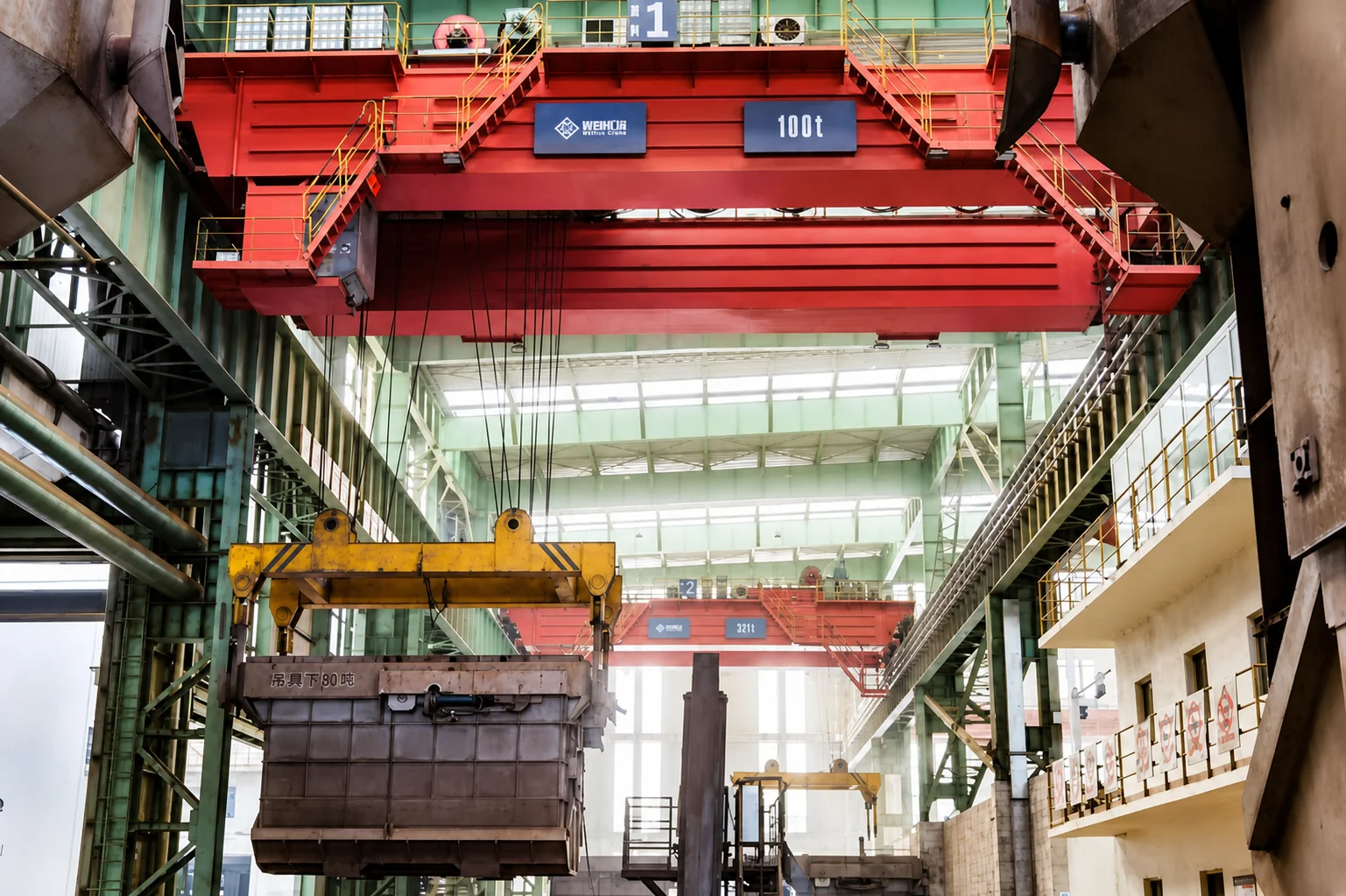
Ladle/ladle crane is specially used for the lifting, transshipment, and alignment of molten metal ladles. It is a high-risk core process equipment in the foundry workshop.The equipment comes standard with a fixed gantry hook structure to withstand the huge load of ladles and molten metal. The lifting mechanism is equipped with two sets of independent braking systems, which have load monitoring and early warning functions for the tilt of the package body.This type of crane has the highest requirements for safety and redundancy, and can complete the liquid metal transportation from the furnace to the casting station, covering steel and non-ferrous metal casting scenes.All key metal components, wire ropes, and electrical components are selected with high temperature resistant models to cope with close-range and strong thermal radiation environments.
Charging and casting cranes
The feeding and casting crane is mainly responsible for feeding the smelting furnace and the precise casting of liquid metal in the casting station, taking into account the needs of heavy-duty lifting and high-precision alignment.Under feeding conditions, the material impact is large, and the casting process requires low speed and stability to prevent the liquid metal from shaking and overflowing.The lifting speed of this model is adjustable, and the micro-motion control performance of the trolley is strong, and it can cooperate with the production line to complete the complete process of feeding, slag removal, and casting.The equipment structure strengthens thermal insulation protection against close-range thermal radiation in the furnace mouth area, while optimizing the operation response, which is convenient for operators to control the dumping of ladles and the flow of liquid metal. It is widely used in continuous casting and mold casting production lines.
Key Factors to Consider When Selecting a Foundry Crane
Load capacity and workshop layout
The first step in the selection is to calculate the maximum load. All the weight of the ladle, the weight of the molten metal, and the weight of the spreader must be included, and a safety margin must be reserved. It cannot be simply matched according to the nominal tonnage of the product.At the same time, it is necessary to map the span of the plant, the height of the rail top, the position of the column, the workshop passage, the layout of the furnace and the casting station.The restricted space needs to optimize the contour of the trolley to avoid obstacles such as the steel structure and furnace body of the plant.It is also necessary to plan the operation route of the cart and reserve a safe passage for the transfer of molten metal.Combine the layout of the workshop to determine the crane span, lifting height, and buffer limit scheme to ensure sufficient space for equipment installation, operation, and maintenance.
Duty class and operating frequency
The working level is the core index that can be easily ignored in the selection of casting cranes, and ordinary A3-A5 light and intermediate cranes cannot be used for continuous casting operations.The foundry hoists molten metal, with frequent start and stop, and large load fluctuations. The mainstream selection of A7 and A8 special heavy work grades.It is necessary to count the number of daily cycles, the length of a single job, and the ratio of no-load and heavy-load alternation to determine the level of work.If the working level is selected to be low, the mechanism, gear, and wire rope will be overloaded and tired for a long time, and the risk of metal fatigue and fracture will quickly occur.Only by matching the correct working level can the life of the equipment be extended and the probability of major failures be reduced.
Lifting speed and positioning accuracy
The lifting speed and positioning accuracy requirements of different casting processes are obviously different. When transporting molten metal, it is necessary to be stable at low speed to suppress liquid shaking.The speed of feeding and transferring the billet can be appropriately increased to ensure production efficiency.The casting station requires precise micro-motion control to achieve precise alignment of the ladles.When selecting the model, confirm the speed regulation scheme of the lifting mechanism, check the micro-motion capacity of the trolley, and take into account the operating efficiency and safety.Too fast speed will cause the metal liquid to shake violently, which will increase safety risks.If the accuracy is insufficient, the pass rate of the finished product will decrease.Professional manufacturers can customize the speed regulation range and positioning control scheme according to process requirements.
Molten metal handling requirements
There are mandatory special requirements for cranes lifting molten metal. Fixed gantry hooks are preferred for spreaders. The lifting mechanism must be equipped with a dual independent braking system, real-time monitoring of the loading load, and an alarm device for the tilt of the package body.It is necessary to distinguish different metals such as molten steel, molten iron, and liquid aluminum, corresponding to different temperature levels and splash protection schemes.At the same time, plan the emergency response design, such as keeping the load from falling in a fault state.Ordinary heavy-duty cranes cannot be retrofitted for liquid metal lifting.All structures, spreaders, and safety components must comply with the relevant safety regulations for molten metal hoisting and meet the requirements of supervision and inspection.
Heat Protection and Safety Requirements for Foundry Cranes
Heat shields and insulation
Heat insulation panels and heat shields are the most basic protective means to isolate the thermal radiation of the ladle. High-temperature-resistant heat insulation panels are installed at the bottom of the main beam, the bottom of the trolley, and the electrical box to block the direct baking of metal structures and electrical components by radiant heat.The selection of insulation materials needs to withstand continuous high temperature and resist metal splashing and burning, while taking into account the lightweight structure to avoid increasing the weight of the crane.According to the distance of the working area from the bath, different thermal radiation levels are divided, and the thickness and structure of the heat insulation board are adjusted.The thermal insulation system needs to reserve space for maintenance, regularly check the deformation and burning conditions, and replace the damaged thermal insulation parts in time to maintain the protective effect.
Heat-resistant components
Ordinary wire ropes, motors, cables, and seals will fail quickly in high temperature environments, and Henan Mine Crane Factory supply casting cranes must choose a full set of high temperature resistant supporting components.High-temperature resistant steel wire ropes, metallurgical special motors, high-temperature resistant special cables, and high-temperature greases can maintain material properties in a continuous thermal environment.Bearings, gears, pulleys and other transmission components should also be upgraded to improve wear resistance and strength at high temperatures.The selection of parts and components should not only look at the nominal temperature, but also consider the long-term thermal cycle aging effect.All accessories of the whole machine close to the high temperature area need to be tested under high temperature conditions to ensure long-term stable operation.
Braking and overload protection
In the case of molten metal hoisting, the braking system is the bottom line of safety. The casting crane adopts a redundant design of dual brakes. The main brake and the safety brake are independent of each other, and the load can still be locked if a single brake fails.The equipment integrates an overload protection device to monitor the lifting load in real time, automatically cut off the lifting action and trigger an alarm when it is overloaded.At the same time, limit limits and cushioning devices are configured to prevent over-stroke collisions between large cars and small cars.The system can collect the status of the brake in real time and give early warning of brake pad wear.Multiple protection linkage, to avoid the risk of falling packages caused by overload and mechanism failure, and to meet the mandatory safety requirements of metallurgical casting scenarios.
Operator protection and remote controls
Traditional cab operation will expose the operator to high temperature, strong light, and metal splashing for a long time. Modern foundry cranes provide heat-insulated and air-tight cabs or wireless remote control systems.The heat-insulated cab is equipped with a heat-insulating layer, shading protection, cooling and ventilation to isolate high temperature and thermal radiation.The remote control scheme can place the operator in a safe area away from the bath to operate, reducing the risk of personal injury.The remote control system needs to ensure stable signal, low latency, and emergency stop function.Enterprises can combine the layout of the workshop, choose the dual modes of cab and remote control, take into account the operating vision and personnel safety, and adapt to different casting processes.
Applicable safety standards
Casting high-temperature cranes must comply with the lifting and metallurgical safety regulations corresponding to the domestic and export target markets, and the domestic requirements such as TSG 51 lifting machinery safety technical regulations and molten metal lifting safety regulations must be met.From design, materials, manufacturing, factory testing to on-site installation and acceptance, every link must be benchmarked to corresponding standards, and reports on flaw detection, load testing, and high temperature testing must be kept.Export projects need to match local industry safety regulations.At the procurement stage, it is necessary to confirm whether the manufacturer designs and produces in accordance with the corresponding standards, and the equipment acceptance and annual inspection also need to comply with the specifications to avoid compliance risks and safety risks.
How to Evaluate Foundry Crane Manufacturers
High-temperature project experience
Evaluation manufacturers first investigate the landing cases of high-temperature casting projects, and give priority to manufacturers with a large number of metallurgical and non-ferrous metal casting crane delivery experience.Ordinary crane manufacturers are familiar with hoisting factories at room temperature, but they lack project experience in molten metal hoisting and strong thermal radiation conditions, and they have insufficient understanding of thermal deformation, dust protection, and safety redundancy design of molten metal.Manufacturers are required to provide project cases of the same tonnage, the same conditions, on-site real shots, and customer feedback to understand the long-term operating performance of the equipment.Mature manufacturers can predict various potential problems in high temperature operating conditions and avoid risks in advance during the program phase.
Custom engineering and testing
The working conditions of the foundry workshop are extremely differentiated, and there are few fully standardized equipment, which requires manufacturers to provide customized engineering design services.Professional manufacturers will survey the working conditions of the workshop on the spot, do thermal environment assessment, load simulation, structural finite element analysis, and adjust the main beam, heat insulation, electronic control, and spreader plans in a targeted manner.Before the equipment leaves the factory, it needs to complete the full load test, brake performance test, and high temperature simulation test, and issue a complete test report.It is necessary to refuse to do only simple re-marking of standardized cranes, customized design capabilities and rigorous factory testing are the key to ensuring that casting cranes are adapted to high-temperature and high-risk working conditions.
Maintenance and technical support
Henan Mine Crane Factory supply Casting cranes are high-risk special equipment, and the late maintenance capacity directly determines the length of downtime and safety level of the production line.When evaluating suppliers, confirm the localized technical team, spare parts warehousing, emergency response timeliness, and regular inspections, non-destructive testing, and annual inspection assistance services.Wearing parts are lost faster in high temperature environments, and the supply of original spare parts needs to be stabilized.Excellent manufacturers can provide remote equipment condition monitoring, predict component aging in advance, and carry out preventive maintenance.A perfect technical support system can shorten the downtime, reduce the probability of sudden accidents, and ensure the continuous operation of the casting production line.
Lifecycle cost comparison
Many purchases only compare the unit price of equipment purchases, ignoring the whole life cycle cost.The comprehensive cost of casting cranes includes purchase price, installation fee, annual inspection fee, replacement of spare parts, maintenance working hours, energy consumption, and loss of downtime.Low-cost equipment often simplifies heat insulation, braking, and material configuration. The failure rate is high in the later stage, the replacement of spare parts is frequent, and the loss of production is huge.During the evaluation, it is necessary to account for all costs within a 5- to 10-year cycle, and comprehensively compare equipment reliability, maintenance costs, and expected service life.The early investment of high-quality casting cranes is higher, but there are fewer failures, lower long-term comprehensive costs and stronger safety.
Common Mistakes to Avoid When Buying a Foundry Crane
Underestimating heat exposure
The most common selection misunderstanding is to underestimate the impact of thermal radiation, only refer to the ambient temperature of the workshop, and ignore the thermal shock of the short-range radiation of the ladle.The purchasing staff believes that the air temperature in the workshop is not high, so they directly choose ordinary bridge cranes without increasing heat insulation protection.After the equipment is put into use, the main beam, electrical cabinet, and cables continue to be heated, and insulation aging, structural deformation, and frequent tripping repairs occur in the short term.Thermal radiation is not continuous and constant, and instantaneous high temperature shocks will occur when the liquid metal is dumped and close to the furnace body.In the selection stage, the maximum thermal radiation intensity must be evaluated on the spot, and sufficient thermal insulation and protection design margin must be reserved.
Choosing the wrong duty class
The low selection of work level is a major safety hazard in the foundry workshop. In order to save budget, some purchases use A5 and A6 grade cranes to undertake high-frequency molten metal hoisting.The structure and transmission mechanism of this kind of equipment are designed according to a medium load cycle, and cannot withstand a large number of daily start-stop and alternating loads in the foundry workshop.After being put into production, the wire ropes, gears, and wheels quickly fatigue and wear, greatly increasing the risk of structural fracture.The work level cannot be judged by the rated load, but must be determined based on the daily work cycle and load spectrum.Rather, the selection margin is too large, and the work level must not be downgraded to drive down costs.
Overlooking safety requirements
Many purchases focus on load and price, ignoring the mandatory safety provisions for molten metal hoisting, and omitting safety configurations such as double braking, load monitoring, and gantry hooks.Some enterprises purchase ordinary cranes and retrofit their own spreaders for molten steel transfer, which is a major safety hazard and cannot pass the inspection of special equipment.Safety configuration cannot be regarded as an optional value-added item, and the safety redundancy of molten metal hoisting is a hard requirement.In the early stage of procurement, it is necessary to sort out the safety list, check the equipment configuration item by item, refuse to delete the safety components, and avoid huge losses caused by later rectification, shutdown, and safety accidents.
Focusing only on purchase price
The simple price comparison is to purchase high-frequency pit-stepping points. Low-cost casting cranes often use methods such as thinning the main beam steel plate, downgrading high-temperature accessories, and simplifying brake protection to compress costs.Short-term procurement costs have fallen, but the equipment failure rate has soared, and the loss of spare parts replacement and shutdown has continued to increase.In the event of a safety accident, the loss is incalculable.Procurement decisions should integrate safety level, equipment life, maintenance costs, and supplier service capabilities.Take the purchase price as one of the reference indicators, not the only judgment criterion, and choose a safe and reliable solution with better economy throughout the life cycle.
Henan Mine Crane Factory Custom
The selection of cranes in foundries and high-temperature industrial environments requires comprehensive consideration of complex working conditions such as thermal radiation, molten metal lifting, heavy-duty and high-frequency operations, and dust.From lifting weight, working level to thermal protection and safety configuration, every parameter is related to production efficiency, equipment reliability and on-site operation safety.Choosing a suitable casting crane must not only meet the current hoisting needs, but also take into account the workshop layout, production cycle and long-term maintenance costs to avoid frequent downtime or subsequent retrofits due to improper selection.
Henan Mine Crane provides lifting equipment for metallurgical, casting and heavy industrial scenarios, including double-girder casting cranes, four-girder casting cranes and metallurgical bridge cranes. Corresponding plans can be formulated according to the load requirements, operating conditions and on-site conditions of the project.Whether it is molten metal transfer, pouring operations, or heavy-duty material handling in high-temperature workshops, professional engineering design and reasonable equipment configuration can provide strong support for production and operation.If you are planning to build a new foundry or upgrade an existing hoisting system, you are welcome to contact the Henan Mine Crane team to communicate project parameters and customized requirements to obtain crane solutions that are more suitable for actual working conditions.