

TRANSFORMERS · GENERATORS · ELECTRICAL EQUIPMENT
Power Equipment Manufacturing Cranes
Lift transformer assemblies, position generator components and move electrical equipment through production with cranes engineered for the work at each station.
Henan Mine Crane supplies overhead cranes, gantry cranes and automated handling systems for equipment manufacturers. Your proposal defines the crane, hook arrangement, working coverage, controls and delivery services around the factory’s actual loads and layout.
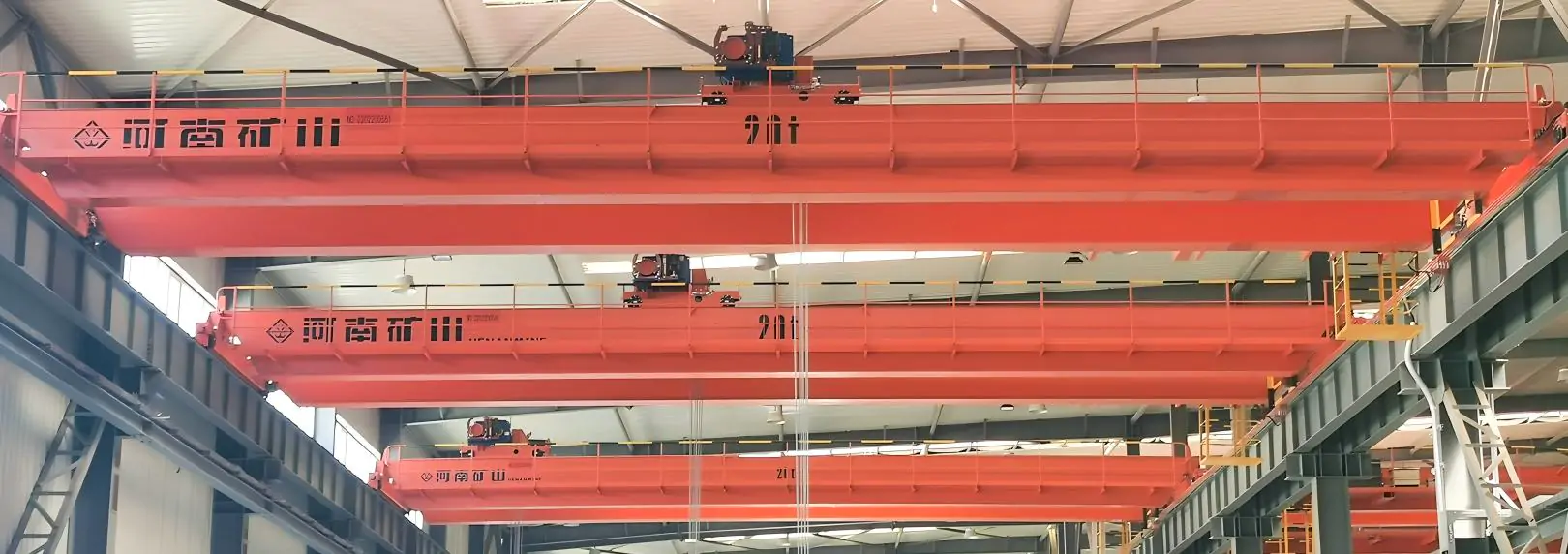
Crane Supply from Layout to Production Handover
A configuration for each process
We develop crane coverage and lifting arrangements for incoming parts, subassembly, final assembly and dispatch. Light tooling and heavy finished equipment can use different crane platforms within one coordinated factory plan.
Controlled handling of valuable components
VFD motion control, low-speed approach, anti-sway and coordinated lifting can be included where the process calls for them. The offer states the functions and acceptance criteria for the supplied equipment.
Equipment and service in one offer
Manufacture, inspection, packing, delivery, installation guidance, commissioning, operator training and recommended spares can be coordinated under the agreed supply scope.
Relevant delivery experience: Henan Mine Crane has customized two automated cranes for power-equipment handling and manufactured an 18-crane fleet for a CRRC clean-energy manufacturing project. These references cover both automatic material movement and multi-bay production lifting.
Lifting Solutions for Transformer and Generator Factories
A power equipment manufacturing crane moves components between production operations and positions them for assembly. The crane arrangement follows the handled component, attachment and working envelope at each stage.
| Manufacturing operation | Equipment approach | What the arrangement provides |
|---|---|---|
| Transformer core and active-part handling | Overhead crane with a suitable beam, slings or purpose-engineered attachment. | Coverage from the assembly stand to the tanking position, with clearance around exposed windings and insulation. |
| Generator stator, rotor and frame assembly | Double-girder crane with the required main, auxiliary or multiple lifting positions. | Controlled movement between machining, inspection, assembly fixtures and transport stands. |
| Switchgear and box-type substation assembly | Electric-hoist overhead crane or automated handling arrangement. | Component transfer and finished-unit handling using the designated lifting points. |
| Cable reels and electrical-material logistics | Crane with a load-compatible attachment and optional positioning or warehouse interfaces. | Repeatable pickup, storage and delivery to the next production station. |
| Testing and dispatch preparation | Overhead or gantry coverage matched to test-bay and loading positions. | Movement into the test position before energization and transfer to the agreed shipping interface. |
Crane Platforms and Catalogue Configurations
Established crane families provide the starting point for engineering. The configurations below identify catalogue lifting arrangements; span, lifting height, duty and control functions are specified for the manufacturing process.
| Crane family | Catalogue designation | Application considered during selection |
|---|---|---|
| LDA electric single-girder crane | 1–20 t family. | Tooling, smaller components and suitable general production duties. |
| QD hook bridge crane | 5–50/10 t family. | General component transfer and assembly using a trolley-mounted lifting system. |
| QD main-and-auxiliary hook crane | 75/20 t and 100/20 t configurations. | Heavy component handling with separately rated main and auxiliary hoists. |
| Higher-capacity QD hook crane | 125/32 t and 250/50 t configurations. | Large assemblies requiring greater lifting capacity and a coordinated building interface. |
Main and auxiliary ratings describe separate hoists. Combined use follows the permitted load combinations for the supplied crane. Larger or specialized arrangements are reviewed against the actual component and handling sequence.
Select the Crane Around the Assembly Sequence
| Process condition | Our engineering response |
|---|---|
| A transformer assembly must enter a tank | Review the component, rigging height, tank opening, approach route and final lowering clearance together. |
| A long rotor or frame uses two lifting points | Calculate the load share and hook positions; specify coordinated motion where required. |
| A component must turn or change orientation | Develop the lifting sequence, support points and permitted hook combinations before selecting the mechanisms. |
| Several stations share one runway | Assess travel routes, task demand, crane separation and access during maintenance. |
| Finished assemblies are heavier than intermediate parts | Check the maximum suspended package at each production stage, including lifting gear. |
Illustrative load check: a 68 t active-part assembly, a 6 t lifting beam and 2 t of slings and attachments produce a 76 t suspended load. A 75 t hoist would not cover that package. These are example inputs; the actual selection uses the approved component and lifting-gear weights.
Compare Crane Arrangements for Equipment Manufacturing
| Arrangement | Useful manufacturing role | Selection basis |
|---|---|---|
| Single-girder electric-hoist crane | General component movement and tooling in suitable production bays. | Load, span, headroom, operating frequency and the electric-hoist duty. |
| Double-girder overhead crane | Heavier assembly work and applications needing a selected trolley or hook arrangement. | Complete lifting load, working envelope, mechanism duty and runway reactions. |
| Double-trolley overhead crane | Long components or loads supported at two defined lifting positions. | Load distribution, trolley spacing, operating combinations and control functions. |
| Double-girder gantry crane | Ground-supported production, staging or loading areas. | Rail foundations, working coverage, vehicle access and environmental exposure. |
| Automated overhead handling system | Repeatable transfer between defined production or storage positions. | Attachment engagement, positioning, station signals, task scheduling and recovery logic. |
Technical Details Included in the Offered Crane
| Parameter | What the technical schedule defines |
|---|---|
| Rated lifting load — t | The rating of each lifting mechanism and the approved operating combinations. |
| Span and travel — m | Runway centre distance, crane and trolley travel, hook approaches and station coverage. |
| Lifting height — m | Lowest pickup and highest required hook positions, including component, attachment and clearance geometry. |
| Motion speeds — m/min | Hoisting, lowering, trolley and bridge speeds, including the required loaded approach speed. |
| Positioning and coordination | Required tolerance, feedback arrangement, level control where supplied, and the acceptance method. |
| Duty and electrical supply | Load spectrum, operating cycles, mechanism duty, voltage, frequency and connected-power information. |
| Building and runway interface | Crane self-weight, wheel reactions, rail requirements and installation clearances. |
| Controls and plant interfaces | Control stations, protection, monitoring options, production signals and contracted automation functions. |
Clean handling around windings and insulation
For exposed electrical assemblies, the design review can include lubrication containment, debris protection, surface finishes and access for cleaning. Contact surfaces and lifting attachments follow the component’s approved handling points. The quotation identifies the selected cleanliness provisions.
Loaded positioning for assembly
The offer defines the required approach performance and how it will be tested with a representative load. Rotor insertion and other close-clearance assembly tasks are coordinated with the equipment manufacturer’s fixtures and procedure.
Test-bay coordination
Crane parking positions, access permissions and electrical-test interlocks are coordinated with the test facility. Any insulation or hazardous-area requirement is addressed for the defined process and location.
Automated Power-Equipment Handling: A Two-Crane Project
Henan Mine Crane customized two automated cranes for a national power project handling box-type substation equipment and power cables. The project combines VFD and PLC control, hoist encoder feedback and Gray-bus positioning for bridge and trolley travel.
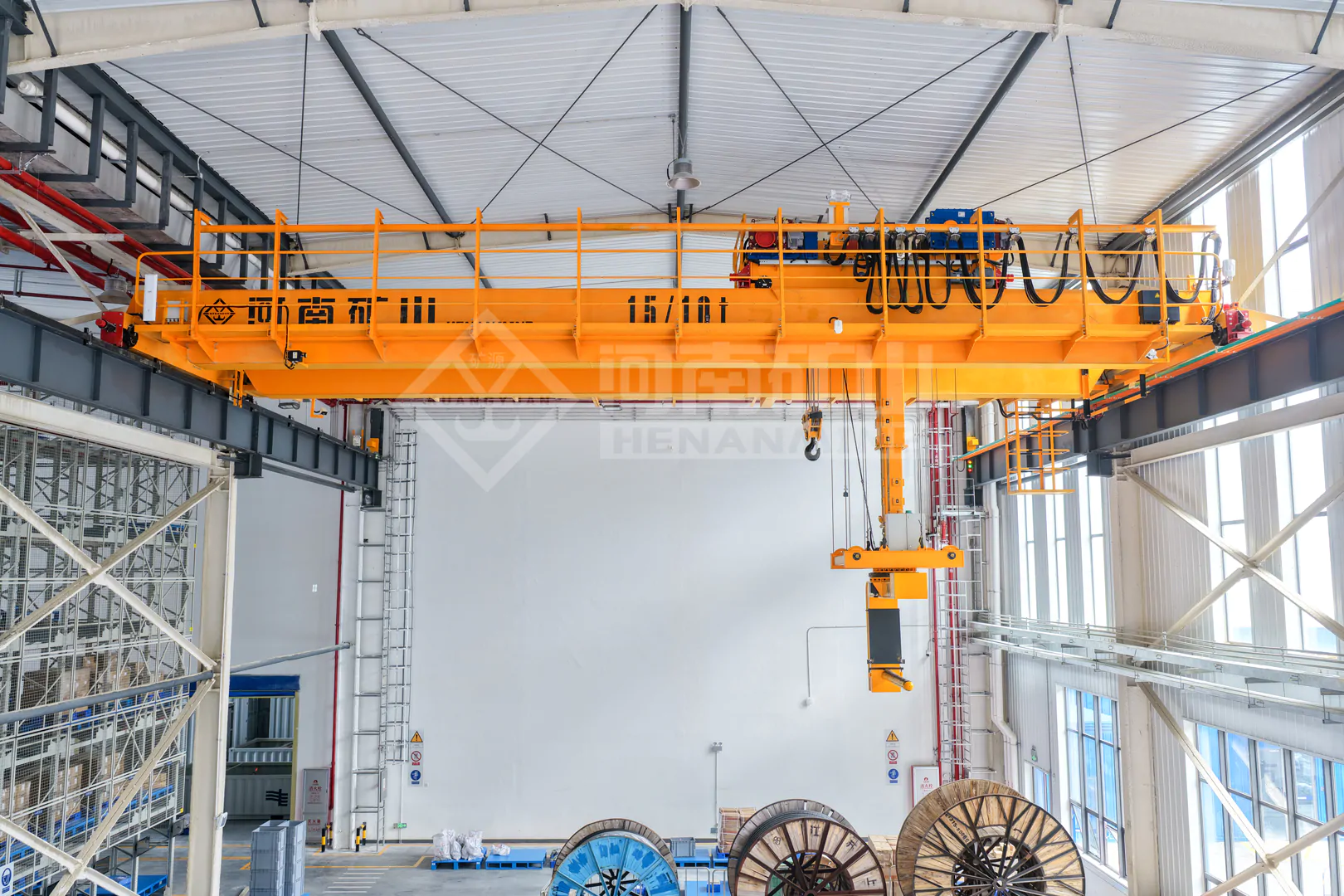
The reported functions include 3D scanning, visual inspection, automatic pickup, obstacle avoidance and anti-sway. An intelligent attachment uses detection switches, while WCS scheduling and WMS warehouse management support handling records.
For a new manufacturing line, we define the load family, station handshakes, task ownership and recovery modes in the automation scope. The mechanical crane, attachment and plant signals are developed as one handling sequence.
Project Experience: 18 Cranes for CRRC Clean-Energy Manufacturing
Henan Mine Crane manufactured 18 high-precision cranes for a CRRC clean-energy equipment manufacturing project. The manufacturer’s report identifies full variable-frequency control across the batch, modular construction and quick electrical connections.
The published manufacturing reference includes 20 t, 80/50 t and 80/10 t overhead cranes serving different production duties. This is a clean-energy equipment manufacturing reference; the crane schedule for a transformer or generator factory is developed around that factory’s components and layout.
A coordinated fleet lets the factory standardize suitable controls, parts and documentation while selecting the load and hook arrangement for each bay. Our proposal can identify these common elements alongside the individual crane schedules.
Installation, Acceptance and Lifecycle Support
Engineering and installation coordination
Arrangement drawings, wheel reactions and electrical interface data support runway, building and erection planning. The supply boundary identifies rails, electrification and incoming power responsibilities.
Factory and site acceptance
The agreed checks cover crane motions, brakes, limits, load protection and control functions. Attachment engagement, station interfaces and representative handling cycles are tested when included.
Handover and service support
Manuals, electrical drawings, parts identification, operator training and recommended spares support production handover. Installation guidance, commissioning and subsequent technical support are itemized in the offer.
Maintenance access is included in the layout review, with attention to hoists, brakes, ropes, wheels, sensors and lifting attachments. For several cranes on one runway, the service arrangement also considers how production can continue when one unit is unavailable.
Power Equipment Manufacturing Crane Price and Supply Scope
Crane price depends on the rated load, span, lift, working duty, hook arrangement, controls and site-service scope. Precision positioning, coordinated lifting, cleanliness provisions and automation can change the configuration substantially.
Public reference prices for general double-girder cranes
| Published configuration | Supplier reference price — USD | Basis |
|---|---|---|
| 20 t capacity; 24 m span; 6 m lift. | US$40,000–60,000. | Kino Cranes public general double-girder price table; checked in 2026. |
| 75 t capacity; 30 m span; 6 m lift. | US$90,000–150,000. | The same supplier’s published general double-girder reference. |
These are another supplier’s reference figures, not Henan Mine Crane quotations or prices for a verified power-equipment manufacturing configuration. The table does not establish the cost of special lifting gear, manufacturing-process options or complete site delivery.
Your Henan Mine Crane quotation
The offer separates crane equipment, attachments or attachment interfaces, controls, electrification, documentation and recommended spares. Packing, delivery basis, installation guidance, commissioning and training are identified with their service scope. Runway steelwork, civil works and plant integration responsibilities are stated so the purchasing team can compare the complete project.
Delivery schedule and warranty terms are provided for the selected equipment and destination.
Get a Crane Layout and Itemized Manufacturing Proposal
Send your production-bay layout, the main component weights and the assembly operations to be served. A process sketch is enough to begin the initial review when the factory layout is still being developed.
Henan Mine Crane will develop: a recommended crane arrangement, load and hook schedule, working coverage, control options, structural interfaces and an itemized equipment and service quotation.
Power Equipment Manufacturing Crane FAQs
Which crane is used in power equipment manufacturing?
Overhead cranes are commonly used for component transfer and assembly inside production bays. Single-girder, double-girder, multiple-hook, gantry or automated arrangements are selected from the load, process, working space and duty.
How is a transformer manufacturing crane sized?
Selection uses the heaviest permitted suspended package at each production stage, including the component, lifting beam, slings and attachments. Transformer MVA rating alone does not determine crane capacity.
Can a crane provide controlled lowering for tanking or assembly?
Yes. The lifting mechanism and motion controls can be selected for the required loaded approach performance. The offer states the operating functions and acceptance criteria for the specified handling task.
Can two hooks or trolleys work together?
Coordinated lifting can be engineered around the lifting points, centre of gravity and load share. Individual ratings, permitted combined operations and fault responses are defined for the supplied configuration.
Can the crane connect to WMS, WCS or production controls?
Yes, where included in the project scope. The interface schedule defines tasks, load identity, station signals, operating modes, alarms and recovery arrangements. Henan Mine Crane has a published two-crane power-industry automation reference.
Can equipment be supplied for an existing factory?
We can review a replacement or additional crane against the existing span, headroom, runways and production layout. The proposal supplies crane reactions and interface data for the project’s structural and installation review.
Are installation, commissioning and spare parts available?
Installation guidance, commissioning assistance, operator training and recommended spare parts can be included. The quotation identifies the selected services, delivery basis, warranty terms and site responsibilities.
Related Manufacturing Crane Equipment

Double-Girder Overhead Cranes
Compare overhead configurations for production and assembly bays.

Electric-Hoist Bridge Crane
Review compact double-girder arrangements for suitable workshop duties.

Double-Trolley Overhead Crane
Explore two lifting positions with a defined operating and load-sharing basis.

Single-Girder Overhead Crane
Select general-purpose lifting for smaller components and tooling.

Double-Girder Gantry Crane
Plan ground-supported handling in staging and loading areas.

New Electric Hoist
Review hoisting equipment for separately rated manufacturing tasks.
Request a Power Equipment Manufacturing Crane Quote
Get a crane package matched to your components, production sequence and factory layout. Contact Henan Mine Crane for engineering, equipment supply and the site services your project needs.
Email: info@hnksglobal.com