

MINE WORKSHOPS · CRUSHER & MILL MAINTENANCE · MINERAL PROCESSING
Mining Industry Cranes for Maintenance & Processing Plants
Lift crusher components, mill drives, pumps and mobile-equipment assemblies along a planned route from the machine to the maintenance stand.
Henan Mine Crane supplies overhead cranes, gantry cranes and grab-handling systems for mining facilities. Established in 2002, we bring crane engineering, equipment supply, installation interfaces and operating support into an itemized project proposal.
What Henan Mine Crane Delivers for Your Mine
A lifting route that reaches the laydown area
We develop coverage from the dismantling position to the repair stand or transport interface. Hook approaches, rigging height, surrounding steelwork and access openings are checked in the arrangement drawing.
Equipment matched to the site conditions
We select enclosure protection, contamination control, finishes and drive arrangements against the actual dust, moisture, temperature and altitude conditions. Hazardous-area requirements receive a separately defined equipment specification.
A support package for remote operations
Your offer identifies installation guidance, commissioning, training and recommended spares. Parts identification, electrical drawings and maintenance instructions support the mine’s own operating and maintenance teams.
| Supply level | What we provide |
|---|---|
| Base crane package | Bridge or gantry structure, end carriages, trolley, lifting mechanism, hook and rope system, drives, brakes, controls and specified protection. |
| Mining process options | Selected low-speed approach, coordinated lifting, lifting beams or attachment interfaces, grab systems, travel zoning and specified environmental provisions. |
| Runway, delivery and site services | Rails and electrification where included, packing and transport scope, installation guidance, commissioning assistance, training and spares, each identified in the quotation. |
Our advantage: workshop lifting, heavy maintenance and bulk handling can be planned within one crane schedule, with the appropriate mechanism and duty for each task. Common components and spares can be identified across the fleet where the configurations permit.
10 t, 32/5 t and 50/10 t Crane Specifications
These QD hook-crane configurations are published in the Henan Mine Crane Product Selection Guide. They provide specific base-platform data for equipment lifting. Mining environment provisions, attachment requirements and the final operating duty are addressed in the project specification.
| Parameter | QD 10 t · A5 | QD 32/5 t · A5 | QD 50/10 t · A5 |
|---|---|---|---|
| Main / auxiliary rating — t | 10 / — | 32 / 5 | 50 / 10 |
| Span of the listed configuration — m | 16.5 | 22.5 | 22.5 |
| Main-hook maximum lifting height — m | 16 | 16 | 12 |
| Auxiliary-hook maximum lifting height — m | — | 18 | 16 |
| Crane working class | A5 | A5 | A5 |
| Main hoisting speed — m/min | 8.5 | 7.5 | 5.9 |
| Auxiliary hoisting speed — m/min | — | 15.5 | 10.4 |
| Trolley travel speed — m/min | 43.8 | 42.4 | 38.5 |
| Bridge travel speed — m/min | 89.8 | 74.2 | 74.6 |
| Catalogue maximum wheel load — kN | 118 | 289 | 404 |
| Catalogue rail recommendation | P43 | QU70 | QU80 |
| Catalogue electrical supply | 380 V · 50 Hz · 3-phase | 380 V · 50 Hz · 3-phase | 380 V · 50 Hz · 3-phase |
Catalogue spans for these families run from 10.5 to 31.5 m in the listed series. Speeds above describe the catalogue configurations; loaded approach settings and VFD functions are specified separately. Wheel reactions for the final supplied crane are issued for the runway and building design. Technical data: Product Selection Guide, printed pages 38 and 40.
Larger components are assessed against higher-capacity crane families. A maintenance crane and a continuously cycling grab crane are selected from their own load spectrum and operating cycles.
Crane Applications Across the Mining Operation
A mining industry crane lifts equipment, components or bulk materials within a mine workshop, processing building or stockyard. Selection starts with the handled load and the complete pickup-to-setdown route.
| Operating area | Typical handling task | Our equipment approach |
|---|---|---|
| Mine equipment workshop | Engines, transmissions, axle assemblies, repair tooling and components from mobile mining equipment. | Single- or double-girder overhead coverage matched to the service bays, stands and component weights. |
| Crusher building | Removal and replacement of crusher components using the machine manufacturer’s lifting provisions. | Hook crane with checked headroom, hook approach, loaded positioning and a suitable lifting interface. |
| Grinding and mill-drive area | Mill motors, gearboxes, external equipment and maintenance tooling. | Overhead lifting coverage coordinated with access platforms, maintenance stands and the mill service arrangement. |
| Pump and dewatering facility | Pump, motor and pipework-module handling. | Crane or hoist arrangement reaching the equipment and agreed removal opening or laydown position. |
| Mineral-processing plant | Equipment installation, component replacement and transfer between maintenance positions. | Overhead coverage with site-specific controls and protection for dust, moisture and process exposure. |
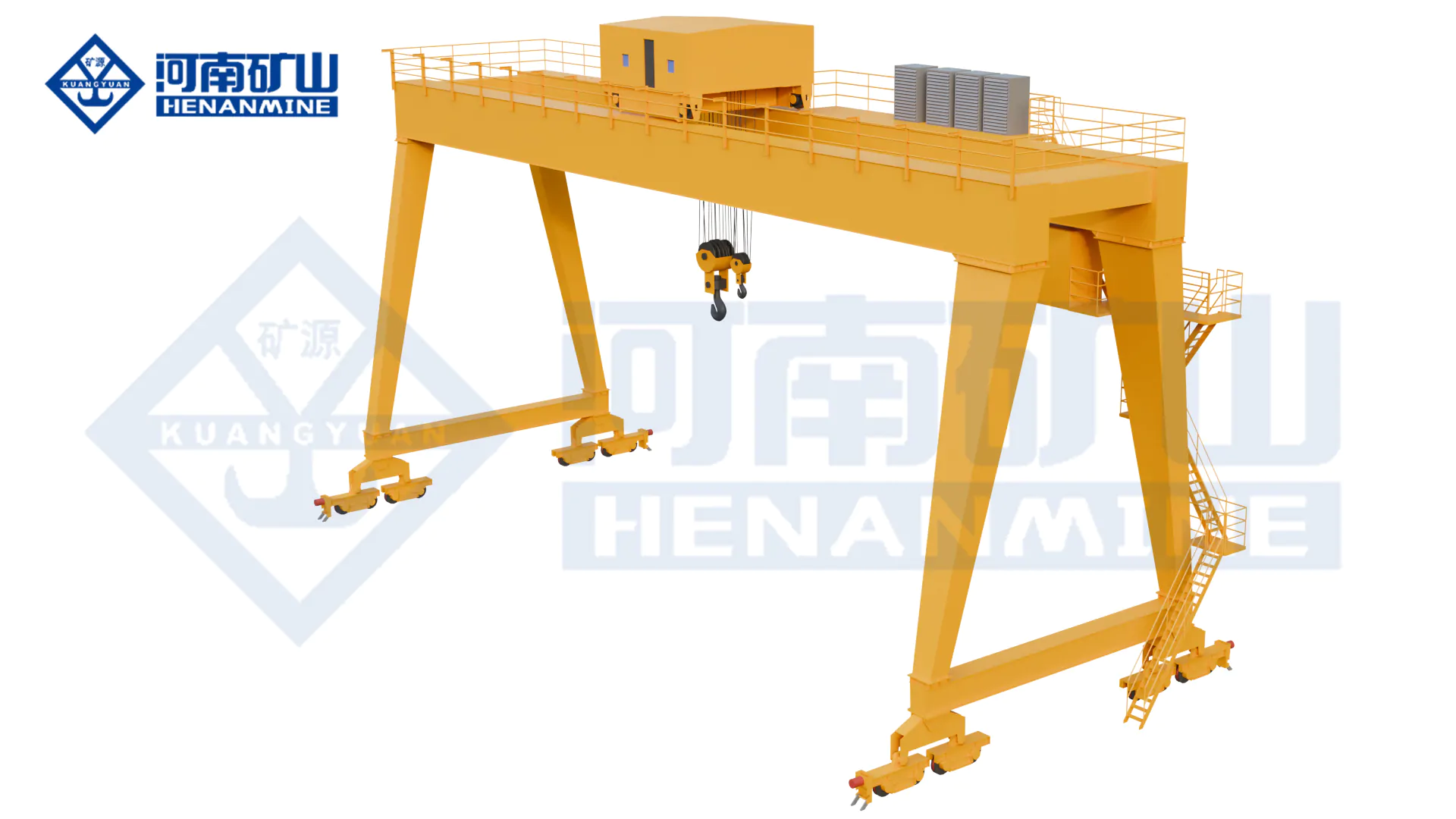
| Outdoor staging or bulk-material bay | Heavy spare components, maintenance assemblies or suitable loose minerals. | Hook gantry crane for equipment loads; a separately selected grab system for bulk-material cycles. |
Select the Crane Around the Maintenance Lift
Use the complete suspended load
Our load schedule includes the component, lifting beam, slings, shackles and any carried attachment. The machine manufacturer’s lifting provisions establish the load interface. Component lifting and dismantling forces are treated separately; extraction tasks follow the equipment manufacturer’s specified tooling.
Illustrative sizing check: a 38 t crusher component + a 3 t lifting beam + 1 t of rigging creates a 42 t suspended package. A 40 t hoist cannot cover this package. A 50 t main hoist is a candidate for review after the load cases, duty and clearances are established.
Check the route to the maintenance stand
We check the hook position above the machine, clearance from roof services and steelwork, the rigging envelope and the setdown position. For an existing plant, the review includes runway condition, available structural capacity and the access available for erection.
Match duty to the actual work
An occasional heavy maintenance lift and repeated grab cycles create different demands on the mechanisms. We use the maximum load, proportion of loaded cycles, travel distances, lifts per hour and daily operating period to select duty. For two-point lifts, the configuration states individual hook reactions, permitted operating combinations and the required coordinated controls.
Compare Mining Crane Configurations
| Configuration | Application fit | What determines the selection |
|---|---|---|
| Single-girder overhead crane | Suitable lighter components, tooling and general mine-workshop duties. | Suspended load, hoist duty, usable hook height and bay coverage. |
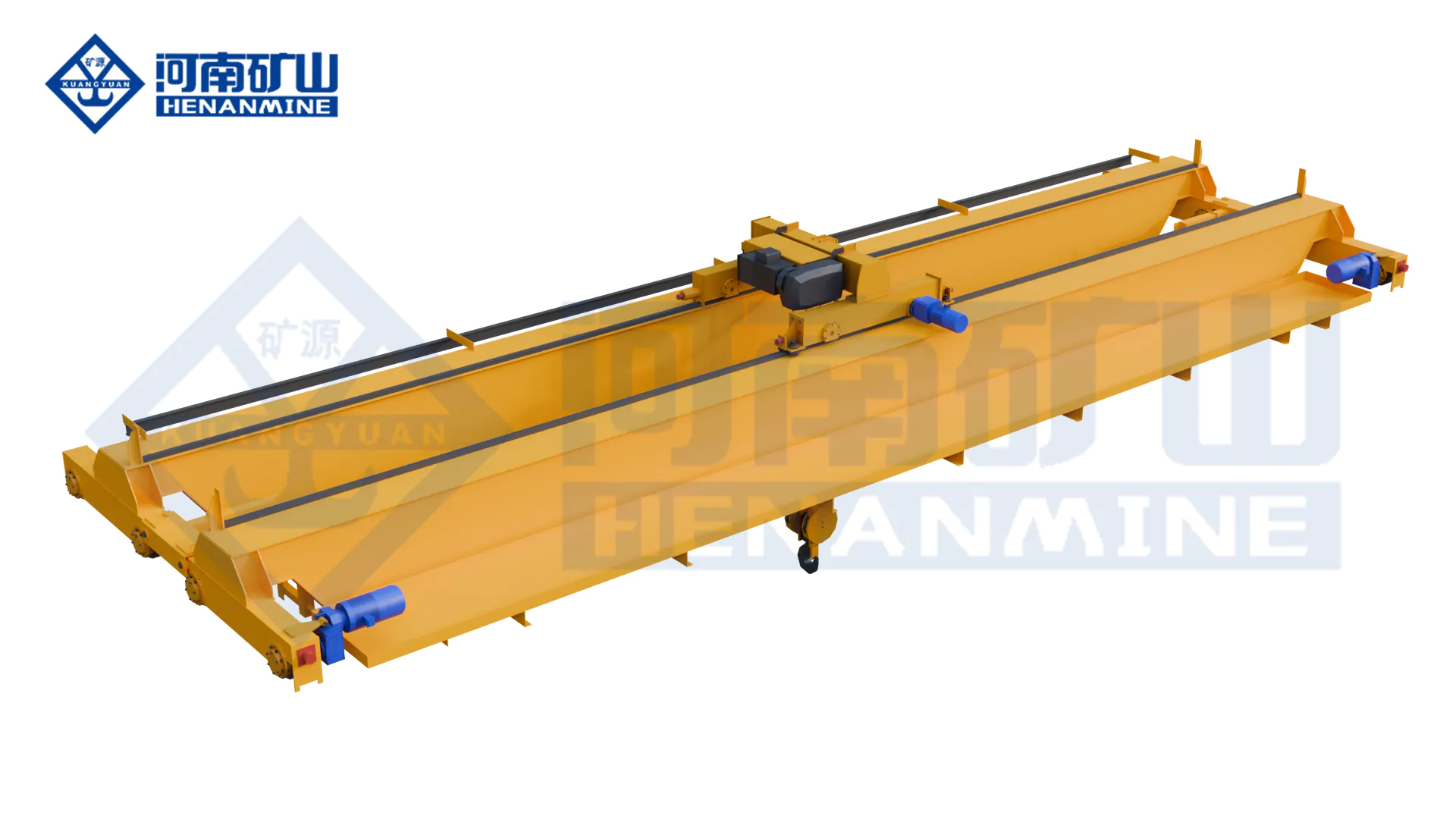
| Double-girder overhead crane | Heavier equipment maintenance, crusher components and mill-drive handling. | Load schedule, trolley arrangement, hook approach, operating duty and runway reactions. |
| Double-trolley overhead crane | Long or unbalanced components requiring two separated lifting positions. | Individual hook loads, spacing, load orientation and the specified coordinated operating mode. |
| Double-girder gantry crane | Ground-supported maintenance, staging and outdoor equipment handling. | Rail foundations, vehicle access, working envelope, weather exposure and parking arrangements. |
| Grab overhead crane | Loose-material transfer, stockpiling or feeding within the covered area. | Material properties, grab self-weight, payload, travel cycle and required throughput. |
The handling attachment and working duty follow the task. A hook crane’s capacity does not by itself establish its suitability for continuous grab operation.
Configuration for Dust, Moisture and Mine-Site Conditions
| Site condition | Configuration response | What the offer defines |
|---|---|---|
| Abrasive mineral dust | Selected enclosures, seals, cable protection and access for inspection and cleaning. | Protection arrangement for the supplied drives, controls, travel equipment and exposed interfaces. |
| Moisture or corrosive process exposure | Selected finishes, electrical protection and provisions for condensation where required. | Coating and equipment requirements for the stated atmosphere and exposure. |
| High altitude or temperature extremes | Review of motor, drive, cooling and control-cabinet suitability. | The operating environment and any required equipment selection or derating. |
| Classified gas or combustible-dust area | Equipment specification developed from the site’s hazard classification and required approvals. | Applicable classification, component markings and supplied documentation for the contracted area. |
| Outdoor gantry service | Weather protection, wind-related operating provisions and the specified parking arrangement. | Environmental operating limits, warning functions and restraint provisions in the offered design. |
| Congested maintenance bays | Selected low-speed approach, operator controls, warning functions and travel zoning. | Control modes, permitted working zones and the functions included in acceptance. |
Dust protection and explosion protection address different conditions. The quotation identifies the environmental configuration supplied for the actual mine location, including any underground installation requirements.
Separate Equipment Maintenance from Bulk-Material Cycles
For ore, concentrate or other loose material, we select the grab from bulk density, moisture, particle size, flow behaviour and the pickup and discharge positions. The crane load includes the empty grab and the carried material. Throughput is evaluated from payload and the complete operating cycle.
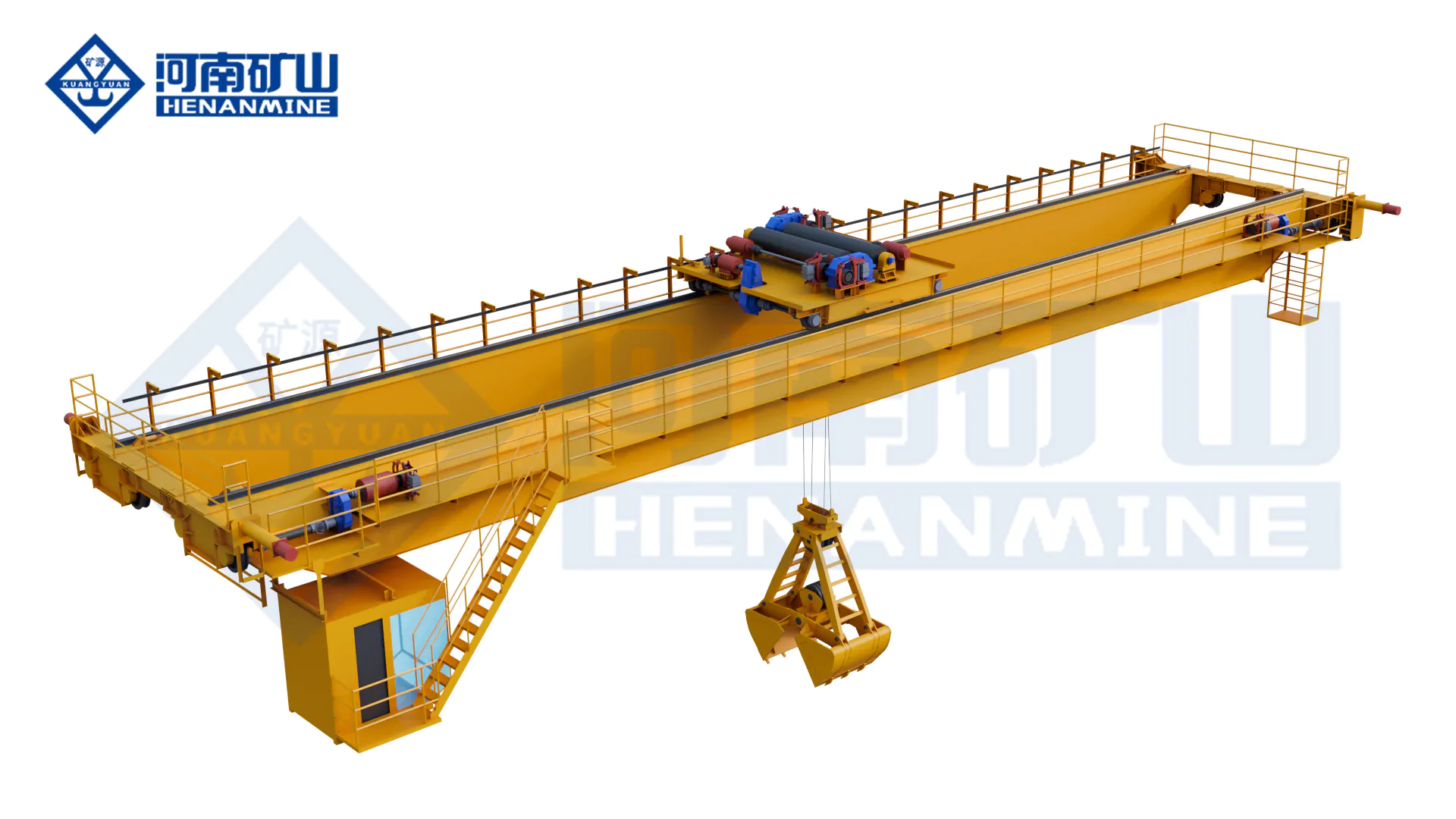
Where maintenance lifting and production transfer share a bay, the proposal considers availability as well as capacity. Separate equipment may be appropriate when a production handling cycle must continue during maintenance.
Mining and Equipment-Workshop Project References
Henan Mine Crane: mining and copper-industry project experience
Henan Mine Crane’s published international project record includes mining projects in Congo and copper-industry projects in Serbia. These references are identified in the company’s overseas project reporting. The crane schedule for a new mine is developed around its own component loads, processing layout and site environment.
Industry reference: two 40 t cranes at La Joya, Peru
Demag’s official La Joya case study describes two 40 t overhead travelling cranes supplied by Trex Perú for the Ferreyros equipment-workshop complex in Arequipa. The two cranes operate individually or in an engineered tandem arrangement for loads up to 80 t, moving large machinery components from the receiving area into the workshop. The project also incorporates restricted travel zones.
This is a third-party Demag/Trex Perú reference. It illustrates how component size, inbound access, coordinated lifting and permitted operating areas shape a mining-equipment maintenance crane layout.
Defined Deliverables from Engineering to Handover
| Project stage | Henan Mine Crane deliverable | Purpose |
|---|---|---|
| Proposal | Crane schedule, load and hook arrangement, preliminary coverage and an itemized supply scope. | Compare the crane package with the maintenance plan, processing layout and budget. |
| Technical approval | Agreed specification, arrangement drawing, wheel reactions, rail interface and electrical supply information. | Coordinate the crane with structural, runway, electrical and equipment designers. |
| Manufacture and acceptance | Agreed inspection records, motion and protection checks, load-test records and checks of contracted process functions. | Document acceptance against the supplied configuration and technical agreement. |
| Handover | Operating and maintenance instructions, electrical drawings, major-component identification and recommended spares. | Support the mine’s operators, maintainers and replacement-parts purchasing. |
| Site support | Installation guidance, commissioning assistance and operator training as defined in the offer. | Coordinate erection, startup and handover within the agreed site-service scope. |
For remote mines, the spare-parts schedule can identify suitable brakes, ropes, electrical components, sensors and drive-related spares for the delivered equipment. Packing dimensions and erection interfaces are coordinated with the agreed transport and site-access plan. Warranty terms, delivery milestones and service responsibilities are stated in the quotation.
Mining Industry Crane Price and Supply Cost
A mining crane price depends on the crane type, load, span, lift, operating duty, environment, attachment and site-service scope. The commercial offer separates the base crane from mine-specific options and delivery services.
| Published general double-girder configuration | Supplier reference price — USD |
|---|---|
| 10 t capacity · 20 m span · 6 m lift | US$25,000–40,000 |
| 50 t capacity · 28 m span · 6 m lift | US$70,000–120,000 |
Kino Cranes publishes these general reference figures, checked in 2026. They are separate configurations from the catalogue examples above and are not Henan Mine Crane quotations or installed mining-project prices. The source excludes unspecified customization and does not establish a confirmed EXW/FOB basis.
Your itemized mining crane quotation
Our quotation identifies crane equipment; selected dust, environmental and control provisions; lifting attachments; rails and electrification; packing and freight basis; installation guidance; commissioning; training; and spares. Runway steelwork, foundations, incoming power and plant-integration responsibilities are stated with their supply boundaries.
The final offer includes the selected technical configuration, delivery milestones, payment terms and warranty scope.
Mining Industry Crane FAQs
What is a mining industry crane?
A mining industry crane lifts equipment, components or bulk materials within mine workshops, processing plants and staging areas. Overhead cranes serve runway-covered bays; gantry cranes provide ground-supported coverage; grab systems handle suitable loose materials.
How do I select capacity for crusher or mill maintenance?
Use the heaviest permitted suspended package, including the component and all carried lifting gear. Selection also checks the machine lifting provisions, load geometry, working route, headroom and operating duty.
Can the same crane handle maintenance loads and bulk ore?
A combined arrangement can be reviewed, but each operating mode has its own load, attachment and duty requirements. Grab self-weight, payload and cycle frequency must be included. Dedicated handling may be appropriate when production cycles must continue during maintenance.
Does every mining crane need explosion protection?
The equipment configuration follows the site hazard classification. Abrasive mineral dust, combustible dust and gas hazards call for different provisions. The technical offer identifies the protection and documentation supplied for the contracted location.
Can a crane be supplied for an existing processing plant?
Yes. We review the available span, headroom, runway arrangement, access and maintenance route. The proposal provides crane reactions and interface information for the project’s structural and installation assessment.
Can an overhead crane replace a mill-liner handling machine?
The equipment roles are assessed against the mill manufacturer’s maintenance procedure. An overhead crane can support the defined lifting and transfer tasks around the mill; internal liner manipulation and specialist tooling require their own equipment and interfaces.
Do these cranes cover underground mine-shaft hoisting?
This page covers overhead and gantry handling for equipment, components and materials. Shaft winding and personnel conveyance are separate equipment categories. An underground workshop installation is assessed for its own access, environment and approval requirements.
Can you supply cranes above 50 t?
Higher-capacity hook-crane families are available for engineering review, including catalogue 75/20 t and 100/20 t arrangements. Final selection follows the complete suspended load, working envelope, duty and building or foundation interface.
What will I receive with a mining crane proposal?
The proposal identifies the crane configuration, load and hook schedule, working coverage, site-specific options, structural and electrical interfaces, and itemized equipment and services. Delivery milestones, payment terms, warranty and site responsibilities are stated in the offer.
Related Crane Equipment for Mining Facilities

Double-Girder Overhead Cranes
Compare overhead platforms for workshop and equipment-maintenance duties.

Single-Girder Overhead Crane
Review lighter component and tooling handling for suitable maintenance bays.

Double-Girder Gantry Crane
Plan ground-supported staging, repair and loading coverage.

Grab Overhead Crane
Select a grab arrangement around material properties, payload and duty.

Double-Trolley Overhead Crane
Explore two lifting positions for components with defined load sharing.

New Electric Hoist
Review hoisting equipment for separately rated component-handling tasks.
Henan Mine Crane · Technical information reviewed: 2026
Technical data: Henan Mine Crane Product Selection Guide, printed pages 38 and 40. Project references: Henan Mine Crane international project reporting; Demag, Cranes for the La Joya mining region, Peru. Public price reference: Kino Cranes, Overhead Crane Price.
Request a Mining Industry Crane Layout and Quote
Send the main component weights, a workshop or plant sketch and the lifting positions to be served. Add the site location, operating environment and target installation or shutdown date if available.
Henan Mine Crane will develop: a crane configuration and load schedule, working coverage, environmental and process options, installation interfaces, and an itemized quotation with delivery and service scope.
Email:
info@hnksglobal.com